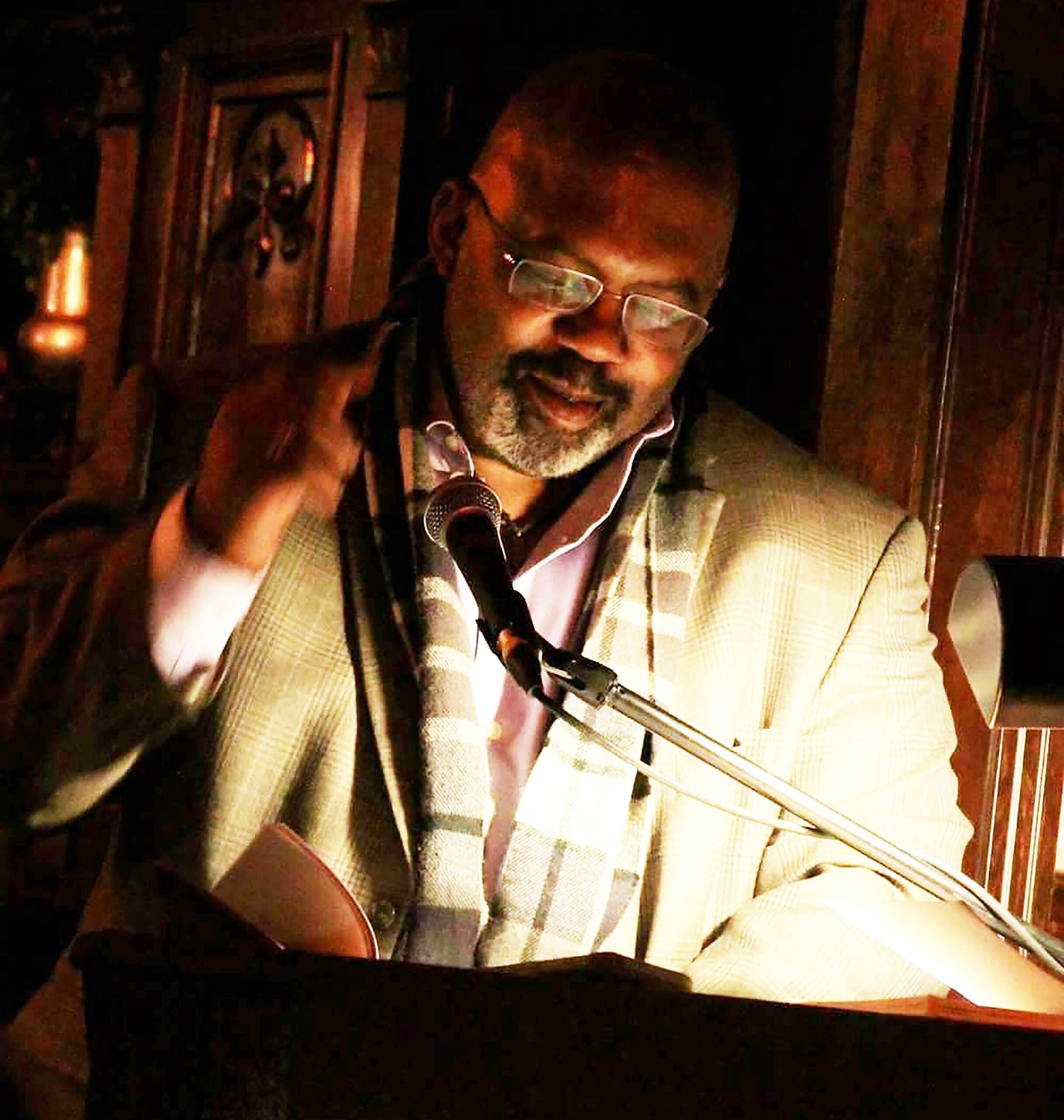
Poet and author Mary Mackey interviews Sacramento poet laureate Indigo Moor

Indigo Moor’s poetry collection Everybody’s Jonesin’ for Something

Poet Laureate Emeritus of Sacramento, Indigo Moor’s fourth book of poetry Everybody’s Jonesin’ for Something, took second place in the University of Nebraska Press’ Backwater Prize. Jonesin’ is a multi-genre work consisting of poetry, flash fiction, memoir, and stage plays. His second book, Through the Stonecutter’s Window, won Northwestern University Press’s Cave Canem prize. His first and third books, Tap-Root and In the Room of Thirsts & Hungers, were both parts of Main Street Rag’s Editor’s Select Poetry Series. Indigo is an adjunct professor at Dominican University and visiting faculty for Dominican’s MFA program, teaching poetry and short fiction. He is also co-coordinator for Open Page Writers.

Mary: Welcome to Synchronized Chaos Magazine, Indigo. Let’s cut to the chase: How did you become a poet?

Indigo: I don’t know. By birth? Circumstance? My entire life, I sought explanations, keys to what I saw around me. That’s all any artist is: someone who can’t be satisfied with leaving the rock unturned. In that sense, I have always been an artist of some kind. If you are asking when I became a practicing poet, it was 1999. What should I call that, my Prince year? I was in Cambridge, MA, trying to figure out who I was. I discovered Paul Robeson. I discovered Othello. I discovered that poetry was not only something I did; it was who I am. I made a conscious decision to dedicate a significant amount of my life to bending toward the written word. Or bending it to me.

Mary: How old were you when you wrote your first poem, and what was it about?

Indigo: As a kid, in school. Even then I knew it meant more to me than it did to many of my friends or classmates. I hungered for it. It was an awakening. But there was no avenue to get me closer. No shortcuts. No mentors. I had other paths to follow. I wrote a lot of bad poems as a child. I remember snippets of some, but nothing that could give me a glimpse of any of them.

Mary: What poets and writers have influenced you?

Indigo: Yusef Komunyakaa was the first to speak to me. He is Southern, a veteran, someone who worked through himself to rewrite the world he knew. “Blackberries” and “Believing in Iron” come to mind. Dien Cai Dau, his book about Vietnam was my introduction to arc. Jean Toomer was next. He went back to the South to write Cane, again the theme of discovering yourself. I like many poets and I read widely. But I gravitate to poets who write themselves into being.

Mary: What events in your life or in society as a whole have influenced you? For example: You are a twice-decorated Gulf War Veteran, a playwright, a Professor at Dominican University, and an Integrated Circuit Layout Designer. Do you incorporate all these experiences into your poetry?

Indigo: I have been working on a memoir, so the different parts of my life are coming together. I would say nicely, but anyone who has written a memoir knows better. Layout designer has never been something that has reached my creative side. I am often asked if there is an overlap. Not that I have noticed. There is no poetry in engineering. But the person who writes poetry can be the same person who is an engineer. And a veteran. A professor. And a person who wears bunny slippers. It all influences me. But I choose what I write about. I am relearning who I was and what I went through during Desert Storm. And as a child. It is all coming together, but not as several rivers converging. More like a dozen different flowers growing in the same planter. Some thrive and have purpose. Some are support, even dying to enrich the soil. Some having no effect, other than preventing a nothingness. That is not entirely fair. There are some things that I thought were dead, that have resurfaced as meaningful events. And others I may never uncover.

Mary: How do you get the initial idea for a poem?

Indigo: It’s usually an image. My work is very imagistic. A new phrase can do so much. Today I heard: “Avoiding the Wagon.” When I found out the wagon in question was something that takes away a dead horse it began a train that will end in a poem. I spent time on a horse farm. It is one of the most life-affirming events of my life. And the idea of this wagon coming still chills me.

Mary: You are a poet who “weaves together historic truths.” How do the poems in your new book Everybody’s Jonesin’ for Something demonstrate this?

Indigo: History does not represent the past. Not to me. Taken as an “event,” anything can be glossed over, any moment. What I strive to find is the emotional event, the moment on one person’s life that history changes. A person decides to shoot up a church. As they sit in the car, what is going through their mind? A farmer hears of Trayvon Martin, how does it affect them? A woman receives a saxophone from her estranged mother. A painter tries to undo the Twin Towers falling on his canvas. History is only history when we forget it is more than a factoid. When we refuse to hold it in us, keeping it at arm’s length.

Mary: How has your poetry changed over the years?

Indigo: I believe my poetry changes as I do. As my lens focuses on different aspects of the world, so does my poetry. How I write changes because I learn different techniques. Everybody’s Jonesin’ for Something contains poetry, prose poems, flash fiction, flash memoir (did I make that up?), and stage plays. The entire book is one interlocking poem about the danger and draw of the American dream. Ten years ago, none of these poems, nor the concept of the book would have made sense to me.

Mary: Tell us more about Everybody’s Jonesin’ for Something.

Indigo: I wrote Everybody’s Jonesin’ for Something to explore my own understanding of the American Dream, which cannot be defined. We are all the heroes of our own stories. The American dream distorts depending on where the desire is spawned. The book is multi-genre because not all desires are best represented in poems.

Bethany Humphries, Editor-in-Chief of the American River Review said, “[Everybody’s Jonesin’ for Something is] no white-washed children’s textbook treatment of U.S. history. . . . It requires the reader to witness the offender’s hand reaching up Lady Liberty’s coppery skirt, to both confront abusers, and to empathize with a litany of memorable victims and survivors. . . . Utilizing a stunning variety of forms to explore a myriad of facets of human desire, from floating tercets to prose to dialogue-heavy scripts to a poetic table of historical footnotes, Indigo Moor delivers unforgettable images like chains ‘hanging like man-o-war tendrils, / like a trembling curtain of almost lynchings.’ There may be times you want to look away, but there are many moments you will want to return to, again and again.”

Mary:  What are the three most important poems in Everybody’s Jonesin’ for Something? Why?

Indigo: There is never an answer to that question. Different poems have different meanings at different times, even to me. “Love Letter to Dr. Ford, from the Patriarchy” gave me a chance to step into the shoes of an institution I detest. To look atrocities as necessary to the survival of an America I am forced to walk through. The play “Catching a Cotton Ball” follows a couple at odds with each other as well as the country that doesn’t accept them. Veterans of Foreign War’s is more personal, pertaining to my own brother and how losing him is an everyday emotionally charged event. I like the range of these three pieces. Such different forms. Different agendas.

Mary: You were the Poet Laureate of Sacramento from 2017 to 2019. How has your involvement in the Sacramento literary community influenced your work?

Indigo: I don’t know if working with any organization influences my work. There are some fractured, but necessary groups in this region. Sacramento Poetry Center has been a stalwart in this community. I think what I am reminded of is that the community and serving the people is what matters.

Mary: If you could ensure that one of your poems would survive to be read 500 years from now, which poem would it be, and why have you chosen it?

Indigo: Yes, I can choose a poem, but only because it means something to me. “Metal: The Tow Truck Driver’s Lament,” from Tap-Root. It was the first poem where I tackled who I believed I was at the time. I think poems are asymptotic to the truth, at best. It speaks to stress and pressure, the belief of being alone in handling far too much. Of the hard road of the past and steam building. It worked for me. Perhaps a little too long to read. But certainly, a cathartic piece.

Mary: Thank you, Indigo. This has been fascinating. Do you have any upcoming readings or classes? How can people get in touch with you?

Indigo: Thank you, Mary. I’ll give you some contact information and you can post it at the end of this interview.

Contact Information for Indigo Moor and links to his writing:
Website: https://www.indigomoor.org
Everybody’s Jonesin’ for Something: To Order
For appearances: Workshops and Readings: https://www.indigomoor.org/appearances
Read Indigo Moor’s essay on how he became a poet: “A Long Overdue Apology” (part of the Marsh Hawk Press Chapter One Series)
And read “A Riotous Anodyne,” his brilliant open letter to the City of Sacramento on the occasion of the 2020 Black Lives Matter protests.

Poet Indigo Moor

Essay from Ike Boat

Life In Greater Accra.

LIGA Series1 By Ike Boat

Photo of the city of Accra, Ghana, from Ike Boat

The LIGA Series describes real-life story of a creative artiste ‘Ike Boat’ and what have been his battles, challenges and struggles in Accra, the capital city of Ghana, West Africa. He conceived the idea to write this ‘Arti-Blog’ based on what he narrates as being a bane of joblessness, homelessness and sleeplessness in this part of Ghana, as he’s been a stranger to natives of the communities where he finds himself – Author : Dennis Mann

In this Series 1 of LIGA he writes about his decision to be in Accra and how life is treating him on daily basis and how he’s coping else facing such harsh conditions as realities, beside the issues of making a living.

LIGA 1

LIGA – Quite such an interesting similarity of the abbreviation or acronym, thus LIGA with regard to the Spanish football premier league dubbed La Liga or the German premier League Bundes-Liga. Well this real-life story as article-blog is not in any-way or means associated or connected with the Spanish soccer i.e.(sport) association, institution or organization in Spain. But on the contrary, it’s exact reflection of acronym used as title of this real-life personal story with regard to happenings to me in Greater Accra region as I made both bold and faith oriented move here a couple of months ago. Whether it’s step in a right direction or not, this really unfolds some aspects of daily life as a bitter-pill to swallow, beside pukes or problems and challenges in this capital city of Accra, Ghana. (West Africa).

Life In Greater Accra (LIGA) the capital of Ghana has generally not been easy with me at all even as I try to be positively busy every day. Unimaginably, I have been trying harder and harder from actual to virtual mediums or mean to ensure that the talents, skills and abilities become useful to individuals and companies I establish contact with but it like throwing punches in the air. However, there have been no positive results or responses. Countless number of employment applications to media companies and individual employers but all seem Cos-90 move. I presume of the reasons being rich achievements on Curriculum Vitae (CV) or Resume, so some companies or business owners think it difficult to agree on particular payment satisfaction. More-so, another application view or presumption is such that some human resource personnel or highly positioned staff members feel uncomfortably they’ll lose their role or position when accepted into the establishment based on multi-skills or talents I possess.  Obviously, there have been hectic and realistic times trying harder with heart of hope and faith to in relation to every-day perseverance in ensuring breakthrough success and progress in the Arts industry. To be precise, as far as the God-given talents, gifts and skills coupled with prospects and potentials of daily hustle and bustle are concerned in this cosmopolitan city of Ghana, West Africa. Factually, the struggles and sufferings have nothing to do with being lazy or act of laziness as a chap with positive dreams, realistic ambitions and holistic aspirations to make life bearable before departure from this earth. Of course, being in Accra has been a long time heart-yearn during my teen-aging years back in Takoradi, where I born and grew up.

         On 19th March,2021 I arrived in Accra from Kasoa precisely the perching residence at Estate Top and Blue Top Estate respectively, thus in house owned by the former International footballer in the personality of Mr.Owusu Afriyie currently based in Deutschland (Germany). The first move was primarily as a result of an invitation to feature as guest on Awake TV program dubbed Pillow Talk hosted by Lady Sherry Nyarko. Graciously, I had generous fund support from a noble figure outside of Ghana as a means of sponsorship for the transportation and accommodation. Indeed, it’s aided the fare and lodging at Mavis Hotel as I did several communications with the management and leadership in charge of this hospitality firm within Asylum Down suburb of Accra. Well, on the aftermath I engaged in thought-processing creative writing in terms of Blog and Vlog 233 Concept for online publication purposes.

         Of course, ups and downs of this LIGA also bring to bear realistic characters of some people being ungenerous in heart even if a person is on the verge of death due to certain harsh human conditions. A clear case study, of personally approaching a man who has stayed in Britain for years (expatriate) in times of dire need to eat and him turning me down with sheer ignorance even though everything show he’s able to provide as little as five (5) Cedis to buy food. It’s quite unconvincing and unbelievable his reason for refusing to show sense of generosity as I called on him at his residence in Asylum Down area of Accra. However, on one occasion I received a good surprise of fifty (50) banknote courtesy madam Harriet Quardey, the boss-lady, owner and prime operator of Mum’s Corner pub, where I have been MC a couple of times. Undoubtedly, it was one hunger day like a stranger who’s uninvited to her house and needed food to survive.  Well, one evening whilst walking on the newly tarred road I came across two (2) Cedis wrinkled banknote on the floor and mine oh, mine oh, it’s time of singing praises of hallelujah choruses unto God as I had nothing to eat the next morning.

         Lo, from one lodging place to another I have been dislodged and slept at unusual wrong areas suffering the night bites of wanton mosquitoes with uncomfortable restlessness leading to state of insomnia. For weeks, I have been sleeping at the wooden structure drinking bar of St. Sam Hotel here at Asylum Down in Accra. Factually, borrowing and owing as a promising artistic talent makes curious minds and conscious masses think differently about supposed star fellow in this infotainment age of technological advancement. Come to think of behind the scenes mock by some in secrecy!

Your guess is as good as mine, oh mine, oh mine – LIGA! There have been countless times of being at food selling joint without money to buy food and quite shamefully begging and pleading to get food and pay-back later. Oh, gosh, hmm – LIGA! The unpredictable times at kenkey and fried-fish with grind pepper selling joint, porridge with sugar and bread selling joint, fried-rice and chicken selling joint, just to mention but a few. Having said this, chef Peter Agombire and assistant Isaac Adobo have consistently contributed to aid my hunger condition as I continue to find lasting solution to such a bane of LIGA. Lest I forget, the one-on-one deep-life conversations with Madam Anna Cole coupled with her rollicking circular designed rice and stew with cooked egg offer at her family residence in Tabora, also remains unforgettable thus in relation to appreciation with grateful heart of gratitude in this LIGA Series.

         Reader, better-still I really don’t take for granted or refuse to express heart of gratitude the supportive manner and care of Mr.Harrison Nii Quaye the professional Real Estate agent (Realtor), who has bought food for me and given to me on several occasion, especially in my critical low moment of being so hard-up and broke, beside hungry in angry times like hum-ani i.e.(human-animal) figure on unfamiliar habitat. At times, escorting him to places such as Achimota, Osu, Labadi, Nima , James Town and other suburbs of Accra onboard a car he drives also has exposed and taught me lots of things about different areas with different arrays of life-style in relation to culture and livelihood as far as this LIGA is concerned. It also needful to mention as appreciable recognition of Mr. Earl Mantey, the Programs Manager of Happy 98.9 FM and Mr. Francis Cann (Dr.Cann) Presenter of Happy 98.9 FM as they have also contributed generously by way of buying food for me and giving token of money at certain point to aid the LIGA hardships. I’m so grateful as well for the media related interactions with them being staff of Global Media Alliance – GMA brand.

         In narrating LIGA, the sob-story of an Italian old-man who passed away at Mavis Hotel also brings about gracious nature of God’s gift of life to us in this part of Africa, Ghana to be precise. Well, one may wonder and ask why didn’t he kick the bucket at his homeland, Italy?  I remember, him dying on same room and bed that I accommodated my first week in Accra and I together with other three men carrying his lifeless body to a police car to the morgue/mortuary. It also reveals how and why as humans we need to thank God on daily basis. Pathetically, this man by first name Andrea in his fifties slept and didn’t wake-up again. And, it’s unknown to none of us at the hotel for days and by the time we realized his body on verge of decay in the room, thus same bed I slept on for days. Of course, together with Mr. Harrison Nii Quaye and Mr. Emmanuel Annan it’s to and fro at the Adabraka Police Station in Accra. Indeed, making realistic report of such death-case in this CoViD-19 times and brought about further investigations. Hmmm, it’s another solemn LIGA moment!

         Indeed, Life In Greater Accra (LIGA) without stating the following VIPs as worthwhile recognition of gratefulness towards their continuous Mo-Mo Support remains incomplete in this Series 1. Thus, notable acknowledgment of appreciation to Mr. Kenneth Anim, Mr. Dennis Agyeman and Mr. Agabus Asmah all have continually given to my state of uncertainties in coping with LIGA coupled with the Accommodation bane. Also, some distinguished International figures that have helped to cope financially with regard to LIGA includes: Mr. Andy Estrada #Dad & Mrs. Julie Estrada #Mom in USA, Madam Aja Pugh in USA, Minstrel Stella Addo in USA,Madam Dagmar Erb in Germany, Madam Lilian Aduka in Nigeria and Madam S.B Jabini in the Netherlands.

To Be Continued In LIGA Series 2 !

Real-Life Art-Blog Written By Ike Boat @ Asylum Down, Accra (Ghana).

Email Address: ikeboatofficial@gmail.com

Whats-App Number: +233267117700

Direct-Call Number: +233552477676

Poetry from Henry Bladon

Your Hands Have Blood on Them

From: The Bird of Paradise (RD Laing – 1967)

Men can destroy the humanity of others,

remember your hands have blood on them

you’ve been told as much

that will corrupt you and destroy you

with unadulterated compassion.

How do you plug a void?

Just don’t ask for trouble

remember your place in the hierarchy

and that last desperate clutch.

Do not despair – the soul dies before the body.

Thanatophobia

When the writer from Rio

lost his treasured notebook

his head started to feel

like a blood-filled bath.

It wasn’t the loss of shopping list

or the plot for his next novel

that most preoccupied the mind,

just the writerly thought about the

paper-based metaphor for death.


Henry is a writer, poet and mental health essayist based in Somerset in the UK. He has a PhD in literature and creative writing from the University of Birmingham. He is the author of several poetry collections and his work can be seen in Pure Slush, Lunate, and Synchronized Chaos, among other places.

Short story from Mike Zone

Snow Crash

By Mike Zone

Months ago before all this began during the harsh winter storm that brought down frozen tears in well maintained suburban houses and somber smiles of a fierce yet humbled resilience which crumbled into a just as fierce breaking and an anxiety of a crippling nature behind the closed doors of the homestead. Barry Klatt sat by the window of in his reading chair dressed especially dashing in tweed green slacks with a brown sweater over a cream dress shirt, hoping a car would crash into a tree, that maybe there would be a lone survivor, preferably a pretty woman with an unblemished face with no recollection of who she was before the accident.

HE WOULD NURSE HER BACK TO HEALTH.

They would fall in love or at the most dismal grow to a romantic carnal affection.

There would be mutual moist kisses and permissive penetration of any God given orifice but first he had to dress to impress and make sure to take photographs to document what a gentlemen he was never to lay hand upon her until a sweet declaration of love.

What if the survivor, were a child?

If it was a female nearing puberty he could care for her like a daughter, raise her into womanhood and a share natural matrimony as she grew to age.

What if it were a male of any age?

Let them burn.

He’d even pour gasoline onto the car and produce a match if needed.

He preferred blondes.

Gentlemen preferred blondes. Ergo, he was a gentlemen.

He selected a book from his secondhand cornflower blue bookcase. A paperback of Japanese death poems though he considered by Charlotte Bronte, he didn’t want to hammer away at a completely implausible simulation. He was the scholarly type who just happened to be a man’s man of the heart with the soul of a poet but didn’t want to venture into type of terrain where he would start questioning himself again.

FIRE IN THE SKY.

A meteor shower was forecasted on the weather channel. He wished upon multiple falling stars. There was a minor tremor and crunching thud, heard moments ago.

Barry Klatt sat in his chair, reading the same poem after half a dozen times or so waiting for his bruised and bloody celestial angel.

Freshly shaved, pink completely shaved bullet shaped head and horn-rimmed glasses with a barely self-contained smile across his lips, slightly tasting the hair from his sandy goatee. Barry’s mind wandered into a sensation of uneasy serenity dwelling in a cave with a monk finding enlightenment envisioning cherry blossoms falling to the ground but only for a moment when a sudden knock at the door broke his trance.

He casually put his book down and cleared his throat as his hand clasped the knob of the door. He had to brace himself for what would follow, whoever it may be…

And just like that a Hollywood wet dream came true, like Hitchcock’s Vertigo or a Harryhausen spectacular like Earth vs. Flying Saucers…you know one of the good ones?

SHE stood at the door, trembling with a dazed incredulous look on her face. Eyes as wide as flying saucers, seemingly dizzy with a heavy case of vertigo, she gasped and fell into his arms.

A FRENCH BLONDE WITH PROMINENT CHEEK BONES. EYES ROUND AS ALMONDS.

Klatt could barely contain his raging boner as the heaving bosom beneath the open ski jacket pressed against his belly and golden locks with red droplets, smoke and scorched metal scented flooded his nostrils and invaded his optic nerves causing a nervous organic jolt throughout his body.

Was it electrical or was it something more otherworldly like ghostly tentacles not quite intangible stroking his atoms trying to rip him apart like amputee haunted by phantom limbs?

He desperately prayed, she did not remember who she was or where she had had after the great awakening. Should he just her place on the couch outstretched, prepare a meal and wait or was it capable of manifesting itself into a dire panic-stricken situation which would require duct tape over the mouth and the emergency shackles placed near the bed with silky pajamas down in basement?

Klatt didn’t think of himself as a monster, but some monsters had good ideas and he was acting with most noble intentions, so how could he even be considered a monster when he was merely following the path of a preordained divine love?

HE WOULD LAY HER ON THE COUCH.

If she woke up screaming?

How could she? He was about to make a big heaping bowl of mashed potatoes with chives. It would rest near her steaming and if screams were to be uttered and stuff so full of buttery carbs, she’d fall asleep full content and satisfied…after initial terror and despair from the unknown.

He removed the jacket and her trendy boots, setting her on the side with her facing him. Let her find something plain, soft and calming if she were to arise from her disoriented state, it may settle her mind allowing the brain to percolate a bit before going off the rails in an alarming fashion.

Also hanging above the couch was a gold print by Georgia O’Keefe, who could lose all rational composure when taking in the stunning visual of an all-encompassing desert flower?

            When things used to go awry with your grandfather Barry, I’d just close my eyes, tip my head back and picture flowers blooming… his mother would often say, staring off into a place where she seemed to believe space existed but all there was, was a wall painted cornflower blue.

Klatt couldn’t help but admire her classic hourglass shape and almost aged out classic movie star unintentionally seductively cascading hair as he looked over the island of his cramp checkerboard floored kitchen.

            “Is this love?” he wondered aloud, imagining a sense of tranquility in a blank slate mind alongside the impact of Cupid’s arrow as he grabbed the whisk along with his bone white mixing bowl transfixed by a sky seemingly littered with falling stars among the reign of thousands of snowflakes.

THEN IT HAPPENED…

As soon as Klatt jubilantly slammed a sack of red skin potatoes on the counter, flaming white heat crashed into blinding white snow and mesmerized by the sound of silence and what should have been blind light, Barry soon found himself out in his backyard, snow half way to his knees, not thinking about wet socks and the warped leather of loafers, trudging almost instinctively toward steaming snow melted crater, finding a shimmery silver sparkling albino octopi , weakening tentacles flailing about searching for even the dimmest hope of survival.

Klatt immediately took the creature and cradled it carefully in his arms, not dismayed but confused as to why he was taking such an action with self-inquiry. Did love really have the ability to bestow such courage?

Sometimes sentinels are sent to die… His heart seemed to sing the statement in mind through the rhythm of life sustaining thumping.

He washed the extraterrestrial cephalopod in the sink with tepid water. It was limp. He waited a few moments.

Would chunks of intergalactic octopi of a standard nature be welcome in these spuds he would mash for his lady love?

The stable butcher knife in his trembling hand didn’t answer his question as he drove the blade into the creature’s head and swiftly split it down the middle, as a milky liquid spewed forth running down his hand being absorbed into his pores as he drove his free hand into the octopi’s head crushing some sort of pulsating organ into its palm.

On the other hand, sentinels resting between the borders between entropy and infinity have a much better grasp on how the universe works and if there just happens to be a tear in the fabric of being in time and new worlds open, isn’t it time for a bit of trans-dimensional perusal and genetic acclimation for exploration? Moaned Klatt’s veins being cleaned out by piano wire.

Something starting breaking and snapping inside Klatt as his knees shattered and organs slide up his chest, a cold thrust rushing up an out of his mouth immediately being caught in a deluge of black celestial charged ink projected from the octopus in the sink, as it lay dying, yellow eyes wide open locking onto Klatt’s own ocular orbs.

The duo’s pupils dilating, filling the eyes eclipsing blues and yellows, liquifying and emulating the alien ink being spurted about the room, each one seeing and experiencing what the other had in each his respective world…

Klatt could taste the color of music emanating from stars long burnt out, a kaleidoscopic spectrum of swirls and rays containing white heat hazes normally perceived by three dimensional receiving creatures as universal dark void but nothing as it seems as the void is a reflection of infinite potential the source of universal chaos and genesis entropy. Tentacles suctioned to the energy of time and space, tearing it asunder to explore new worlds outside their own realms causing ever more variances subverting the nature of time and reality itself…could universes branch out and eventually stretch to a breaking point where all of us and everything could exist at once never really being full living beings but a mass entity of existence growing on a tree being devoured by these beauty sleek, silver lined creatures with yellow star shining eyes who could pick a random body, form it to its needs akin to terraforming and implant its consciousness within, so it live through an eternity?

Klatt saws worlds die and be born in intergalactic fire and rain, wondering if this is how he was meant to die without feeling self-satisfied individualized romantic love…

KROMM STARTED TO BREATHE THROUGH THE VARIOUS ORFICES OF KLATT….

The octopi was essentially what would be considered a point for his people. He slung himself into Barry Klatt’s mouth, gradually shoving himself inside.

 Words entered Klatt’s mind, at first booms as they faded away with what he felt was his existence.

            You yourself will never know how you were meant to live and die, Barry Klatt except for what befalls your Terran mind and body in these moments. Part of your mind shall survive as will your body but you as an entity shall not. I shall retain how little you’ve lived along with certain characteristics which gradually erode along with the memories your mind has recorded. I wish you well in a place you shall never journey to for the existence of a world outside life has alluded us for tens of thousands of epochs. Probability is an objective god of a neutral source and you shall find no mercy as trillions of creatures born to die in various natures have not.

 There was an explosion of ink, blood and human male organs splattered on the wall.

Something crawled toward the couch where a beautiful slightly bruised woman rustled around in her sleep. The creature that was not yet fully Kromm yet incompletely Barry Klatt gazed down at her as it stroked its newly sprouting sixth tentacle, eagerly awaiting the other two, secreting something between ink and saliva as it reached a tentacle to stroke majestically golden hair.

Would it eat her?

Love her?

Essay from Kahlil Crawford

WHITE EARTH REFLECTION

In the land of Mnísota (Minnesota), the “Twin Cities” consist of the Imnížaska Othúŋwe (Saint Paul or StP) and Bdeóta Othúŋwe (Minneapolis or MPLS). These two areas are noticeably different in layout and structure. Modern MPLS, like most U S. cities, is on a grid with mostly straight and narrow streets. Modern StP, on the other hand, has a plethora of curved streets and avenues. 

One day, at an Irish bar in Imnížaska Othúŋwe, I was taught the reasons for this contrast (plus the finer points of Celtic barspeak (i.e. drinking a pint of “Smithwick” (pronounced “Schmi-diks”) should be preceded by the “Slainté” salutation rather than “Cheers”). Another Irish bar taught me the ins and outs of “The Troubles” and Irish nationalism, but I digress…

It was posited that the structural difference between the Twin Cities is due to their respective ethnic histories. Saint Paul was considered “an Irish town” akin to Chicago whereas MPLS was considered “a German Town” akin to Milwaukee. It was insinuated that the Irish tend to have more cyclical thinking akin to their famed Celtic knots and that the design principles of the knots are evident throughout the urban planning of StP. In contrast, Germans are often characterized as being more linear-minded which, in theory, may have contributed to the more geometric layout of MPLS.

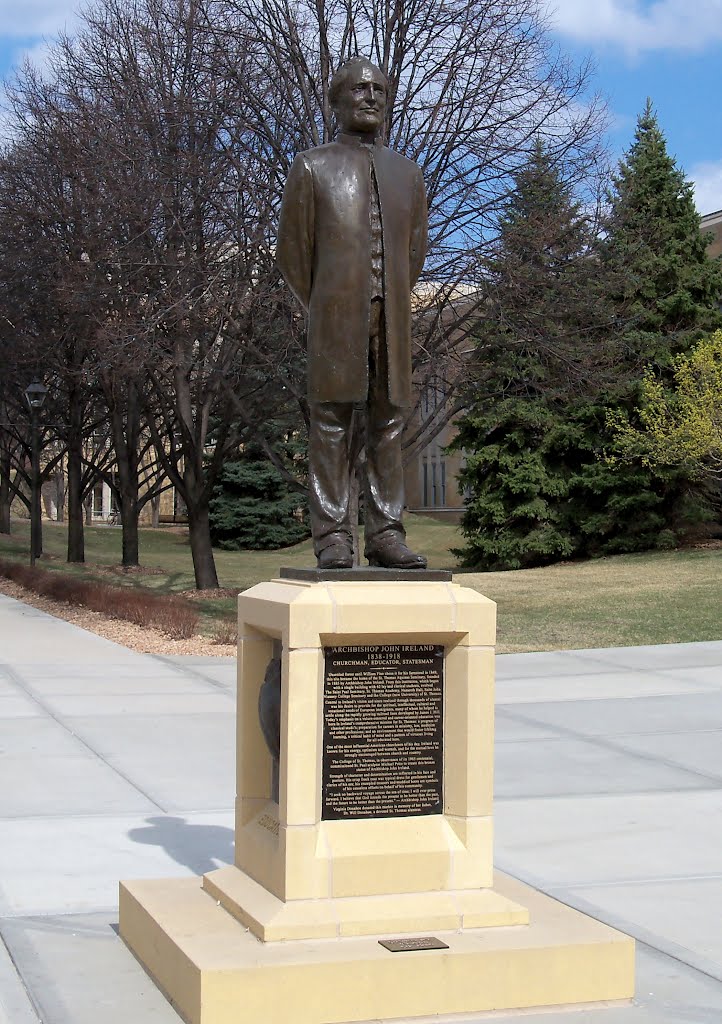
As a Black Chicago “native” of Celtic descent, I can relate and speak more to the former. Walking around Imnížaska Othúŋwe felt more like home to me – with its pastoral vibe and statues and architecture that seem to narrate the city’s story. One statue, in particular, portrays a priest standing in a semi-disheveled state – his pants legs are wrinkled and his shoes are worn from his tireless labor:

Archbishop John Ireland, a native of Contae Chill Chainnigh in Éirinn (County County Kilkenny, Ireland) developed much of modern (not contemporary) Saint Paul. In the wake of the 1862 Sioux Uprising, he founded the Irish Catholic Colonization Association which settled over 4,000 Irish Catholic immigrant families on 400,000 acres of farmland in Mnísota. (Photo Credit: Jon Platek)

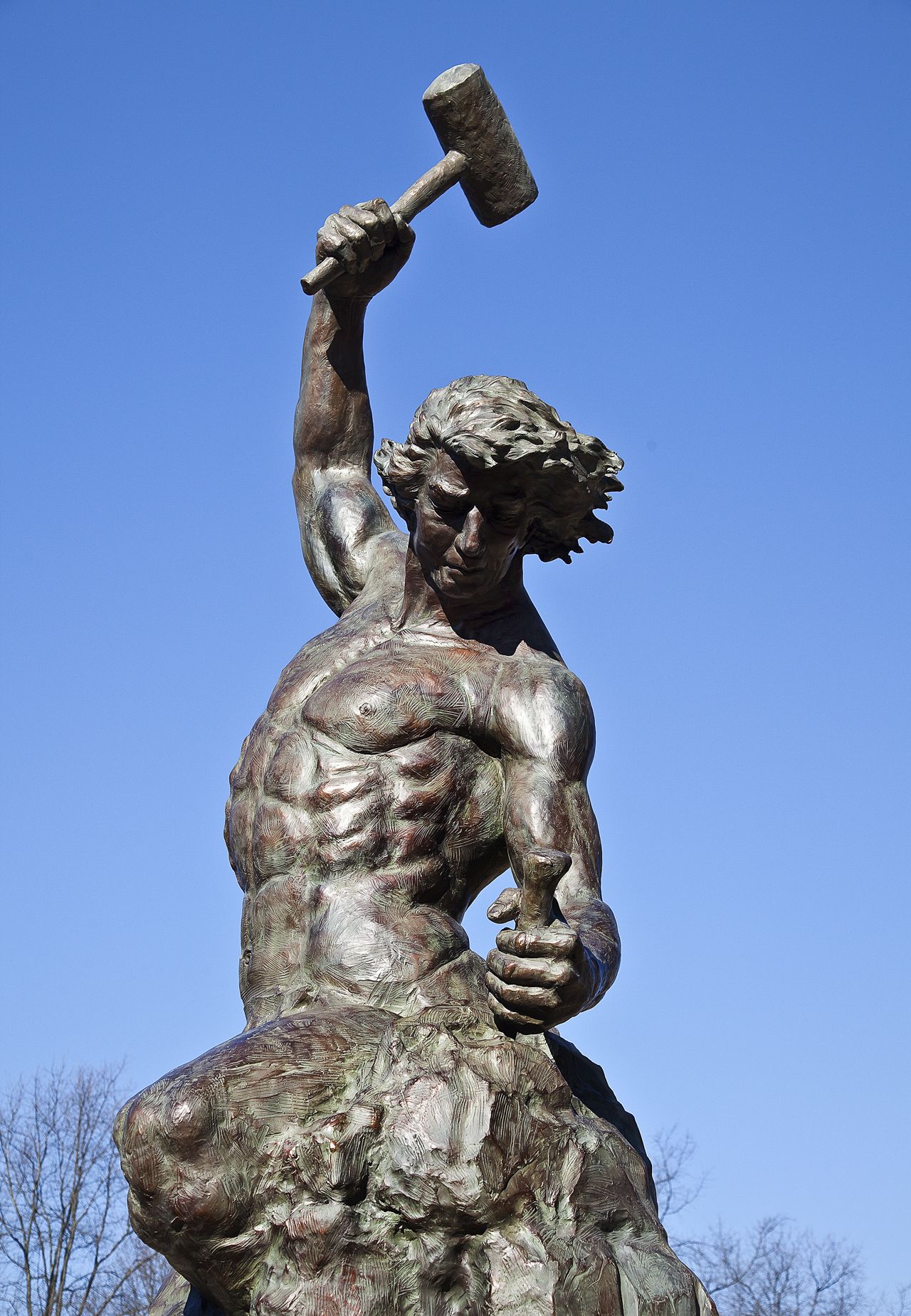
In Bdeóta Othúŋwe, there is a replica of the “Self Made Man” carving himself into existence from a granite block using a mallet and chisel. Surely, this feat requires concise design and execution – a single mistake could render him deformed and crippled – which speaks to the geometric precision that shaped MPLS.

(Photo source: Reddit)

My highlighting of these contrasts is not a treatise on the peoples’ character – it is an illustration of the historical evolution of their towns. Today, the Twin Cities are so diverse that ethnic generalizations are irrational. Generations of race and cultural mixing, as well as ongoing immigration and migration, have transformed Minneapolis-Saint Paul into one of North America’s unique “melting pots”: 

Where else can you find ᐅᒋᑉᐧᐁ (Ojibwe), Oceti Sakowin (Sioux), Latin@s, African-Americans, Southeast Asians, East Africans, Scandinavians, Germans, Irish, etc. living (and mixing) together?

Poetry from Charlie Robert

 There’s an Addict in the House
  
 There’s an Addict in the House and they’re
 Cracking Down all over town.
 We have programmed him to report at First Light but 
 Confidence is running low.
 Hey Man!
 Given the opportunity he will ruin our scene.
 Somewhere his ancestral home still stands.
 Let’s stash him there.
 In the place where the wind comes up from the Lake.
 Where Elders drive by and Mourners high-five.
 Where resolutions are covered in cellophane.
 Cold in a bowl.
 What will happen to him is anyone’s guess.
 Caesar felt the first knife and thought it was the last.
  
  
 The Funcle
  
 I like hanging with the Funcle.
 He knows the waitress from Woolworth’s and can
 Charm her at Will.
 On cue he gets cheese with his pie.
 Someday soon he will cup her breasts.
 His brothers are evil.
 The women they date are 
 Shiny and Pink.
 Someday soon they will win First Prize.
  
 I like hanging with the Funcle.
 Once we caught a pickerel the length of a gar.
 Its bony teeth bit phantom steel and we
 Smashed its Head on the State Line Bridge.
 His brothers are virtuous and
 Join the Choir.
 Their signs light up the dark.
 Who was it that told them The End Is Near?
  
 I like hanging with the Funcle.
 He’s writing a poem called Saxophone Heaven and
 Posting a Selfie when the Big Hand hits Twelve.
 His brothers have delusions of adequacy.
 Their history bleeds out whenever it can.
  
  
 Epiphany
  
 Razor Sharp.
 In their Clarence Darrow clothes.
 Guilty was their game.
 Turn and Fire on the Count of One.
 Did you do it?
 No.
 Are you certain?
 No.
 Darkness at dawn.
 The cell is as hot as the Devil’s Coat.
 Down the hall.
 Old Sparky.
 Licking his chops.
 Hissing. 
 Throbbing with Juice.
 Did you do it?
 Yes.
 Are you certain.
 Yes.
 I roll up my mattress.
 Wait for the tray.
 Eggs.
 In the shape of a noose.
 A turd on the edge of the plate.  
  
  
 Take That Commie Shrimp Dick
  
 Beans in the Bunker.
 Back on the Menu.
 Mambo Sweet Papi.
 Havana Cigar.
 We’re Deep Underground.
 We’ll never Be Found.
 Take That!
 Commie Shrimp Dick. 
 Both Bobby and Jack.
 Love Marilyn Monroe.
 It’s Time to Attack.
 Get On with The Show.
 Whose Rockets are Hard?
 Who’s Let Down their Guard?
 Take That!
 Commie Shrimp Dick.
 Back in the Bunker.
 Havana Cigar.
 Your Bomb was a Clunker.
 Didn’t even Make Par.
 There’s Lice in your Beard.
 Top Secret.
 We’re Cleared.
 Take That!
 Commie Shrimp Dick.  
  
  
 Check Please
  
 Front Door.
 It’s locked.
 It’s locked.
 I think.
 It’s locked.
 Knock Knock.
 We’re in 
 The Pink.
 The Lights.
 Bark Bark.
 They’re on.
 They’re off.
 They’re on. 
 King Kong. 
 The Lights.
 Ping Pong.
 The Stove.
 Dear Friend.
 We’re at 
 The End.
 It’s on.
 It’s off.
 Let’s check.
 Zoloft.
  
 Metal.
  
 Ticking.
  
 Heat.
  
 Cherry Red.
  
 They’ll find me in the morning.
  
 Gripped in pain they will wonder.

Charlie Robert is a writer and poet living in Silicon Valley. His work is Punchy. Stark. Peopled with characters heroically flawed. Addicts and Taoists. Heidis and Hitlers. Beasts. Caged and uncaged. He has been published in various Literary Journals / Small Press Anthologies including Milk and Cake Press, Iconoclast, NOMADartx, Rat’s Ass Review, The Rye Whiskey Review, Synchronized Chaos, Sacred Chickens, Orchards Poetry Journal, Pikers Press, and is forthcoming in others. Find him at: https://www.charlierobert.com/

Christopher Bernard’s Ghost Trolley story chapters

The Ghost Trolley: A Tale for Children and Their Adults

Chapters 8, 9, and 10 (earlier chapters are in prior months’ issues)

By Christopher Bernard

Chapter 8. The Black Tent

A dozen yards from the tent stood a rock outcropping in the shape of a perched falcon, and the children crouched behind the rock and watched.

Then they heard the sound. At first it was soft, almost gentle, something between a sigh and a groan; except that it seemed to go on too long. Then it slowly became louder, until it was almost a low, deep wail, going on and on, on and on, until suddenly it burst into a ferocious yell, followed by a sound of deep sobbing, and then the words “No . . . ! No . . . No . . . ” The words turned into a whimper and finally trailed off into silence.

Sharlotta suddenly curled up against Petey’s side.

The sounds started again.

Tears appeared on the young girl’s cheeks as the sound again grew again to a climax before again fading away.

“Me deddy,” she said in a small, trembly voice, and her little arms hugged Petey.

Petey awkwardly put his arm around the girl’s shoulders.

They sat there for a long time, holding each other as they listened, but no more sound came from the tent.

Then something caught the corner of Petey’s eye and he looked over Sharlotta’s shoulder.

It was stepping carefully through the trash and garbage, making its way past the snarling dogs, which yipped at it and made it stop briefly and hiss and growl before stepping carefully ahead again. It didn’t seem to notice the children, even when it passed near them, but continued on toward the black tent as though with a definite destination. Petey watched it casually walk past the guards to a corner of the tent far behind the entrance. Then, glancing back as if directly at Petey, she stuck her nose inside a tear in the tent wall and slipped inside.

It was a large tabby cat—just like the mother of the kitten they had saved from the Korgan kids that morning.

There was a gleam in the cat’s eye just before it slipped into the tent, which made Petey think of something.

“I have an idea,” he whispered.

“Oh?” said the girl, miserably—it was not the first time she had heard those words—as Petey snuck away.

Sharlotta was beginning to wonder where the boy from Howtiz had gone when a shout erupted from one of the guards as a cloud of smoke brewed up from a trash pile nearby on the other side of the tent, and the guards ran to stamp it out.

A few moments later she nearly jumped when she heard someone run up behind her and turned around, with a flinch. Petey stood near her with an uncontrollable grin; flashing a half-used-up book of matches with a picture of Jackie Robinson on the cover that he always kept with him as a lucky charm.

“Wait!”

“What?” Sharlotta’s whisper came from just behind his left ear.

“Don’t push!”

“Why not?” 

“Because there’s a big hole and I don’t want to fall in.”

“But me foot be sticking out! Maybe they see me!”

“I can’t go forward or I’ll fall into the hole!”

The darkness enfolded the two children like a blanket of untouchable velvet.

They had had just poked inside the tent where the cat had gone, the torn flap just big enough to accommodate them.

Petey’s eyes had not yet adjusted to the darkness, and he had stopped because his outstretched hand was dangling over a void, groping for a floor that wasn’t there.

They had to wait what felt like an agonizingly long time before their eyes adjusted to the darkness. They could hear the guards busy stamping out the fire outside.

Slowly out of the darkness the two eyes of the large tabby appeared, looking at them from where it sat perched not far away. What was wrong with these peculiar animals? it seemed to think. Couldn’t they see in the dark? At least they’d had sense enough to follow her into the tent.

Petey saw a shadowy light rising from below, then the outlines of a deep pit at the bottom of which he and Sharlotta could have broken their necks if they had fallen in.

Except for the sounds from the frantic guards outside, there was dead silence in the tent, and a cold smell of damp earth penetrated the air.

“There be steps,” Sharlotta whispered, her eyes adjusting quicker than Petey’s. “Down the hole.”

Petey made out a set of rough wooden steps winding down the sides of the pit to its distant bottom.

The tabby blinked, then started nonchalantly washing its face.

Petey crawled over to the top of the steps, with Sharlotta, who was finally able to pull her exposed foot into the tent, close behind. Then they cautiously descended, only once making the wood creak loud enough to waken whatever slithering creatures inhabited the pit.

The bottom of the steps led to a short corridor lit by a burning lamp sputtering in the gloom. A rusty iron door stood at the other end. From behind the door came an eerie stillness, especially after what they had heard outside the tent. Then the door creaked and started to open.

The steps were openwork and gave little cover, but the children had no choice but to scurry under them as quietly as they were able.

One Eye came out with an irritated look – the sounds of the guards fighting the fire could still be heard coming from above – then he closed the door and walked up the stairs, his dirty boots passing within inches of Petey’s face: the same boots he had seen on the embankment.

The children hunkered down.

“He not lock the door,” the girl whispered.

As soon as the steps stopped shaking from the Korgan’s tread, the two children scurried out and down the corridor, then pushed against the door, which opened silently.

The boy sucked in his breath.

Chapter 9. The Secret of the Tent

Lined up along one wall of the small, airless room, tied and gagged in a squat on the dirt floor, were a very young boy and an even younger girl and a young adult woman, all with the same soft, cocoa-colored skin as Sharlotta’s.

They looked up tensely at Petey as soon as he came in, as though expecting only the worst: Petey realized he must look like a dwarf Korgan. But when Sharlotta came in behind him, pulling her matted, muddy hair from her face, their faces widened with a shock of joy, and they began giddily trying to talk through their gags. The look on Sharlotta’s face when she saw them was even more startling: she looked like she wanted to shriek with happiness, but was doing everything she could to keep silent, and the result was that her face flushed a deep purple.

But Sharlotta’s joy turned into something more terrible when she saw, in the far corner of the room, tied to a chair under the room’s only light, a middle-aged man with torn clothes and a bruised face and a cut above his left eye, blood trickling down a gray-streaked, bearded chin. His right leg was twisted in an unnatural way. An empty stool stood in front. The man looked up at them, with a look in his eyes of defiance and fear. Then an incredulous smile flickered to his lips as, through his daze, he recognized his eldest daughter.

“Deddy!’ Sharlotta cried out despite herself.

“Sharlee . . .” her father murmured, and fainted.

“Quick, quick!”B

But Sharlotta was already busily untying the ropes binding her father. Petey soon untied and ungagged the others, telling them to keep silent, while Sharlotta, after undoing the knots, tried to revive her father by hugging and coaxing him and whispering in his ear. He had woken but was groggy and weak. He could barely walk (one leg was almost dislocated) and could only stand with the support of his wife, who, in terror and exhaustion, seemed to feel she had no choice but to look to Petey and her daughter for guidance.

“We be blindfolded when they bring us here,” the mother said, “before they begin . . .” She couldn’t use the word “torture” “. . . on your father. No knowledge have I where we be.”

“We be in black tent in trash dump in Korgan camp on Quixiona Plain at edge of Avana Forest,” said Sharlotta. (So that’s where we are, thought Petey. He had been wondering, though the information was not entirely enlightening.)

“But how you be here?”

“Too much to explain!” said Petey. “We gotta get out of here before One Eye gets back.”

They didn’t need to ask who he meant by that name.

Seeing the ropes used to tie up Sharlotta’s family, lying on the floor like sleeping snakes, had prompted a thought in Petey, which he whispered to Sharlotta and her family. They agreed it was their only hope of escaping.

Petey took the longest of the ropes—the one that had tied up Sharlotta’s father—

and carried it with him into the corridor.

“I be coming with you,” said Sharlotta in a hush, following him on tip-toe.

“Okay,” whispered Petey. “Close the door.”

“Why?” said Sharlotta.

“It’s got to be dark.”

“But what about . . .” and she pointed toward the corridor lamp hanging above their heads.

“Just close it!”

Sharlotta scowled; she didn’t like being ordered around, especially by a boy, but, since this was his idea, and so far his ideas had worked, she complied and closed the door.

Petey swung the rope up toward the sputtering lamp and, after a few swings, managed to extinguish it. The hall went pitch black. Then they groped their way to the winding steps and quickly ascended toward the half-light penetrating the tent till they were nearly at the top steps.

“Good enough,” a voice said outside the tent above them. “You can handle the rest.” It was One Eye.

Petey tied one end of the rope to a post at the side of the steps, then stretched it across, a few inches above the step, tying the other end to the opposite post. Then he did the same thing across the next step down. The two children snuck down and hid under the steps at the bottom.

They had just gotten there when they heard someone take a step on the wooden stairs above them: one step, then a second, then a third, regular and heavy, making the wood creak slightly.

Petey felt a seizure of panic. Had the rope come undone?

Suddenly there was a curse and a cry, followed immediately by a clattering thundering and the steps clattered and swayed as though about to collapse over the heads of the children, and a body came tumbling to the bottom and along the ground several feet in front of them in the pitch dark, then gave out a long groan and sigh, and was still.

Sharlotta whispered after a moment of silence, “He be dead?”

“I don’t know. I don’t think we should find out.”

They gingerly tip-toed through the dark, feeling for the Korgan and sneaking around the big outstretched body, which was shuddering and wheezing (Not yet! thought Petey as he squeezed past), then they opened the door to the cell. Petey looked back at the unconscious Korgan. He looked like a sleeping giant that might wake at any moment. His single eye was open and stared crimsonly at him.

“It work!” said Sharlotta.

The eyes of her own family shone in the light of the room’s little lamp, and Petey opened the door wider and showed them One Eye outstretched on the floor.

Petey led them out and around the unconscious Korgan, then up the steps, slowly, as the father was unable to move fast; Petey untying the ropes when he got to them and giving them to Sharlotta, who tossed them into the darkness below, like slithering snakes dropping down a well.

There was only one way out of the black tent now, Petey realized, as Sharlotta and her frightened family sat on the topmost steps near the flap where he and Sharlotta had entered. He took his little book of matches with Jackie Robinson on the cover and went over to the side of the tent furthest from the flap.

There was only one match left.

Then Petey heard a distant groan, coming from the bottom of the pit.

He was recovering. If he found them, they’d be worse than dead.

The boy hastily struck the last match – a little too hastily. The tip sparked and sputtered, and almost went out (the matchbook had gotten wet from the mud), till he moved his finger down so the rest of the match could catch fire, by so doing almost burning himself.
            Then, biting his tongue hard so he wouldn’t cry out as the flame bit the end of his fingers, he knelt and touched the flame to the bottom edge of the tent wall where it almost touched the ground; he hoped the canvas was not wet.

Please burn, tent! thought Petey, biting his tongue as hard as he could. Nice tent! Come on! Please! Burn!

He was about to either drop the match or shout out with pain when the canvas slowly began to respond.

It was a very small and very weak flame, and Petey, afraid it would die before it had half a chance, took out his handkerchief and fed it, like kindling, to the little crescent of red eating its way a little at a time up the black canvas.

Then, suddenly, the fire took.

Chapter 10. Escape

He ran back to the torn flap and cautiously looked outside.

“Fire!” cried one of the guards, as smoke began billowing from the back of the tent. Both guards ran toward the new fire.

Almost simultaneously a shout came up from the bottom of the steps.

Petey pulled Sharlotta out by the hand, who pulled her father, who pulled her mother, who pulled her little brother, who pulled her little sister, and out of the tent they slipped, the father hobbling painfully, over to the rock outcropping in the shape of a falcon a dozen yards from the black tent. The tent was rapidly being eaten by the flames.

The wind had grown in force, whipping from the north.

A flame shot up behind the tent, like a great yellow and red tongue, with the sound of an explosion. In the distance Korgans turned with startled looks and after a moment began running toward the tent.

The escapees ran as fast as they were able (the mother helping the father hobble along at a pace that was agonizingly fast for him), weaving through piles of debris, past wreckage and heaps of cast-off equipment and slurries of blasted rock, to the far side of the dump and a half-collapsed wall along the edge of it, far from the fire. As they stopped and were huddling down in the narrow shadow of the wall (the sun was high and hot), Petey slipped and fell on his face. The ground where they were standing was thick with mud.

Sharlotta stared at Petey as he picked himself back up, blushing from his clumsiness through the new layer of mud on his face, then said excitedly to her family, “Do like we do!”

And she started speading mud over her brother and sister’s faces and clothing.

“It be our disguise.”

“Of course!” said her mother, with a flash of pride in her clever daughter.
            The father weakly began applying mud to his face. “I doubt I ever be able to make this ugly mug look like a Korgan,” he said. “No matter how hard I try.”

“We see about that,” said the mother, who began vigorously spreading mud over his head and hair where he couldn’t see. Her husband returned the favor, smoothing mud over his wife’s pretty, cocoa-butter face. It was curious to Petey to see the two adults, enthusiastically smearing dirt all over each other – the contrary of anything his own parents had ever commanded of him.

“You know, this be fun,” the father said, with a pained chuckle, “if we be in less of a pickle.”

Soon they were daubed all over with mud, with wild-looking eyes and dirty clothes and faces half-hidden under tangled and ratty hair.

“There,” said Sharlotta, looking everyone over critically.

It was unfortunate her parents stood out so much, by their height and spareness: there was no way they could be disguised as Korgan children, who were, of course, short and almost all squat. But there was nothing to be done about it: they only hoped the adults could be made to look like sick and ailing Korgans, keep their heads down, and take their chances. The mud would hopefully hide the beautiful chocolate brown of their skins.

Petey, now something of a masterpiece of filthy slovenliness, was about to speak when something struck the back of his head.

“Ow!” he cried as he spun around indignantly.

The two Korgan children they had met earlier stood a few yards away, Bang Bang laughing tauntingly and pointing at Petey. Blue Moon stood, giggling, at his side. What were they doing there? Had they been following them? There was no time to figure that out! The two of them began singing out in childhood’s universal chant of mockery:

“You – are – Pao – nas! You – are – Pao – nas!”

Petey picked up a handful of gravel and threw it at them, and they laughingly side-stepped it and started throwing rocks back in rhythm to their chant, which was soon returned in kind, and the rock and mud throwing was in full spate.

Beely, Sharlotta’s little brother, grandly smeared from head to foot, began wailing when a pebble struck his nose.

The two parents realized any attempt to stop the fight was likely to call attention to them, so they huddled against the wall and waited for the contest between the children to be resolved.

“You – are – Pao – nas! You –  . . . !”

Sharlotta interrupted them, shrieking back in her loudest voice:

YOU arrrr Paonas!”

Petey picked it up, yelling, with Sharlotta, “You – arrrr – Pao – nas! You – arrrrr – Pao – nas! You – arrrrr – Pao – nas!”

Soon, Sharlotta, Petey, Beely, who, at four, felt he was almost grown up, and Sharlotta’s sister, little Johja – who, only three, had no idea what they were shouting – were all chanting together, “You – arrrr – Pao – nas!” outshouting Bang Bang and Blue Moon, and (all except for little Johja, whose attempts at rock throwing got no further than her shadow) assailing them with a crescendo of gravel and handfuls of mud, until Bang Bang was struck on the top of his head by a small rock from the hand of Sharlotta.

He yelled, shocked he was not invulnerable, then started bawling at the top of his lungs. This was the sign for the others to launch an all-out attack, swooping in a stampede. Blue Moon yanked at the blubbering Bang Bang, and they dashed off, the sounds of the boy’s bawling floating back on the wind.

“Let’s follow them!” Petey called to Sharlotta in triumph – a little too soon, in Sharlotta’s estimation. How like a boy! But Petey went on excitedly, “We’ll be safe! The Korgans are worried about putting out the fire, they’ll just think we’re a bunch of kids playing chase!”

(“I be no kid!” protested Beely.)

“ . . . and Bang Bang and Blue Moon might lead us to an exit from the camp! Anyway, we can’t stay here.” Looking at Sharlotta: “Can we?”

“But what about me parents?” said Sharlotta, looking at them in their resplendent muddiness, her mother holding her father, who was still weak from the terrible things that had been done to him in the tent.

“I can come back for them as soon as we know how we can get out of here.”

“He be right, Sharlee,” said her father. “It better than all us stay here. But best you hurry. I no like the look of that fire. You go with them, Meena.”

“Faar, I no can leave you here,” said the mother.

The fire was growing on the far side of the dump despite efforts by the Korgans to put it out. Shouts echoed across the camp.

“We can’t wait!” said Petey. “Come on!” And he dashed off after the two Korgan children as they disappeared into a confused crowd that seemed uncertain how to respond to the fire.

“Go! Hurry!” said Sharlotta’s mother. “Take Beely and little Johja with you. No one notice four dirty kids running away from a fire. We be all right here.”

“Maybe not all right, exactly, but at least we up against a wall,” the father said mordantly.

Beely and little Johja looked at Sharlotta with mouths agape.

“Do everything your sister say,” the mother said to them in her firmest Mom “don’t-even-think-of-talking-back-to-me” tone. “You follow her.”

And Sharlotta grabbed their hands and ran after Petey, who had already vanished among the Korgans.

The fire was spreading; they could hear shouts and cries of increasing alarm.

Then there was a big explosion to the north; a cloud of dust swept over them and the shock wave threw them to the ground.

Sharlotta immediately rose, coughing, and looked back to make sure her parents were all right.

“Go!” ordered her mother, her arms covering her husband as the dust blew over them. “Go!”

 And Sharlotta, hesitant to leave, watching her parents disappear in the dust, finally turned and ran with the little ones in the direction where Petey had gone.