
I.
where out of black
by a small stretch of sand
the moon grasps
the breakers unawares
I feel like I've gone back
to the beginning
when I sat with a pail
and packed it with sand

since then what passed
rolling in the radiant grass
touched by moonlight
and hand and a breast
heaved towards the low tide rocks
by the bridge span

how right Euripides was
in that
I lean on a cane
who wanted to crawl back
to the beginning
and do it again


II.
a man lived here
until his wife died
his children left
and all he had left
were television shows
of comedies and commercials

(he had seen the massive
wings of fascism spread
and briefly landed)

he had worked, had lived
had suffered and grew
old like the rest
and when there wasn't
anyone to talk to
he resolved to go
I saw him leave
without a wave

except he bowed
unto the trees
and the birds

and the rain


III.


the light is what
you're reading
and where it is
not is also there
in its places

at night a stag
moves between
trees silent
as the shadows
the trees have surrendered

the hunter moves down stream

and safe is wanted
Poetry from Randall Rogers
Taxi Driver


Best thing about
not making it as
a writer
is you can write in peace,
read too,


live happy, free,
suffering from the effects
of status
inconsistency.


Monumental


Cucumber
madness
pickling
minds
fraught
chiseled on the mountain
head-rushing
LSD trips
in stone
representing
hope, freedom,
the American way
of love
Christian values
dammit
in travail,
growth, organization,
and war
at night
in the moonlight
howling.


Among the Inhabitants of the Ant-farm


I would be
wondering if there were
no God
the idea to create one
might be overwhelming.


Rodent


Sharp incisors
naked tail
furtive
eyeball chewing
pet
worthy
of plague.
Essay from Robert Thomas
Palio: Back In Time
I have visited Italy a number of times. The country and culture keep pulling me
back, luring me from the modern simplicity, and chain store repetitiveness of new world America, into an old world that has lovingly retained its ancient patina of history. Italy always tugged at my deep sense of aesthetic with its art, architecture and culture.
From the ruins of a city born of Romulus and Remus to the rebirth of the classical form
in Renaissance Florence; from the creative genius of Da Vinci and Michelangelo to the
works of Ettore Sottsass and Renzo Piano, Italy has brought forth a vast array of eras
and genius, whose creations have enhanced its geographic walls, turning it into one of
the world’s great museums.
I return again. This time to Siena. However, rather than remain a passive observer
of art and architecture, as before, I now immerse myself in one of Italy’s cultural
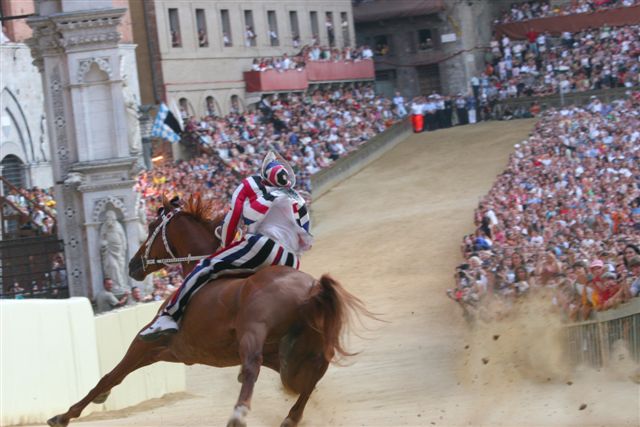
masterpieces: Il Palio Siena, the annual bareback horserace which began in 1633, and
has continued almost unabated ever since. Twice during the summer, in July and
August, Siena reaches back in time as Medieval costumed residents participate in the
Corteo Storico, a parade that winds through the back streets, and around the central
piazza before the historic race takes place. The city becomes a glorious pageant,
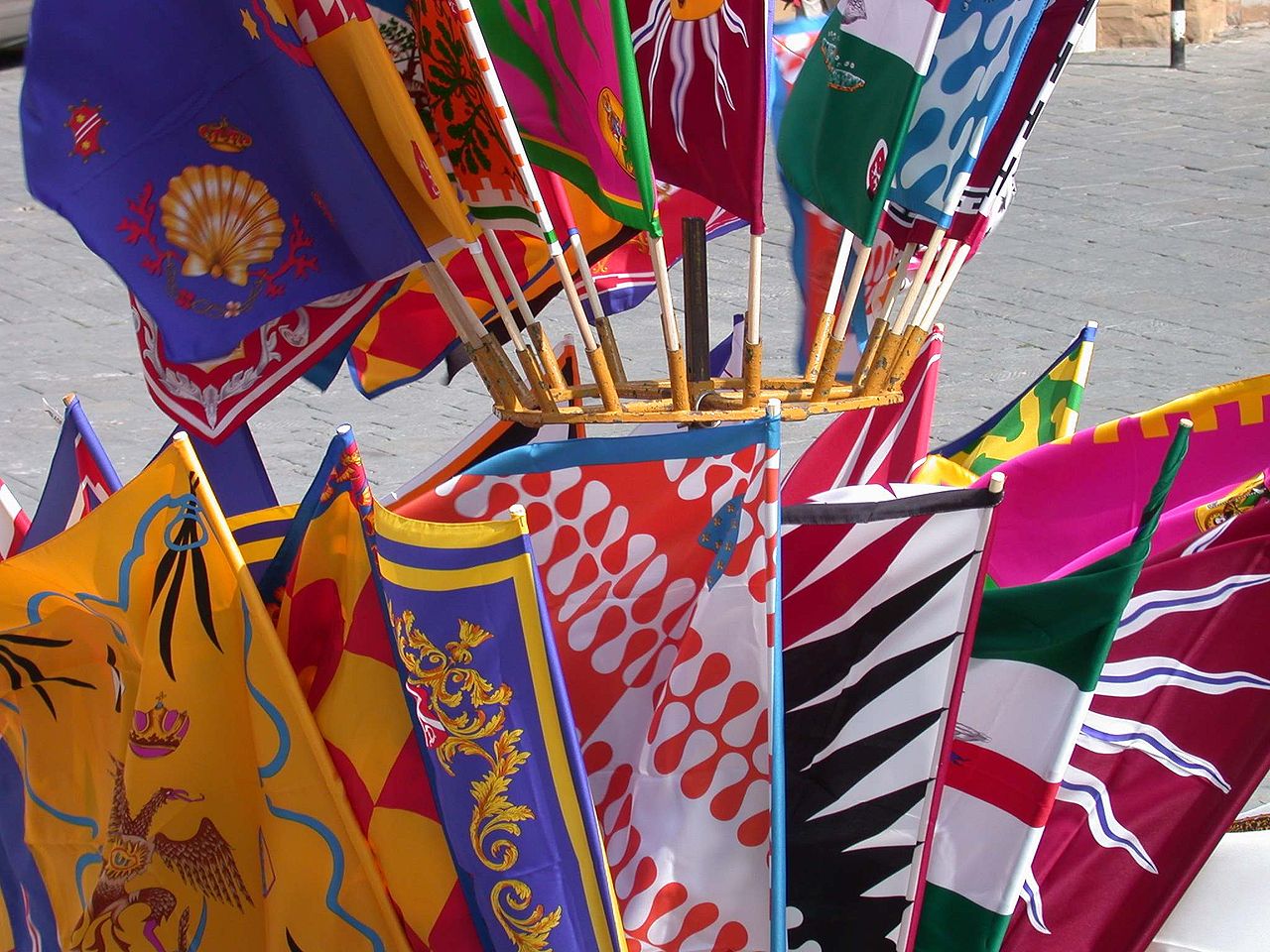
decked with colorful flags representing the seventeen competing contrade or districts.
A single horse and rider represents each contrada. While only ten horses race in any
single heat, those not selected in the July race will enter the August race. In both
months, the streets of Siena echo with the chorus of fraternal song. Boisterous
taunting ensues between nemici (enemy contrade), and an air of intense rivalry mixes
with festivity.
With bag in tow, I head down Via Salicoto towards my apartment located just under
the Mangia Tower overlooking Piazza del Campo. I wondered if Tony, my Bay Area
friend, arrived before me. He and I planned the trip a year prior, as a brief stag getaway from our beloved partners. Tony, a stout demonstrative fellow, born in Tricarico, a small hilltop village in the ankle of Italy, never visited Tuscany. His family moved to Milan after the war, and after spending some time in Northern Italy, he emigrated to America. He never planned to stay, but only to learn English and a trade, before returning back to his homeland. However, the fates had other plans for him, as he fell in love with an immigrant woman, Elena, and married. He developed a successful trade, the proceeds of which went into buying up real estate. Like many other immigrants to America, with little in his pocket, a limited education, and much
ambition, he found a successful niche for himself, and decided to become an
American.
Via Salicoto is a narrow lane wedged between high villa walls of brick and cut
stone. The thin passage only allows for sunlight to reach the cobbled pavement during
a short period of time during the height of the day. This was a blessing, as it was hot,
and the buildings shadow afforded me a degree of comfort as I pulled heavy luggage
behind me, the small rollers frequently catching in thin crevices between cobbles.
Gazing ahead I could see the bright open space of the Campo. I quickened my pace in
anticipation of viewing the famous tufa and clay packed racecourse. As I walked out
into the bright sunlight, the ornately carved white marble loggia, the Cappella di Piazza, appeared to my left. Built in 1352 to honor the Virgin Mary following the end of the Black Death pandemic, its tall niched pillars held statues of saints revered by the
locals. Towering above it stood the crenelated Torre del Mangia, supposedly named for
a gluttonous bell ringer. I could only glimpse the top stories of buildings that
surrounded the Campo. A high thickly padded barrier blocked my view of the entire
campo. The fence allowed for residents to have access to the campo, while providing
protection from the riders and their horses that sometimes careened into the sides of
the racecourse.
I followed the fence line to number 78, located just outside a large iron-studded and
arched wooden double door. Inside the entry I encountered a small sunlit courtyard
with a stairway leading up one flight to my rented residence. The proprietor sent me a
door card, which I touched to the entry lock. The spacious place had two bedrooms, a
large bath, a kitchenette and a living room, with windows that overlooked the Campo.
Tony and I selected this flat specifically so we could scan the entire racecourse during
the event without having to stand shoulder to shoulder with a horde of others out in the
heat.
I heard a knock at the door, and expected to see Tony, but instead, an attractive
woman in her 30s stood before me.
“Buona Sera, I want to introduce myself. I am Maria Sciponi. I am the caretaker of
the apartment, and I am available if you need any assistance.”
She spoke fluent English, and I assumed she knew I was American, based on the
reservation information. Maria gave me a quick tour of the apartment, and instructed
me on several kitchen appliances.
“Is this your first time in Italy?” she asked. “
“No, I have been to Italy several times, and this is my second visit to Siena.”
Maria had a wonderful lilt to her voice, enhanced by a sweet Italian accent. Bright
red lipstick highlighted her lovely smile. Her eyes were dark, accentuated by heavy
black arching brows reminiscent of Frida Kahlo. She explained that the apartment was
within the Torre contrada, and they had a horse racing in this week’s Palio. Before
leaving, she left me a number of brochures from various restaurants, and a timetable of Palio events.
“Ciao, enjoy yourself,” She whispered in a soft seductive voice, closing the door
behind her.
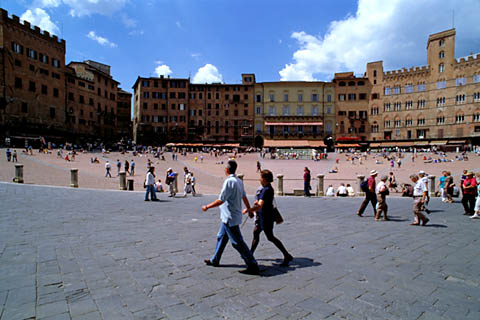
I opened the large shuttered windows facing the Campo. Before me lay a vast
scallop shaped piazza surrounded by multistory buildings. The race track encircled the
entire outer edge of the piazza. In addition to the padded wall below me, steep
temporary bleachers, shielded by a low wooden fence along the track, ringed the
remaining plaza. Narrow openings, the ends of passages from various parts of the city,
broke the symmetry of stone edifices. Along these streets the contradiaoli (district
residents) led their riders and horses into the Campo from the various districts
throughout the city. A low fence encircled the inside circumference of the race track,
creating a large central area where people, unable to rent an apartment above or one of the bleacher sections, could gather to watch the race.
“Hey, Bob…Bob.” A voice called out from below the window. Tony arrived, waving
frantically to get my attention.
“Ciao Tony, come through the wooden entry, and up the stairs. I’ll meet you at the
door.” I opened the door and watched him slowly climb the steps. After a good hug
and some back patting, I showed him to his bedroom, where he set down his luggage.
I immediately went to the kitchen, and fixed us both a Negrone. Exhausted from
having toted his bag through several blocks of crowded pedestrian lanes, he sat back
on the sofa and sighed. He complained of losing the directions to the rental, and
having to rely on locals to find the place.
“They don’t speak Italian here,” he grumbled.
In spite of having spent some time in Northern Italy, Tony still retained the
Lucanese dialect of Basilicata, a dirt poor region of southern Italy. The area remained
quite feudal with a very unique dialect of its own. It remained the poverty belt of Italy
even after WWII, and no public education system was ever established while he lived
there.
The tongue of Siena was primarily Tuscan; therefore, Tony had some difficulty with
the nuances of directions people offered him. Given Tony’s penchant for belaboring his
gripes, I hoped the differences in dialect would not interfere in our ability to relate to the locals. It was getting late, and the sun was already below the line of terra-cotta
rooftops capping the city.
“Let’s hit a trattoria for dinner,” I suggested. Tony agreed, and I grabbed a number
of brochures left by Maria. The top brochure listed Trattoria La Torre, located on Via
Salicotto. We headed out and around, finding the restaurant close by. Outside the
entry hung a colorful flag representing the Torre contrade. The narrow street
discouraged any alfresco dining, and since it remained hot, we opted to dine in, and
headed towards the entrance. An extensive and inviting menu hung next to the door.
Some of the names of the Secondi were unfamiliar to me, but I counted on Tony to
translate for me.
Diners filled the tables. The waiter escorted us around them and down a flight of
stone stairs into what seemed to be a hewn out cavern. Chisel marks covered the
arched limestone ceiling, as well as the walls. A series of tables lay end to end, with an
elderly couple sitting at the far end of the table. The waiter seated us at the other end,
poured us a couple glasses of wine, and handed us our menus.
“At least I can read the menu,” Tony groused.
I then knew that this was going to be an ongoing issue throughout the trip.
“We’ll see if these people can cook real Italian.”
For Tony nothing short of Southern Italian cuisine would satisfy him. I loved his
cooking, and looked forward to the great meals he created in his kitchen. However, hot
peppers always infused his cuisine. From previous visits to Tuscany, I remember the
food being on the mild side. I guessed he would not find the food to his liking, but he
would put up with it. We agreed on an antipasto of Caprese, and ordered the ravioli
pomodoro to start, deciding to wait to see how full were before ordering a secondo.
We talked of the next day’s events, which included individual contrada celebrations
taking place among the warren of streets radiating out from the Campo. Suddenly, we
heard a round of applause from the upstairs room. Next, rhythmic clapping
accompanied the sound of a rousing song.
“It’s their contrada song,” Tony noted. “I guess they’re starting early.”
Shortly after the chorus subsided, the waiter led two gentlemen down to the table
and sat them near us. An elderly man, and a younger male in his twenties or thirties,
both wearing fazzoletti (kerchiefs) of the Torre contrada, sat opposite each other with
the older gentleman facing Tony. As they read through their menus, Tony suddenly
gasped, and in a loud, and excited voice he uttered,
“Giordano, Giordano Pace!”
The older man turned, looked toward Tony, and immediately stood up.
“Tony Calano,” he replied.
Tony immediately stepped around the table to greet the man. Exchanging multiple
hugs, they engaged in a highly animated Lucanese conversation with each other.
Giordano introduced the younger man as his son, Stefano.
“This is an old friend of mine from Tricarico,” Tony informed me. “We grew up
together.”
Conversation between them continued throughout the meal, as they made up for
lost time. Between animated bouts of Italian, Tony kept me informed of their
conversation. The Paces moved to the Siena area shortly after the Calanos left to go
north. While living in Tricarico, the family eked out a living as herders and breeders,
raising sheep and horses. They rented their grazing land from a distant landlord, who
eventually sold the property. The new owner did not want to continue their lease. The
Paces had an opportunity to buy land just outside Siena on a rent to own program
offered by the government. Their knowledge of animal husbandry, particularly of
horses, allowed them to prosper in Siena by providing steeds for the Palio. They also
raised sheep, giving the local cheese makers access to their milk.
Tony waved at the waiter. “Cameriere—peperocino per favore,”
As soon as the server set the small canister of dried peppers on the table, Giordano
quickly snapped it up, drew out a pepper, crinkled it in his fingers, and sprinkled it
across his pasta. Tony soon followed suit.
As we finished up the last of the meal, Stefano reached down to his side and pulled
a long strip of leather from a loop on his belt. He laid the object on the table between
us. Taken aback at its sudden appearance, Tony and I sat silent for a moment, as both
Stefano and his father looked at us with wide grins.
“Pene di bue,” Giordano explained, gesturing toward the object with his hand.
“Pene di bue,” he said again, gesturing as if we should know its significance.
Tony smirked, and with a delicate touch, he gently pushed it away from him, as if it
were some tainted object. I nudged Tony with my hand and gave him an inquisitive
look.
“What gives?” I asked. Tony told me it was a tanned ox penis “Ew, why is he
showing that to us, at a dining table, no less?”
Upon seeing our repugnance, the two men laughed. They explained that it was a
horse whip used by the jockey during the race. The whips were traditionally made from
the foreskin of an ox penis. Stefano used the this particular whip during his practice
trials. He considered it special, and a good luck piece. He kept it with him, since
nemici sometimes stole them from jockeys. The men inferred that Stefano was racing
in the Palio, and he represented the Torre contrada in the race.
We congratulated Stefano, and offered a toast to his success. I assumed he rode
one of his own horses, and asked about its characteristics. Stefano, who knew
English, explained that riders preferred a mixed breed horse—a fast sprinter, with high
maneuverability. Sudden speed and quick moves are key strategies employed during
the race. The horse also had to have a sedate demeanor, remaining calm, yet
responsive with chaos all around them. Racers also chose horses with low, wide
withers. Riding bareback left no protection for the male anatomy, and high narrow
withers could be problematic. Bareback riding required the jockeys to use their legs to
hold onto the horse. A horse with large bulging flanks forced the rider’s legs outward,
making it difficult to grip. Stefano knew his horse well. He began training it as a foal,
eventually riding it every day. He confided in a low voice that his horse was indeed
both fast and attentive to his cues, which gave him an extra advantage. He planned to
get out front as quickly as possible, and stay there, using his horse and whip to block
others from gaining an advantage on him.
“Santa Maria blessed me when I got my horse,” he said with a sly wink. Apparently,
horses were allocated by lottery. Did he obtain his horse by chance? Stefano’s wink
said otherwise.
“ How did you come to ride for Torre contrade?” I asked. Most riders were hired by
contrada based on their past successes. Riders did not owe any particular allegiance
to a district. They may switch contrada on any given year.
“Last year I married a woman who lives in the Torre contrada. I had ridden before,
and while I never won, I have come in second numerous times. Given my history, and
the marriage, they delighted in having me represent them this year, particularly with my own horse.”
Before leaving, Stefano invited us to tomorrow night’s contrada dinner, which took
place at Piazzetta Arrigo Pecchio, a ways down Via Salicoto. Dinner began at seven
pm, but the party started much earlier.
Tony and I finished our meal at eleven pm. We left the cafe, which remained filled
with revelers. In the warm Tuscan air, we heard choruses bellowing from various
corners of the city. People stirred about in gatherings of mutual camaraderie
throughout the long evening. Once in our beds, we were lulled to sleep by the distant
melodies emanating from all corners a joyous city.
A sudden loud noise from the other room awakened me. “Tony is that you?” I
asked.
“ Si, si it’s me.” He replied. “ I knocked over the standing lamp in the living area.
Nothing broke.”
“ Tony you’re up early?” I wondered why he was up at six am.
“I woke up early and could not go back to sleep. I thought I would go for a short
walk, and get some espresso before eating breakfast.”
“Okay, bring me back a double, I’ll catch you later.” Awake and already thinking
about today’s events, I shifted about in bed for fifteen minutes, before deciding to get
up.
After a shower, shave and dressing, I took a look out of our apartment window. The
sun broke over the rooftops, illuminating church towers and domes all across the city.
The view of antiquity stirred an intense emotion in me: an animus of some kind, an
ancient archetypal sense of historic continuity was about to play out, as it had since
the fourteenth century. Early morning revelers busied themselves up and down the
passagi, rolling out trattoria awnings, placing tables and chairs, and setting up souvenir stands. Shouts of “Bongiorno, e un bel giorno, per uno gara.”lilted from the passages.
A new Palio day had begun.
Looking down , I noticed Tony and Maria engaged in conversation. I thought it was
nice that he had been able to connect with her. She might come in handy, should we
need her services, and speaking Italian to her might make things easier. Tony held a
paper tray containing what appeared to be two small paper coffee cups as he stood
closely in front of her. At one point Maria put her left hand on Tony’s shoulder, and
with her right hand she gently caressed his cheek. For a moment nothing was said
between them as they stared directly into each other’s eyes. Maria then kissed him
gently on the cheek, turned and walked around him, heading towards Via Salicotto.
Tony stood alone for a minute, turned to watch her go, then continued on through the
door below. Perhaps Maria’s services went beyond housekeeping? I decided to let
sleeping dogs lie, and not bring the incident up, leaving Tony to reveal his intensions, if
he wished.
Breakfast consisted of biscotti, prosciutto and melon, with espresso. Maria had
stocked the small refrigerator well. Following colazione, we decided to explore the city.
With a map brochure of the city sights, we headed out the door. We definitely wanted
to see the cathedral; Santa Maria Assunta and its Biblioteca Piccolomini.
Special Murano glass lighting made for each of the contrade adorned the building
facades all along the various passageways. Colorful banners also festooned the narrow
lanes. The contrade erected gates between each other, manned by locals who briefly
questioned unfamiliar pedestrians. However, as we wore no fazzoletti identifying us as
nemici, and we spoke primarily in English, we had no difficulty passing though to our
destinations. Locals set up tables and chairs along the streets and small plazas
throughout the city in preparation for the nights festivities. On the eve of the race,
contrade engaged in ritual events as they dined outdoors in their districts.
Passing from the Torre Contrada into the Aquila Contrada, we arrived at the Duomo,
where we stood before a magnificent gothic facade designed by Nicola Pisano. The
entire cathedral was built piecemeal, the Black Death having interrupted construction.
A larger nave was never completed, leaving a portion of the wall exposed to the
elements. Three large doors embraced the front of the cathedral, cradled in
meticulously carved Gothic stone arches. On either side of the doors tall spires
loomed upward. Directly above the center door a large rondel housing a stained glass
window faced the front. Two additional spires abutted either side of the rondel. A large
intricately carved triangular edifice capped the round stained glass window. One could
spend hours exploring all of the stone carvings and architectural detail displayed on
the face of the church.
Upon our entry into the cathedral, a cavernous arched nave, held high by
horizontally striped columns of white and black stone immediately drew our eyes
upward. Medieval and Renaissance paintings, as well as carved statues covered the
side arcades and vaulted ceilings. Above and along the arcades, tall gothic arched
windows infused bright light to the interior. At the far end of the nave, the vaulted
ceiling gave way to a large coffered dome. The entire floor consisted of intricate
intaglio involving geometric designs; a multitude of scenes from pagan antiquity; the
old testament; the life of Christ, and the saints. The artwork was almost overwhelming.
Everywhere I gazed some new delight of religious significance appeared. Marble
statues by Michelangelo; Bernini; Pisano, and Donatello stood solitary in some places,
while wall niches housed others. An ornately carved pulpit by Nicola Pisano stood on
eight columns, each standing atop carved lions. Densely packed reliefs of varying
depths, depicting significant events in Christ’s life, covered the octagonal pulpit rail.
At the end of the left aisle stood the door to the Piccólomini Library. A highly ornate
interior adorned the single room. Intensely colored frescoes covered every square inch
of the walls and vaulted ceiling. The library housed a collection of 15th-century
illuminated manuscripts. Tony and I were overcome by the shear beauty of the main
cathedral and the library, and it took us several hours to appreciate its magnificence.
All of it appeared well preserved, and looked as fresh as the day it was completed
On the way back to our contrada, we decided to stop for a light alfresco lunch at
trattoria. Searching for a good place to eat, we passed a street labelled; Via Dei
Malcontenti. “Perhaps this was an old speaker’s corner?” Toni chuckled. Curious,
we hesitantly passed through the via, expecting someone to jolt from a door and start
bitching at us about something. However, we escaped unscathed and arrived at
Piazza Mercato with our egos intact. Centered in the Piazza, a large sheltered structure supported by an array of pillars, held a weekly market. Adjacent to the market we glimpsed an array of umbrellas advertising Antica Trattoria Papei across the bottom of the canopies. Hungry, we headed directly for the trattoria. We ordered vino and a
light snack, and sat back al fresco to do some people watching. When the waiter gave
us our food, I asked about the Via Dei Malcontenti. He informed us that in ancient
times prisoners were escorted down the passageway to a gallows for their hanging. I
thought Malconenti seemed a bit of an understatement, given the fate of the prisoners.
Perhaps Via Condannato (doomed) would have been more appropriate. Tony and I
briefly discussed what crimes might have resulted in a death penalty back then.
Witchcraft and heresy first came to mind. We agreed that the Inquisition likely provided
a good amount of activity for the hangman.
We assumed that mostly locals wore their contrade fazzoletti or other identifying
attributes. Occasionally, two groups of competing rivals met each other as they
passed before us. This usually resulted in a brief confrontation and shouting match.
Fortunately none of the skirmishes lasted long or ended in violence. However, on
occasion things reverted to fisticuffs. In fact, ritualized pugilistic events (Cazzotti)
between contrade took place in the Campo at other times of the year. These
structured events involved as many as 200 men, ending in hand shakes all around.
Tony and I decided to sit and relax with a couple of aperitifs for the rest of the late
afternoon, as we absorbed the excitement all around us. Small bands of men and
women occasionally stopped and sang their contrade songs to the delight of
customers sitting at the cafe
At one point I blurted, “I saw that you met Maria the other day.” A long pause
ensued as Tony seemed to choose his words carefully.
“Si, si. She is a nice woman, and quite beautiful, as well.”
No matter what age, men continue to admire attractive women. However, instead
of being an opportunity, older men tend to shift to a more aesthetic point of view.
“ I love the old architecture of this city”, Tony continued. He obviously did not want
to pursue the previous topic.
As evening approached, we headed back to our apartment. Sienese party goers
already packed Via Salicoto. After a quick freshening up, we walked back down the
via, striding between rows of long tables placed on either side of the passage. We
eventually came upon Piazzetta Arrigo Pecchio. At one end of the piazzetta a large
table reserved for dignitaries was separated from the rest. We heard our names called
out. Turning towards the sound, we noticed Giordano and Stefano seated near the
center of the separate table. Giordano stood and pointed to two empty seats at
another table nearby. We joined the crowd and settled down for the nights festivities.
In fact we felt privileged, as individual contrade events were the singular domain of the
contradiaoli, and tourists were perceived as outsiders.
Servers scurried about placing food items on various tables throughout the
contrada. It was not long after we sat down before a young girl set a simple appetizer
of bruschetta before us. Tony introduced us to those sitting nearby, and we eagerly
engaged in conversation with them. Of course the topic on everyone’s mind was who
was going to win the race, and what were the chances that the Torre Contrada would
be the winner. The talents and number of wins of jockeys were pitted against the best
horses, as well as the influences of individual contrade. Of course, despite the
differences in opinion, in the end, everyone agreed that the Torre contrade would have
a better than even chance of winning this year. While they have won many races in the
past, they had a history of long dry spells and had even garnered the nickname—The
“Contrada Nonna,” with a lack of wins from 1961-2005. More recently they had not
won since 2015. Nevertheless, they seemed to feel that this was their year. They had
an excellent jockey, and they considered it good luck that he married a Torre resident.
Additionally, the Torre rider was on his own well trained horse, and Torre had
contributed more than sufficient money to give them a certain edge. It was an edge
that was always vague in character, and was never quite fully explained to me. Like
many money related influences in Italy, it was primarily expressed by hand and facial
gesture. Given the history of the Palio, I wondered just how much of the “influence”
was conspiratorial lore, rather than reality. In any case it was an integral aspect to the
event. Another contribution of their positivity was that their nemici, Contrade Orca, had
won by a nose ahead of them the previous year, and they were hungry for revenge.
Along with Stefano and Giordano, several other dignitaries sat at the main table.
Next to Giordano was the president of the Banca Monte Dei Paschi di Siena, one of
Italy’s oldest banking institutions. Evidently, he lived within the contrada and was a
significant figure in the administrative structure of the Palio. Along with providing
funds for contrade, the bank also donated for the maintenance of Corteo Storico
costumes and flags. On the other side of Stefano was the Contrade Torre Capitano.
The head organizer and initiator of “influence”. It was his responsibility to make sure
the contrade had the best advantages available.
The Capitano stood and tapped into the microphone, gaining the immediate
attention of all participants. After a short speech, trumpets began to play, and people
stood at their tables to sing the contrada anthem:
“Siena illuminata di vita
risplende,
Risplende il Campo
Dai mille colori,
La fede e gia accesa
Nel corri e vinci, Torre,
Torre!
Fatti Strada attraverso
Torre,
Tutta Siena, le strade, I
Palazzi
Vola verso la folla Che
corre,
La Bella Vittoria
festeggera.
La Gloria va a te….”
Following the anthem, speeches ruled the evening. Along with various dignitaries,
other contradiaoli added to the oratory. People touted the positive attributes of the
contrada and its inhabitants, while humorously demeaning those of other contrade.
Episodes of joyous song intermittently interrupted speeches, as participants engaged
in a night of community spirit.
Late into the evening I began to feel the effects of perhaps seven or eight glasses
of vino. The light from lamps bedecking the streets and piazzas became rather diffuse,
as if they had suddenly gone nova. Tony also looked none too alert. I gave him a
nudge, and suggested we go back and get a good night’s sleep. Tomorrow was the
day of the race, starting with the Corteo Storico in the early afternoon. We approached
Stefano and his father, and bid them good luck in tomorrow’s race, and slowly ambled
back to our residence.
Still a bit groggy after the previous night, I did not want to walk down to get an
espresso from the caffe. Dressed in my undershorts, I grabbed a robe from the
bathroom, and immediately filled the Bialetti espresso pot, and put it atop a burner on
the stove. While reaching for a cup, I heard a light tap at the door. Upon opening, I
found a copy of an American edition of The Guardian on the stoop. “Beautiful Maria” I
thought, “She doesn’t miss a trick.” I grabbed the paper and began paging through it
as I sipped my morning espresso. USA news was much more palatable now that an
ailing America had finally taken a good dose of political Ipecac, and retched up the
germ that was the Trump administration.
“Buongiorno, Come stai questa mattina?”
“Oh, g’morning Tony. I’m feeling just a bit off this morning. Too much wine and
good cheer last night. However, after a good breakfast, strong coffee and a shower, I
should be ready to go.”
“I’m okay,” Tony admitted. “I slept solidly through the night. What time does the
parade start?”
“ Uh…I goofed up. I thought it was much earlier, but according to the brochure it
doesn’t start until 4 pm this afternoon, after which the race begins at 7:30 pm. So, I
guess we have another day of sightseeing in store for us. Siena has several interesting
places to visit. How about we first visit the National Gallery, and if we have more time
after that, we can go see St. Catherine’s Sanctuary?”
“Sounds good, Tony replied. “Oh great there’s still some prosciutto in the fridge.”
We spent the morning browsing the National Gallery, a museum filled with 13-18th
Century Sienese artworks. The most impressive were the large 12th and 13th century
alter pieces ensconced in gold leaf. The artwork was primarily two dimensional with
figures of Christ, the Madonna, and various saints. Evidently they had an ample supply
of gold at the time, as it covered every inch of gothic framing in the museum. I
wondered where it all came from, given that the Americas were yet to be discovered.
Perhaps, Africa or Asia Minor?
We soon became sated with gothic art, and left the gallery. Instead of going to St.
Catherine’s, we decided to walk the streets and experience the city’s preparations for
the Palio. We strolled along Via di Citta, which, a block or two out, circled around the
Campo, and gave us a good sampling of the life of Siena. Approaching one o’clock in
the afternoon, Tony came to an abrupt stop.
He asked, “Are you hungry?” To which I gave him a serious head nod.
“Wait here, I’ll grab something special for us, and we can eat at the small piazza
down the street.”
Before I could tell him my order, he broke away and strode into a nearby shop. The
sign above the place read, Proscutteria e Convivo, which translated into something
like; Ham shop and Caterer. While waiting, I amused myself by gawking at the various
medieval costumes people wore as they passed by. Obviously, they were participants
in the day’s pageant. The quality of the ancient couture struck me. Sienese historians
interpreted medieval couture as quite extravagant. Participants wore tunics and coats
of silk and velvet. Furs, including ermine adorned many costumes. Many men wore
tights beneath tunics, a fashion that has resurfaced with women in today’s world.
“Okay, lets go.”
Tony quickly turned and headed down the street carrying a brown bag at his side.
We entered Piazza Indipendenza, surrounded by a number of shops, a trattoria, and a
large ochre stained building with an arched loggia. Luckily, we found a vacant bench
nearby, and immediately occupied it. Tony pulled from the bag a couple bottles of
Peroni Nastro, which he opened with a quick pop of the cap against the edge of the
seat. Next he withdrew a couple of what appeared to be hamburgers. However, upon
closer look, the bun was not filled with ground meat. I could not identify the
substance, and the texture was novel to me. It looked something like six week old
dried fat.
“Mangia, mangia!” Tony demanded. “Once you taste it, I will tell you what it is.”
I’m game for new experiences, particularly when it comes to food, but I did not
expect such a surprise in Italy. I have had fried crickets in Myanmar, and roasted
Guinea Pig in Peru, but for the most part, Italy’s cuisine was pretty familiar to me. I
gazed at the sandwich for a few seconds, built up a bit of courage and took a bite.
After a number of chews, I found the texture soft, yet chewable. It had the texture of
abalone. It seemed that the texture was the thing with this food, as the flavor was
dominated by the sandwich’s condiments, Tony gazed at me as I ate, expecting some
reaction from me. Finally, I asked what I ate.
“ Lampredotto, cow’s stomach.” He replied.
I lurched for a second, as the image of a foul smelling belly filled with semi-digested
cud flashed through my head. Once I got passed its unique position in the carcass of a
cow, I found it not bad at all.
We finished our lunch, and continued to explore the back streets of Siena. As we
crossed from one contrada to another, festival adornments changed color. Young men
in each contrada practiced flag throwing, an old art form stemming from their function
as signals in medieval battles. During the Corteo Storico these “alfieri” are
accompanied by trumpets that herald their arrival, and drummers provide a steady
beat to which they coordinate their moves. They compete against each other during
the parade.
It was after 2 pm, and the streets became increasingly crowded, as people began
heading for the Campo. We decided to go back to our residence, lest we get stuck in
the crowd. Nevertheless, we had to squeeze our way through the hordes to get back
to Via Salicotto. Once at the apartment, we opened a bottle of Chianti, laid out a plate
of affetatti misti, and pulled up a couple of stools to our windows.
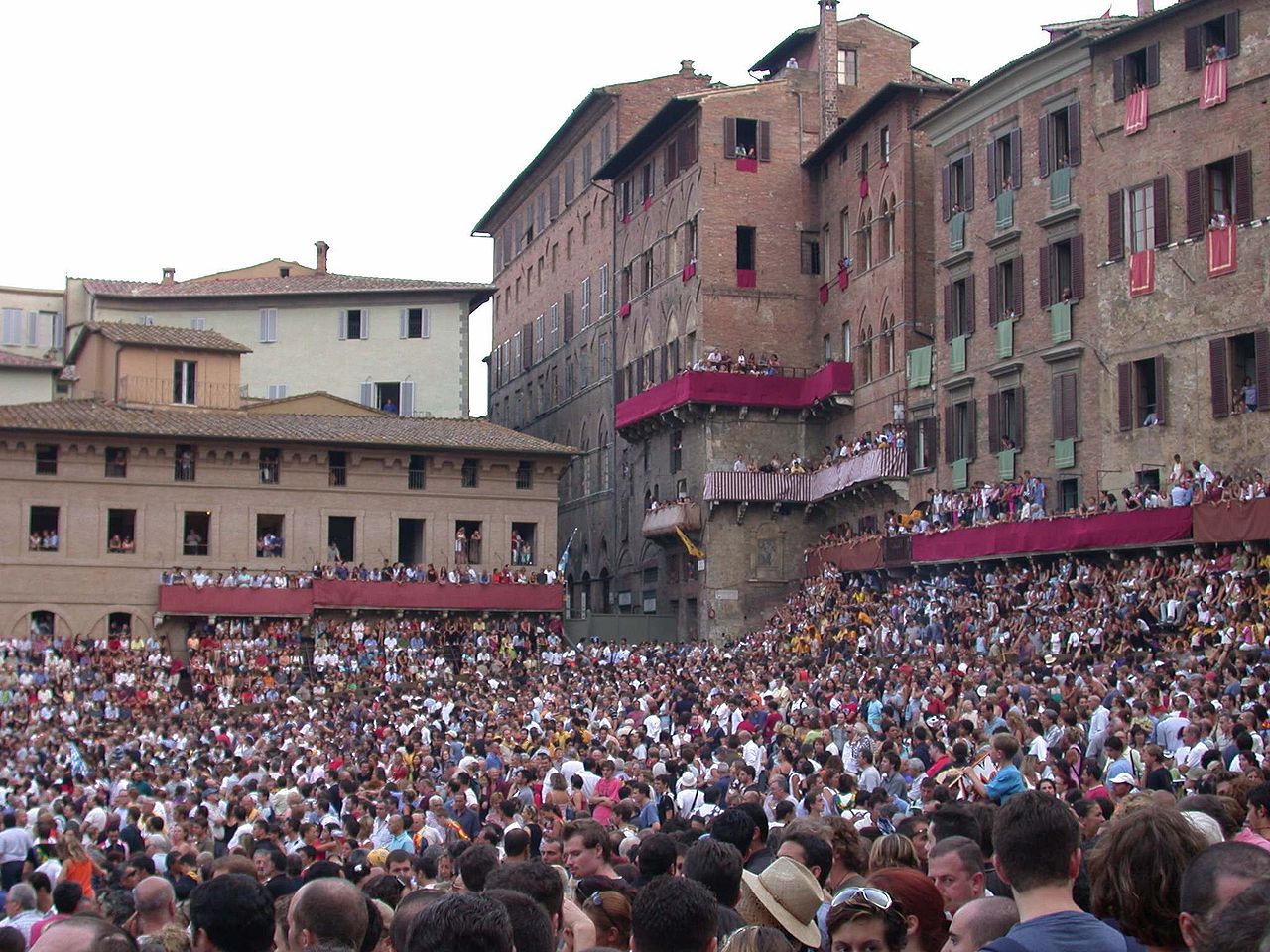
The Campo was dense with people. Thousands of onlookers, stood shoulder to
shoulder, in the center of the Campo, jostling to get a good view. Contradiaoli hung
out windows waving their contrada banners, while a blanket of citizens covered the
bleachers. The electric atmosphere forced me to step back and take a deep breath to
keep from falling into some Palio-induced manic state. I had never experienced such
an emotionally intense event as the Palio. Rival college football games did not even
come close to the energy displayed in that arena.
Suddenly, a hush came over the crowd, and trumpets blared a loud fanfare. From
our right came a contingent of carbinieri on horseback, all decked out in feathered
Napoleonic style hats and button fronted uniforms. They were granted applause as
they took one lap around the track in a slow trot, and then completed a second lap at
full speed. Shortly after they exited the Campo, the sound of snare drums began to
echo in the piazza. A number of standard bearers preceded the battery of drummers.
Following the drummers, were trumpeters, who once again began to blare out a
traditional march — The Squilli la Fe’, Marcia Del Palio announcing the beginning of the parade.
For the next hour or so, a multitude of medieval costumed participants made their
way around the Campo. Alfieri from each contrada stopped before a small stage of
judges to demonstrate their skills. Contingents of armored swordsmen, archers,
lancers and cavalry paraded before the crowd. Robed clerics swayed in procession,
along with pages attending their masters. Chaparon topped men, and women of
nobility in long velvet dresses, merchants, artisans and guilds proudly showed off their
finery. I later learned that the clothing was all hand made and stored in a magazzini del
sale’, until the next Palio. Throughout the year, seamstresses repaired and refitted the
clothing. Near the end, the competing horses were exhibited to the public, each with a
sash representing the contrada for which the horse was racing.
Finally, the Carroccio, a large wooden wagon pulled by four white oxen appeared.
It is another holdover from times of war, when the wagon held the signs of cities
contributing to the war effort. It was a rallying point, and was guarded by the bravest
of soldiers. For the Palio, its primary function is to hold the Drappellone, a silk drape
that is the trophy for the winner of the race. Each year the Carroccio holds a newly
designed banner. Following the wagon, a line of alfieri, representing all of the contrade, lined up along the front of the Torre de Mangia. At the blare of nearby trumpets, they began to wave and toss their flags for a short period of time.
Once the parade ended, a hush came over the crowd. After a short spell a loud
boom sounded, announcing the beginning of the race. Jockeys on their horses
emerged from a side passage. As they come out onto the Campo, they were handed
their Pene di Bue. A huge roar emanated from the crowd. The horsemen slowly
trotted towards the mossa, or starting line. A lottery determined a horses position on
the mossa. However, one’s position also depended on that elusive “influence”. The
tenth horse (Rincorsa) held back behind the others, determined the efficacy of
influence. As the riders jostled among themselves, the rincorsa decided the optimal
time to begin the race. He initiated the start by suddenly racing forward towards the
other horses.
Tony and I applauded and cheered as Stefano came out onto the course. His bay
horse looked magnificent. The riders mingled about until an announcer called their
name to the starting position. He called Torre fourth. Stefano rode in to the line of
horses at the mossa, and began turning and bumping into others as he vied for his
position. It took about 10 to 15 minutes of maneuvering among all of the horses
before the rincorsa made his move. Determining the optimal advantage, the rope was
dropped and the rincosa leaped forward.
Despite the simplicity of the shape of the racecourse, it is deceptively dangerous.
The course has a high and a low point, as well as two dangerous sharp curves; one at
San Martino, the other at Casato. Coming into the curve at Martino the raceway
begins to decline. At Casato the course begins to incline. While accidents occur at
both turns, the San Martino curve tends to garner the most, and the more serious.
Stefano, quick out of the starting gate, began the first of three laps. Slightly ahead
of him to the left galloped his nemico, Orca. Directly behind him followed the
Chiocciola horse. As they came into the first turn at Martino all three horses began to
slow, allowing the others behind them to catch up. As a result, the riders went into the
turn as a group, resulting in a couple of horses ramming into the outer wall and
stumbling, as they tried to avoid the Cappella di Piazza, which juts out, narrowing the
track, and limiting how many horses can pass through. One rider lost his grip and fell
off his horse, leaving his steed to go it alone. This did not mean he would lose the
race. This odd idiosyncrasy of the Palio allowed a riderless horse to continue to run,
and if it finished first, the owning contrada would win.
Coming out of the turn, Stefano and Orca competed neck and neck for the lead, as
they headed along a straight stretch of track leading to the sharp corner at Casato.
Chiocciola lost ground in the turn, and was now lagging farther behind with the rest of
the riders. Rounding Casata, both horses butted up against each other in an attempt
to gain an advantage in the turn. Orca closed in on his right, so Stefano actively used
his right hand to whip against the Orca jockey, flogging the jockey’s hands and reins,
as he pushed Orca up against the inside corner of the fencing. The Orca jockey had to
pull up a bit to be able to round the corner. Now out front, Stefano headed down the
fastest leg of the race; the broad curve that allows the jockeys to run their steeds at full
gallop. The speed of his horse and his training, were now paying off, putting him even
further ahead of Orca.
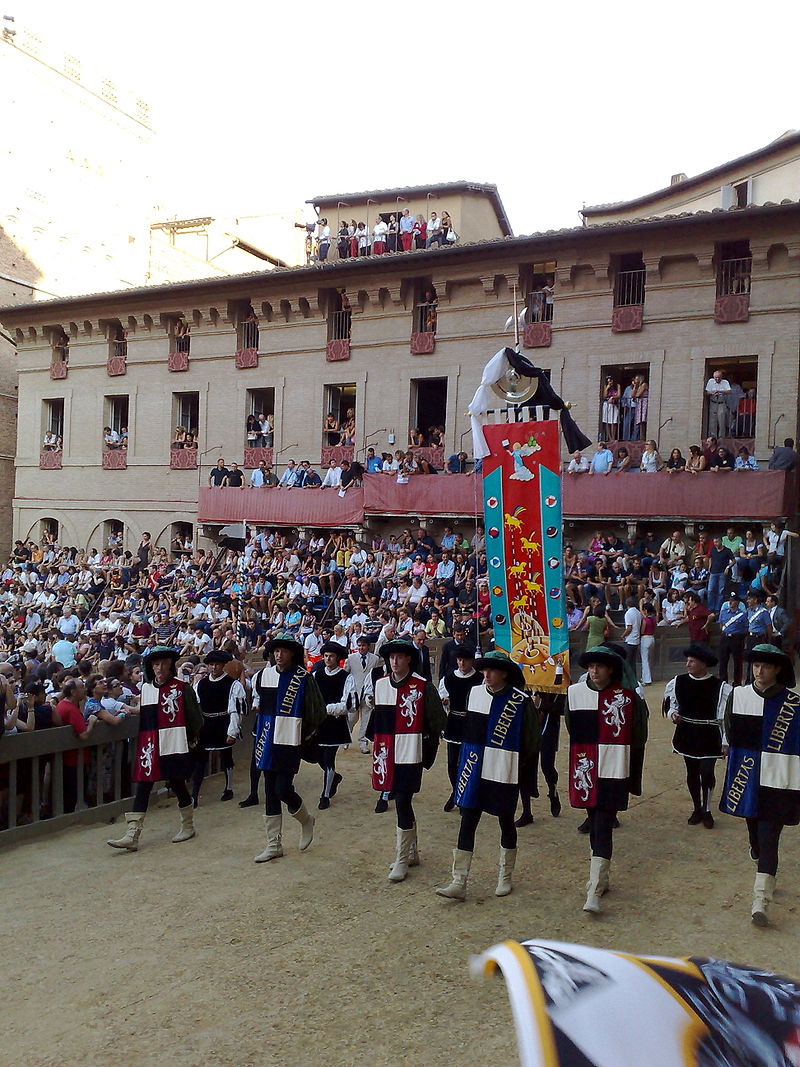
As Stefano pulled into St. Martino for a second time, he had no competition to stifle
his turn. However, Orca closed the gap, and remained a close second. By the time
Torre managed the Casato bend, Orca closely tailed him, and began to catch up as
they rounded the wide turn for a second time. Stefano managed to keep the lead until
he got to Martino, where he took the turn too wide and bumped into the outer wall,
slowing his pace. This provided Orca the opportunity to take the lead.
With Orca now in the lead, Stefano pulled out all the stops. He beat the rear of his
horse with his whip, and caught up with Orca just as they entered the Casata turn. The
horses’ flanks now pressed hard against one another. The nemici approached Casato
neck and neck, beating the heck out of each other as they rounded the last turn
towards the finish. With the end of the race in sight, the noise from the frenzied crowd
rose to a deafening level. Just ahead of them lay the finish line. Stefano once again
relied on his horse’s speed, and began whipping frantically. Slowly, Torre began to
edge out Orca, and by the time they got to the finish, Stefano led by a neck.
Several loud booms went off announcing the climax of the race.
The crowd of Torre contradiaoli rushed to their hero. The fans overwhelmed
Stefano. They all wanted to touch him, hug him, kiss him and even grab a piece of his
clothing. Eventually, Torre guardians came forth and surrounded him, allowing him to
dismount. Gangs of people took smart phone photos of Stefano and his horse, as he
made his way though the masses. Torre contradiaoli removed the Drappellone from a
nearby balcony, and hung a Torre fazzoletto upon the staff of the banner. They then
paraded it about the Campo to be touched and kissed by members of the contrada.
The celebration in the Torre contrada went on all night, and into the following day.
A dry spell broke, and Torre, once again was victorious. Additionally, they edged out
their rival, Orca, which made the victory even more significant for them. Tony and I
celebrated with them into the early hours of the morning, and Torre contrada would
continue to celebrate for months to come.
The next afternoon, we both napped through most of the plane ride home. The
incessant sounds of numerous bell towers pealed out Torre’s Contrada’s victory
throughout the night, and kept us awake. The stewardess woke us with her
announcement of lunch. We conversed about the past day’s experience, and Stefano’s
victory. We agreed that the trip was well worth it, and we had garnered memories of a
lifetime. At one point my curiosity got the better of me and I had to ask, “Were you
able to say goodbye to Maria?”
“Maria? Maria who?” Tony responded.
Short story from Santiago Burdon
Naked Truth
“Famous isn’t good for a writer. You don’t observe well when you’re being observed.”
Ken Kesey
I mentioned to a poet friend of mine, one of the few I respect, if he believed a writer could consider himself a success by the amount of nude photos of women and surprisingly a few men are sent to him.
I’m not sure how to measure my efforts as a success or as a failure. My point of view is if I am doing what I’ve always wanted to do as a profession, then I have achieved success.
I’ve mentioned my somewhat modest expectation to others when discussing the subject and it has received a variety of comments. But the comment that has been most popular is; “Bullshit! You can’t tell me you don’t want your book to be a best seller or have your books made into movies and make a shit load of money. Come’on, everyone wants to be famous and I’m not talking the Warhol fifteen minutes kind.”
That would be a wonderful perk without a doubt but it is not my reason for being a writer. I sincerely am not concerned if what I write is accepted or rejected. Rejection letters are just fuel for my creative fire. I selfishly write for myself not for an audience. Twisting your prose to fit the perimeters of an audience is a fucking trap without any hope of escape.
A true writer knows this predilection is actually a curse we’re born with. It manifests in our souls, with an insatiable need to be recognized. I described a writer in a poem written years ago.
“A Poet is an Artist that paints in darkness
Words of the poem are colors creating light
A Writer is blessed with all of the answers
Cursed with the search of which questions to ask.”
It’s the first time I’ve directly quoted myself.
“Okay, but get back to the naked pictures, will ya. No one is interested in this boring literary mumbo jumbo.”
Who said that? I was just thinking the exact same thought. Now that is an incredible phenomenon.
So I’ve been receiving what I consider a large amount of nude photos on my WhatsApp, Facebook, Instagram and Gmail accounts and have become curious about its relevance in determining my success as a writer. I’ve researched the subject to investigate if other writers have experienced the same anomaly. I haven’t discovered any mention of it being so. I surely can’t be the only writer out there that has received this type of appreciation in response to their work.
I don’t write erotica although I’ve described brief moments of sexual activity in some of my stories.
So my poet friend said he’d get back to me, it was something he had to think about. Although I judged him as an accomplished poet, he turned out to be an unreliable counselor. He would’ve made a terrible bartender without the ability to give advice. After a week I contacted him to ask if he had made a decision concerning my question. He first apologized and then started laughing, commenting he didn’t think I was serious. He believed it was all a joke, a setup or research for a story. Now I had his complete attention after convincing him my question was authentic.
” In order to make an educated decision I’d need to look at the pictures. Do you think that could be possible?” He inquired.
” I’m not sure how seeing the photos would help in determining an answer to my question. Besides, all the senders asked me to keep them private and not share them.”
” How many photos exactly have you received? Are the women totally naked and can you see their faces?”
“I guess close to twenty five including the three photos of men.”
” Were there suggestive messages with the photos? Also, are you sure they were sent in response to your writing? Are you on some type of dating site?”
“Yes, some included sexual messages. Most mentioned my poems and I’m not on a dating site. So, what do you think?”
“I rarely receive more than fifteen comments on my poems when I post them.” He said with a sarcastic tone. “So I’m going to conclude yes, it does have a relevance in determining your success as a writer. Although, the most viable explanation is that your poems appeal to a unique audience of sick, twisted and perverted readers.”
The phone hummed a dial tone without a goodbye.
And I thought; What was with the Dutch uncle’s attitude? Why did he say it like it was a bad thing?
Poetry from Jeff Bagato
 Feasts of Mushroom Plenty

 Put down the musket, put down the hoe,
 put down the marketing bag
 and take up a life of crime
 against the workaday grind
 plowing trenches across lifetimes and souls;
 the sun rises only once,
 but the moon rides on forever,
 dusting silver light down
 upon all the roads to freedom,
 and joy and that kind of mushroom plenty
 to feed the millions now wandering
 among the trees

 What looks like doom through TV eyes
 evaporates to mist and shadows
 and the ghosts of blind accountants
 and the technocrats of soulless dread

 Let the moonlight shine in!
 Let the mushrooms grow!
 Sit back on a twilight lawn
 and watch foxes, deer and bats
 teach the ways of the night
 at the borders of the lingering,
 remembering mind—
 the morning birds all died in the heat,
 and the early fruits withered on the vine,
 while creatures of the shadows
 hold feasts of wine and love
 and endless time
A multi-media artist living near San Antonio, Jeff Bagato produces poetry and prose as well as electronic music and glitch video. He has published nineteen books, all available through the usual online markets, including And the Trillions (poetry) and The Toothpick Fairy (fiction). A blog about his writing and publishing efforts can be found at http://jeffbagato.com
Jaylan Salah Interviews Egyptian Film Director Amir Ramses
Romanticizing Decaying Cities and Embracing the Other
Conversations with Egyptian Director/Auteur Amir Ramses
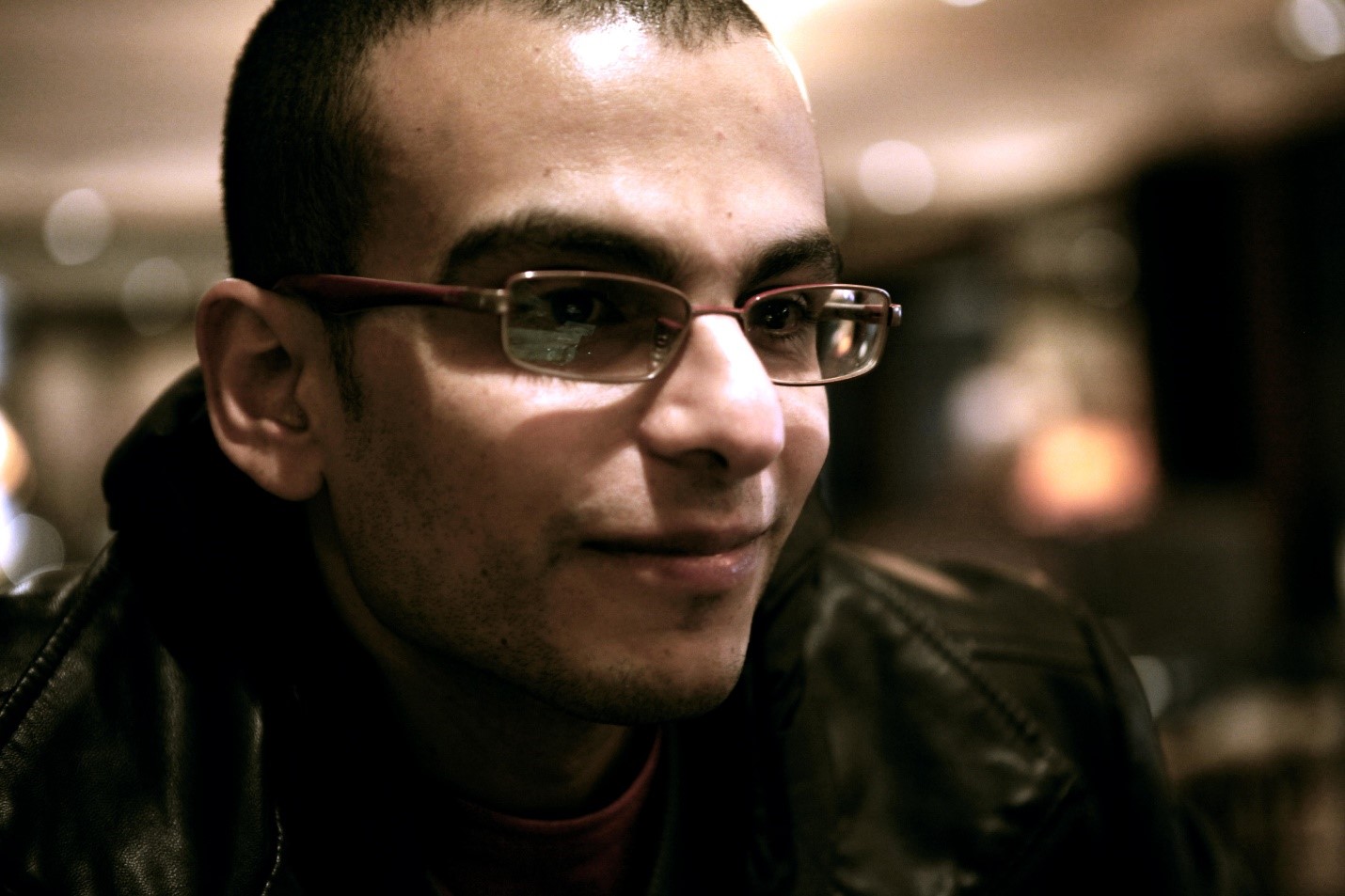
(Amir Ramses)
When I think of a film director, the stereotype always comes to mind, a neurotic heavy smoker, who speaks incessantly, is socially awkward, and has a fascination with beautiful muses.
Take all that and throw it aside, and witness Egyptian director and auteur Amir Ramses. Ramses studied filmmaking at the Higher Institute of Cinema and worked as assistant director for 5 years with the legendary director Youssef Chahine. He directed multiple short films, documentaries, and features; wrote one novel Song of Songs published in 2010.
Mind you, physically he’s a mix of Woody Allen and Youssef Chahine, but when it comes to his personality, Ramses is the extreme opposite. No stuttering or neurosis, Ramses carefully picks his words, dodges unwanted questions, and navigates his way through the interrogative interview like a pro. His directing style is heavily influenced by what the former two had on him,
“Personality-wise, I am a very demanding director with an attention to detail that sometimes comes as bossy. I see things in a certain way and expect everybody on a film set to see them that way.”
His infatuation with Allen’s dark humor, hopeless romantic males falling for stunning girls in the Big City is obvious, but his string of complex relationships and his interest in the humane side of people and relationships are owed to his work as an assistant director to Chahine who might have given him a deeper outlook on what was at the core of the modern world of relationships in Egypt,
“When it comes to sense of humor, I love sitcoms especially older ones. But I believe that my sense of humor is closer to Woody Allen than any other artist. For example, I love Seinfeld but I find the show’s sense of humor cruel on its characters. My preferred sense of humor is much more empathetic and kinder toward its characters. Woody Allen is the one who comes to mind when describing this trope, even when he makes fun of his characters at the end of the day, he loves them so much. I use the sense of humor in my works as a defense mechanism against the stupidity and cruelty of society. I believe that there are things in life that you cannot express openly without getting in trouble unless you use it in a comedy sketch.”
Does he refer to his spectacular feature Cairo Time an enjoyable drama set over a single day and showing a subtle connection between unrelated characters, only connected through a thin red line of how humanity conquers fear, prejudice, and aggression?
“Woody Allen has been the main inspiration for Cairo Time. The scene inside the girl’s [a girl who wants to have sex with her boyfriend but is afraid because of societal sexual restrictions] head is very Allen-esque, completely absurd, and over the top. I used 3 shots only to construct the scene and relied on the bizarreness of the cop character [played by renowned Egyptian comedian Bayoumi Fouad]. In every shot, I left a space for the actors’ body language and movement. It had the longest, establishing shots throughout the whole movie. Another thing that made this scene stand out was the actor’s improvisation. I know a lot of directors don’t like that but I enjoy actors’ improvisation during rehearsals. Fouad was very creative in this [improvisation] and helped to add layers to his character.”
I had to ask Ramses why improvisation scared off some directors to which he replied that it was not a controlled environment.
“You are not just talking about the character but the rhythm and the pace of the scene and how to fit that with the changes that the actors make. Some actors are great with their creativity but their improvisation is uncontrollable within the scene tempo.”
If there was anything that Ramses learned from Chahine, that would be how the Other might not be that scary if only people learned how to listen and communicate. In one of the interconnected stories in Cairo Time, the character of Layla -played by legendary Egyptian actress Mervat Amin, known for her stellar beauty and sex appeal in the 70s- opts for a conservative lifestyle, denouncing her art and her past accomplishments as an actress. This is no strange to what happened in the entertainment industry in the early 90s when a group of actresses wore the Islamic head covering (hijab) and announced they were born again, away from their superstardom which was lustful and sinful. Layla in Cairo Time represents this kind of thinking, and in her quest for redemption, she hears a fatwa -a nonbinding legal opinion on a point of Islamic law- that states how women who get married on the screen are married in real life, thus should seek divorce whether they intend to get married again. And that’s what Layla does, she seeks divorce from one of her frequent past costars, Sameh -played by another legendary Egyptian star and TV personality, Samir Sabry- and that’s when tensions spark,
“Without expressing that in a comedy, that particular subject matter could have earned me an accusation of Blasphemy. Instead of criticizing this fatwa -which took place in real life- contextualizing it in a comedy made it more approachable and acceptable by the audiences, who found it the source of ridicule rather than grim seriousness.”
اعلان فيلم ” بتوقيت القاهرة ” 2015 || سمير صبري، نور الشريف، ميرفت أمين – YouTube
Ramses’s Cairo Time was his tribute to two things; the city, and the golden era of Egyptian cinema, through a set of characters that he carefully sketched. Despite all being of a certain age, Ramses was not interested in tackling a non-conventional age group for a movie audience that has been used -especially since the 2000s era- to watching only youthful faces leading films on the big screen,
“I was more interested in the meanness of the city and how that affected my characters. They have all been people betrayed by an old glory, thwarted off to islands rather than taking the front of the city in which they grew up, all because of their age. Whether Layla who gave up her acting career and that made her angry at her past or Sameh whose past caught up to him after he lost his movie star glamour and became a forgotten so-called legendary actor, living in total denial of that fact. As for Yehia, his memory betrayed him and that led to his feeling of isolation in the city. I’ve had this obsession with the power and withdrawal of memory, the ability to retain our stories or feelings after the memories are gone, and reflected that through the character of Yehia. The same goes for all the young characters. I believe they were all victims of how cruel the city is and what it does to our souls. The young man is obsessed with stories about himself and how they give him greater pleasure than his real life. The boy and girl want to have sex but society is suppressing their desires by forcing a moral and emotional compass for them to live through. Their stories reflected what I call the societal castration of our ability to love.”
Multiple themes could be traced in Cairo Time among them was amnesia and our relationship with whoever we deem “different” from us. One of the master scenes in the film was when Yehia -whose memory was decaying throughout the film- pretended to forget his daughter to set her free from his collapsing world,
“In this scene, I was intent on framing actors’ eyes. Eye contact or the lack of it was my focus point while shooting it. Dorra’s [the daughter] eyes following her father all the time. Yehia talking and avoiding eye contact with his daughter at all costs. I shot it in extreme close-ups and depended on a very sensitive scale from both actors, when to look and when to steal a glance. The scene that preceded it was all long shots, but this one was a group of extreme close-ups brought together to form an emotionally charged scene. The framing was very tight. Although the place was spacious, I wanted to block the way for both characters to give the feeling of entrapment. The main take from this scene was not the dialogue but how their eyes stared, looked away, and glanced.”
The character Yehia in Cairo Time is named after one of his mentor’s Chahine’s iconic alter ego Yehia Shokry Mourad, an alias that Chahine used in multiple films to represent a fictional version of himself. In his film Ramses pays homage to the master Chahine through the portrayal of Yehia using the same name, the character was even played by late actor Nour El Sherif who portrayed Yehia Shokry Mourad in one of the original Chahine movies, An Egyptian Tale,
“My favorite Chahine directorial phase was the pre-Emigrant era starting from Cairo Station and so forth, specifically the films that have a running theme of accepting the Other, our ability to understand the difference, and how we relate to others different from us. The Other might not have the same desires, moral codes, cultural backgrounds, or interests but we still have to accept them as we would like to be accepted. This was a recurring theme in Chahine’s films and one of my artistic obsessions as well, even in literature books that discussed these themes were my favorites. I believe that my documentary Jews of Egypt has been made through the same lens of understanding the other.”
Jews of Egypt – عن يهود مصر – YouTube
Jews of Egypt is a big story. It was one of the most well-received Egyptian documentaries in the past decade, opening the door for multiple ripoffs and works of art that tackle the same topic -but mostly from a less in-depth lens. Ramses followed his subjects all over the world, chasing the remaining Egyptian Jews and attending their ceremonies, investing himself in their lives to give us a lengthy documentary divided into two parts: one follows Egyptian Jews in the first half of the twentieth century until their second grand exodus after the tripartite attack of 1956 and the other Jews of Egypt: End of a Journey examines the lives of the last remaining members of the Egyptian-Jewish communities. But that’s not all that Ramses learned from the Egyptian francophone auteur,
“It’s hard to pin what I learned from Chahine, but mainly the ability to enjoy what you are doing, regardless of the results. Before working as an assistant director with Joe, making short movies and such, I used to care about the end product, and what people might think of them. After working with Chahine, I learned how he “made” films for the sake of the process, not what the results will be. Chahine also, like me, adores his actors. Even the ones making minor roles are seen through a lens of love and compassion. He cocooned his actors with protection that almost seems sacred on set, which bothered as on a technical level -how we catered to actors’ moods and whims as per Chahine’s orders. His movie sets were never a source of nuisance or stress. Yes, sometimes he lost it and got angry but even then, he knew when and how to do it.”
Among his many recurring themes, Youssef Chahine’s infatuation for my hometown, Alexandria, was undeniably omnipresent. I asked Ramses whether this was also a prominent motif in his films,
“I believe that Alexandria is omnipresent in my films as well. Cairo Time starts in Alexandria; I consciously chose to make the main protagonist Yehia Shokry Mourad from Alexandria. In my first feature The Edge of the World, the main plot takes place in Alexandria, and people enjoyed how I shot the movie there. What I love about Alexandria the city no longer exists in our present but has become a part of our past of how we perceive the city. If I were to make a movie about Alexandria, I’d make certain creative choices that would be impossible to achieve visually with the current resources. It would be a fantasy film and need big budgets in terms of graphics and production design to tell the tale that I love. I’m not sure whether this modern version of Alexandria would be plausible to use as the background for the tale I have in mind to honor the city of my dreams.”
Ramses is very tactical. He carefully works the question in his mouth like a rolled cigarette and lets out few, careful puffs. He doesn’t use his words in vain, always concentrating on making himself as clearly understood as possible. Although most of his films were female-centric, definitely passing the Bechdel test, and filled with genuine female narratives, Ramses doesn’t see himself as a feminist director nor does he express a certain yearning to work with a particular actor, unlike many auteurs back in the time such as Youssef Chahine and Yousry Nasrallah, he doesn’t have a muse of sorts,
“I don’t like labels. I don’t see myself as a feminist director, I never put gender as a conscious artistic decision. I believe that the human is oppressed in the society regardless of their gender. I only tell stories that interest me without putting in mind that I want to glorify a certain gender or let it win at the end of the tale. In this corner of the world, women could be more oppressed than men, but at the end of the day, men are also oppressed. I’m more interested in people, although I won’t deny that women are prominent beings in my obsessions, infatuations, and even nightmares. But I’m mainly interested in the story rather than picking a gendered story specifically to tell.
“There is no particular actor with whom I prefer to work with. I believe that every director needs to work with a variety of actors throughout his directorial career. Sometimes even in the same project. Some mental actors approach a character through their analysis and mindsets, others are pure emotions. How you orchestrate that is the core of a director’s work. I hate the term “leading actors”. It’s a communication process that I immensely enjoy. I adapt to communicating with both kinds of actors as I believe this is a director’s job.”
الإعلان الرسمي لفيلم حظر تجول | Curfew Official Trailer – YouTube
Ramses’s latest film “Curfew” also takes place in one night during the period of a state-imposed curfew in Egypt in 2013; starring legendary 90s sex bomb Elham Shaheen as a mother trying to reconcile with her daughter -played by top-billed actress Amina Khalil- while hiding a dark secret of her own. The film was bold in condemning a taboo subject in Egyptian society; pedophilia and incest. While recording this interview, Ms. Khalil was still a star on the rise, now she has become one of the most revered actresses of her generation, tackling different subjects in her art such as ADHD and female liberation from familial confinement, I had to ask Ramses on the process of creating Curfew, how he viewed Khalil and Shaheen as actresses,
“Curfew was a challenge for me to shoot because it depends on two women trapped in a single place. I tried to make the presence and the environment dominant throughout the movie to encapsulate the audience’s feelings of entrapment, but in the frame, we follow the actresses around. I used wide lenses and the camera was handheld, following the two actresses around as if it was part of their skins. I wanted their features to look realistic and not beautified. The actresses were not posing in any scene. The technique has been harnessed to give the actress the space to not disconnect from their stream of feelings. At the end of the day, Curfew is an acting game more than anything else. Sometimes when you are directing a movie, you might think of something that would look pretty but on the ground, it wouldn’t be suitable for what you have in mind. Curfew is not about breathtaking frames, but the claustrophobia that these two women live together. This was what I aimed at visually. Lighting was another important element and I made sure to have areas of darkness in every frame. Doors and windows were their “acting out” moments.
There’s a spark in Amina [Khalil] and that is her flexibility. She knows how to listen to the director and can come to rehearsals and table reads with her ideas and input. She could in a second take her acting in another direction if you suggest it to her without letting her old thoughts about how a scene is made get in the way. She is not stagnant and her ability to adapt is mesmerizing to me. I saw this in the first rehearsal that we made together. I came out of it [the rehearsal] in awe of Amina. I have never seen an actress able to get rid of their thoughts and intricacies about a character that easily and that was a pleasant surprise for me.
Elham [Shaheen] was a great choice in the role of a mother. She is the only actress I can think of who lets her inner artist triumph above all other considerations. I always compare her to actresses from her generation and even the later ones who are more obsessed with their societal image, maybe social media or the talk shows have caused this to be a major issue but still actresses are always thinking about how their characters would appeal to audiences, whether they would be criticized for playing them, how they would look and what their physical appearance would play into the role. That’s not the case for Elham. She loves the character and plays it as it is. Working with her is smooth. She broke every one of my obsessions and fears regarding the actor’s comfort zone concerning how they look on screen. She has always been bold enough to go wherever the character went, regardless of how that showed her in the real world. She doesn’t put herself as a celebrity on a pedestal and doesn’t care that she looks beautiful on-screen if the role was [like in Curfew] that of a battered, long-imprisoned woman. She doesn’t think of how people would receive the movie because, within its realms, she leaves herself to the experience.”
Death is a recurring theme in most of Ramses’s movies. In Cairo Time, the death of the wife is a catalyst for Yehia’s trip down memory lane. Curfew’s titular murder and the eventual suicide of Yehia Murad -another manifestation of Ramses’s muse Yehia Shokry Mourad as superimposed from his mentor’s original films- meets a tragic ending. Does that ring a bell for Ramses?
“I’m not obsessed with death. Come to think of it, death is absurd apart from aging or the [COVID-19] pandemic. Maroun Bagdadi -famed Lebanese director- died suddenly after an accidental fall down an elevator shaft although he had a lot ahead of him. Theo Angelopoulos -a late influential Greek filmmaker- died in a motorcycle hit and run while shooting his last unfinished film. With that aside, I don’t think I’m a director who has a project but I am a director who enjoys what he does. I prefer to die in the middle of the heat; while doing what I love the most. What horrifies me is the period of having established everything that I had in mind as an artist and living beyond that. I make movies as a way of feeling alive so the point where I would like to die would be any point in my career timeline, regardless of how far I’ve reached it.”
With the Egyptian cinema going through a high-tech phase of creating series of action/superheroes movies, Ramses is one of the few auteurs of our modern times. Just like you would never find his mentor Chahine shooting an action movie a la golden era of cinema style, Ramses is sticking to the same realm of cinematic verses with his focus on dramas and light comedies. I had to ask him whether it was a budgetary choice to remain in the zone he slowly dug a name for himself into or were there other artistic decisions to stir away from the big-budget mania,
“I can’t tell you whether there is a more difficult scene to shoot than the other. Yes, it’s difficult to shoot an explosion or a highly choreographed action scene that would take 5-6 days to execute. At the end of the day, I find what’s difficult is what I can’t control as a director. Action scenes are draining and difficult to execute but controllable. However, controlling an actor’s emotions, savoring their features and their eye contact is more difficult and cannot be compensated if the scene is spoiled.”
Ramses’s Facebook is overflowing with art; his preferred music, his dog, paintings, and movie posters. Among the films that he quotes a lot is the 1998 Lebanese war dramedy “West Beirut”, a film directed by Ziad Doueiri which we both share a keen interest in. As far as his sense of humor goes, Ramses was fully capable of creating a similar film, so I asked him why he hadn’t yet,
“The era of political correctness in which we currently live. Ziad Doueiri himself wouldn’t be able to criticize the war through this lens nowadays. Even his point of view has matured as can be seen in “The Insult” [a film directed by Doueiri in 2017] and yet the liberty of expressing how you see the world as an artist has changed in the time of political correctness.”
Wong-kar Wai, legendary Hong Kong director is another great source of inspiration and obsession for Ramses, and I had to nag him to direct a romance along the way of rich colors, stellar soundtracks, and observant cinematography. His seriousness and tactfulness cracked as he replied playfully -probably for the first time since we started the interview,
“Get me a project like “In the Mood for Love” and I’ll do it in a second.”
Synchronized Chaos September 2021: Coming and Going

Welcome, readers, to September’s issue of Synchronized Chaos Magazine. This month’s submissions invite us to consider our trajectories as individuals, social groups, or even as a species inhabiting the planet.
Some philosophers and social theorists see the development of civilization as a forward march towards greater moral and material progress. Others view how human societies develop over time in a less linear way. To them, societies take some steps forward and some backward, and sometimes make changes that are just changes, not advancements or declines. And others see societies as capable of simultaneously advancing in some areas yet declining in others.
This month’s contributors ponder where we are moving as individuals or as larger societies. Where have we come from, and where are we going?

Lorraine Caputo writes of trains in Mexico, how they can bring reunion as well as separation. Robert Thomas provides cultural commentary and observations through the lens of two different restaurant dinners, and Sandeep Kumar Mishra writes thoughtful and poetic reflections on travel, exile, loss and the complex humanity of the third world and its residents. Kahlil Crawford outlines the cultural and ethnic history of the St. Paul/Minneapolis area. Ike Boat writes of a hardscrabble up-and-coming life as an artist in urban Accra, Ghana. Poet Mary Mackey interviews Sacramento (California)’s poet laureate Indigo Moor, whose recent collection Everybody’s Jonesing for Something explores the hope, dreams, death and injustice involved with the American Dream.
Mark Young and Charlie Robert intersperse bits of history into clever poems. Mark presents fresh mechanically generated pieces starting with ‘found writing’ in literary and non-literary texts, and Charlie Robert echoes American history with scat-like chant pieces.
Dr. Thomas Fink’s poetry considers what happens when we look at organic life and impose our ideas of what progress means, while Andrew C. MacDonald writes of rural life and the passage of time.

Some philosophers posit the existence of a ‘human nature’ that includes some psychological characteristics that stay relatively stable across cultures and throughout time. To them, people and societies face perennial questions and challenges. Several of our contributors speak to tensions that have been considered part of our nature.
Binod Dawadi encourages people to choose peace and tolerance over materialism, greed, prejudice and exclusion. Henry Bladon writes of the journey of death, physical death and soul-death through harming others. Christopher Bernard’s monthly installment of his story The Ghost Trolley presents through a childhood heroic adventure a conflict between those who seek a simple and humble life and those who wish to dominate and control others. Chimezie Ihekuna’s monthly screenplay preview showcases a drama about a corrupt business manager – and those under him who must choose justice or revenge. Z.I. Mahmud, in his monthly installment of his thesis on the works of Charles Dickens, illustrates how Dickens uses literary devices to advocate for humane values in David Copperfield.
Others among our contributors also speak to questions humans face and seemingly universal aspects of the human condition, but on a more personal and individual level.
Hongri Yuan, in poems translated by Yuanbing Zhang, uses imagery to evoke our pursuit of transcendence amidst our difficult and mundane lives. Jack Galmitz speaks to how we see each other and how we might wish to be remembered. Mahbub rejoices in various forms of love as a comfort during personal or political tragedies. R.P. Verlaine sings of love lost, memory, and remonstrance. Mike Zone writes of a man who loses, or gives over, part of his humanity through love and imagination, and becomes something other than himself.
Michael Steffen’s speakers have to decide whether to step out of their comfort zones to learn and grow, while Mark Blickley presents a man who rethinks his behavior. J.J. Campbell’s short e.e. cummings-esque poetic pieces look at the dangerous and dull places our minds can go when left alone. Elizabeth Hughes reviews Vincent Hollow’s poetry collection Swan Songs of Cygnus in her monthly Book Periscope column, which draws on astronomy and cosmology as a metaphor for the emotional journey of love and grief.
Sushant Kumar celebrates the hard work and devotion of mothers. As he reminds us, we all have someone who birthed and who raised us, we all come from somewhere.