Flag of the country
The place of worship is golden soil,
A hot spring is a healing herb.
The motto he always used to say,
The flag of the Motherland is sacred

My flag flutters in the sky,
Uzbek pride is the national flag.
Reflecting four different meanings,
The flag of the Motherland is sacred.

Clear skies and blue waters,
The reflected blue color is blue color.
My grandfather's soul is happy enough,
The flag of the Motherland is sacred.

Red color is blood
Green is characteristic of nature.
White is a symbol of purity, peace,
The flag of the Motherland is sacred.

We are the future of this country.
Our stars of tomorrow.
Let us raise the flag of this country.
The flag of the Motherland is sacred.
Murodova Muslima Kadyrovna is a student in the 6th “A” grade of the 30th general school of Jondor district, Bukhara region, Uzbekistan.
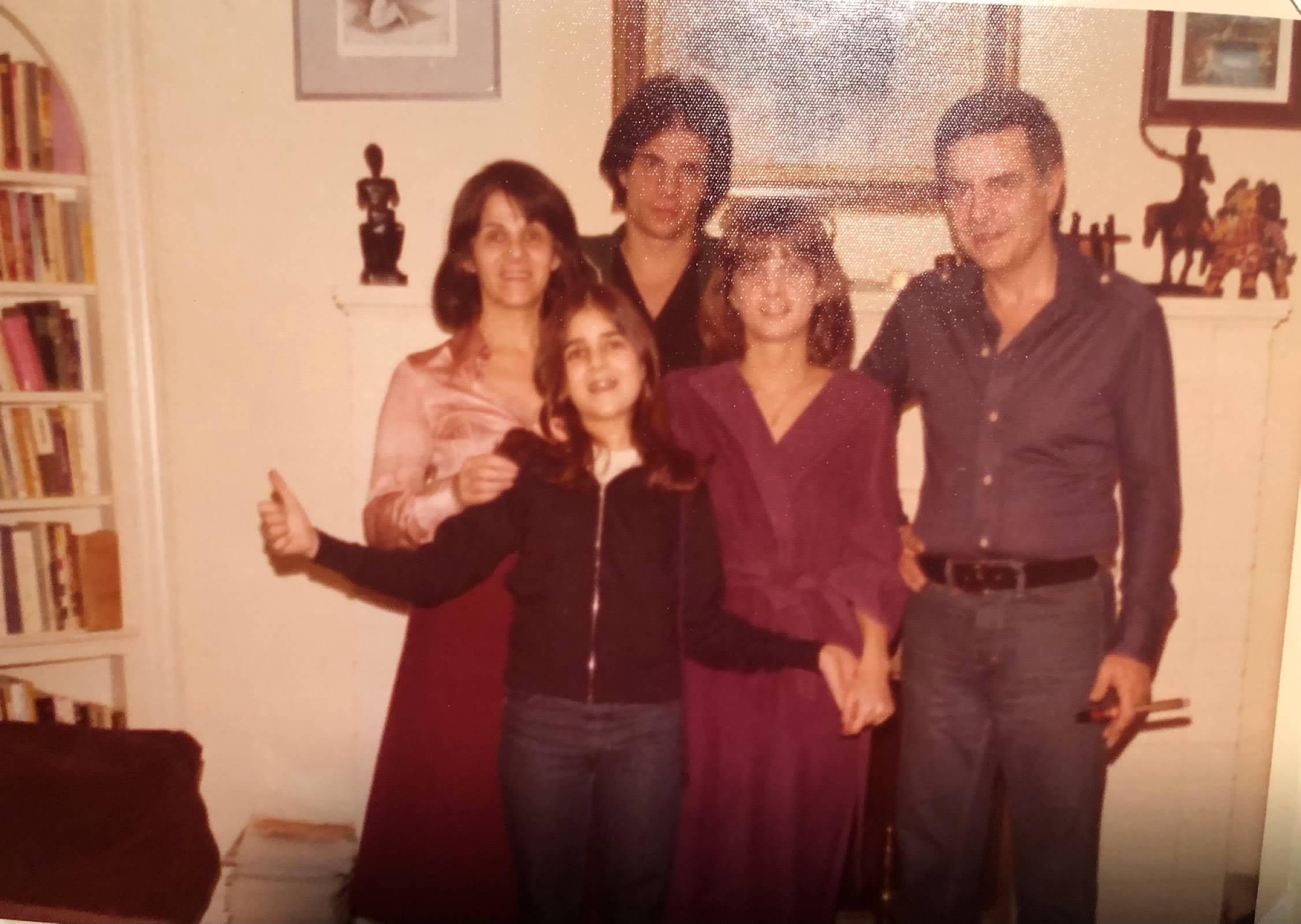
We had always been apartment dwellers. When my parents first arrived in this country, they lived on Amsterdam Avenue in the upper 90s, in a walk-up with other refugees as neighbors. Then they found an apartment in Forest Hills.
When I was born, my parents moved with my brother, sister, and me to a doorman building with a blue lobby in Kew Gardens. This two-bedroom was all I knew. My best friend, Claudia, lived down the hall, and Lucy, my babysitter, lived in an identical apartment below mine. Claudia’s parents worked for the airlines, so she was alone a lot, a latchkey kid. Lucy was the super of the building, and she was home all the time. My mom didn’t work, but she went to Queens College and then graduate school.
Mom played a game of tic-tac-toe with all the beds. Many times we switched rooms and reconfigured furniture to try to make it work. I stayed with my parents in their room till I was five. Then I shared a tiny bedroom with Debi, while Dorian slept on the couch or a vacated bed,
and my parents slept in their room. Once my parents slept in the living room so Dorian could have his own room for a while. Often we had visitors from overseas, and Debi, Dorian and I had to sleep on cots in the living room. This was especially fun for me.
My dad enjoyed apartment life, overheated, with a handyman available at all times. I liked being in a bustling household, sharing beds and being underfoot.
My mom wanted space. She’s the one who found the house. She had gone to her cousin’s for a card game in Forest Hills. She told me that the card table was by the front window. She looked
up to see a hand-painted “For Rent” sign on the porch of the house directly across the street. She said she excused herself from the game and slipped into her mink coat. She knocked on the door of the stucco house and talked to the owner.
A few days later, my family visited the house. It was old. We went upstairs single file, whispering. “It’s so big,” Debi said. “I love it.” I agreed that it was grand, with so much space. The backyard was big enough for me to do three cartwheels in a row on a diagonal. On the second floor, the bedrooms were all different, and we each called the one that we wanted. Still, I didn’t believe it was really going to happen.
Suddenly, my dad was on board to move. I never thought this would happen, ever. He was seated in an armchair in our apartment living room, and we were surrounding him. My family was animated. My world was starting to tilt.
Wait, I said. I don’t want to leave.
I’ll drive you to P.S. 99 every morning, said my father.
I’ll pick you up in the afternoon, said my mother.
Claudia can sleep over every weekend, said my father.
You can have your own room, said my mother.
We can get a dog, said my brother.
My bare feet were deep in the tan shag rug. I didn’t want my world to change. I wanted Lucy and Claudia in my building. I wanted my school to be across the street. I didn’t want my own room. I didn’t even want my own bed. I only wanted to sleep with Debi in hers. My universe,
the way I had known it for all of my eleven years, would crumble if we moved. I tried to say something, but when I opened my mouth, a sob came out, and once I started, I couldn’t stop.
We moved a few weeks later.
That night, we all went to bed in our separate rooms.
Debi shouted, Goodnight, Les.
Can I sleep in your room? I said.
No, she said
Maybe tomorrow? I asked.
Maybe, she said.
And then it was too quiet, and it was the first time I was alone. Goodnight, John Boy, I said.
My sister giggled. I heard Dorian laughing, too.
Debi said, Goodnight, Elizabeth!
Dorian said, Goodnight, Ma!
Goodnight, Daddy, I said.
Then my father joined in: Goodnight, Billy Bob. More laughter because it was really Jim Bob.
Goodnight, everybody! Mom said.
I stretched and pressed my toes into the wooden frame of my water bed, the smile still on my face, and went to sleep in a room of my own.
I can call you love

The last pulse of light is stubborn, at regular intervals
I can call you king from the foam of the sun.
or the premature eyes of the moon ...
The minutes before sunrise they are hieroglyphs ...
Is that I am, so vulnerable like the course of the foam that stays or breaks on the shore
I can call you love and kiss your feet or confuse you with a stranger
Don't tempt me with music that encloses the deranged image of the Grail and his train of suicide bombers
Because I am here, Flickering between heaven and earth!
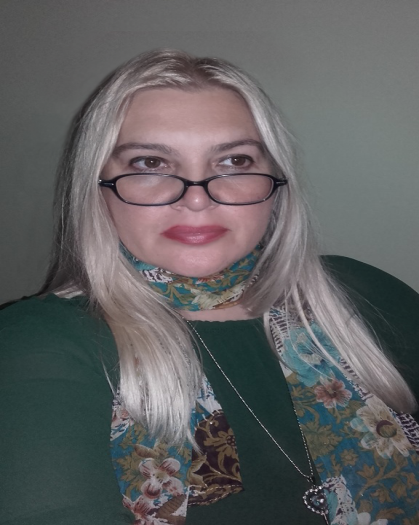
Graciela Noemi Villaverde is an Argentine poet/writer based in Buenos Aires. She has a degree in letters and is the author of seven books of poetry. She has been awarded several times worldwide. She works as the World Manager of Educational and Public Relations of the Hispano-Mundial Union of Writers UHE and World Honorary President of the same institution.
THE GREAT REPLACEMENT“Fox News Media and Tucker Carlson have agreed to part ways.” 4/24/23
Good-bye, Tucker. We’ll miss your giggle.
Who else makes faces on prime-time TV
while spewing rhetorical questions?
Who else waxes indignant
about Bud Light’s sales pitch,
Dr. Seuss’ fantasies,
Mr. Potato Head’s parts,
or “Green M&Ms go woke”?
Here are some of Tucker’s greatest hits:
#1 George Floyd died of a drug overdose.
(Blasted after the autopsy ruled homicide.)
#2 COVID-19 vaccine—Maybe it “doesn’t work,
and they’re simply not telling us.”
#3 During the 2020 election, there was
“meaningful voter fraud in Georgia.”
#4 Russian’s invasion of Ukraine is a “territorial dispute.”
Why take Ukraine’s side? Has Russia “killed your dog?”
Tucker pulls conspiracies out of hats,
recasting news as “us” vs. “them.”
From O’Reilly, Tucker inherited his populist schtick.
Like O’Reilly, the populism is fake;
stokes suspicion and fear in “common folks.”
But Tucker’s racism is genuine.
He feeds viewers raw chunks of white nationalism.
Talks about the “Great Replacement” theory,
a plot to replace Patriots with immigrants
who will vote to make America second-rate.
He’s a Fox News entertainer, not a reporter.
But is Tucker the character he plays on TV?
His e-mails cast doubt—
in private, says he loathes Trump,
but bows and scrapes in public,
flame-throws hot topics in a squeaky voice,
his face scrunched-up with disbelief.
Tucker was Kevin McCarthy’s chosen one.
Sole winner of the January 6 video footage,
expected to document the party line.
So he edited out door-bashing,
cop-smashing,
office-crashing--
what viewers of real news stations viewed
with horror and dismay.
Tucker spliced snippet that showed tourists
milling about peacefully. Respectfully.
See? They’re trying to frame Proud Boys and Q-Anon.
It’s them against us again.
But January 6 was ignited by Fox and friends.
Weeks and week of trash-talk—
Dominion voting machines skewed election results,
stole the election from #45.
Fox hosts knew these claims were baseless,
dished out conspiracy anyway,
night after night,
to feed viewers’ outrage,
and maintain ratings.
So Dominion sued.
Fox had to pay big bucks: $787 million.
Someone’s head must roll!
“We’ll be back Monday,” said Tucker--
unaware of the sword of Damocles over his head.
Fox took a page from its own script--
adapted the “Great Replacement” theory.
Replaced Tucker.
Good-bye, Tucker. I’m trying not to giggle.
Copyright 4/2023 Patricia Doyne
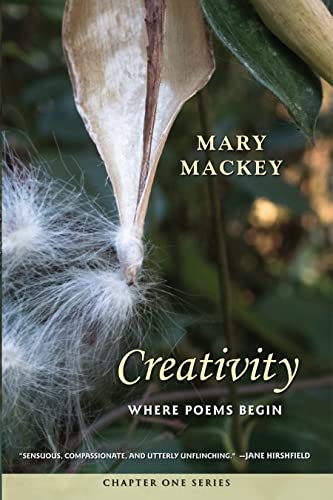
The greatly talented Mary Mackey’s slim but profound and beautifully written book has a slightly disingenuous title. If you are expecting a scholarly exploration of the creative mind such as you will find in Arthur Koestler’s classic work The Act of Creation or Silvano Arieti’s Creativity: The Magic Synthesis, you may be disappointed. Or if you expect something like those works but focused on literary creativity, you may also be.
But what you will get is just as worthwhile. I can see why Mackey did not call her book “My Creativity: Where My Poems Begin,” because, though no sufferer from imposter syndrome, she is too courteous toward her reader to thrust her ego unapologetically into the foreground. Even the most brilliant writer realizes that the world does not revolve entirely around her. But the revised title is an exact description of what we find in these pages.
That Mary Mackey is not better known is a bit of a scandal, because we are in need of her eloquence and originality. But I have long given up on the taste of the public and many of its would-be literary critics – eloquence and originality have been replaced by vulgarity and imitativeness (and aesthetics has long been replaced by politics) as the keys to success in contemporary America, may the gods and the Muses forgive all of us.
Unhappily, even posterity cannot be entirely depended on to have taste, intelligence or judgment. If Darwin rules, we can hardly expect natural selection to be wiser or kinder than we have been. And contemporary culture is beginning to look more and more Darwinian with each passing season. In the meantime, a few lucky readers will benefit from her books. And this is one of the gems among them, and is likely to ignite interest in her other books.
What, after all, is this nebulous thing we call “creativity”? Every time we speak we are engaging in a creative act, as the linguist Noam Chomsky regularly points out. We invent an original response to every event that happens to us – every moment is fresh, novel, unrepeatable, however boringly familiar it might seem to our half-asleep minds and benumbed senses. Every night, every dreamer creates a new universe.
But there is a hierarchy in creativity: though there is clearly a relationship between them, there is also a qualitative difference between this kind of creativity, shared by all sentient beings, and the creative leaps that result in the discovery of relativity, the painting of Les Demoiselles d’Avignon, writing Ulysses, or composing Bob Dylan’s anthems from the ‘60s.
Or writing a book like Mary Mackey’s prize-winning poetry collection The Jaguars That Prowl Our Dreams or her other collections (which include Skin Deep, Sugar Zone, and Travelers With No Ticket Home) and her densely poetic novels such as Immersion, A Grand Passion, and The Valley of Bones.
There is another difference: most successful artists, grateful for their creativity, or merely taking it for granted (and perhaps afraid to look too searchingly into a gift horse’s mouth for fear the horse will bolt at reason’s first cool poke), they revel in its fruits but don’t make a quest to discover its sources. Mackey is not satisfied merely to enjoy her gift; she has decided to try to find out where it comes from, what causes it, how she has become to be so graced.
And the result is this memoir of her creativity.
It has often been said that the most valuable gifts often come in small packages, and many a short book holds more substance than a far weightier tome. The saying surely applies here.
To say that Mackey has found the ultimate source of her phenomenal gift – the source of the Nile, the Higgs boson that transforms chaos into resplendent form – might be going too far, but to say she has come as close as it might be possible to go is, I think, not claiming too much.
Her book is divided into thirteen short chapters, most of them concentrating on moments in her life when she became most aware of the assertively creative currents within her as they broke into consciousness. These include experiences of intoxicating fantasy during the extreme fevers Mackey has had since she was an infant; experiences that drove her mind into visions and ecstasies that became key to how she engages layers of the mind (“preverbal” as she calls them) where the imagination is allowed to dominate consciousness before the mind is caught, and frozen, in a pragmatic net of language and concepts that are required if we are going to successfully negotiate and survive in the world.
The experiences she recounts include the writing of her first poem (in, of all places, geometry class), and the opening lines of her first novel in the austere silence of the Swedish stacks of a university library; her experiences over several years in her twenties of living in the jungles of Central America where she found a place in the physical world that embodied the imaginative exaltations of her fevers; the long creative drought when she was turning herself into a professional scholar and university teacher; her creative breakthrough later on during a period of deep misery; and her exploration of ways to contact the most powerful emotional sources of her creativity that escaped the self-destructive strategies of many poets and artists of the past.
There is a poetry of exaltation and a poetry of serenity – in the past often called “romantic” and “classic”; in the modern world, “modernist/postmodernist” and “conservative,” “authentic” and “bourgeois.” Mackey, for good reasons, wanted the exaltation of the romantic without paying a price for it in derangement and self-destruction. And her book ends by describing the success with which she found her way to the Holy Grail of poetry: a means of contacting the demons and gods of poetic creation without letting them tear her to pieces. And the result has been the discoveries she has made in the secret places of her mind and graced her readers with over the years.
And yet the final secret remains. We all have dreams, and yet not all our dreams are beautiful, meaningful, or powerful. Indeed most of them are rather banal reconnoiters of the less-interesting corners of our everyday minds. Whereas Mackey’s explorations have yielded, through a combination of courage, determination, relentless work, searching intelligence, and demanding and shaping taste, along with her deep dives into the wordless, conceptless, formless seas of her subconscious – the ocean of childhood from which we all emerged – poetry of a dazzling beauty and rare profundity. And for this we must always be grateful, though still mystified.
Este è um poema criando-se
this is a poem creating itself em um idioma
in a language you don’t understand
think of it as a dancer
whose face is hidden behind a beaded veil
uma bebida prieta a black drink that
lets you hear jaguars speak
a city seen from 20,000 feet
um barhulo/ a noise that wakes you à meia-noite
tropeçando tropeçando stumbling through the
darkness knocking at your door
— “This Is a Poem Creating Itself,” from Sugar Zone
Mary Mackey’s Creativity: Where Poems Begincan be ordered here or from your local bookstore.
_____
Christopher Bernard is a novelist, poet and essayist as well as critic. His books include the novels A Spy in the Ruins, Voyage to a Phantom City, and Meditations on Love and Catastrophe at The Liars’ Café, and the poetry collections Chien Lunatique, The Rose Shipwreck, and the award-winning The Socialist’s Garden of Verses, as well as collections of short fiction In the American Night and Dangerous Stories for Boys. He is also a co-editor and founder of the semiannual webzine Caveat Lector. His children’s stories If You Ride a Crooked Trolley . . . and The Judgment of Biestia, the opening stories of the Otherwise series, will be published in the fall of 2023.
VIOLIN AND ME

In a bed of red silk
you lie silent and wait for me.
My view is on the icicles
which chained the window of my room.
I look trough glass teeth in the distance to pine forest
I breathe air with a set, you are here, but it is as if you are not.
The memory of your sad sounds spoils my soul.
 I watch you in the corner by the fireplace,
the dust has covered you, and the warmth spreads the smell of the past.
I hear you in my mind, without touch, and I write a poem about you.
Wrapped in a plaid robe, I sit in an old sofa,
 I'm afraid these old hands will touch you so I forget who you are?
That's why I fantasize through a living film as if on the canvas of life,
your sweet sounds and our sadness that we both share;
years have passed and I'm still young in mind with you,
I'm not old... Violino my dear!


THE HOUSE AND YOU

Hang the coat of sorrow in the closet,
the worn sinful heels in the shoebox with other torn footwear,
sheet and anything on the bed that was absorbent
all your sleepless nights bring out into the sunshine of oblivion.
Then he frames his tear in a wooden frame and placed above the fireplace
Let the heat ray set her free then when the time comes.
 Enter the children's room and remember yourself so small and carefree.
Take a white cloth and wrap it around yourself in multiple layers of separation,
Let your long hair down to caress your body.
Put a Beatles record in an old record player and sing along, with tambourine
get out of the house you don't own, you created it yourself,
thinking it belonged to you, but it didn't.
You have no home in the world of transience.
Know Him and invoke renunciation and dance to invoke heavenly love.
Bricks dissolve into red dust from dancing,
and you find your peace in the ruins
 and you realize only then that it was your house
an iron cage that has an exit.


Maja Milojković was born in 1975 in Zaječar, Serbia.
She is a person to whom from an early age, Leonardo da Vinci's statement "Painting is poetry that can be seen, and poetry is painting that can be heard" is circulating through the blood.
That's why she started to use feathers and a brush and began to reveal the world and herself to them.
As a poet, she is represented in numerous domestic and foreign literary newspapers, anthologies and electronic media, and some of her poems can be found on YouTube.
Many of her poems have been translated into English, Hungarian, Bengali and Bulgarian due to the need of foreign readers.
She is the recipient of many international awards.
"Trees of Desire" is her second collection of poems in preparation, which is preceded by the book of poems "Moon Circle".
She is a member of the International Society of Writers and Artists "Mountain Views" in Montenegro, and she also is a member of the Poetry club "Area Felix" in Serbia.
in the box of the tomorrow
skull fragrance
& pasta bowling
& forest hush
is this ladder a worm to snow?
you bother me
danish zoo
sherman coyote
chickpea— don’t!halo farm
in charge of the sauce
(mumble, mumble)
crackling toulouse
shopping for
a tooth
at the old ben franklin store
balking
falcon
J. D. Nelson’s poems have appeared in many small press publications, worldwide, since 2002. He is the author of ten print chapbooks and e-books of poetry, including *Cinderella City* (The Red Ceilings Press, 2012). Nelson’s first full-length collection is *in ghostly onehead* (Post-Asemic Press, 2022). Visit MadVerse.com for more information and links to his published work. His haiku blog is at JDNelson.net. Nelson lives in Colorado, USA.