Christopher Bernard’s Ghost Trolley story chapters

The Ghost Trolley: A Tale for Children and Their Adults

Chapters 8, 9, and 10 (earlier chapters are in prior months’ issues)

By Christopher Bernard

Chapter 8. The Black Tent

A dozen yards from the tent stood a rock outcropping in the shape of a perched falcon, and the children crouched behind the rock and watched.

Then they heard the sound. At first it was soft, almost gentle, something between a sigh and a groan; except that it seemed to go on too long. Then it slowly became louder, until it was almost a low, deep wail, going on and on, on and on, until suddenly it burst into a ferocious yell, followed by a sound of deep sobbing, and then the words “No . . . ! No . . . No . . . ” The words turned into a whimper and finally trailed off into silence.

Sharlotta suddenly curled up against Petey’s side.

The sounds started again.

Tears appeared on the young girl’s cheeks as the sound again grew again to a climax before again fading away.

“Me deddy,” she said in a small, trembly voice, and her little arms hugged Petey.

Petey awkwardly put his arm around the girl’s shoulders.

They sat there for a long time, holding each other as they listened, but no more sound came from the tent.

Then something caught the corner of Petey’s eye and he looked over Sharlotta’s shoulder.

It was stepping carefully through the trash and garbage, making its way past the snarling dogs, which yipped at it and made it stop briefly and hiss and growl before stepping carefully ahead again. It didn’t seem to notice the children, even when it passed near them, but continued on toward the black tent as though with a definite destination. Petey watched it casually walk past the guards to a corner of the tent far behind the entrance. Then, glancing back as if directly at Petey, she stuck her nose inside a tear in the tent wall and slipped inside.

It was a large tabby cat—just like the mother of the kitten they had saved from the Korgan kids that morning.

There was a gleam in the cat’s eye just before it slipped into the tent, which made Petey think of something.

“I have an idea,” he whispered.

“Oh?” said the girl, miserably—it was not the first time she had heard those words—as Petey snuck away.

Sharlotta was beginning to wonder where the boy from Howtiz had gone when a shout erupted from one of the guards as a cloud of smoke brewed up from a trash pile nearby on the other side of the tent, and the guards ran to stamp it out.

A few moments later she nearly jumped when she heard someone run up behind her and turned around, with a flinch. Petey stood near her with an uncontrollable grin; flashing a half-used-up book of matches with a picture of Jackie Robinson on the cover that he always kept with him as a lucky charm.

“Wait!”

“What?” Sharlotta’s whisper came from just behind his left ear.

“Don’t push!”

“Why not?” 

“Because there’s a big hole and I don’t want to fall in.”

“But me foot be sticking out! Maybe they see me!”

“I can’t go forward or I’ll fall into the hole!”

The darkness enfolded the two children like a blanket of untouchable velvet.

They had had just poked inside the tent where the cat had gone, the torn flap just big enough to accommodate them.

Petey’s eyes had not yet adjusted to the darkness, and he had stopped because his outstretched hand was dangling over a void, groping for a floor that wasn’t there.

They had to wait what felt like an agonizingly long time before their eyes adjusted to the darkness. They could hear the guards busy stamping out the fire outside.

Slowly out of the darkness the two eyes of the large tabby appeared, looking at them from where it sat perched not far away. What was wrong with these peculiar animals? it seemed to think. Couldn’t they see in the dark? At least they’d had sense enough to follow her into the tent.

Petey saw a shadowy light rising from below, then the outlines of a deep pit at the bottom of which he and Sharlotta could have broken their necks if they had fallen in.

Except for the sounds from the frantic guards outside, there was dead silence in the tent, and a cold smell of damp earth penetrated the air.

“There be steps,” Sharlotta whispered, her eyes adjusting quicker than Petey’s. “Down the hole.”

Petey made out a set of rough wooden steps winding down the sides of the pit to its distant bottom.

The tabby blinked, then started nonchalantly washing its face.

Petey crawled over to the top of the steps, with Sharlotta, who was finally able to pull her exposed foot into the tent, close behind. Then they cautiously descended, only once making the wood creak loud enough to waken whatever slithering creatures inhabited the pit.

The bottom of the steps led to a short corridor lit by a burning lamp sputtering in the gloom. A rusty iron door stood at the other end. From behind the door came an eerie stillness, especially after what they had heard outside the tent. Then the door creaked and started to open.

The steps were openwork and gave little cover, but the children had no choice but to scurry under them as quietly as they were able.

One Eye came out with an irritated look – the sounds of the guards fighting the fire could still be heard coming from above – then he closed the door and walked up the stairs, his dirty boots passing within inches of Petey’s face: the same boots he had seen on the embankment.

The children hunkered down.

“He not lock the door,” the girl whispered.

As soon as the steps stopped shaking from the Korgan’s tread, the two children scurried out and down the corridor, then pushed against the door, which opened silently.

The boy sucked in his breath.

Chapter 9. The Secret of the Tent

Lined up along one wall of the small, airless room, tied and gagged in a squat on the dirt floor, were a very young boy and an even younger girl and a young adult woman, all with the same soft, cocoa-colored skin as Sharlotta’s.

They looked up tensely at Petey as soon as he came in, as though expecting only the worst: Petey realized he must look like a dwarf Korgan. But when Sharlotta came in behind him, pulling her matted, muddy hair from her face, their faces widened with a shock of joy, and they began giddily trying to talk through their gags. The look on Sharlotta’s face when she saw them was even more startling: she looked like she wanted to shriek with happiness, but was doing everything she could to keep silent, and the result was that her face flushed a deep purple.

But Sharlotta’s joy turned into something more terrible when she saw, in the far corner of the room, tied to a chair under the room’s only light, a middle-aged man with torn clothes and a bruised face and a cut above his left eye, blood trickling down a gray-streaked, bearded chin. His right leg was twisted in an unnatural way. An empty stool stood in front. The man looked up at them, with a look in his eyes of defiance and fear. Then an incredulous smile flickered to his lips as, through his daze, he recognized his eldest daughter.

“Deddy!’ Sharlotta cried out despite herself.

“Sharlee . . .” her father murmured, and fainted.

“Quick, quick!”B

But Sharlotta was already busily untying the ropes binding her father. Petey soon untied and ungagged the others, telling them to keep silent, while Sharlotta, after undoing the knots, tried to revive her father by hugging and coaxing him and whispering in his ear. He had woken but was groggy and weak. He could barely walk (one leg was almost dislocated) and could only stand with the support of his wife, who, in terror and exhaustion, seemed to feel she had no choice but to look to Petey and her daughter for guidance.

“We be blindfolded when they bring us here,” the mother said, “before they begin . . .” She couldn’t use the word “torture” “. . . on your father. No knowledge have I where we be.”

“We be in black tent in trash dump in Korgan camp on Quixiona Plain at edge of Avana Forest,” said Sharlotta. (So that’s where we are, thought Petey. He had been wondering, though the information was not entirely enlightening.)

“But how you be here?”

“Too much to explain!” said Petey. “We gotta get out of here before One Eye gets back.”

They didn’t need to ask who he meant by that name.

Seeing the ropes used to tie up Sharlotta’s family, lying on the floor like sleeping snakes, had prompted a thought in Petey, which he whispered to Sharlotta and her family. They agreed it was their only hope of escaping.

Petey took the longest of the ropes—the one that had tied up Sharlotta’s father—

and carried it with him into the corridor.

“I be coming with you,” said Sharlotta in a hush, following him on tip-toe.

“Okay,” whispered Petey. “Close the door.”

“Why?” said Sharlotta.

“It’s got to be dark.”

“But what about . . .” and she pointed toward the corridor lamp hanging above their heads.

“Just close it!”

Sharlotta scowled; she didn’t like being ordered around, especially by a boy, but, since this was his idea, and so far his ideas had worked, she complied and closed the door.

Petey swung the rope up toward the sputtering lamp and, after a few swings, managed to extinguish it. The hall went pitch black. Then they groped their way to the winding steps and quickly ascended toward the half-light penetrating the tent till they were nearly at the top steps.

“Good enough,” a voice said outside the tent above them. “You can handle the rest.” It was One Eye.

Petey tied one end of the rope to a post at the side of the steps, then stretched it across, a few inches above the step, tying the other end to the opposite post. Then he did the same thing across the next step down. The two children snuck down and hid under the steps at the bottom.

They had just gotten there when they heard someone take a step on the wooden stairs above them: one step, then a second, then a third, regular and heavy, making the wood creak slightly.

Petey felt a seizure of panic. Had the rope come undone?

Suddenly there was a curse and a cry, followed immediately by a clattering thundering and the steps clattered and swayed as though about to collapse over the heads of the children, and a body came tumbling to the bottom and along the ground several feet in front of them in the pitch dark, then gave out a long groan and sigh, and was still.

Sharlotta whispered after a moment of silence, “He be dead?”

“I don’t know. I don’t think we should find out.”

They gingerly tip-toed through the dark, feeling for the Korgan and sneaking around the big outstretched body, which was shuddering and wheezing (Not yet! thought Petey as he squeezed past), then they opened the door to the cell. Petey looked back at the unconscious Korgan. He looked like a sleeping giant that might wake at any moment. His single eye was open and stared crimsonly at him.

“It work!” said Sharlotta.

The eyes of her own family shone in the light of the room’s little lamp, and Petey opened the door wider and showed them One Eye outstretched on the floor.

Petey led them out and around the unconscious Korgan, then up the steps, slowly, as the father was unable to move fast; Petey untying the ropes when he got to them and giving them to Sharlotta, who tossed them into the darkness below, like slithering snakes dropping down a well.

There was only one way out of the black tent now, Petey realized, as Sharlotta and her frightened family sat on the topmost steps near the flap where he and Sharlotta had entered. He took his little book of matches with Jackie Robinson on the cover and went over to the side of the tent furthest from the flap.

There was only one match left.

Then Petey heard a distant groan, coming from the bottom of the pit.

He was recovering. If he found them, they’d be worse than dead.

The boy hastily struck the last match – a little too hastily. The tip sparked and sputtered, and almost went out (the matchbook had gotten wet from the mud), till he moved his finger down so the rest of the match could catch fire, by so doing almost burning himself.
            Then, biting his tongue hard so he wouldn’t cry out as the flame bit the end of his fingers, he knelt and touched the flame to the bottom edge of the tent wall where it almost touched the ground; he hoped the canvas was not wet.

Please burn, tent! thought Petey, biting his tongue as hard as he could. Nice tent! Come on! Please! Burn!

He was about to either drop the match or shout out with pain when the canvas slowly began to respond.

It was a very small and very weak flame, and Petey, afraid it would die before it had half a chance, took out his handkerchief and fed it, like kindling, to the little crescent of red eating its way a little at a time up the black canvas.

Then, suddenly, the fire took.

Chapter 10. Escape

He ran back to the torn flap and cautiously looked outside.

“Fire!” cried one of the guards, as smoke began billowing from the back of the tent. Both guards ran toward the new fire.

Almost simultaneously a shout came up from the bottom of the steps.

Petey pulled Sharlotta out by the hand, who pulled her father, who pulled her mother, who pulled her little brother, who pulled her little sister, and out of the tent they slipped, the father hobbling painfully, over to the rock outcropping in the shape of a falcon a dozen yards from the black tent. The tent was rapidly being eaten by the flames.

The wind had grown in force, whipping from the north.

A flame shot up behind the tent, like a great yellow and red tongue, with the sound of an explosion. In the distance Korgans turned with startled looks and after a moment began running toward the tent.

The escapees ran as fast as they were able (the mother helping the father hobble along at a pace that was agonizingly fast for him), weaving through piles of debris, past wreckage and heaps of cast-off equipment and slurries of blasted rock, to the far side of the dump and a half-collapsed wall along the edge of it, far from the fire. As they stopped and were huddling down in the narrow shadow of the wall (the sun was high and hot), Petey slipped and fell on his face. The ground where they were standing was thick with mud.

Sharlotta stared at Petey as he picked himself back up, blushing from his clumsiness through the new layer of mud on his face, then said excitedly to her family, “Do like we do!”

And she started speading mud over her brother and sister’s faces and clothing.

“It be our disguise.”

“Of course!” said her mother, with a flash of pride in her clever daughter.
            The father weakly began applying mud to his face. “I doubt I ever be able to make this ugly mug look like a Korgan,” he said. “No matter how hard I try.”

“We see about that,” said the mother, who began vigorously spreading mud over his head and hair where he couldn’t see. Her husband returned the favor, smoothing mud over his wife’s pretty, cocoa-butter face. It was curious to Petey to see the two adults, enthusiastically smearing dirt all over each other – the contrary of anything his own parents had ever commanded of him.

“You know, this be fun,” the father said, with a pained chuckle, “if we be in less of a pickle.”

Soon they were daubed all over with mud, with wild-looking eyes and dirty clothes and faces half-hidden under tangled and ratty hair.

“There,” said Sharlotta, looking everyone over critically.

It was unfortunate her parents stood out so much, by their height and spareness: there was no way they could be disguised as Korgan children, who were, of course, short and almost all squat. But there was nothing to be done about it: they only hoped the adults could be made to look like sick and ailing Korgans, keep their heads down, and take their chances. The mud would hopefully hide the beautiful chocolate brown of their skins.

Petey, now something of a masterpiece of filthy slovenliness, was about to speak when something struck the back of his head.

“Ow!” he cried as he spun around indignantly.

The two Korgan children they had met earlier stood a few yards away, Bang Bang laughing tauntingly and pointing at Petey. Blue Moon stood, giggling, at his side. What were they doing there? Had they been following them? There was no time to figure that out! The two of them began singing out in childhood’s universal chant of mockery:

“You – are – Pao – nas! You – are – Pao – nas!”

Petey picked up a handful of gravel and threw it at them, and they laughingly side-stepped it and started throwing rocks back in rhythm to their chant, which was soon returned in kind, and the rock and mud throwing was in full spate.

Beely, Sharlotta’s little brother, grandly smeared from head to foot, began wailing when a pebble struck his nose.

The two parents realized any attempt to stop the fight was likely to call attention to them, so they huddled against the wall and waited for the contest between the children to be resolved.

“You – are – Pao – nas! You –  . . . !”

Sharlotta interrupted them, shrieking back in her loudest voice:

“YOU arrrr Paonas!”

Petey picked it up, yelling, with Sharlotta, “You – arrrr – Pao – nas! You – arrrrr – Pao – nas! You – arrrrr – Pao – nas!”

Soon, Sharlotta, Petey, Beely, who, at four, felt he was almost grown up, and Sharlotta’s sister, little Johja – who, only three, had no idea what they were shouting – were all chanting together, “You – arrrr – Pao – nas!” outshouting Bang Bang and Blue Moon, and (all except for little Johja, whose attempts at rock throwing got no further than her shadow) assailing them with a crescendo of gravel and handfuls of mud, until Bang Bang was struck on the top of his head by a small rock from the hand of Sharlotta.

He yelled, shocked he was not invulnerable, then started bawling at the top of his lungs. This was the sign for the others to launch an all-out attack, swooping in a stampede. Blue Moon yanked at the blubbering Bang Bang, and they dashed off, the sounds of the boy’s bawling floating back on the wind.

“Let’s follow them!” Petey called to Sharlotta in triumph – a little too soon, in Sharlotta’s estimation. How like a boy! But Petey went on excitedly, “We’ll be safe! The Korgans are worried about putting out the fire, they’ll just think we’re a bunch of kids playing chase!”

(“I be no kid!” protested Beely.)

“ . . . and Bang Bang and Blue Moon might lead us to an exit from the camp! Anyway, we can’t stay here.” Looking at Sharlotta: “Can we?”

“But what about me parents?” said Sharlotta, looking at them in their resplendent muddiness, her mother holding her father, who was still weak from the terrible things that had been done to him in the tent.

“I can come back for them as soon as we know how we can get out of here.”

“He be right, Sharlee,” said her father. “It better than all us stay here. But best you hurry. I no like the look of that fire. You go with them, Meena.”

“Faar, I no can leave you here,” said the mother.

The fire was growing on the far side of the dump despite efforts by the Korgans to put it out. Shouts echoed across the camp.

“We can’t wait!” said Petey. “Come on!” And he dashed off after the two Korgan children as they disappeared into a confused crowd that seemed uncertain how to respond to the fire.

“Go! Hurry!” said Sharlotta’s mother. “Take Beely and little Johja with you. No one notice four dirty kids running away from a fire. We be all right here.”

“Maybe not all right, exactly, but at least we up against a wall,” the father said mordantly.

Beely and little Johja looked at Sharlotta with mouths agape.

“Do everything your sister say,” the mother said to them in her firmest Mom “don’t-even-think-of-talking-back-to-me” tone. “You follow her.”

And Sharlotta grabbed their hands and ran after Petey, who had already vanished among the Korgans.

The fire was spreading; they could hear shouts and cries of increasing alarm.

Then there was a big explosion to the north; a cloud of dust swept over them and the shock wave threw them to the ground.

Sharlotta immediately rose, coughing, and looked back to make sure her parents were all right.

“Go!” ordered her mother, her arms covering her husband as the dust blew over them. “Go!”

 And Sharlotta, hesitant to leave, watching her parents disappear in the dust, finally turned and ran with the little ones in the direction where Petey had gone.

Short story from Mark Blickley

“My Better Half”

People who see me must think I’m eccentric, emotionally disturbed, or lonely. People who speak with me have told me that I’m an obnoxious, good-for-nothing bastard, a nasty prick, but I don’t give a fuck what anyone thinks. I don’t even care who reads this damned notebook. My name, Andrew Tremper, is right on the cover for all to see.

It all started about nine years ago. I was shacking up with this girl who was what they call a “modern dancer.” We lasted a little under a year together. Her name was Miriam and she went to some artsy-fartsy college up in New England to study THE DANCE. When she returned to New York she joined a dance company called Dervishing Divas. I met her at a performance on Manhattan’s Upper West Side.

I was confused. I’m an educated man and I know what a dervish is—it’s spinning around, out of control. But the Divas didn’t spin. Hell, they barely moved. For over an hour all they did was lift a leg or move an arm or twitch their head every few minutes while electronic music slammed into our eyes and pulsing lights irritated our eyes. The Dervishing Divas sucked, but Miriam looked awfully good in her low-cut leotard, and I could see that she had the rounded buttocks of a thoroughbred horse.

I don’t even remember how I got to a Dervishing Diva performance or where I heard about them, except that back then I used to make the rounds of a lot of inexpensive arts events because there was always lots of women and I was posturing as an arts enthusiast, a good looking, well built arts enthusiast. Hell, I remember the night I nailed Miriam. I had to put up with hours of her artspeak about how the Divas don’t dance, they manipulate movement and shit like that. Well, let me tell you, she moved like a worm with a match under it later that night and a lot of nights that followed.

When she finally skipped out on me, the bitch left me a going-away present—a life-size cardboard cut-out of myself. On a note pinned to its crotch, she said she had it made because talking to the cutout was the only time she could have an adult conversation with me, expose her feelings without being ridiculed, cut-off, or ignored. The note said a helluva lot more than that, it was a freakin’ manifesto, but you get the idea. It was a real artsy exit, don’t you think? And probably the highlight of her creative career. I mean, just imagine all the thinking, planning, and execution involved in trying to make me feel like a complete shit.

I was going to throw the damned thing out, but I grew sort of attached to it. She did pick a pretty decent photo of me to enlarge in cardboard, although I’ve always thought of myself as somewhat taller than I am. Standing back to back with the cutout proves we’re both the exact height, five feet ten and three-quarters of an inch. That sonofabitch dancer nailed me down to three-quarters of an inch. In her manifesto, she predicted I’d keep the life-size cutout because I was so in love with myself. Miriam was wrong. I kept it to show the other broads I bang the monument of obsessive love given to me by a former member of the Dervishing Divas. The girls I take up to my apartment all seem to be impressed, so I guess Miriam’s cruelty backfired on her. How’s that saying go about a last laugh?

I kept the cardboard cut-out of myself inside my apartment for about three or four years. It made its world debut at a stupid party thrown by a woman I was involved with who lived in Hoboken. The point of the party was that no one could speak. Everybody had to write these responses, keep them in their pockets, and then show them to other guests when communication was desired. We were kind of like idiotic mimes without makeup. I feel like an ass even admitting that I’ve attended parties that, but hey, in a time of wildfire viruses, artsy babes are the most liberal and liberated, so I played the game to win the prize. Sue me. It’s better than sitting home and choking the chicken in front of adult video rentals although that, too, has its moments.

I cut up a few garbage bags and wrapped them around my cardboard cut-out that I named Sir Andrew. As I pulled the plastic around Sir Andrew’s head, it felt as if I was trying to suffocate myself, which is ridiculous because I don’t hate me. I pulled the plastic off Sir Andrew and decided to take him outside in all his glory. I figured I’d allow other people to enjoy twice the pleasure of our handsome face.

I had to carry my cardboard cut-out of myself down to the PATH train station at Thirty-third Street. PATH trains are subways that link New York City with New Jersey, and man did I get some bizarre reactions to carrying a life-size cut-out of myself under my arm as I crossed the state line beneath the Hudson River. I dug the attention.

The reason why I decided to take Sir Andrew—I’m just plain old Andrew—to the party was because I’ll be damned if I’ll spend my time writing out silly shit on slips of paper just to appease some piece of ass. If they want me to be silent at a party, fine, they can talk to my life- sized cardboard cut-out, Sir Andrew. He won’t answer them back.

Sir Andrew was the hit of the party. A gorgeous redhead even slipped me her phone number when her hostess wasn’t watching because she wanted to hook up with the “creative genius” that had turned the party’s conceit into what she said was a new art form, for some crap like that, yet all I did at the party was smoke some pot, down glasses of great cognac that the label said was made by monks, and eat like a pig. Whenever anyone approached me with their little fuckin’ witty remarks on paper I’d shrug, shake my head, and point to Sir Andrew, who I propped up in a corner of the living room. So there you have it, the secrets of a creative genius. My mother used to yell at me that if I kept my mouth shut people wouldn’t know how stupid I was. I guess the old bag was right. Anyway, tragedy befell me and Sir Andrew later that evening. I had planned to spend the night with my girlfriend, but she caught me making out with the redhead in the bathroom and pitched a fit. That’s when the silent party turned into screams.
I told her to shut up and stop running the integrity of her party, to pull something out of her fuckin’ pocket for me to read if there was something she wanted to say.

The redhead immediately ran off and shortly afterward my girlfriend kicked me out of her apartment. I grabbed Sir Andrew and staggered my way back towards the PATH station. I was really loaded; that bitch should not have driven me out of her home. Before I even made it over to the subway, a Hoboken cop gave me a summons for pissing in the street. I think I even accidentally sprayed a bit on poor Sir Andrew.

I had a hard enough time navigating through the streets and train turnstiles, but with Sir Andrew tucked under my arm it became damn near impossible. My cardboard cut-out smashed into telephone poles, parked cars, fire hydrants, as well as other pedestrians, and was nearly decapitated by closing subway doors. By the time we arrived home, Sir Andrew was bent, ripped, crumpled, and stained. He looked exactly the way I felt. He slipped out of my hands as I flopped onto my bed.

When I woke up the next afternoon the first thing I saw was Sir Andrew, face-up on the floor, next to my bed. He looked scary. It was as if I was looking in a mirror at a decaying, diseased image of myself. My first impulse was to crush my cut-out and toss it into the garbage, but the idea of trashing myself like that was too disturbing. That was when I realized how attached I’d become to the fuckin’ thing.

I couldn’t keep the cut-out, but I wouldn’t throw it out either, until I could replace it. That’s when I remembered walking past this porno palace right off of Times Square that advertised they could make life-sized cut-outs from photos, although the sample displays were all these gross-looking naked people with bloated breasts and shriveled shlongs. They reminded me of my first experience at a nudist beach. I was about fifteen years old and was expecting to see all these incredibly hot babes jiggling about, playing volleyball, stretched out in the sand flashing more than just a smile. What a disgusting shock to discover that the nudists were mostly guys, middle-aged or even older and the women on the beach looked like my Mom’s friends, or like our neighbors.

Anyway, I set up a timer on my camera and took fresh portraits of myself in my favorite outfits, and picked out the best one. The guy at the porno palace couldn’t believe that my balls weren’t at least hanging out through my zipper. He charged me eighty-seven dollars and change and did a beautiful job. When I picked it up I noticed something quite interesting. My cardboard facial expression had a really strange look to it. I’ve since heard it described as compassionate, concerned, thoughtful, and affectionate. The truth was that my expression was affected by total anxiety. It was the first time I had ever used my camera timer, the first time I ever took pictures of myself and I didn’t think I was going to pull it off. I was too embarrassed to ask someone to take multiple portraits of me because they might think I was some kind of conceited, narcissistic bastard.

I liked having the new, updated version of Sir Andrew with me. Because of Saint Andrew’s success at the Hoboken party, I decided to regularly ferry it out in public. And let me tell you, it attracted and engaged more female strangers than if I had been walking the most adorable puppy in Manhattan. I did notice, however, that when talking with these curious and inquisitive women they seemed to be paying more attention to my cardboard face rather than to my real face that was sputtering out words of charm and profundity.

The first question I was always asked was, of course, why do I have a life-size cut-out of myself? My answer would vary according to the appearance of the inquisitor. If guys asked me I would usually say something like my girlfriend is going out of town and couldn’t bear to be without me for even a day, so she forced me to clone myself so I could travel everywhere she went. Or I would feign shock that they hadn’t heard about the terrorist attack in Florence and that they needed an immediate model to replace the recently exploded statue of David, so I was on my way to Federal Express Sir Andrew to the Italian authorities, you know, stuff like that.

When young women asked me the same question my response was dependent on how they looked. If I wasn’t attracted to the questioner I’d give them the same answer I gave the guys. If the woman looked like she had potential, I’d say something romantic like I was on my way to launch this cardboard representation of myself into the Hudson River, not unlike a Viking funeral pyre, because my dreams of trying to connect with true love had died, or my response would be something humbly humorous, like I decided to invest all my negative traits into this cut-out and was on my way to burn it in a sacrificial fire of repentance and purification or some shit like that. You get the idea.

Funny thing, it turned out women didn’t invest any of my negative traits into Sir Andrew- –they did the exact opposite. Sometimes I’d bang babes that I swear were more in love with my cardboard self than with me. I remember one girl insisting that I prop the cut-out by the bed and keep the lights on so that she could see Sir Andrew while we did the nasty. There certainly are a lot of freaks out there, but freaks are the most fun in bed.

Sir Andrew was pretty good for me in more ways than just the babe department. I never needed a scale. When I’d start to pork up a little all I had to do was compare myself with the cardboard stud and it would force me to keep myself in check. I had to maintain the same handsome and appealing appearance as Sir Andrew because my worst nightmare would be that one day I’d be cruising the streets with Sir Andrew and no one would recognize that it was a life-sized cut-out of me. Call it vanity if you want, but I call it a fight against nostalgia. I don’t ever want Sir Andrew to -represent my glory days—he must be representative of the here and now.

I take Sir Andrew with me almost everywhere I go these days. Aside from his talent for attracting women, I discovered that he also supplies me with peace and safety when I travel home to Manhattan after working in one of the sleaziest neighborhoods in Brooklyn. All the fruitcakes, psychos, and homeless assholes seem to fall instantly in love with Sir Andrew. I just lean back in my subway seat, close my eyes, and hold up the cut-out like a shield while some lunatic mutters away at it instead of pulling out a knife or hassling me about money. They tell the cardboard all about their wildest and sickest thoughts, experiences, confessions and actually seem to find comfort from that stupid look on Sir Andrew’s face.

But the truth is, I’m starting to get a little pissed over all the attention paid Sir Andrew. Why the fuck does everybody love him so much? Why is he more important to people than I am? I mean, if I don’t take care of him, protect him, he could easily be destroyed because he’s so goddamned fragile even a little moisture could melt his compassionate smile into a sneer and ruin him! Ruin us!

What started out as a gimmick to attract attention to myself has really boomeranged into a gimmick that diverts attention away from me. Sometimes I feel like I’m the prop and that my cardboard image carts me around to help me keep in touch with the rest of humanity. To be honest I guess I’d like to be more like Sir Andrew. I’ve noticed that I have a tendency to sprinkle profanities and slang into my speech in order to bolster my image as a strong man, but Sir Andrew is completely silent and no one, man or woman, has ever questioned his strength or manliness. And he really seems to be able to help people with their problems because he listens to them and stares them in the face when they’re talking to him.

In some ways I sort of admire Sir Andrew, but it’s kind of hard to change when your role model is yourself.

Mark Blickley grew up within walking distance of the Bronx Zoo, He is a proud member of the Dramatists Guild and PEN American Center. . His latest book is the text-based art collaboration ‘Dream Streams’ (Clare Songbirds Publishing House). His videos, Speaking in Bootongue and Widow’s Peek: The Kiss of Death, represented the United States in the 2020 year-long international world tour of Time Is Love: Universal Feelings: Myths & Conjunctions, organized by esteemed African curator, Kisito Assangni.

Poetry from Charlie Robert

 There’s an Addict in the House
  
 There’s an Addict in the House and they’re
 Cracking Down all over town.
 We have programmed him to report at First Light but 
 Confidence is running low.
 Hey Man!
 Given the opportunity he will ruin our scene.
 Somewhere his ancestral home still stands.
 Let’s stash him there.
 In the place where the wind comes up from the Lake.
 Where Elders drive by and Mourners high-five.
 Where resolutions are covered in cellophane.
 Cold in a bowl.
 What will happen to him is anyone’s guess.
 Caesar felt the first knife and thought it was the last.
  
  
 The Funcle
  
 I like hanging with the Funcle.
 He knows the waitress from Woolworth’s and can
 Charm her at Will.
 On cue he gets cheese with his pie.
 Someday soon he will cup her breasts.
 His brothers are evil.
 The women they date are 
 Shiny and Pink.
 Someday soon they will win First Prize.
  
 I like hanging with the Funcle.
 Once we caught a pickerel the length of a gar.
 Its bony teeth bit phantom steel and we
 Smashed its Head on the State Line Bridge.
 His brothers are virtuous and
 Join the Choir.
 Their signs light up the dark.
 Who was it that told them The End Is Near?
  
 I like hanging with the Funcle.
 He’s writing a poem called Saxophone Heaven and
 Posting a Selfie when the Big Hand hits Twelve.
 His brothers have delusions of adequacy.
 Their history bleeds out whenever it can.
  
  
 Epiphany
  
 Razor Sharp.
 In their Clarence Darrow clothes.
 Guilty was their game.
 Turn and Fire on the Count of One.
 Did you do it?
 No.
 Are you certain?
 No.
 Darkness at dawn.
 The cell is as hot as the Devil’s Coat.
 Down the hall.
 Old Sparky.
 Licking his chops.
 Hissing. 
 Throbbing with Juice.
 Did you do it?
 Yes.
 Are you certain.
 Yes.
 I roll up my mattress.
 Wait for the tray.
 Eggs.
 In the shape of a noose.
 A turd on the edge of the plate.  
  
  
 Take That Commie Shrimp Dick
  
 Beans in the Bunker.
 Back on the Menu.
 Mambo Sweet Papi.
 Havana Cigar.
 We’re Deep Underground.
 We’ll never Be Found.
 Take That!
 Commie Shrimp Dick. 
 Both Bobby and Jack.
 Love Marilyn Monroe.
 It’s Time to Attack.
 Get On with The Show.
 Whose Rockets are Hard?
 Who’s Let Down their Guard?
 Take That!
 Commie Shrimp Dick.
 Back in the Bunker.
 Havana Cigar.
 Your Bomb was a Clunker.
 Didn’t even Make Par.
 There’s Lice in your Beard.
 Top Secret.
 We’re Cleared.
 Take That!
 Commie Shrimp Dick.  
  
  
 Check Please
  
 Front Door.
 It’s locked.
 It’s locked.
 I think.
 It’s locked.
 Knock Knock.
 We’re in 
 The Pink.
 The Lights.
 Bark Bark.
 They’re on.
 They’re off.
 They’re on. 
 King Kong. 
 The Lights.
 Ping Pong.
 The Stove.
 Dear Friend.
 We’re at 
 The End.
 It’s on.
 It’s off.
 Let’s check.
 Zoloft.
  
 Metal.
  
 Ticking.
  
 Heat.
  
 Cherry Red.
  
 They’ll find me in the morning.
  
 Gripped in pain they will wonder.

Charlie Robert is a writer and poet living in Silicon Valley. His work is Punchy. Stark. Peopled with characters heroically flawed. Addicts and Taoists. Heidis and Hitlers. Beasts. Caged and uncaged. He has been published in various Literary Journals / Small Press Anthologies including Milk and Cake Press, Iconoclast, NOMADartx, Rat’s Ass Review, The Rye Whiskey Review, Synchronized Chaos, Sacred Chickens, Orchards Poetry Journal, Pikers Press, and is forthcoming in others. Find him at: https://www.charlierobert.com/

Poetry from Sushant Kumar

 Mother looks exhausted

 …..And she works
 Nowhere, some say
 Neither at any
 Administrative workplace
 Nor any I/NGOs
 No job; nothing, she does.
 Yet, she wakes up
 Always early in the morning
 Along with cock’s doodle -doo
 And, the whole day and late night
 And in sun, in rain,
 She accomplishes
 Something;
 Called, household chores
 
 Cause, She, a Mother,
 Who beholds a golden
 Future for her offspring
 She has no such thing
 As OFFICE TIME
 And, A Housewife,
 An identity all provide
 And exhausted,
 She always looks 
 Multiple times than any
 Office goer
 As her eyes awake like
 Owl over the night
 And hands unrest like
  A machine
 
 Cause, A golden future
 As she beholds
 For her offspring.
 Be conscious and
 Considerate
 And read and interpret
 Your mother’s eyes,
 You see
 Tears rolling down
 Yet, smile on face
 And exhausted
 Yet, loaded with affection
 As your achievement is
 Her satisfaction
 
 So, she cares
 Upbringing you
 The best way
 Because, as a golden future she
 Beholds
 For her offspring
 Though her work is not recorded
 In any administrative office
 
 Yet she is uncelebrated,
 Unsung hero
 Behind her offspring,  
 As a golden future always she
 Beholds
 For her offspring. 
Poet Sushant Kumar

Bio: Sushant Kumar B.K. is a Nepalese poet, educator and freelance writer who resides in Gulariya, Bardiya, Nepal. He has MA degrees in English Literature from Central Department of English, Tribhuwan University(TU) and Political Science from Kathmandu Central. At present, he has been pursuing his third master degree in Public Administration. He teaches at Janasewa Multiple Campus, Baidi, Bardiya. He is also the principal of Bageshwory Secondary Boarding School, Gulariya, Bardiya, Nepal. He writes poems in English and Nepali language.

He has attended writing workshop jointly organized by Fulbright Nepal and Dignity Initiatives, Kathmandu, Nepal. His poem “An Age of Paradox” has been published in An International Anthology, Pandemic Poetry 2020, and his poems are featured in The Kathmandu Post, The Himalayan Times, The Gorkha Times, My Republica, Indian Periodical(India), Grey Thoughts(USA), The Piker Press (USA), Borderless Journal(Singapore), Williwash WordPress (Nigeria), Sindh Courier(Pakistan) ,Seto Pati, Sahitya Post, Shabdasopan, Central Khabar and Firewordsdaily . He can be contacted at bksushant26@gmail.com.

Short story from Mike Zone

Snow Crash

By Mike Zone

Months ago before all this began during the harsh winter storm that brought down frozen tears in well maintained suburban houses and somber smiles of a fierce yet humbled resilience which crumbled into a just as fierce breaking and an anxiety of a crippling nature behind the closed doors of the homestead. Barry Klatt sat by the window of in his reading chair dressed especially dashing in tweed green slacks with a brown sweater over a cream dress shirt, hoping a car would crash into a tree, that maybe there would be a lone survivor, preferably a pretty woman with an unblemished face with no recollection of who she was before the accident.

HE WOULD NURSE HER BACK TO HEALTH.

They would fall in love or at the most dismal grow to a romantic carnal affection.

There would be mutual moist kisses and permissive penetration of any God given orifice but first he had to dress to impress and make sure to take photographs to document what a gentlemen he was never to lay hand upon her until a sweet declaration of love.

What if the survivor, were a child?

If it was a female nearing puberty he could care for her like a daughter, raise her into womanhood and a share natural matrimony as she grew to age.

What if it were a male of any age?

Let them burn.

He’d even pour gasoline onto the car and produce a match if needed.

He preferred blondes.

Gentlemen preferred blondes. Ergo, he was a gentlemen.

He selected a book from his secondhand cornflower blue bookcase. A paperback of Japanese death poems though he considered by Charlotte Bronte, he didn’t want to hammer away at a completely implausible simulation. He was the scholarly type who just happened to be a man’s man of the heart with the soul of a poet but didn’t want to venture into type of terrain where he would start questioning himself again.

FIRE IN THE SKY.

A meteor shower was forecasted on the weather channel. He wished upon multiple falling stars. There was a minor tremor and crunching thud, heard moments ago.

Barry Klatt sat in his chair, reading the same poem after half a dozen times or so waiting for his bruised and bloody celestial angel.

Freshly shaved, pink completely shaved bullet shaped head and horn-rimmed glasses with a barely self-contained smile across his lips, slightly tasting the hair from his sandy goatee. Barry’s mind wandered into a sensation of uneasy serenity dwelling in a cave with a monk finding enlightenment envisioning cherry blossoms falling to the ground but only for a moment when a sudden knock at the door broke his trance.

He casually put his book down and cleared his throat as his hand clasped the knob of the door. He had to brace himself for what would follow, whoever it may be…

And just like that a Hollywood wet dream came true, like Hitchcock’s Vertigo or a Harryhausen spectacular like Earth vs. Flying Saucers…you know one of the good ones?

SHE stood at the door, trembling with a dazed incredulous look on her face. Eyes as wide as flying saucers, seemingly dizzy with a heavy case of vertigo, she gasped and fell into his arms.

A FRENCH BLONDE WITH PROMINENT CHEEK BONES. EYES ROUND AS ALMONDS.

Klatt could barely contain his raging boner as the heaving bosom beneath the open ski jacket pressed against his belly and golden locks with red droplets, smoke and scorched metal scented flooded his nostrils and invaded his optic nerves causing a nervous organic jolt throughout his body.

Was it electrical or was it something more otherworldly like ghostly tentacles not quite intangible stroking his atoms trying to rip him apart like amputee haunted by phantom limbs?

He desperately prayed, she did not remember who she was or where she had had after the great awakening. Should he just her place on the couch outstretched, prepare a meal and wait or was it capable of manifesting itself into a dire panic-stricken situation which would require duct tape over the mouth and the emergency shackles placed near the bed with silky pajamas down in basement?

Klatt didn’t think of himself as a monster, but some monsters had good ideas and he was acting with most noble intentions, so how could he even be considered a monster when he was merely following the path of a preordained divine love?

HE WOULD LAY HER ON THE COUCH.

If she woke up screaming?

How could she? He was about to make a big heaping bowl of mashed potatoes with chives. It would rest near her steaming and if screams were to be uttered and stuff so full of buttery carbs, she’d fall asleep full content and satisfied…after initial terror and despair from the unknown.

He removed the jacket and her trendy boots, setting her on the side with her facing him. Let her find something plain, soft and calming if she were to arise from her disoriented state, it may settle her mind allowing the brain to percolate a bit before going off the rails in an alarming fashion.

Also hanging above the couch was a gold print by Georgia O’Keefe, who could lose all rational composure when taking in the stunning visual of an all-encompassing desert flower?

            When things used to go awry with your grandfather Barry, I’d just close my eyes, tip my head back and picture flowers blooming… his mother would often say, staring off into a place where she seemed to believe space existed but all there was, was a wall painted cornflower blue.

Klatt couldn’t help but admire her classic hourglass shape and almost aged out classic movie star unintentionally seductively cascading hair as he looked over the island of his cramp checkerboard floored kitchen.

            “Is this love?” he wondered aloud, imagining a sense of tranquility in a blank slate mind alongside the impact of Cupid’s arrow as he grabbed the whisk along with his bone white mixing bowl transfixed by a sky seemingly littered with falling stars among the reign of thousands of snowflakes.

THEN IT HAPPENED…

As soon as Klatt jubilantly slammed a sack of red skin potatoes on the counter, flaming white heat crashed into blinding white snow and mesmerized by the sound of silence and what should have been blind light, Barry soon found himself out in his backyard, snow half way to his knees, not thinking about wet socks and the warped leather of loafers, trudging almost instinctively toward steaming snow melted crater, finding a shimmery silver sparkling albino octopi , weakening tentacles flailing about searching for even the dimmest hope of survival.

Klatt immediately took the creature and cradled it carefully in his arms, not dismayed but confused as to why he was taking such an action with self-inquiry. Did love really have the ability to bestow such courage?

Sometimes sentinels are sent to die… His heart seemed to sing the statement in mind through the rhythm of life sustaining thumping.

He washed the extraterrestrial cephalopod in the sink with tepid water. It was limp. He waited a few moments.

Would chunks of intergalactic octopi of a standard nature be welcome in these spuds he would mash for his lady love?

The stable butcher knife in his trembling hand didn’t answer his question as he drove the blade into the creature’s head and swiftly split it down the middle, as a milky liquid spewed forth running down his hand being absorbed into his pores as he drove his free hand into the octopi’s head crushing some sort of pulsating organ into its palm.

On the other hand, sentinels resting between the borders between entropy and infinity have a much better grasp on how the universe works and if there just happens to be a tear in the fabric of being in time and new worlds open, isn’t it time for a bit of trans-dimensional perusal and genetic acclimation for exploration? Moaned Klatt’s veins being cleaned out by piano wire.

Something starting breaking and snapping inside Klatt as his knees shattered and organs slide up his chest, a cold thrust rushing up an out of his mouth immediately being caught in a deluge of black celestial charged ink projected from the octopus in the sink, as it lay dying, yellow eyes wide open locking onto Klatt’s own ocular orbs.

The duo’s pupils dilating, filling the eyes eclipsing blues and yellows, liquifying and emulating the alien ink being spurted about the room, each one seeing and experiencing what the other had in each his respective world…

Klatt could taste the color of music emanating from stars long burnt out, a kaleidoscopic spectrum of swirls and rays containing white heat hazes normally perceived by three dimensional receiving creatures as universal dark void but nothing as it seems as the void is a reflection of infinite potential the source of universal chaos and genesis entropy. Tentacles suctioned to the energy of time and space, tearing it asunder to explore new worlds outside their own realms causing ever more variances subverting the nature of time and reality itself…could universes branch out and eventually stretch to a breaking point where all of us and everything could exist at once never really being full living beings but a mass entity of existence growing on a tree being devoured by these beauty sleek, silver lined creatures with yellow star shining eyes who could pick a random body, form it to its needs akin to terraforming and implant its consciousness within, so it live through an eternity?

Klatt saws worlds die and be born in intergalactic fire and rain, wondering if this is how he was meant to die without feeling self-satisfied individualized romantic love…

KROMM STARTED TO BREATHE THROUGH THE VARIOUS ORFICES OF KLATT….

The octopi was essentially what would be considered a point for his people. He slung himself into Barry Klatt’s mouth, gradually shoving himself inside.

 Words entered Klatt’s mind, at first booms as they faded away with what he felt was his existence.

            You yourself will never know how you were meant to live and die, Barry Klatt except for what befalls your Terran mind and body in these moments. Part of your mind shall survive as will your body but you as an entity shall not. I shall retain how little you’ve lived along with certain characteristics which gradually erode along with the memories your mind has recorded. I wish you well in a place you shall never journey to for the existence of a world outside life has alluded us for tens of thousands of epochs. Probability is an objective god of a neutral source and you shall find no mercy as trillions of creatures born to die in various natures have not.

 There was an explosion of ink, blood and human male organs splattered on the wall.

Something crawled toward the couch where a beautiful slightly bruised woman rustled around in her sleep. The creature that was not yet fully Kromm yet incompletely Barry Klatt gazed down at her as it stroked its newly sprouting sixth tentacle, eagerly awaiting the other two, secreting something between ink and saliva as it reached a tentacle to stroke majestically golden hair.

Would it eat her?

Love her?

Synchronized Chaos August 2021: From My Vantage Point

Welcome to August’s issue of Synchronized Chaos Magazine! We hope this issue finds you safe and healthy and able to pursue your creative dreams and reconnect with others.

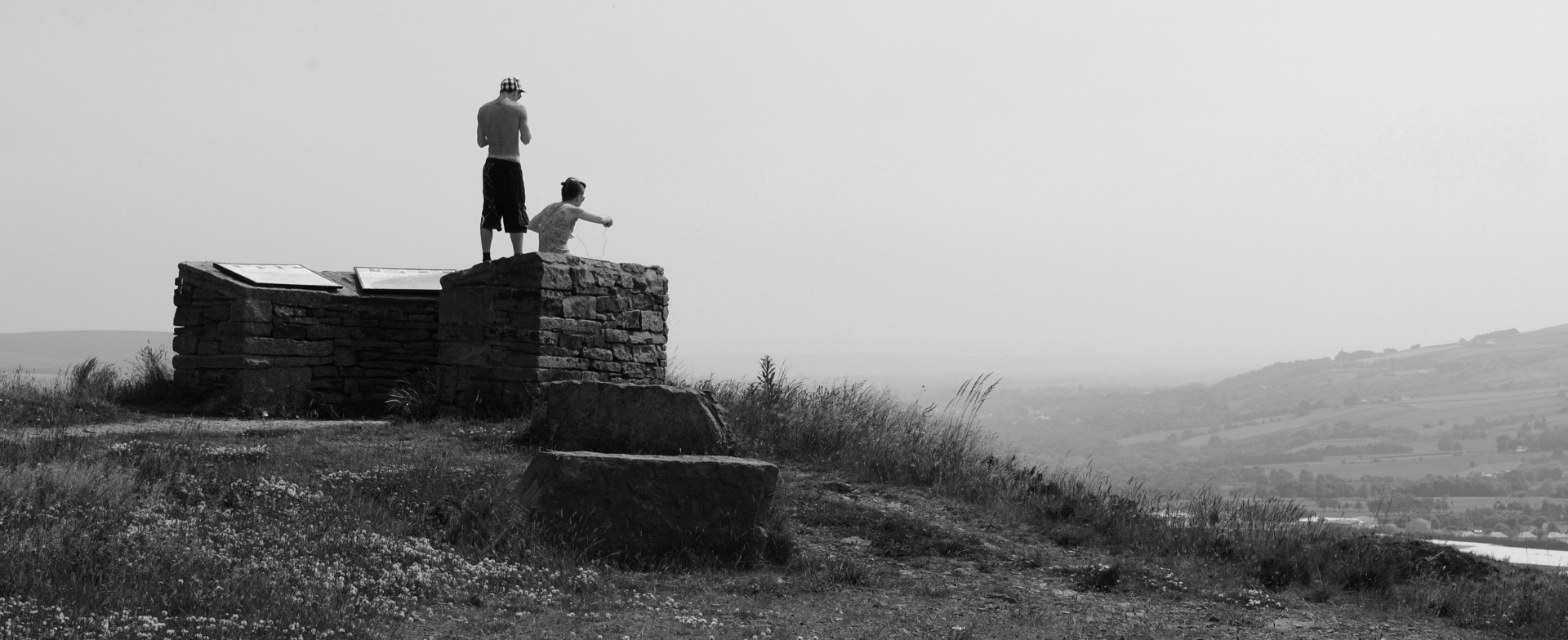
This month’s theme is From My Vantage Point, and is all about our perspectives, how and where we see the world.

Photo from Jon Luty, ‘On Top of the World’ Top Of The World Free Stock Photo – Public Domain Pictures

Jerry Durick’s poetic speakers observe their world from a variety of vantage points. His speakers are often detached, like Jack Galmitz’ characters, who are inert, calm, and isolated to a degree.

This slightly removed perspective can be lonely.

J.J. Campbell reflects on isolation, intimacy, nostalgia and his advancing age in his poetry, while Michael Lee Johnson’s illustrated pieces are quiet reflections of age and solitude.

Sherzod Artikov, in a poignant piece, depicts an elderly aspiring actor who dreams of playing King Lear while resembling the character.

A more distant, abstract vantage point can also inspire thoughts of transcendence. Hongri Yuan, in poems translated from Mandarin to English by Yuanbing Zhang, suggests that our lives and bodies hold reminders of eternity.

Sharma Shashi leaves her Earth-bound home for a dream voyage to the stars at night, while Mahbub looks at nature, mortality, and inter-cultural disrespect and power relations from a standpoint of openness and curiosity. He wonders why the world is, or has to be, the way it is.

Ship Wheelhouse Interior, from Lynn Greyling: https://www.publicdomainpictures.net/en/view-image.php?image=186882

Some writers take a more close-up perspective in their pieces, focusing in on the absence or presence of personal relationships.

Aloysius S. Harmon writes of moments alone at home after the loss of a loved one to death, while Abigail George reflects on how romantic emotions can change over time, on personal growth in and out of relationships.

Nibana Dahal’s poem reminds us all of the giddy uncertain energy at the early stage of a romance. Santiago Burdon probes the lonely bitterness of addiction and the persistence of hope. (Santiago just released a new poetry collection, Not Real Poetry, available here).

Stephen Jarrell Williams’ poetic speakers pan back out to a more universal view, and are unashamed of their sentiment and caring.

Cliffside Vantage Point, photo from Charlotte Merritt Cliffside Vantage Point Free Stock Photo – Public Domain Pictures

Travel can also expose you to new people, cultures, and perspectives, giving you a fresh vantage point while leaving you less lonely.

Bonnie Lee Black observes casual friendliness and conversation among neighbors and strangers in Mexico, while Kim Malcolm finds tranquility in a South Korean Buddhist monastery.

Robert Thomas remembers bonding with men different from himself way out in back country Texas over the beauty of a well-designed automobile engine.

In a more fanciful vein, Christopher Bernard’s short story The Ghost Trolley involves a young boy who journeys into a realm of peaceful people plagued by those who seek to dominate them.

This adventure tale reflects one of humanity’s perennial struggles, as does Chimezie Ihekuna’s screenplay The Conflict, also about creatures with the best, and the worst, of intentions.

Rajendra Ojha expresses similar sentiments in a poem urging humans to use our lives for compassionate and good purposes.

The Almost Hidden Creek, photo from Bobbi Jones the-almost-hidden-creek.jpg (1920×1920) (publicdomainpictures.net)

Other writers address social issues from a broad perspective. Steven Croft reviews Joyce Carol Oates’ new poetry collection American Melancholy, which explores America’s strengths, flaws, and contradictions.

Ken Ciocco reviews Michael Robinson’s new poetry collection From Chains to Freedom, which illustrates the effects of past and present American racism on the Black male psyche.

Others narrow their lenses, looking at individual characters’ stories to explore broader societal themes.

Z.I. Mahmud looks at women characters in Charles Dickens’ David Copperfield to explore themes of feminism, strength, independence and caring. David Myles Robinson comments on the disorientation and unrest of the 1960s in the United States through the interactions of a couple and then of a dysfunctional family in excerpts from his new novel Words Kill.

Ike Boat focuses in on his own life in his autobiography, outlining his teaching, DJing, MCing, and promotional creative work.

Ocean View Lookout, from Charlotte Merritt Ocean View Lookout Free Stock Photo – Public Domain Pictures

In a completely different vein, two writers play with language itself. Mark Young crafts poems using ‘found text’ from various poetic and non-poetic sources as a starting point, and J.D. Nelson tweaks words and letters to produce a variety of sound effects.

Mickey Corrigan also provides humorous pieces about the state of Florida.

Whichever ‘lenses’ you use to observe our world, we hope you have a spectacular and inspiring view this month.

Poetry from Hongri Yuan, translated from Mandarin to English by Yuanbing Zhang

Poet Hongri Yuan

Three Poems

By Chinese Poet Yuan Hongri

Translated by Yuanbing Zhang

The Stars of The Dawn

When the sky gallops like the rivers

you stand in the street of the city on the world

look up at the sky and you could almost hear the singing of the stars

summoning you in the depths of space.

And the Heavens of the gods

are towering lofty cities like the mountains

on gold coast of time;

And on the mammoth ship of platinum

the rings of light twine around giant’s necks of men and women

 their eyes are like the stars of the dawn.

2016.4.28

黎明的辰星

当天空疾驰如江河

你站在人间之城的街道

向天仰望 仿佛听到群星的歌声

在太空的深处向你召唤

而诸神的天国

在时光的黄金海岸

矗立山岳般的巍峨之城

而白金的巨轮之上

巨人的男女 项佩光环

眼眸如黎明的辰星

2016.4.28

Only the Eternity is Equal to It

I am a singer from the heavens

my song is silent, only the soul can hear it.

Those ancient gods are the mountains behind me,

they gave me the flowers of millennium from paradise,

let my song mellow and sweet as the smile of the heavens;

let the face of time blush and lift the veil of death;

let the ancient earth reveal the true face of gold.

Oh, you’ll see another you,

as old as the sun, as young as the dawn

his kingdom is huge and only the eternity is equal to it.

4.04.2015

唯有永恒与之齐名

我是一位来自天堂的歌者

我的歌曲无声 唯有灵魂听见

那些古老的诸神 是我身后的山岳

他们赠我千年的仙果

让我的歌声芳醇 甘美如天国的笑容

让时光的脸儿羞红 掀去死亡的面纱

让古老的大地 露出黄金的真容

哦 你将看到另一个自己

古老如太阳 年轻如黎明

他的王国之巨大唯有永恒与之齐名

2015.4.4

My Heaven is Inside My Body

My heaven is inside my body,

my heaven is a great many,

like stars in the night sky,

with silver towers,

huge edifices that look like apphires ,

golden palaces, gardens of crystal.

My body is bigger than the universe,

countless gods and angels are my partners,

as if they are countless myself.

Neither time nor life and death in my words

dawn and dusk are the same name,

and sadness and joy are the same words.

11.08.2020

我的天国在身体之内

我的天国在身体之内

我的天国居多犹如夜空的繁星

白银的楼阁 蓝宝石的巨厦

黄金的殿堂 水晶的花园

我的身体比宇宙更巨大

无数的天神与天使是我的伙伴

他们仿佛是无数的我自己

我的词语里没有时间也没有生死

黎明与黄昏是同一个名字

而悲伤与欢喜是同一个词语

2020.11.8

Bio:Yuan Hongri (born 1962) is a renowned Chinese mystic, poet, and philosopher. His work has been published in the UK, USA, India, New Zealand, Canada, and Nigeria; his poems have appeared in Poet’s Espresso Review, Orbis, Tipton Poetry Journal, Harbinger Asylum, The Stray Branch, Pinyon Review, Taj Mahal Review, Madswirl, Shot Glass Journal, Amethyst Review, The Poetry Village, and other e-zines, anthologies, and journals. His best known works are Platinum City and Golden Giant. His works explore themes of prehistoric and future civilization.

Tranlator Yuanbing Zhang

Yuanbing Zhang (b. 1974), who is a Chinese poet and translator, works in a Middle School, Yanzhou District , Jining City, Shandong Province, China. He can be contacted through his email- 3112362909@qq.com.

Address:No.18 middle school Yanzhou District ,Jining City, Shandong Province, China  Yuanbing Zhang

Phone:+86 15263747339 Email:3112362909@qq.com