My name is Roozario Wiggins Sr. I’m a native Louisianan born and raised. Proudly, the first of my mother’s children to graduate high-school and college. While attending college in Wyoming the reality of culture shock hit me hard. Big open space, mountains and cattle were quite the opposite of my upbringing (low-income housing neighborhoods, crime and the sounds of gunshots every other hour).
Wyoming showed me I can be proud of the things I’ve accomplished, that your environment doesn’t determine your outcome or automatically hinder your future success. The world can be a frightening place when you’re alone. I know this fear first hand and became well acquainted with it as I grew up fatherless. The moment RJ came into this world I knew I was ready to make any and every sacrifice needed to assure he wouldn’t grow up ever experiencing the loneliness I did as a child and still experience to this day at the age of 25.
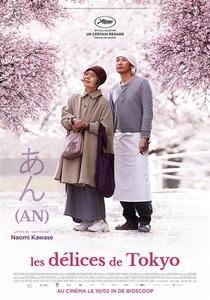
Cinema Critique: Les Délices de Tokyo by Rui M. Carvalho (30 May 2017)
Full of poetry, Les Délices de Tokyo, a movie directed by NAOMI KAWASE, is a film that imprisons us inside the screen. Gradually we forget everything around us, until we almost refuse to be confronted with the end of this wonderful piece of art.
At first glance the story seems trivial: one Spring’s day, Tokue, a 76-year-old woman approaches Sentaro, the chef of a small restaurant. Sentaro mainly sells dorayaki, a small cake filled with red-bean (azuki) jam and Tokue explains him that she always wanted to make them, she implores him to let her have that life opportunity. He tells her “no” but she leaves a small sample… and he finally accepts.
Aditionally, there’s a teen named Wakana, a very perceptive person, a regular customer, who ultimately also applies to work at the shop. Together they are a family, Tokue, as the mother of Sentaro and Wakana, and a “mystic” member who seems to glue together all the feelings of these characters.
We can’t imagine a possible end to this story, but Tokue gives us very subtle clues, for example, when she speaks of the natural world in a way that might seem strange to us because she’s much more aware of nature than most folks inside a city… There’s a sense of being different, being isolated inside the grey walls of buildings in open air. Tokue’s eyes emanate compassion in a mysterious way.
We are only able to understand them when the owner of the restaurant learns that Tokue is a patient who lives in a leprosarium… and demands Sentaro fire her, something he refuses but must accept at the end.
When Sentaro and Wakana visit Tokue, for the first time, at her home, the leprosarium, the vivid Wakana alerts him that he will be seeing people with deformed faces. When they meet the patients, the lepers are talking together, smilling, happy despite their reality: they are also a family. That’s the power of being accepted as we are… despite our differences, our different ways to see the universe and the different ways others see us.
Also, there’s no victory against nature here ; the nature of disease. On the contrary, Tokue determinedly accepts everything… especially without words, simply with the way she looks to cherry blossoms. She sees herself as a piece of the natural world, destined to live and to die. Maybe the fact that the actress deals with cancer in real life helps her with this role.
At the end, we remember the moment when she explains she had to release the canary Wakana gave her… he asked her to do so… and this, combined with the fact that she confesses that after her death, through a cassette recording, leaves us a final thought: a timeless reminder that our mind wants to forget that we are sick for awhile so that we can be happy during all moments of life. That’s certainly the secret of her azuki jam.
This movie explains the human condition in depth: the capacity of small things to change our lives; the importance of simple ordinary people; the power of chance that can transform small moments into important parts of history. The photographic look of the film’s scenes additionally help the director with this therapeutic message. The random bubbles of the boiling beans and Tokue’s coat, with colors resembling cherry blossoms, look like living creatures. Visually, even minor background objects come to life.
This is a movie about the most important people: the simple people.
Amy Lynn Santiago’s three-year-old son Nicholas Volker was suddenly, terribly ill. Problems that had started with a fever and an abscess that would not heal now trapped the boy in the hospital for years. He endured multiple surgeries, chemotherapy, dangerous and powerful drugs, and the permanent removal of his colon. Finally, as Nick’s care exceeded the family insurance’s two million dollar lifetime benefits cap, the physicians in his Milwaukee hospital decided to sequence his genome.
Upon discovering that he had two rare genetic diseases, they were able to successfully treat them with a bone marrow transplant. However, Nicholas, now 11, lives with long-term side effects from his ordeal, including PTSD, learning disabilities, social issues from living in near isolation for four years, and a permanent ileostomy.
His parents believe that gene sequencing could have saved him and others from much of what he went through, and advocate for this sort of personalized medicine through their nonprofit One in a Billion Foundation.
Dr. Michael Goldman and the San Francisco State University Department of Biological Sciences also see the promise of personalized genomic medicine, and hosted a one-day conference in South San Francisco June 2nd to highlight developments in the field.
A Belated Appraisal of “Still Life With Woodpecker,” by Tom Robbins
“Unwilling to wait for mankind to improve, the outlaw lives as if that day were here.”
—Bernard Mickey Wrangle
In 1980, Ronald Reagan became POTUS, MTV turned negative one, & Tom Robbins published Still Life With Woodpecker. Peradventure, your mother was a Tom Robbins fan when you were growing up. You remember his books & their quirky titles — Skinny Legs And All, Jitterbug Perfume — & Uma Thurman as a hitchhiker with prosthetically enlarged thumbs in the film adaptation of Even Cowgirls Get the Blues. You may have borrowed your mom’s copy of Even Cowgirls the novel, on the pretext of reading it, but being an adolescent at the time, all you really did was flip through the pages looking for sex scenes.
So, you nearly missed the Tom Robbins express train to cult literary Nirvana. Luckily, in your present life as a grownup in a whole new millennium, you chance upon a rack-size paperback of Still Life With Woodpecker, from a free pile or tiny library, & take it home to read. Suddenly, your mother’s enthusiasm all those years ago comes back, & makes perfect sense. You are soon hooked by this winsome yarn about a wayward modern princess named Leigh-Cheri, on the cusp of adulthood, who breaks away from her punctilious parents for a fateful sojourn on Maui.
“Who knows how to make love stay?” That’s the question asked early on & woven through the novel. We are invited to ponder the fleeting & elusive quality of love, why we can’t hold on to the first rush of connection & stay in love, forever. At the core of Still Life With Woodpecker is a love story, irreverently told by the inimitable Tom Robbins, comprising equal parts oldfashioned storybook romance, Greco-Shakespearean tragedy, Lady & the Tramp, & Bonnie & Clyde. This love story begins & ends with a bang, literally, in the form of dynamite. It dispenses with sentiment, skips over courtship, & cuts to the chase. If you’re a reader of warped sensibility who usually spurns romance, given what it signifies as a modern literary genre, here is an alternative romance that may suit your taste.