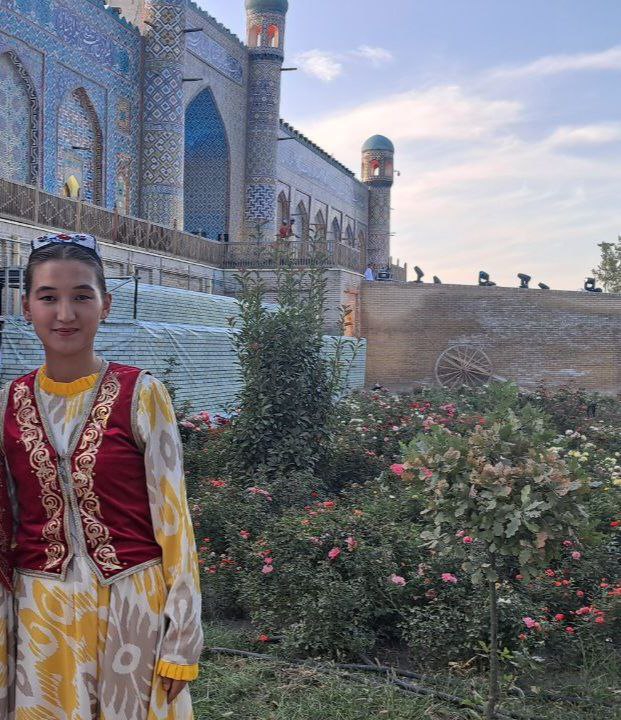
I, Nishonboyeva Shahnoza, was born on October 28, 2001, in Yangi Gulboq village of Mingbuloq district, Namangan region. The rural environment, sincere people, and a lifestyle based on hard work played a significant role in shaping my worldview. There are two sons and one daughter in our family, and I am the only daughter. This taught me from an early age to be responsible, patient, and determined in pursuing my goals.
The role of my parents in my life is invaluable. My father, Botirov Ma’murjon, was born on August 16, 1968. His diligence, honesty, and determination have always been a great example for me. My mother, Akbarova Gulchehra, was born on February 15, 1971. Her kindness, patience, and constant support have been the greatest foundation in helping me reach where I am today. The upbringing and confidence given by my parents encourage me to take bold steps in life.
Currently, I am a fourth-year student at Kokand State University, consistently striving to gain knowledge. During my student years, I have not limited myself to academic studies alone; I have worked on self-development and acquiring modern knowledge and skills. As a result of my efforts, I developed a strong interest in mental arithmetic. I earned certificates in this field and established a mental arithmetic course for children.
Today, the achievements of my students are my greatest accomplishment. Their enthusiasm for learning and every success they achieve give me even greater responsibility and inspiration. My main goal is to help my students reach higher levels, develop their potential, and contribute to their becoming globally recognized young individuals in the future. Along this path, I continue to learn, obtain new certificates, and expand my knowledge.
The role of my parents-in-law and my spouse in my achievements is also extremely significant. Their trust, constant assistance, and support give me the strength to overcome any difficulties.
Another important goal for my future is to work in a preschool educational institution and become a strong and experienced educator. Over time, I aspire to rise to the position of director, relying on my knowledge and experience, and achieve high results in the field of education. Of course, this path requires continuous hard work, self-improvement, and professional development. I am ready for it.
My life path is a journey of moving toward my dreams with determination and building the future through knowledge and hard work. I firmly believe that every effort and every day of hard work will eventually bear fruit. Because every step taken with dedication and faith leads toward a bright future.
In 2025, she transitioned from a contract to a grant during the Grand-Contract selection stage.
She is a member of the “Council of Leading Girls”.
She holds 3 international and 21 official certificates.
She has participated in 2 international scientific-practical conferences.
She took part in the III International Handicraft Festival.
She received a Level B certificate in the National Exam for the Mother Tongue subject.
Pedagogical Foundations of Moral Education and Worldview Formation in Primary School Students
Islomova Maxsudaxon
Qo‘qon State University
Faculty of Primary and Technological Education
Primary Education Program, Group 05/24
Abstract:
This article explores the pedagogical foundations of moral education and the formation of worldview in primary school students. The primary education stage is a crucial period in personality development, during which moral education, norms, social values, and initial worldview are formed in students. The article analyzes the essence and content of moral education and worldview, as well as their role in the development of the student’s personality. It is concluded that a properly organized pedagogical process contributes to the formation of positive moral qualities and a broad worldview in students.
Primary education is the main stage where a student’s attitude toward knowledge, tendency to imitate, interest in learning, and activity are formed. Therefore, instilling moral virtues and embedding national and universal values is an important pedagogical task. The integrity of education and upbringing processes plays a key role in forming a positive worldview in students.
Today, in the context of globalization, educating the younger generation to be morally mature, with strong beliefs and a correct worldview, is one of the most pressing issues. From this perspective, studying the pedagogical foundations of moral education and worldview formation in primary school students is of significant scientific and practical importance. The country’s education system, i.e., academic institutions, not only provide theoretical knowledge but also focus on raising morally educated youth, which is currently a requirement of the times. It is no secret that the importance of moral education is steadily increasing worldwide.
Morality has a historical and changing character; moral norms are defined by social conditions and vary across different strata of society. A moral norm is recognized by society and is a rule whose compliance can be obligatory or voluntary. To ensure that primary school students remember and understand morality easily, it can be defined as follows: “Morality is behaving politely, respecting elders, helping friends, speaking truthfully, and doing good deeds.”
Moral education is a purposeful pedagogical process aimed at developing in students the moral norms, behavior, and values accepted by society. Moral education in primary education is particularly important because at this stage, children begin to form an understanding of behavior, habits, and worldview. Through observation and imitation of teachers and parents, children quickly acquire moral qualities.
When forming moral education in primary school students, it is important to consider the ideas of great thinkers, as our ancestors highlighted high virtues such as human perfection, morality, honesty, justice, compassion, and patriotism in their works. Their perspectives have retained their value over the centuries and still serve as a strong theoretical and moral basis for educating the younger generation. The lives and activities of these thinkers serve as exemplary models for students because they demonstrated a pursuit of knowledge, diligence, and moral excellence. Furthermore, the universal and national values promoted in their works help form a correct worldview, national pride, and moral maturity in primary school students. Therefore, using the heritage of great thinkers in moral education is pedagogically important and effective. The ethical views of Eastern scholars help cultivate humanity in students’ hearts.
Along with moral education, students’ worldview gradually develops. Modern psychology considers worldview as a part of personal development. The foundation of worldview is formed by scientific knowledge.
Worldview is the system of a person’s knowledge, concepts, values, and beliefs about existence, nature, society, humanity, and the meaning of life. It determines a person’s attitude toward events, behavior, and life position. Worldview is not just a collection of knowledge; it also encompasses inner beliefs, attitudes toward values, and goals. Its formation is a continuous process influenced by education, social environment, family upbringing, and personal experience.
The foundation of worldview is laid during primary school years. At this stage, children perceive surrounding events in a simple but emotionally intense way. Therefore, education provided at this stage directly influences their future perspectives. Students learn mostly through observation, imitation, and practical activity. Their worldview develops through the teacher’s personality, family environment, classroom processes, and social surroundings. In particular, a teacher’s personal example, fair and caring attitude contributes to forming positive perspectives in students.
The following methods are used to develop worldview in students:
Integrating education and upbringing;
Ethical conversations and educational hours;
Explaining through tales, stories, and instructive proverbs;
Group games and activities;
Instilling national and universal values.
In addition, fostering independent thinking, encouraging questioning, and teaching problem-solving also broadens students’ worldview.
Conclusion:
Primary education is the foundation of personality development. At this stage, students begin to form moral virtues, national values, and worldview. In shaping these qualities, it is essential to use the works of great scholars and thinkers to guide children correctly and teach knowledge they will apply throughout life. Properly organized education and upbringing contribute to the development of a positive worldview, strong moral values, and well-rounded personalities in students.
References:
Yoldoshev O’. Didaktik prinsiplar tizimida tarixiylik. Tashkent: Fan, 2005.
Yoldoshev J. Hayot va tafakkur sayyorasi. Tashkent: Fan, 1991.
Yoldoshev O’. Ta’lim nazariyasi asoslari. Tashkent: Fan, 2006.
Khodjayev B.X. Umumiy pedagogika nazariyasi va amaliyoti. Tashkent: Sano-standart, 2017.
Yoldoshev O.J., Ziyayev A., Yusupov M., et al. Umumiy pedagogika. Tashkent: Fan va texnologiya, 2017.
Mavlonov V. Development of vigilance and awareness in students based on neuro-linguistic programming technologies. Pedagogika, TDPU, 2017/3.
Nurmatova M. History of Origin and Social and Pedagogical Need of Tutor’s Activity. International Bulletin of Applied Science and Technology, 3(2023):151-154.
Nurmatova M.O.Q. Is’hoqxon Ibrat’s Contribution to Knowledge and Enlightenment. Academic Research in Educational Sciences, 3.NUU Conference 2(2022).
Nurmatova M.O.K. Psychological and pedagogical features of older preschool children. Youth and the XXI Century (2015).
Nurmatova M. Teacher-Leader in Education. Current Scientific Research in the Modern World, 2018.
Nurmatova M. Work “Odob vs-Salihin” – a Handbook on Politeness and Rules of Conduct. Current Scientific Research in the Modern World, 2018.
In our long forgotten of summer days I pine for forbidden forests And a winter love that will wreak havoc Inside my amorphous vein Lately I scream at the stars in the night long haul The sky seems forgotten and unlikely An innocence that hangs in the tropical rain The ecological summer that God created I still seek for an unassuming answer My past years gone and dusted under a oak tree Oaths of haunting fairies in the far land The sea change of the seasons as tomorrow comes I will hold roses under my bosom At nighttime the sky again becomes my neighbor I scream and wait as the year pass by.
my head is an ocean in which I more frequently drown than swim. my mouth is a loaded gun and I am the finger that holds the trigger. sometimes I cannot stop myself from getting tangled in the algae of my depression, from drowning in a sea of anxiety. sometimes I cannot stop myself from firing on the first one to cross my path.
my head is a void, an endless continuum in which I often find myself lost. as I walk through the gates at the precipice of nothingness I am greeted with only a baleful silence. with every step I take in my own mind I fear that I will slip into the deep and never be able to return again. my head is an ocean in which I more frequently drown than swim.
Riley “Ri” Winters (she/they) is a young transgender poet, author, and musician from San Francisco, California. Her work focuses on social justice, identity reclamation, and self-expression, and advocates for mental health awareness and LGBTQ+ rights.
USE OF DIDACTIC GAMES AND MODERN TEACHING METHODS TO INCREASE STUDENTS’ INTEREST IN SCIENCE IN SPECIALIZED CLASSES OF FUTURE TEACHERS
Kadirova Feruzakhan Abdiyaminovna Andijan State Pedagogical Institute Master’s student of pedagogy Scientific supervisor Abdullayeva Nasibakhan Jorayevna
Today, the reforms carried out in the education system require future teachers to deeply master modern pedagogical approaches. The use of didactic games and modern interactive methods is important in teaching.
Didactic games increase students’ interest in the lesson and make them active participants. For example, in the role-playing game method, students take the role of a certain profession or pedagogue and solve a problem situation. In this process, they apply their theoretical knowledge in practice. Or through a game organized in the form of a question-and-answer competition, students strengthen the topic and test their knowledge based on healthy competition.
The brainstorming method, which is one of the modern teaching methods, also develops students’ independent thinking. For example, students are asked to express different ideas by setting a problem on a new topic, in which each idea is appreciated and a general conclusion is drawn. This method is used by students forms the ability to think freely and defend one’s point of view.
The cluster method is also one of the effective methods, for example, a certain concept is written on the board, and students branch out their thoughts related to this concept. As a result, a comprehensive idea of the topic is formed This method is especially useful in the systematization of theoretical topics.
Through the insert method, students analyze their knowledge in the process of working with the text. They confirm the information they know during the study, determine new information and identify incomprehensible aspects, which develops students’ independent learning skills.
Case study, that is, the method of analyzing problematic situations, can also be widely used in specialized subjects. For example, students are given a pedagogical situation and asked to find a solution to the problem. This increases the ability to work in a team.
The use of information and communication technologies has also become an integral part of the modern lesson. Presentations, videos, online tests and lessons organized using interactive platforms attract the attention of students. For example, quick assessment through electronic test or explanation of the topic through interactive presentations.