When Books Breathe: How Stories Transcend Borders, Time, and Silence
When Books Breathe
In a world constantly racing forward, books remain the quiet keepers of human memory. Unlike fleeting trends or temporary platforms, they stay rooted, whispering stories from past centuries into the ears of modern souls. A book doesn’t demand attention; it earns it slowly — through pages that unfold truth, pain, joy, and hope.
When a person opens a book, they don’t just read. They listen — to distant lands, silenced voices, and forgotten times. Through the weight of a well-crafted sentence or the simplicity of a child’s rhyme, literature transcends borders. A young woman in Uzbekistan can feel the struggles of a mother in Sudan, or the joy of a boy in Peru, all through ink and imagination.
Books breathe when we let them live in our minds — when we carry their messages beyond the bookshelf. In this sense, books are alive not because they are printed, but because they are read, shared, and remembered. They wait patiently, knowing their time will come when a reader is ready to receive.
In a noisy age, the stillness of reading becomes a quiet revolution. Through books, we learn not only about the world, but how to become more human within it. They do not speak louder than others — they speak deeper.
Mushtariybegim Ozodbekova is a student and aspiring writer from Uzbekistan. She enjoys exploring literature as a bridge between cultures and generations. Her writing reflects a deep belief in the power of language to inspire empathy and awareness.
This article was inspired by my own experience of discovering books during a time of personal reflection. In today’s fast-paced world, I wanted to write something that reminds us of the silent strength books carry — and how they connect readers across continents, cultures, and time.
navy shorts that absorbed the salty texture of the sea
—raises her arm to shield her eyes from the glittering beam.
Ships fly across the waves,
seagulls float in the sky;
a brushstroke deeper,
layered in long tones of slate and teal.
The water moves with quiet muscle,
creases of white gathering near the shore
before breaking into lace at the toes
of seven figures drawn by tide—
some standing close where the water sighs,
ankles kissed by foam;
others linger just behind,
head slightly rested back, caressed by the soft ocean winds.
A few drift farther down the shore,
turned slightly, as if to say:
‘come see what the horizon hides.’
Three boys with their feet buried in the chilling sand,
one with a backwards hat, trying to fight the glaring gleam.
Two others play rock, scissors, paper
—their conversation captured in the pause between waves.
Sand, pale gold and warm with noon,
holds footprints like soft echoes.
The sun presses down,
gives the waves a shimmer that sings.
Light folds over each figure, placed precisely,
spaced like notes in a slow chord—
black shirts, white sleeves, a shoulder bare to the sun,
each color bleeding into the sea and sky.
Portraits Without First Chapters
The silence after a story that’s missing its end—
that’s how we meet them.
A pair of wrinkled hands, softened with time, already slower.
Their voices linger not in memory but in my imagination.
A train ticket with no date,
folded in a drawer beside war medals
and recipes written in a language,
we never learned to speak.
The note tucked into a borrowed book,
Laying neatly between pages of stories
flat, delicate, and fragile.
Maybe from someone they loved
before the word “family” included us—
a couple of letters to me,
a name I’ll truly never know.
We hold their endings like heirlooms,
guessing at beginnings.
Through photographs where they are younger
than we’ll ever know them to be.
A Childhood in Five Objects
Its fur dulled by the decade of sun,
ears bent from too many hugs,
eyes stitched with storied only I recall.
It once leaped from planets I drew in crayons,
spoke bedtime whispers only I could hear.
A stuffed rabbit slumps against the wall, now it waits—
from the last time, I tucked it in, quietly guarding retired dreams.
Where tea parties once were held.
Its patterns are now a faded trail,
stories of imagination yet more vibrant than
the wallpaper’s flowers ever dared to bloom,
echoes etched deeper than time could consume.
It has caught the weight of every goodbye—
To dolls, to friends, to phases passed.
Now it cradles still, but never forgets the shape of my steps.
Their spines creased with thumbprints of belief.
Each page reverberates my mother’s voice,
each character a mask she wore—yet all I remember is her.
Now they rest like loyal sentinels,
inked in the versions of me they kept,
a carpet lies bruised with soft indentations.
Framing skies that changed with my moods,
stormy eams, sunlit breaks, a single star I wished upon.
Four repeating seasons, every item slowly maturing with the age of time.
At night it played the moon’s lullaby,
by day, the chatter of birds on the branches.
Now it reflects back the outside world,
but never quite lets it in.
Warping my height as I grew each year,
Flashing glimpses of twirls, tears,
and the first stolen lipstick swipe.
Reflecting words mouthed in silence, a face rehearsed,
it now holds the quiet imprint of every version I’ve been.
Sally Lee is a student at an international school in Seoul, South Korea. Immersed in a multicultural environment, she draws inspiration from the diverse cultures and experiences around her. She is currently working on her writing portfolio.
My Poetry Translation and Recording Featured in a “Sound Walk” at the Boston Public Garden
ECHOES APP
Location: Boston, Massachusetts, United States
A collaboration with between Cantabridgian poet Jacques Fleury and Bostonian musician Rachel Devorah Wood Rome, Ph.D.by Jacques Fleury
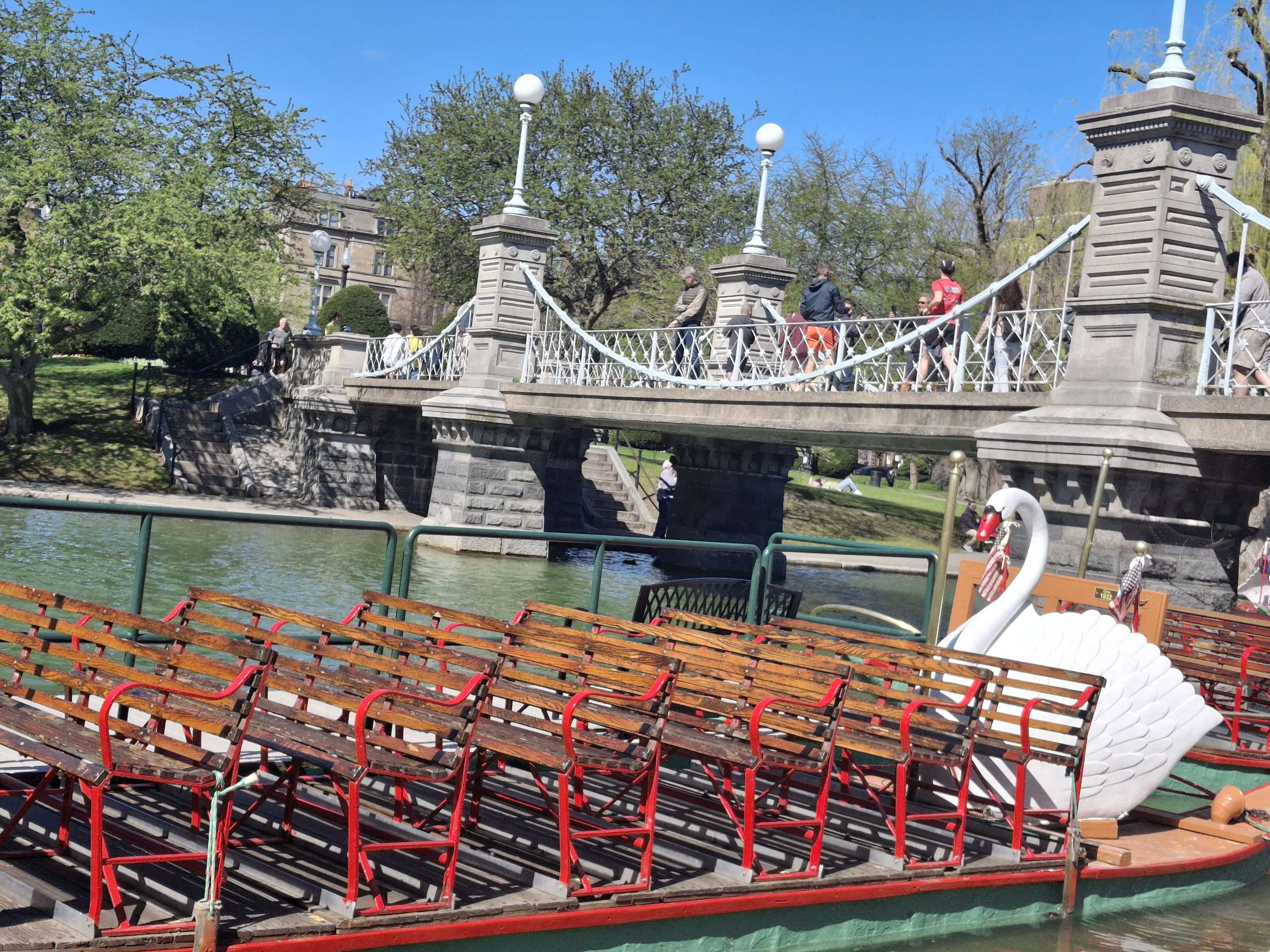
Boston Public Garden Image C/O Jacques Fleury
I am featured in a “Sound Walk” recording on the Boston Public Garden!
I was commissioned by Berklee College of Music Professor, Dr. Rachel Rome, who discovered me on the Haitian American Artists of Massachusetts Facebook page, to translate and record a poem to her naturalistic electronic musical composition at Berklee recording studios. The recording is divided into three sections, each having its own sound and intent achieved by dividing the poem into three parts. You can listen to it as part of your meditation practice, whether manually or at the Boston Public Garden itself should you be visiting or live in the Boston area.
The poem was originally written in English by Dr. Jason Allen Paissant, a professor of Jamaican descent who speaks seven languages.
It is about the manmade erosion of our natural wonders and entitled TREENESS. Below is the poem, the translation and link to the public garden recording which you can listen to manually or visit the garden to listen automatically on the app.
Check it out!
Link to my Haitian Creole translation of the poem Treeness at the Boston public garden, which will be there indefinitely…
You can visit and listen for years to come on your phone by downloading the ECHOES app!
“All Soundwalks are located at Boston Common and Boston Public Garden. Boston Common and Public Garden are open
from 6:30 a.m. until 11:00 p.m. each day.
Installation Title: Jaden Piblik/public garden
A diverse collection of plants from around the world live together in the Boston Public Garden, embodying the ideals and contradictions of the United States. Heralded as the “first public botanical garden in the United States,” this historic site reflects a uniquely American paradox: the aspiration for multicultural democratic inclusivity juxtaposed with the tenants of colonialism. Nature is not left to thrive on its own terms but meticulously curated, shaped to conform to Victorian notions of beauty and order. jaden piblik is an electroacoustic soundwalk setting of the Haitian-Cantabrigian poet Jacques Fleury’s Haitian-Creole translation of the English-language poem “Treeness” by Jason Allen-Paisant. The work bridges languages and traditions, resonating with the complex, layered histories embodied in the Public Garden itself.”-qtd. from the Echoes website.
Jacques Fleury is a Boston Globe featured Haitian American Poet, Educator, Author of four books and literary arts student at Harvard University online. His latest publication “You Are Enough: The Journey to Accepting Your Authentic Self” & other titles are available at all Boston Public Libraries, the University of Massachusetts Healey Library, University of Wyoming, Askews and Holts Library Services in the United Kingdom, The Harvard Book Store, The Grolier Poetry Bookshop, amazon etc… He has been published in prestigious publications such as Spirit of Change Magazine, Wilderness House Literary Review, Muddy River Poetry Review, Litterateur Redefining World anthologies out of India, Poets Reading the News, the Cornell University Press anthology Class Lives: Stories from Our Economic Divide, Boston Area Small Press and Poetry Scene among others…Visit him at: http://www.authorsden.com/jacquesfleury.–
Jacques Fleury’s book You Are Enough: The Journey Towards Understanding Your Authentic Self
Rachel Devorah Wood Rome Rachel Devorah Wood Rome is a Boston-based electronic musician, educator, and labor organizer. She values machines for their patience and capacity to remember. She is interested in superhuman prolongation, opaque complexity, the re-signification of archaic tools and materials, and parallels between the physical properties and social meanings of spaces. Her work has received support from the Adrian Piper Foundation (Berlin), EMS (Stockholm), INA/GRM (Paris), the Goethe Institut [DE], MassMoCA [US], the New Museum [US], New Music USA, STEIM (Amsterdam), Swissnex [CH], and Villa Albertine [FR]. It has been released on pan y rosas discos (Chicago); Infrequent Seams (NYC); and Full Spectrum Records (Oakland), published by parallax; Feminist Media Histories; and Ugly Duckling Presse, and has been heard in fourteen countries on four continents performed by/with artists such as Nava Dunkelman, Fred Frith, Forbes Graham, Brad Henkel, Seiyoung Jang, Ava Mendoza, Roscoe Mitchell, Robbie Lee, Lydia Moyer, Ryan Muncy, Liew Niyomkarn, Erin Rogers, and the William Winant Ensemble. She is employed as an Assistant Professor of Electronic Production and Design | Creative Coding at the Berklee College of Music, and Vice President of Full-Time Faculty with MS1140 AFT Massachusetts.
Annotation: One of the most important but difficult goals for teachers in language teaching is to find a balance between fluency and accuracy. Fluency helps learners express their thoughts clearly and confidently, while accuracy makes sure that their language use is correct and fits the situation. Focusing on just one part of communicative competence may slow down its overall growth. So, for language learning to be effective, it’s important to take a balanced approach that includes activities that focus on both fluency and accuracy. So, this article talks about how important it is to have a balanced approach to helping students improve their grammar and fluency. It looks at free conversation, role-playing, and discussion exercises to help people speak more fluently, as well as grammar and pronunciation exercises that are designed to help people speak more accurately. The article gives teachers suggestions on how to do things and real-life examples that will help them get good results in the classroom.
Firstly, teachers have a significant impact on students’ values, attitudes, and behaviours, and this influence frequently extends beyond the classroom. Whether intentionally or unintentionally, teachers act as role models for their students because they are authority figures who engage with them on a daily basis. Students are more likely to internalise and emulate teachings that exhibit traits like honesty, respect, punctuality, and a love of learning. This influence is particularly potent when the younger generation is developing their social identities and moral convictions.
For instance, a teacher who treats every student fairly and kindly not only fosters a positive learning environment in the classroom but also sets an example for how to use empathy and respect in daily interactions. Likewise, when a teacher calmly manages a challenging lesson or adjusts to unforeseen circumstances in the classroom, they can encourage students to be resilient and determined in their own lives. Since students witness values being exhibited in practical settings rather than merely in theory, such a role model frequently has greater impact than direct instruction.
The movie Freedom Writers tells the story of Erin Gruwell, a teacher who really lived. She changed the lives of many students from troubled backgrounds by being dedicated, caring, and willing to go above and beyond the standard curriculum. Through her work, they learnt that discipline, empathy, and faith in the potential of others can help them get through difficult times. In daily life, even small things like warmly greeting students every morning, showing real interest in their lives, or admitting mistakes can have a big impact on how students think and act. In short, teachers are not only teaching academic subjects when they show their students the qualities they want to develop in them. They are also helping young people grow as a whole. Their actions become a living program that teaches them life skills and moral values, and the effects of education go far beyond the classroom.
Activities that focus on clarity put a lot of emphasis on using the right language, which helps students improve their grammar, vocabulary, and pronunciation, making their communication clear and professional. Fluency encourages people to speak without thinking, while precision stops mistakes from becoming ingrained over time and builds a strong language base. Typically, these kinds of activities are short, controlled, and meant to help students practise certain language patterns before they use them in free communication. To help students remember how to use things correctly, teachers often use repetition, targeted correction, and clear explanations. One of the most common ways to learn is through drilling, where students repeat certain structures over and over again until they know them by heart.
For instance, practicing conditional sentences like “If I had studied harder, I would have passed the test” helps students learn both how to do things automatically and how to do them correctly. Games with a grammar focus are also useful resources. Grammar review becomes engaging and interactive when students are required to use the appropriate tense when asking and responding to questions, such as “Find someone who has been to London,” in the “Find someone who…” activity. Simple pairwork exercises that teach students to hear and pronounce subtle sound differences that can impact meaning, like differentiating between ship and sheep, can help students improve their pronunciation accuracy.
It is commonly known that tongue twisters, which are brief sentences or phrases with repeated and similar sounds, are useful tools for improving spoken language accuracy and fluency. Their ability to engage several facets of speech production—pronunciation, articulation, rhythm, and intonation—all at once makes them valuable in the learning process. From the standpoint of fluency, tongue twisters instruct students on how to rapidly and fluidly pronounce a series of sounds without making undue pauses or hesitations. The speaker concentrates on creating seamless transitions between the sounds because they are frequently similar but marginally different, which is reminiscent of the requirements of natural communication. The tongue twister “She sells seashells by the seashore,” for instance, compels the learner to make rapid sounds, improving speech coordination. With regular practice, such tasks reduce hesitation and improve the natural flow of speech.
In conclusion, developing comprehensive language competence requires striking an efficient balance between speaking activities’ accuracy and fluency. While accuracy guarantees that their speech is grammatically correct, precise, and socially acceptable, fluency enables students to convey their ideas clearly, maintain communication flow, and grow confident in real-life confrontations. A balanced approach recognises that these two elements are not mutually exclusive but rather interdependent: accuracy without fluency may impede spontaneity and natural expression, while fluency without accuracy runs the risk of fossilising errors. Teachers must use a variety of teaching strategies that incorporate both form-focused and meaning-focused activities in order to achieve this balance. While focused drills, constructive criticism, and pronunciation practice help improve accuracy, role-plays, debates, and discussions encourage students to speak freely, fostering fluency.
Importantly, activity sequencing and adaptation should be in line with learners’ communicative needs, learning objectives, and proficiency levels. Students are more willing to take chances and try new things with language when they are in a classroom setting that is encouraging and views errors as chances for improvement. So, a well-rounded approach gives students the communicative competence they need to operate with assurance and effectiveness in a variety of real-world situations, in addition to improving language proficiency. Teachers can develop students who are not only articulate and expressive but also precise and contextually appropriate in their speech by carefully crafting speaking exercises that foster both fluency and accuracy. By ensuring that language acquisition progresses from isolated skill mastery to true communicative ability, this all-encompassing approach equips students for meaningful interaction in everyday, professional, and academic contexts.
References:
1. Brown, H. D. (2007). Principles of Language Learning and Teaching (5th ed.). Pearson Education.
2. Harmer, J. (2007). The Practice of English Language Teaching (4th ed.). Pearson Longman.
3. Nation, I. S. P., & Newton, J. (2009). Teaching ESL/EFL Listening and Speaking. Routledge.
4. Richards, J. C., & Rodgers, T. S. (2014). Approaches and Methods in Language Teaching (3rd ed.). Cambridge University Press.
5. Thornbury, S. (2005). How to Teach Speaking. Pearson Longman.
6. Ur, P. (2012). A Course in English Language Teaching (2nd ed.). Cambridge University Press.
7. Bygate, M. (1998). Theoretical Perspectives on Speaking. Annual Review of Applied Linguistics, 18, 20–42.
8. Ellis, R. (2003). Task-Based Language Learning and Teaching. Oxford University Press.
Panoyeva Jasmina O’tkirovna was born on November 14, 2006, in the Shofirkon district of Bukhara region. She graduated with a gold medal from School No. 13 in Shofirkon, demonstrating academic excellence and dedication throughout her studies.
Currently, she is a first-year student at Bukhara State Pedagogical Institute, majoring in Foreign Languages and Literature. Jasmina is an intellectually curious and active young woman who regularly participates in the “Zakovat” intellectual game, showcasing her critical thinking and broad knowledge.
In addition to her academic and intellectual pursuits, Jasmina has also contributed as a volunteer to several environmental projects, reflecting her strong sense of social responsibility and commitment to sustainable development.
With her passion for learning and active involvement in both academic and social initiatives, Jasmina continues to grow as a promising and motivated student, ready to make meaningful contributions to her field and community.
Our publication expresses great sorrow at the suffering in Gaza. We call for the return of the hostages, for an end to the siege, and for humanitarian aid to be allowed in for the starving people of the region. To support the people of Gaza, you may contribute to the Middle East Children’s Alliance.
Also, For the Writers, a manuscript coaching service, seeks to document what’s happening in the region by compiling first-person journalistic narratives from anyone of any background in Gaza. They’ll put the stories live on the site to create a digital archive to bear witness to history. Writing is invited from those in the region, of all faiths, races, or national backgrounds.
I am whipping up another modest lil issue of our journal, and just wanted to extend a hearty invitation in case you might have a poem or essay which you are looking for a great home for that could fit into small showcase we are assembling! The theme is ‘contrarians’, you could submit up to 10 haiku or senryu for consideration challenging assumptions and conventions of society, government, or English Language Haiku (especially! :D) for consideration. Please send work to jbphotography746@yahoo.com
Now, for our first August issue: Longings of the Heart.
Strider Marcus Jones probes the search for truth, memory, history, beauty and love. Abdijabborova Sabrina considers both the richness of world culture embedded in linguistic metaphors and the challenges diverse metaphors pose for cross-cultural communication. Mesfakus Salahin reflects on humanity’s journey through the ages and on what makes a civilization. Mahbub Alam wonders at the great variety of world climates and events: peace in some places, suffering in others. Rus Khomutoff poetizes about memory and nostalgia and living in multiple places in one’s mind. Christina Chin and Jerome Berglund observe smaller and larger ways living creatures navigate the world and assert their existence.
Mykyta Ryzhykh wonders how to stay human in the face of numbing devastation. Iduoze Abdulhafiz renders colonialism into the language of science fiction, with an alien protagonist pondering concepts of parasitism and existence. Bill Tope mourns the lives broken because of homophobia and transphobia and illustrates how far some people have to go into self-delusion to survive. James Tian lampoons hypocrites who demand that others care for land they themselves trample. Don Bormon shows respect to those who took to the streets for justice during a recent Bangladeshi student protest. An anonymous writer in the United States declares independence from the current presidential administration. Otabayeva Khusniya takes a fresh look at George Orwell’s classic Animal Farm with an eye to how well-intentioned revolutions can end up replicating old injustices if power imbalances remain.
Some contributors look into various realms of human creativity. Yongbo Ma reviews poet Deborah Bogen on her inspirations and journey as an artist. Duane Vorhees crafts burnished pieces concerning art and creation, particularly how one’s poems can embody and become their subjects. Patrick Sweeney’s one-line monostichs craft nuanced thoughts in single lines. Mauro Montakkyesi reviews Dr. Jernail Singh Anand’s sci-fi work of moral philosophy Epicasia. Karimova Navbaxar Mahmudjanovna encourages teaching children the art practice of applique to enhance skill and creativity and advocates for reforms in Uzbek preschool education and for the use of innovative technological approaches.Sevara Uzaqova considers the value of blended instruction for second-language English learners. Panoyeva Jasmina O’tkirovna and Sevara Uzaqova share methods for language learning that focus on real-life conversation and application as Muattar Tursunboyeva shares ways to teach language arts that inspire student creativity.
O’ktamova Shakxnozabonu outlines techniques for tooth implantation and post-treatment care. Ahmadova Sarvinoz discusses treatments for dental cavities. Boyqobilova Nargiz Aliamardonova relates the importance of uninterrupted sleep to human mental and physical health. Sabina Nafasova outlines theories about the value of incarceration in public safety and offender rehabilitation. Sattorova Mohinur Lazizovna explores methods for efficient water conservation in industrial processes. Faizullayeva discusses environmental issues concerning the atmosphere and advises on sustainable practices. G’ayratbek Toshmuxamedov outlines his own journey as an athlete and an academic. Sattorova Mokhinur highlights the importance of English language learning to young people’s ability to succeed in the modern world.
Muqimova Nazora celebrates the beauty and creativity of computer coding. Surayyo Nosirova highlights her inspirational experience at animation technology camp. Jasmine Rashidov considers modern communication technology and social media to ultimately be beneficial to young people’s cultural exchange and education, despite negative effects such as cyberbullying. Ismoilov Muhammadmirzo points out uses for technology for mapping and data processing functions in predictive ecology.
Maftuna Rustamova affirms the potential for young students and researchers to accomplish much in science. Muslima Olimova showcases the innovation and achievement of the students at the new Uzbek technology and career center Muslima Academy and the amazing potential of Uzbekistan’s students and digital entrepreneurs. Urazaliyeva Sarvinoz Saidakhmadovan shares a moving tale of a rural family determined to educate their children. Khumushbibi Kholikulova acknowledges the incredible potential of Uzbekistan’s young women to succeed in many different areas, as Olimova Sevara explores the many ways Eastern European women’s lives changed for better and worse with Soviet modernization.
Zumrad Sobirova sings the praises of her independent Uzbek homeland. Mahzuna Habibova urges her fellow Uzbek nationals to draw courage from patriotism and the glory of their country. Shahnoza Ilnar qizi Allayarova sings of the virtues of the Uzbek people and of the dignity of the nation. Maftuna Rustamova praises Ghulam Shomurod’s book The Value of the Great, which highlights important figures in Uzbek history and encourages young people to emulate them. Dilobar Maxmarejabova urges the world’s youth not to ignore or denigrate their own cultural heritages in this age of globalization. Ermatova Dilorom Baxodirjonovna describes and celebrates traditional Uzbek clothing. Xavier Womack reflects on how each of us learns from and contributes to the lives of others around us as Isaac Aju offers a letter of encouragement to the world’s emerging writers. One emerging writer, Farzona Hoshimova, shares her journey and literary accomplishments along with her gratitude to those who supported her along the way.
However, Chimezie Ihekuna speaks to the tension between optimism and dreams and reality and cynicism. Doug Hawley and Bill Tope craft a story together about an alcoholic humorously remaining in denial. Mirta Liliana Ramirez describes an unstable relationship with an unreliable lover or friend. J.J. Campbell’s poetry speaks to love, loss, the search for connection, and being beaten down by life.
Abigail George reflects on lingering grief for a lost lover and for parents who have drifted away from her. Chorshanbiyeva Gulnoza Mirzo expresses her love for her deceased father. Doug Holder offers a brief moment of tenderness to his wife as she grieves. Irma Kurti speaks to grief and humans’ tender hearts as Cherise Barasch evokes a Jewish ritual of remembrance.
Stephen Jarrell Williams crafts scenes of people navigating a troubled world together in small groups, finding strength and comfort from their faith. Michael Robinson also explores themes of faith, looking at how his awareness of physical mortality due to a health crisis reminds him of the spiritual concept of dying to selfishness and finding new life through Christ. Maja Milojkovic reflects on the themes of compassion, sorrow, and sacrifice in the relationship of Christ and the Virgin Mary. Eva Petropoulou Lianou puts out a humble plea for peace and compassion. Peace Ogunjemilua speculates on the meaning of hope and what keeps us believing – which may be as simple as a flower.
Surayyo Nosirova shares reasons why some young adults may struggle with mental health in college and offers hope and strategies for overcoming. Bibixanifa Jumanazarova praises the strength of women who rise above and shine through adversity. Priyanka Neogi urges readers to dig deep within themselves and work to reach their goals. Maria Miraglia shares her determination to love selflessly, even in a world where she can be betrayed. Taylor Dibbert speaks to making the most of everything, even English food!
Sayani Mukherjee speaks to appreciating the delicate beauty of craft and nature in urban areas. Brian Barbeito finds wonder in a single small snail shell as Gregory Wallace revels in the dazzling splendor of the sun, moon, planets, bees, and Milky Way. Su Yu showcases the work of elementary and teen writers, whose works mostly celebrate urban and rural nature.
Dr. Jernail S. Anand reflects on how the Earth will always be there for humans, even when other people or our deities fail us. Dante Parameseo, along with a humorous take on relationships, offers a poetic piece on a tamarisk tree that’s in touch with reality more elemental than human art or concepts of beauty. Vo Thi Nhu Mai encourages us to get out of our own way, to come to life with gentle spirits and appreciate the cherry blossoms. Finally, Wazed Abdullah finds joy in riding his bicycle.