Poetry and essay from Mark Young

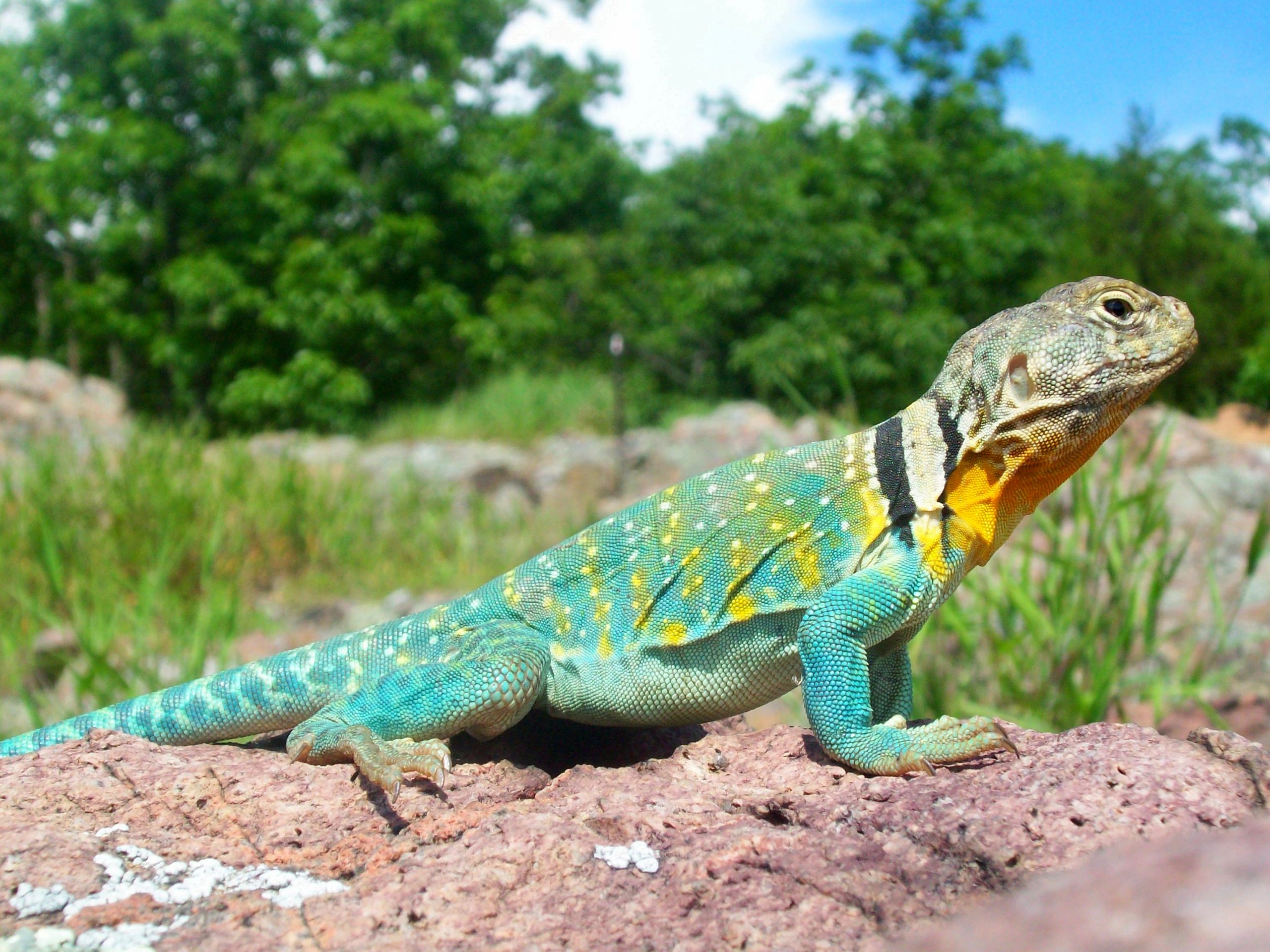
Blue, yellow, white, and gray lizard with an orange neck, black eyes, black stripes near the neck and a blue and yellow body with white spots. Perched on a rock on a sunny day in a grassy and rocky field by some trees.
Common Collared Lizard, Wikimedia Commons
Lizard

I sit on the parched front porch;
around me the house is falling down,
soon my rocking chair may fall through the verandah.
The lizard under the shadow of the rock looks at me
as though I am its new tenant.
My skin is dried and crinkled like my landlady lizard.
I may shed it soon.
Perhaps human skin is the latest lizard fashion —
Lazy Lizard, poke your tongue back in.

Old Elijah in the pawnshop looked at me between rows of watches,
'Latest crocodile skin bags, Sir.'
I wondered if his wife had died.
E.Levy's Emporium; goods bought, sold and exchanged.
Amongst broken guitars, pictures of flowers and chipped vases
ruled 'Lijah,
amongst his rocks, in their dusty shadow.
'Lijah Lizard, put your Woolworth glasses back on.

The sun beats down on my little verandah.
Here I am sitting like a guard watching my own Sahara.
Join the French Foreign Legion.
See the sands.
Allons enfants de la patrie.
French generals, German captains
dwelling in the shadow of Moroccan rocks,
Legion Lizards, put your képis back on.

It is near the end for me now.
Perhaps it is best to rest
instead of cramming in all those little things
I would like to have done.
I wanted to see the big city.
Still, there is an even bigger one
waiting for me now,
waiting for me in the shadow of the rock of ages.
Leaving Lizard, put your halo on.

9/1959

 
A note on 'Lizard'

'Lizard' was the first poem I ever wrote. I was seventeen, suffering teenaged angst & concerned about my mortality which, for some reason, seemed particularly fragile at the time. I don't know why but I decided to write about it, perhaps write it out of me or clarify my feelings. It ended up being a poem; & in the course of writing it my attitude towards death turned around. I was quite happy by the time I'd finished. I cannot remember if there was much revision. I have a feeling that there was little if any. & even then I wrote at a typewriter. Something about the separation between writer & instrument – you have to hold a pen; there is a distance between your fingers & a keyboard. It's like the start of a relationship. Those tentative touches to test the waters.

I knew no writers, though my mother wrote verse for the women's magazines of the time, knew poetry only through college & that part of my first year at University when I attended lectures. I think we did Eliot & Yeats at Uni, but everybody else I studied had been dead for at least a century. I was unenthusiastic about it. I was a musician, a classically-trained contrabassist. The cello would have been my preferred instrument – it still is the one whose sound I love the most if I put aside the personal sound of Miles Davis - but I was a lover of jazz, & the bass was an instrument for jazz.

But here I was writing. & sufficiently impressed by what I'd done to write some more. Three poems altogether, in the space of a couple of weeks. I showed them to my mother who suggested I send them off to the N.Z. Listener, a colonial imitation of the English Listener, the back with the radio programs, the front with articles & reviews & one or two poems in each issue. It was one of the few serious outlets for poetry at that time available in N.Z. I didn't know what literary journals were, or little magazines. Unsurprising, because I think there was only one of each in the country then.

They were accepted. 'Lizard' was the second poem published, just after my eighteenth birthday.

I still played & wrote jazz. But when I returned to university the next year I had the cachet of being a Published Poet. Yes, definitely capital letters. I didn't consider myself a writer but others did. I was asked to edit the University Literary Society's annual publication. I became involved with other writers. I discovered Poetry, got influenced by people who wrote it, felt I had to write, wrote crap for the next three years. There was nobody I knew who wrote like I did when I started out so I started to write like other people who I really had nothing in common with.

Somewhere during this time I gave up playing music. If I'd played flute or piano I might have continued, but playing bass in those days was a dangerous undertaking. Wellington isn't known as windy Wellington for nothing, & there weren't many yank-tanks around, & none owned by anyone I knew. The taxis were still relatively small, English-made but not English taxicabs. Most of them I couldn't fit my bass into. I had to carry it, my shoulder fitting into its waist, whenever I had to play anywhere. Ultimately the visions of me getting caught in an uplift & blown down a hillside or off the bridge between home & the university became too much.

What saved me from becoming a pallid poet in the English tradition was Don Allen's 1960 anthology The New American Poetry which probably made it to N.Z. the year after its publication. I found in it poets whom I felt at home with, who wrote in a similar manner to how I had done when I first started writing, whose influences I didn't mind. Who I quite shamelessly stole from. Gary Snyder's 'Riprap' — "Lay down these words / Before your mind like rocks;" MY's 'The Quarrel' — "Put down those words / rocks picked hastily from the beach of mind." Charles Olson's 'The Lordly & Isolate Satyrs' — MY's 'Oriental Bay' — "The motorcyclists of Cocteau / were Death's / angels." Frank O’Hara's 'In Memory of my Feelings' — "My quietness has a man in it;" MY's 'The Tigers' — "Within the tiger / reels a turmoil of desires." Poems to Denise Levertov, to LeRoi Jones. They went through my blender, came out sometimes smooth, sometimes chunky. But within a couple of years I was writing as myself, still referring to those who'd influenced me but from a different stand- & viewpoint. Openly acknowledging my influences is something I have always done. From 'Mirror/Images:' "There is / an A-Z of those whose images I have pursued / perused & used."

& it all started with 'Lizard.' It makes use of stereotypes but I knew no better then. It has the last vestiges of my belief in Christianity although I think that had gone out the window a year or so before, but not that long ago to make me hesitate to use facets of it. 'Lizard' is, in all senses, a pure poem. Colloquial, uninhibited by influences, its form shaped by the poem rather than the reverse. Because I always lumped my earliest poems in a basket labeled "crap, not to be opened" it took me forty years & the prompting of others to recognise it for what it was, a poem that still works, & something to be proud of.

"When one is seventeen, one isn't serious" wrote Rimbaud. But he was fifteen when he wrote those words, & I think he probably changed his mind in those intervening couple of years.

6/29/2004


Poetry from Celeste Alisse

I don’t believe you actually hear me.

You listen too strongly 

and can’t begin to fathom 

The continual storm of impulsive implications 

that jut themselves into my jugular.


Tearing and gnawing at flesh-

Pulling until skin snaps like spandex-

And I’m bleeding again.


But once the smeared scars sink 

Into my skin and 

I’m healthy like before,

Except now I am a liar.


So I scrape and saw away a little bit

At the end of every day and

Bruise my own cheeks for the sake of honesty.


And now I’m back at square one,

With your ears wide shut

And your eyes closed wide-


Why is the never-changing truth

That if I do not bleed, I must be lying.

Poetry from Anindya Paul

The river is another companion

The surprising stream was with you 
The mystery was carried away with the flapping sound of water 
Come down from the stone navel
Weapons wear torrent clothing
Hear the heavenly call throughout the centuries. 
You made me mound 
You are crazy and fickle about me
But a clear beauty blossomed under the current 
 Let's float in the waterfall
 Make love to the river.
 Fill the bubble with love
 Our fate is written on the gravel
 You are flowing with the river 
You are flying in the moisture
 That made my pores are wet. 
 Dreams wake the beauty of the boat
 Moonshing washes away sweat stains
 Drowning in your flow. 

Story from Jim Meirose

It’s Time for your Operation                         


Now, which ache, pain, or disorder led to Peter and Pat being at the hospital checking in for Pat’s major surgery, doesn’t matter at all. All that matters, is that her day had come at last. So now they sat, in a bare beige box of a waiting room. Peter sat idly thumbing through magazines. Pat nervously studied the otherwise empty bland, silent, room.
After some minutes, Peter said, I need to use the men’s room. You okay here alone?
Yes, sure.

So, Peter left Pat alone. As she idly picked up something to read, a man entered, and took a seat across. Pat glanced up from the page. Oh—blank face he has—tiny eyes. He is looking away. He is quiet; good. So. And, at last, an interesting article to read—thank God.
But—
Miss. Miss.  
The man. Look up.
Yes? 

The man said quietly, Are you here for surgery today?
Yes, I am. Why?
Are you nervous at all—about your surgery today? 
A bit, I suppose.
I bet you don’t know the real reason you’re here. 
Squint, but—what’s this—
Ma’am. I’m really sorry for this, but—you got to know. They told you you need this. But that’s a lie.
His eyes—what—
You’re not sick like they told you. No—you’re not.

His eyes—somehow—turned different, now.
—where the hell’s Peter—
Leaning slightly toward her, the man went on, saying, Have you really pictured what’s going to happen after they take you back there? You’re about to go back there to be slowly and methodically wounded. Really badly wounded—you know? Then, after today, it might take months or years for you to recover—if ever. It’s all an experiment, you know. They say you need this, that it’s to help you—but that’s a lie.  You don’t need to be here, Ma’am.  

She stared—motionless, afraid—don’t move—Peter, come back, Peter—her hands clenched hard as if holding on for life above a great drop.
Heh, he said, shifting in his chair—heh. Heh. They call it—an “operation”. Heh. Not hardly strong enough of a word for what they plan to do to you. They’ll use this blade, that blade, this drill, those saws, each tool designed to inflict a very particular type of injury. Heh. Heh.
Peter. Where’s Peter—

You’ll be knocked out lying there, with them shouting over you things like, scalpel! Forceps! Yes, heh! You won’t know, but they’ll be yelling scalpel forceps sponge sponge forceps scalpel hollering, and cutting. Cutting, and hollering—

—no—no—let go—let him go on. Breathe, calm—Peter’ll be back—this is just—nothing. Don’t look at him. Don’t look. Like—yes like you did way back driving to work in that stopped dead traffic by that red light waiting by that scary big teenage preacher, always there on that same curb you passed every day; scary, in his black suit and wide tie, holding his big black bible-book parted open, bellowing the word of God at the top of his lungs, staring at you, staring—always there every day—even in that blinding hard downpour that day—just don’t look over—these’re all just crazy. Just harmless. Just—don’t look. Just don’t look at th’ miserable drenching downpour soaking him to his skin, sluicing ice-cold to the gutter, or his book, or his yelling down, out, ’n away—no! It’s just sad. It’s just miserable. These kind are just miserable. Feel sorry. Just feel sorry. 

These can’t be saying the true words of God; no, these just shout loud-n’-long, all nonsense, all deluded, all ignored—‘n every time over’s just thank God, ah, the green light. Green at last—but where’s Peter—

The man went on speaking into the side of her face, saying—and when its all over, they’ll roll you into what they’ll call a recovery room. They’ll bring you around. You’ll think it’s nearly over. But the real torment’s just begun. They’ll surround you laughing loud down in your face as you waken to a world of pain—pain so horrible, that you’ll immediately regret having let them do this to you. You’ll hurt so much, you ‘ll wish yourself dead; maybe even wish you’d never been born. How fun! How fun! Then—and get this—for the next few days, they’ll toy with you. When your pain is most terrible, they will sedate you, and—and all will sink to gone, but, heh, you’ll slowly come around again, rising into torment, then, sedation, again—down, then up, back into torment—cranked tighter, harder, worse and worse every time—until they tire of you. They’ll cut you loose and send you home. 

But—ha! Ha! Your old life will be gone. Your new life will be—pain. So much pain, that you’ll cry inside, Why did I do this to myself? What was the reason? Was there ever any reason at all? You’ll struggle for hope. And sure, in time, things will calm a bit. But the pain will nag you. So you’ll go back. For more scans, examinations, tests—then they’ll tell you, hey, listen, Just one more small procedure will cure you. Oh yes, yes, don’t worry. It’ll be very small. Another minor operation’s definitely required, but—it’ll pay off. You’ll be totally well again. In your desperation, you’ll have no choice but to agree; bad memories slather’d o’er in the turned back to time, so, back here again! He. Hee. Te’heeeeeee! Yah, back here, for their pleasure, again—and again and again and again, as many times as they see fit! Because, you know—because your world’s not your world anymore, it is theirs! 

So now—tell me. Do you still feel good sitting here waiting for them today? Hey, listen. Enjoy these last moments you’ve left in your old world, because they’re about to blast it away after they take you back through that door—there’s a reason we’re the only species who cut each other apart for fun, and put each other back together again! There’s a reason and you—you are part of the very sick reason ah ah sick yes very sick sick sick sick reason—

Blam! 
Blam? 
Whut?

Hup, flinch, and duck! A blast of red engulfs the world, earsplittingly loud; the horrible crazy yelling man disappears, gone, transformed into a hot red boiling mist expanding out,  dissipating away from what’s left, which collapses, tangled, torn, red-soaked and sodden, onto the floor, a steaming bag of rags, and there, stands—the drenched crazed boy preacher, shotgun lowered, muzzle smoking, face pushed in your car window—why the hell’d y’ roll down your window, in this pouring rain—You, he shouts—you passed by every day, even now where I stood freezing in the rain, suffering to bring you God’s word, yes, God’s word—to save you! To save! But; look at me, soaked and suffering; why did you not help me? Why did you not help! He reaches in, grasping, yelling, You need punishment! 

Punishment! Punishment scalpel forceps punishment sponge sponge punish forceps scalpel punish’ no! No, no—you’re yelling, No, I didn’t mean it, I didn’t—dear God, let the light turn! Let the light turn—now please, dear God—
Green!
Thank God! Bu—
Blam!

A final blast of red engulfs the world, earsplittingly loud; the miserably drenched raving holy boy yelling at you disappears, gone, transformed into a red roiling mist expanding out dissipating away from what’s left, which collapses, tangled, torn, red-soaked and sodden, onto the floor, a steaming bag of rags, and there, stands—Peter, leaning, shotgun lowered, muzzle smoking, standing where all the crazies had been, but now, thank God, all’s gone.
Peter! My God, my God!

It’s all right now, Pat. Come on. It’s time to go in the back.  
Uh—thank God, but—why’re you all in white? Those gloves, that mask, the—are you really Peter? Why do you look that way? Why those clothes? Why—my God.
What?

Where did you get that gun? You don’t do guns. You’ve never done guns.
Peter waved her face into silence.

Never mind. You are safe now. The only important thing now is—your operation. Come in to the back, they’re waiting.
Hear them? They’re calling. 
It’s time for your operation.



Poetry from Duane Vorhees

LABOR IN THE FUTURE


Continual production

at the off-spring factory

depends on joyful toil

as per union contract.


THE LAMENT OF AN OCTOGENARIAN LIBRARIAN


The ears of gray age

are evergreen

to flattering

young lips.


Wrinkled fingers page

through libraries

of memory

for quips

and smart repartee,


but arthritis

turns books to dust

and bugs.


The passage of days

makes men flaccid

and takes acid

to love.


EIGHT THESES


01.Though may flies,

we measure our lives

in terms of many eons


02.Love is equal to hate

and both can be misplaced


03.We jackknife ourselves before a cross,

a crescent, a star, a lotus,


04.We walk our lives on that high wire

we stretched between the mountains


05. Reason is trumped by belief

and faith may be deceived


06.Since we invented sin,

then we must devise synagogue


07.On one side the fountain,

on one side the fire


08.Devotion to the mosque

won't delay the mausoleum


BECOMING A POET


I never learned to talk,

knew it from within;


didn’t come by the laws

of any alphabet

but stole them from the din

of fortune’s graduates.


The body drives the mind.


My throat knew how to sing

before it learned to rhyme.


Until my eyes could read

I thought that I could think.


And then, I learned to weep.


QUBBA AL-TURBA AL-SULTANIYYA

And Other Intimate Architecture


There was a trivial citadel

that existed to impede access

to your perfumed garden paradise.

And you were its timid sentinel.


I was just a dutiful student

who honored all my obligations

and practiced my prayers and prostrations

with you, my own beautiful student.


My fingers worshiped at the twin domes

that heaven your naked marble mosque.


The minarets misted in the dusk

and we infidels were left alone

to prove the functions of 2 in math.


That exercise exhausted our thoughts

such that we taliban soon forgot

the rehearsed sureh of The Straight Path.


We had one last equation to solve--

my fixed ambition was to conquer

your famed fragile but stubborn structure,

penetrate its crenellated walls.


Our algebra engineered a bridge,

and it carried me over the edge.

Stories from Peter Cherches

Pot Luck

	My next-door neighbor was throwing a little party, a get-together, a pot luck. He couldn’t very well exclude me since the whole building was invited, so I made my signature pot luck dish, a simple but popular potato salad made from halved boiled new potatoes, skin on, dressed with tarragon mustard, mayonnaise, and capers.
	I put some pants on and rang the bell next door. One of the guests, another neighbor, opened the door with a chicken drumstick in her right hand. I knew her face, but not her name. “Come on in and join the festivities,” she said. 
	I introduced myself. “Pete,” I said, and extended my right hand to shake as I balanced the bowl in my left hand against my chest. She shifted the drumstick to her left hand and shook my clean, dry, recently washed right hand with her greasy one. 
	“Tanya. You live right next door, right, Pete?”
	“Right,” I said, “I share a wall with this apartment.”
	“I’ve heard,” she said.
	What did she hear? What did the neighbor tell her? 
	“Oh?” I said.
	“Yes indeedy. Your next-door neighbor and I have no secrets from each other!”
	Was it something that could count as a secret? What could the neighbor have heard? 
	“Some pretty amusing stuff, I’ve got to say,” she added.
	Amusing? Do I talk in my sleep, loudly enough for the neighbor to hear? Does he have access to my unconscious, an access even greater than mine? I needed to find out what the neighbor heard. Should I be blunt, get right to the point, or would it be wiser to start by fishing around? 
	I decided to cast my line and see what bit. “Amusing?”
	“Surely you wouldn’t disagree.”
	“Well,” I said, “I’ve never really thought about it.”
	“Are you serious?”
	“Sure I’m serious. Why shouldn’t I be serious?”
	“Well,” she said, “it’s just that it’s really funny to a third party, to be honest. No offense.”
	It must have been pretty funny to a second party too, if the neighbor told her about it.
	“I guess I’d have to hear it through your ears,” I said, hoping she’d get the hint.
	“I guess you would,” she replied. “Well, have a good time. This chicken’s really good, by the way. The old Greek lady in 2B made it. I don’t know what these herbs are, but it’s so yummy.” She walked away.
	I found a table to drop my potato salad bowl on and picked up a drumstick. Tanya was right. Yummy.
	Then the neighbor, my next-door neighbor, that is, saw me and came over. “Welcome to my humble abode,” he said. “Are you having a good time?”
	“Well, I just got here.” Then I said, “I’m glad I decided not to skip this shindig and stay in my apartment. With all this crowd noise it would be pretty hard to get anything done, what with the thin walls and all.”
	“Thin walls? I’ve never noticed. Well, have fun, and get yourself a glass of Zinfandel before it’s all gone.” He walked away, and soon I saw him whispering conspiratorially into Tanya’s ear.
	“Mrs. Papadopoulos!” I said as the lady from 2B came toward me. “Your drumsticks are delicious.”


The Efficiency Expert

	I was walking back to my cubicle from the pantry when I noticed a meeting in the fish bowl conference room. Seated in the room were my boss (the head of editorial), her boss (the head of creative), and her boss (the head of marketing), as well as a person I did not recognize at first. Then it hit me. I rubbed my eyes. Yes, I was sure, it was the neighbor! What’s he doing here? What business does he have with my management chain of command?
	I sat down with my tea and tried to make sense of the situation. Then Susheela, one of my co-workers, came by. She said to me, sotto voce, “Have you heard about the efficiency expert?”
	I wondered if they still used the term “efficiency expert” in Mumbai, where she grew up. A good old no-bullshit term, tells you right where you stand, unlike “management consultant.”
	“No,” I said, “What gives?”
	“There are rumors of big cuts coming. They want to make us leaner and meaner.”
	“I could certainly be leaner,” I said, “but I don’t think I could be any meaner.”
	“This is no joke. Nobody’s safe,” she said.
	Least of all me, I thought. Who gives a shit about proofreading in the 21st century?
	Was the neighbor the efficiency expert, the management consultant? I was never sure what he did for a living. What a coincidence that of all places he’d be doing his dirty business here in my front yard. Surely I’d be the first to go. That bastard has a vendetta against me, I was sure. I wouldn’t be surprised if he engineered this whole thing himself, just to get me fired from my job, or perhaps to see how I’d grovel under the threat of impending unemployment.
	Well I wouldn’t grovel, nosiree Bob. I’m close enough to retirement that I could just bite the bullet, maybe freelance a little. I’d have more time for writing. Maybe it’s a blessing in disguise.
	A few minutes later, my manager came over to my cubicle. Uh oh, I thought, here comes the bad news.
	“Hey Pete,” she said, “the guy whose company services our printers said you look just like a guy from his apartment building.” I knew it, I thought, until my manager added, “But you don’t live in Bay Ridge, do you?”
	“No, Park Slope.”
	“I thought so. Well, I guess you have a lookalike in Bay Ridge.”
	Whew. I dodged a bullet, for the time being at least. So it wasn’t the neighbor after all, and it wasn’t the efficiency expert. 
	But what if the efficiency expert rumor were true nonetheless? 
	Well, at least I’d stand a fighting chance with a total stranger.


The Neighbor Asks a Question

	One day in the elevator the neighbor asked me something surprising. It was surprising enough that he even asked me something, since he often stares at his shoes and ignores me if we happen to be sharing the elevator. He asked me, “You know Judy Lieberman, don’t you?”
	The only Judy Lieberman I could remember was a grade-school classmate, and all I could remember about her was the Valentine’s Day card. It was our teacher’s idea, and I can’t imagine such a scheme would fly today. We would pick a name at random from a box and send a Valentine’s Day card to that person. The boys picked from a box of girls’ names, and vice versa. So each boy would send a card to one girl classmate, and a different girl, in my case Judy Lieberman, would send one to a boy. I suppose a boy and a girl could have drawn each other, but I don’t know what the odds would be given about 15 names of each gender. I can’t remember who I sent mine to, but I’m pretty sure it wasn’t Judy Lieberman, and I’m positive it wasn’t Susan Klugman, my arch-enemy from spelling bee—that I’d have remembered. I do remember Judy Lieberman’s Valentine’s Day card. It had a drawing of a dachshund and it said “I long to be your Valentine.” Why was the neighbor asking me about Judy Lieberman?
	“Well,” I said, “I went to school with a girl named Judy Lieberman, but I haven’t thought about her in over fifty years.”
	“As I thought,” he said.
	As he thought? Why did he think anything about me and Judy Lieberman? How did he even know about her? As far as I know, he’s not from the old neighborhood.
	“Did you go to P.S. 217?” I asked him.
	“No.”
	“Did you know Judy Lieberman?”
	“No.”
	“Then why did you ask me if I knew her?”
	“Just checking,” he replied as the door opened to the lobby.


Being Human

	I woke up wondering if I was human. I pinched myself, my left cheek with the thumb and forefinger of my left hand; I’m a lefty. I felt something, so I figured I must be corporeal. And if I was wondering about my humanity, I was clearly sentient. So why the concern? I chalked it up to AI.
	I had been experimenting a lot with the new generation of artificial intelligence chatbots. I had prompted them to write stories in my style, and the ones that were generated often called the main character Peter Cherches, which makes sense since many of my stories have me as the main character. Not me exactly, a fictional analog of me. But that fictional me was always a reflection of the real me, a vessel for my own anxieties and confusions. Look, I won’t deny the fact that I’m a narcissistic S.O.B. My stories have been about myself for years, though I only started using my own name regularly in the past ten years. Before that it was usually I or He, and for a while in the nineties it was Clarence.
	On the surface those AI stories about Peter Cherches were pretty good counterfeits of my fiction, but on closer examination there was something off about Peter Cherches, something not quite real, something like a hologram of Peter Cherches, a hollow illusion. The Peter Cherches of the AI stories was a stranger to me, and now I was starting to feel like a stranger to myself.
	I need to get out, I thought. Sitting in the apartment, alone in a chair pinching my cheek, was not helping things. I needed social intercourse, human contact, to reconnect with my own humanity. 
	Maybe I’ll go to the Korean produce shop across the street and chat up Tai, the owner. Wait, what was I thinking, Tai’s place has been gone for at least fifteen years; now it’s a coffee place. I guess I’ll take a small load down to the Wash-Dry-Fold Laundry and exchange pleasantries with Judy, the owner. So I gathered up some dirty clothes from the hamper, threw them in a laundry bag, and left my apartment.
	As I was leaving the building, the neighbor was just coming in. He was smiling. Not just smiling, beaming. Completely uncharacteristic for someone best described as a prune.
	“Ain’t it grand to be human?” the neighbor said as we passed each other. 


The Laundry Room

	I don’t do my own laundry, I send it out, but I do pass through my building’s laundry room to get to the recycling area. The other day I saw the neighbor down there, taking his laundry out of the dryer, engaged in conversation with Mrs. Papadopoulos from 2B. 
	The neighbor was talking loudly, agitated. “He’s not a nice person! You should see the contempt on his face every time he looks at me. I swear, one day I’m going to kill that scumbag.”
	Who was he talking about? I wondered.
	“You’re just imagining things,” Mrs. Papadopoulos said calmly.
	“I’m not imagining things. And don’t think I don’t hear him talking about me all the time. Lies! Bald-faced lies!”
	Who would be talking about him all the time, telling lies?
	“He’s always been very polite to me,” Mrs. Papadopoulous said. “A very considerate young man.”
	“Young man! He’s no young man. I’ll bet he’s at least as old as I am.”
	“At my age you’re a young man too, young man.”
	Who were they talking about? To Mrs. Papadopoulos he’s a very nice, considerate young man, and to the neighbor he’s a scumbag. I suspected it was somebody who lived in the building. I didn’t want it to look like I was eavesdropping, so I passed through to drop off my paper recycling.
	As I was walking back through the laundry room, to the elevator, Mrs. Papadopoulos called out to me.
	“Top of the morning, young man!”
	

Poetry from Patrick Sweeney


listening to the Heart of the Sunrise in a field of radiant canola flowers 


even Vermeer's name glistens


my dead brother's apothegms keep bouncing off the walls 


dog-eared obituaries of old age


the inch worm when she's full grown


taking a night course on mass-extinction planning 


rainy night train crowded with philosophers


I'm on a Dirac diet of one word per hour


upgrading my inattention to transcendental occlusions


he was the kind of man who always came to a complete stop