Wide Reading Among Kids – WRAK Donation Promo-Script.
A child can read. A child can dream big by reading one book. A child be it from a rich home or a poor home has the same potential to dare to dream. The easiest way for our beautiful pearls to escape this world into a world of possibilities is for them seeing themselves in stories. Stories told by locals and in African settings. Wide Reading Among Kids – WRAK campaign needs you to put a seraphic smile on our little one’s face.
Make your contribution in a form of donation as low as 1 Cedi daily and in one year you’ve blessed a community. Kindly, send your Mobile Money Support as Donation to MTN: Mo-Mo Pay ID: 760719 or Pay to 0594064037 – Account Name: Donkomi Fie Ltd. Better-Still, Call or WhatsApp: +233247654113 for more information or Enquiry about up-coming WRAK Outreach Programs, Book Camps and Educative Projects. You can also log on to: www.widereadingamongkids.org to read and learn more. Go-Fund-Me Donation Web-Link: www.gofundme.com/f/xccby-wide-reading-among-kids https://soundcloud.com/ikeboatofficial/wrakpromojingle
Wide Reading Among Kids – WRAK – Improving Kids Reading
Originally, Written By Dennis Mann #Founder#President#Director – WRAK. Re-Written Edited And Studio Recording Voice-Over By Ike Boat
Out There

It’s out there
We must drive in it
Walk in it
It’s out there
It’s too much with us
Getting and spending
We get it
Understand what we
Have done
Wasted our powers
Given our hearts away
Lost the tune
Forgot the words
The weather changes
Sealed in the politics
Of now
Of what we did
What we are doing
It’s out there
That’s all
Just out there
The earth of it
The air of it
The water
Collecting the evidence
Details it will use
Against us
It’s all out there.


Climate

This hot breeze holds the afternoon
summarizes it in a brief moment
says so much about what we have
these days – too much sun, heat,
a few clouds that give into the days
spinning by, so little rain. This is
the climate change they promised us
warned us about, while we were too
busy with other things, things that
seem trivial now in the nineties, in
this heat wave, in this drought. We
air-condition what we can, we sit
in any shade we find, fill plastic pools
for the dogs, joke about running
through the sprinkler like we did as
children, a game we no longer can
play. The news we hear and watch
doesn’t bother mentioning this any-
more, as if the scientists have given
up on us, realize playing Cassandra
didn’t help, doesn’t help and like us
feel this hot breeze, that summarizes
what’s left of our afternoon, this brief
moment that says so much about what
we have done.


Rain

We used to say, farmers need the rain
whether We knew they did or not,
but now We all need the rain
like today it rained all day
not just our lawns and lakes
but our spirits too
need the rain
bogged down the way We have been
in a spiritual,
a psychic drought
tired, dry days, one after another
till today
We all needed the rain
and it came down
all morning, all afternoon, this evening
beyond trying to satisfy our lawns and
our lakes, the sound of the rain
the ticking at times at our windows
the whoosh in the wind
and the calming hush of it
bring a peace along with it
a whole day of this peaceful sound
of rain
We should all now say we need the rain.
Welcome, readers, to September’s issue of Synchronized Chaos Magazine. This month’s submissions invite us to consider our trajectories as individuals, social groups, or even as a species inhabiting the planet.
Some philosophers and social theorists see the development of civilization as a forward march towards greater moral and material progress. Others view how human societies develop over time in a less linear way. To them, societies take some steps forward and some backward, and sometimes make changes that are just changes, not advancements or declines. And others see societies as capable of simultaneously advancing in some areas yet declining in others.
This month’s contributors ponder where we are moving as individuals or as larger societies. Where have we come from, and where are we going?
Some philosophers posit the existence of a ‘human nature’ that includes some psychological characteristics that stay relatively stable across cultures and throughout time. To them, people and societies face perennial questions and challenges. Several of our contributors speak to tensions that have been considered part of our nature.
Others among our contributors also speak to questions humans face and seemingly universal aspects of the human condition, but on a more personal and individual level.
Sushant Kumar celebrates the hard work and devotion of mothers. As he reminds us, we all have someone who birthed and who raised us, we all come from somewhere.
there I was
looking out the window
across the courtyard
at a woman at the window
where I lived in her gaze in her
faces and in a tiny space
like dust settling on a table


****


a giant work
a monument
to all the junk
piled on the earth
and one
The Key of Heaven


If your soul wakes up and see golden heaven
At this moment, the fragrant honey makes you suddenly realize “Emptiness in Non-emptiness& Being in Non-being”
Even in  black forest of the hell, you still hold the key of heaven
And the lightning of your mantras makes the python spit out those gems of time,
and those golden books of jade version from the gods in prehistoric.
8.14.2017

天国之钥


如果你灵魂醒来看到金色的天堂
这一刹那的芳馨之蜜让你顿悟了空空之妙
即使在地狱的黑色森林也依然手握天国之钥
而你的咒语之闪电让巨蟒吐出那时光的宝石那史前诸神的玉版金书
2017.8.14

Cherish: The Memory of the Heaven


Today I would like to thank the world that looks like the hell.
It makes the fire that cherish the memory of the Heaven burning inside me;
it reminds me of the precious fruit of the sweet golden tree.
Those palaces and towers swirling music from outer space,
those giants whose bodies are limpid and happy,
those oceans are blue cocktails,
those rivers are the nectar of the soul;
However those mountains float in the sky like clouds, layer upon layer.
None of stone has no transparent smile.
The wind pass through the body and sings mysterious words.
None of flowers will wither,
as if old sun is both eternal and young.
8.26.2020


怀念天堂


今天 我想感谢这地狱的人间
它让我体内燃起怀念天堂的火焰

让我回忆起甜蜜的黄金之树的宝石之果

那飘洒着天外乐曲的宫殿楼阁

那身体空明而欢喜的巨人

那海洋是蓝色的鸡尾酒

那河流是灵魂的琼浆

而那山岳如云朵般飘浮

在层层叠叠的天际

没有一块石头没有透明的笑容

风穿过身体吟唱 神秘的词语

没有一朵花会凋谢

仿佛古老的太阳 永恒而年轻
2020.8.26


Don't Forget The Other You


Don't forget the other you,
those numerous you who either in the body or outer space,
those sweet smiles and the diamond flowers that never withers,
make boundless years on earth turn into a snippet of bird song.
Yes, that's crows of Phoenix from heaven.
Those sweet lightnings hit you,
let you suddenly wake up and see Gold Heaven is with you.
And your body is  golden body of giants,
make all time to become sweet.
6.10.2019

不要忘了那另一个你


不要忘了那另一个你
那在身体里在天外的众多的你
那甜蜜的笑容永不凋谢的钻石之花
让你在尘世的漫漫岁月化成一声鸟鸣
是的,那是天国鸾凤的啼鸣
那甜蜜的闪电击中了你
让你恍然醒来 看见黄金的天国与你同在
而你的身体是巨人的黄金之体
让一切时光变得甜美
2019.6.10


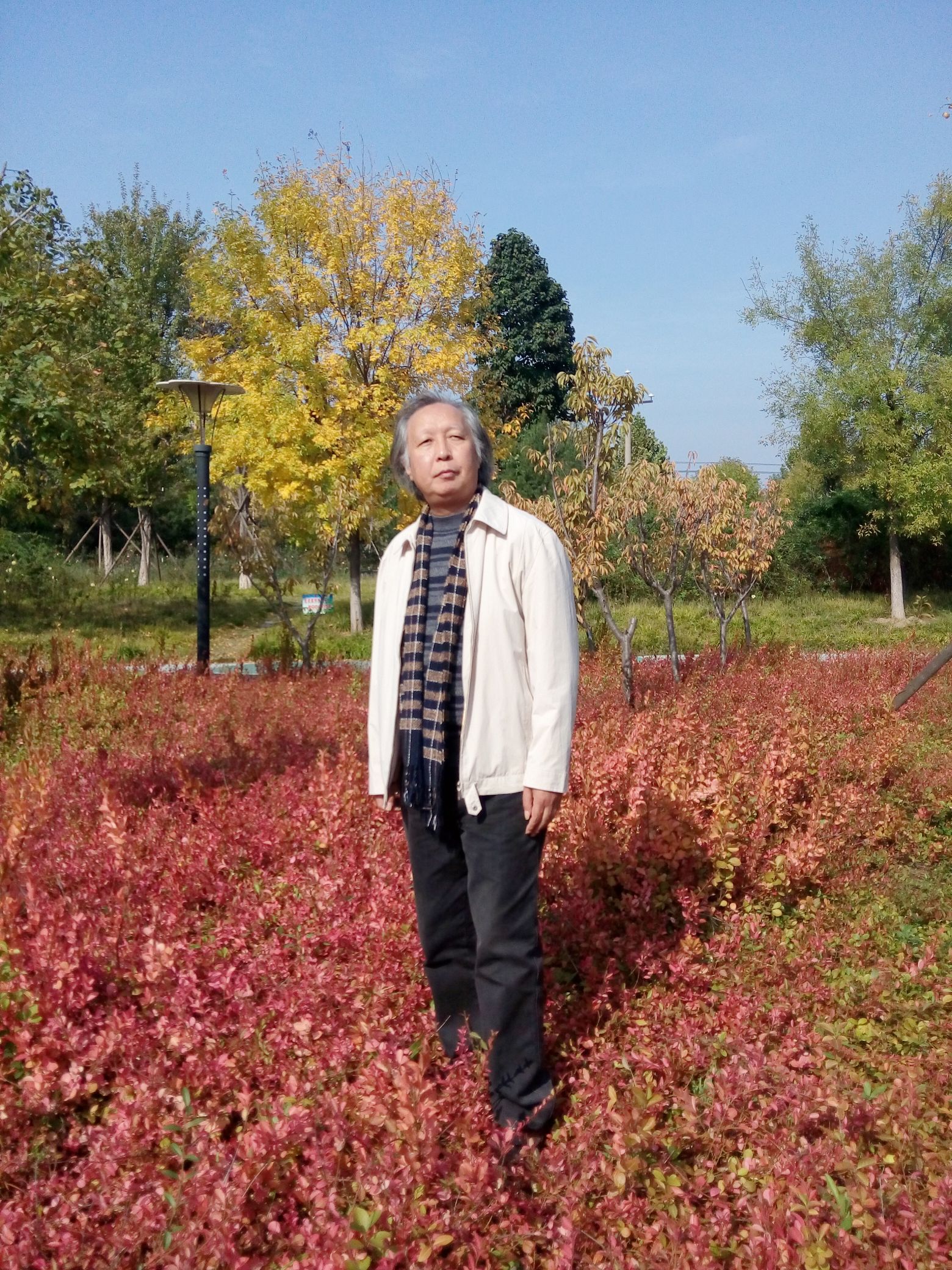
Bio:Yuan Hongri (born 1962) is a renowned Chinese mystic, poet, and philosopher. His work has been published in the UK, USA, India, New Zealand, Canada, and Nigeria; his poems have appeared in Poet's Espresso Review, Orbis, Tipton Poetry Journal, Harbinger Asylum, The Stray Branch, Pinyon Review, Taj Mahal Review, Madswirl, Shot Glass Journal, Amethyst Review, The Poetry Village, and other e-zines, anthologies, and journals. His best known works are Platinum City and Golden Giant. His works explore themes of prehistoric and future civilization.
Yuanbing Zhang (b. 1974), is Mr. Yuan Hongri’s assistant and translator. He himself is a Chinese poet and translator, and works in a Middle School, Yanzhou District, Jining City, Shandong Province China. He can be contacted through his email-3112362909@qq.com.
The farmhouse auction
Citadels shot golden while
farmyards purchased
long summer nights orchids watched.
Their patience fell into arms
that gave what needed—
prize blooms candescent
the silo’s hover.
The scene paled in memory now,
there’s shock when
death of one announces;
it avows boons doors had shouted
to youth gathered for deep appraisal
when their childhood was wonder
marked love shared with
nights that followed.
Each our yes from out them—
a sequence years form of
if failed undertakings
dreamed in the past stand
us envisioned
for glorious futures
cleft presence
abandons.
Night visions
The heavy land coils under
bond of peace.
Its reach affords
proved love’s ground
dying gives way to
in hollers firmament cheats.
Those passing shots comb the rage
planets succumb of
as ours barely alone
feels confidence
treason bothers
along owned nights agape at stars
their shower with dreams
this holy lounge,
trimmed fields doctored.A holding innocence
The clock tames their racked world with justice reluctant.
It forgets the passions that
rummage in their veins
as they seem an ounce of heaven harrowing
that tic-toc feeling desire ascends with
when youth climb to extend the
cut-life that wants its reign
pulled over the eyes of
what remanded—
lines pressed by Time
and the martyrdom
upheld with
so that shock blames each
the vaulting defendant.
 NOW (SONNINA)

                Another sick excuse
                  to postpone now.
                   We won’t excuse
                  this: a proper now
                 must clear our field
                              of lice,

                        must firmly field
         short-ra(n)ge objections. The matter lies
   beyond defensive asset orientation allowing fuel
              to sap its alleged beneficiaries.
             This now calls everyone to fuel
                  hospitably. Beneficiaries

                               spring
              forward. To reactivate spring.


 EXECUTIVE SOLILOQUY

 You’re the style
 of dog that spays its dozing master.
 This season’s
 consumption record: wretched. On
 the edge of treason.

 But we’ll see
 about that, Buster.
 We’ll turn you
 into a sound investment.

 Some stellar
 magnetisms remain to be
 unearthed by an imminent

 name brand who
 figures how to plant a miracle.
Thomas Fink has published 11 books of poetry– most recently A Pageant for Every Addiction (Marsh Hawk P, 2020), written collaboratively with Maya D. Mason, Hedge Fund Certainty (Meritage P and i.e. P, 2019) and Selected Poems & Poetic Series (Marsh Hawk, 2016). His books of criticism include “A Different Sense of Power”: Problems of Community in Late Twentieth-Century U.S. Poetry (Fairleigh Dickinson UP, 2001) and the co-edited anthology, Reading the Difficulties: Dialogues with Contemporary American Innovative Poetry (U of Alabama P, 2014). His work appeared in Best American Poetry 2007, edited by David Lehman and Heather McHugh. His paintings hang in various collections. Fink is Professor of English at CUNY-LaGuardia.