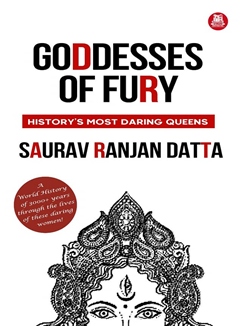
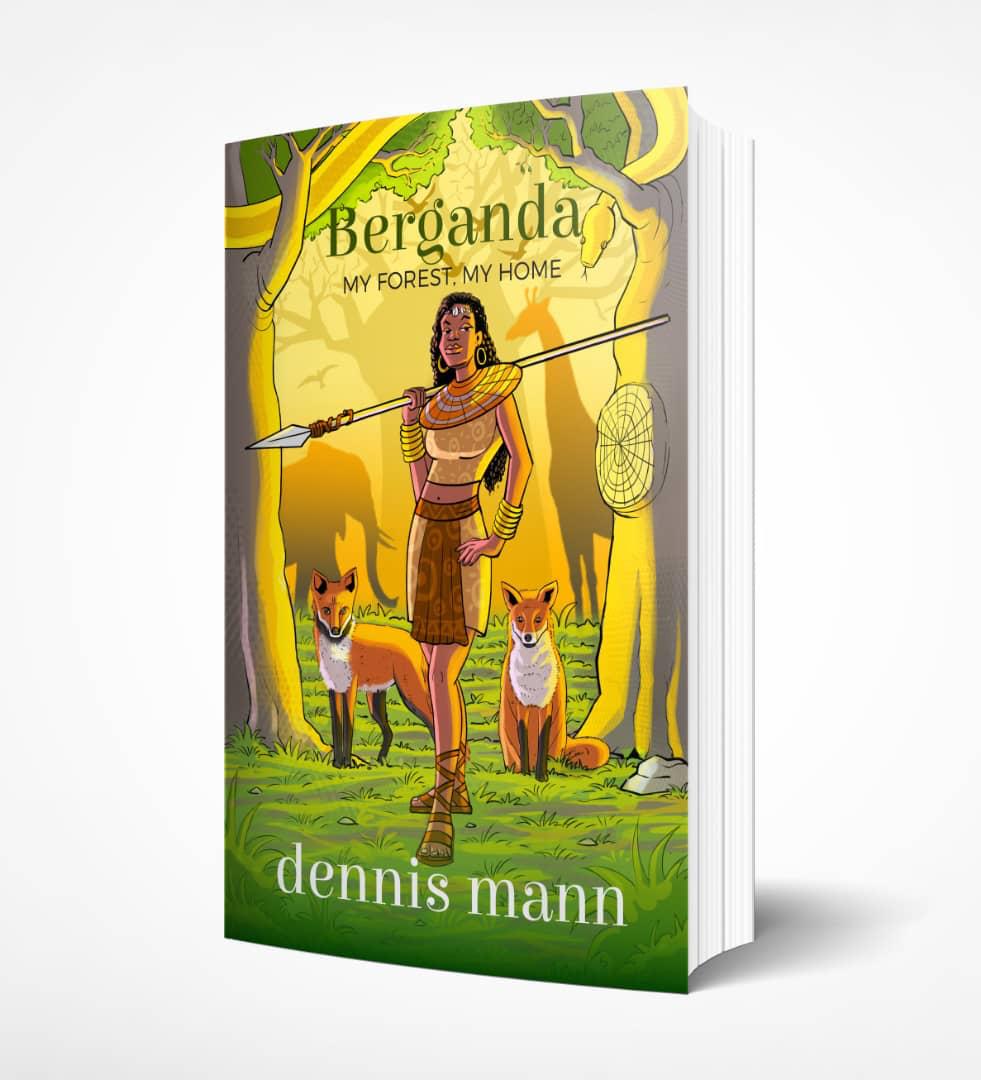
The purpose of this book is to erase a wrong notion from our minds that the history of this world was shaped only by tough, unflinching, strong men who were physically active as warriors. On the contrary, this book proves that women influenced events as much as men. They even surpassed all their contemporary males in bravery and intelligence many times. This book also analyses certain occurrences in world history that shook our past. Here, the readers will get the chance of travelling more than 3000 years in time through the lives of these daring women. The chapters would also read like crime thrillers because of much vengeance and bloodshed that happened in our past. To sum up, Goddesses of Fury is a work which narrates our complicated bygone days from around the world.
The book is available over Amazon for purchase. Grab your copies now.
Graciously, as a gifted poetic fellow I often like titles of whatever I write to differ from others. Thus, I hope this title BBR & BRR will not take you on wonderland but a special roller-coaster to ensure that you read deeper to the punch-lines as a means to absorb within the mental faculties of knowledge acquisition in the world of literature. Well, the twist and turns of words by a rapper makes him or her a tongue-twister, but in poetry we often prefer to describe it as ‘Word-Play’, hence every poet or spoken-word figure becomes a ‘Word-Player’ to bring-out a sensible story-line in relation to performance. Any-way, let me not be like ‘Hum-Ani’ beating around the bush or even the adventures of Berganda finding a solution to ensure afforestation.
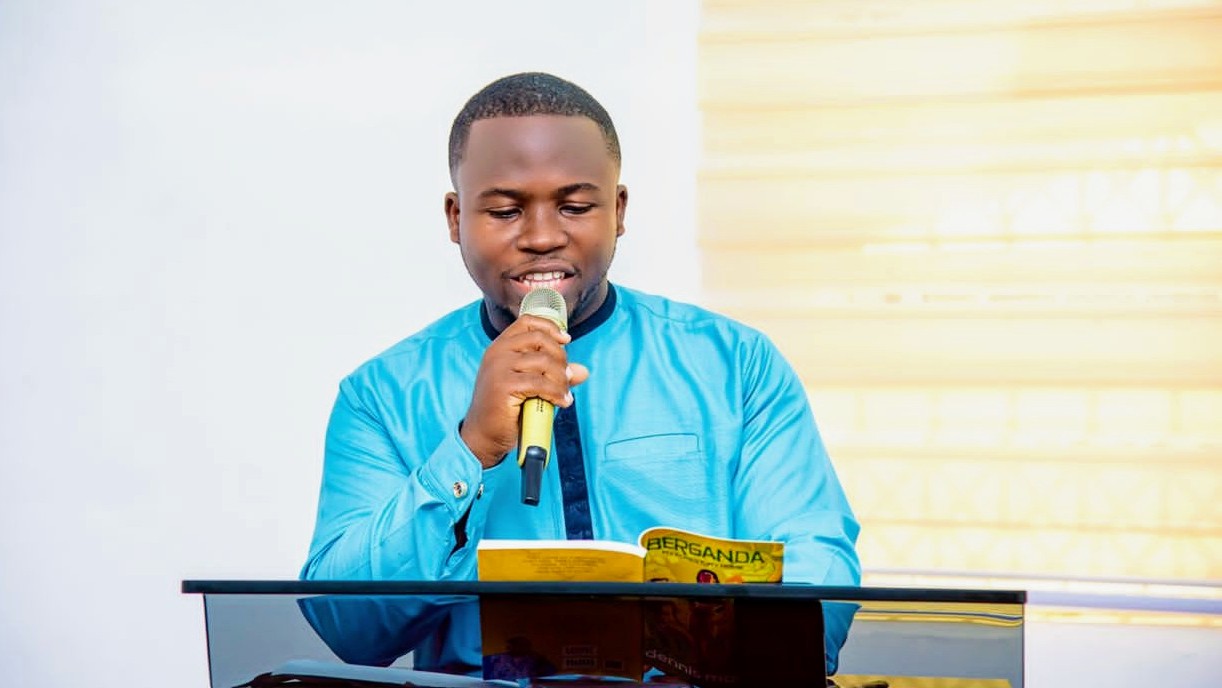
Lo, BBR is the chosen abbreviation Berganda Book Release and BRR means or refers to Berganda Reading Review as I’ve spent quality day-to-day time to engage in the usual Read Aloud Session – RAS of this educative and informative second (2nd) book of Ghana’s fascinating kids author in the personality, Sir Dennis Mann, founder and president – Wide Reading Among Kids – WRAK.
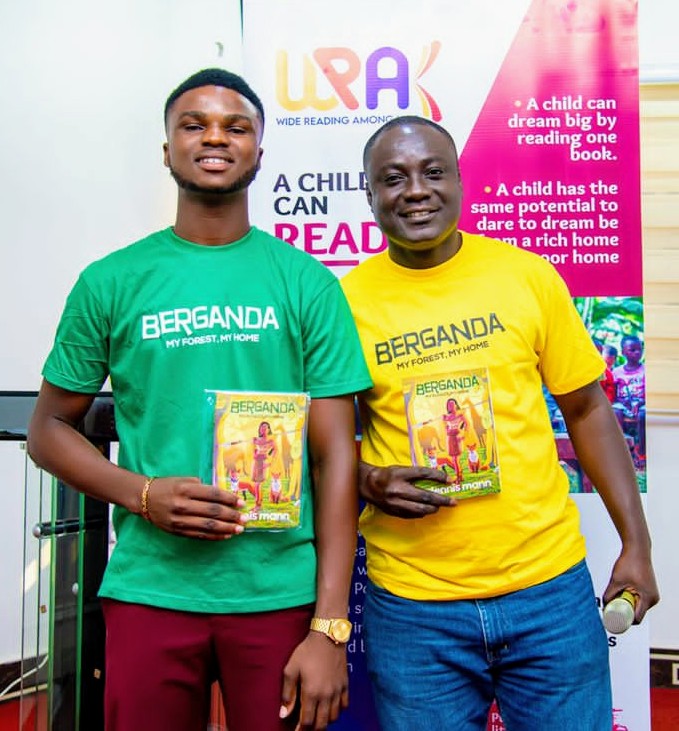
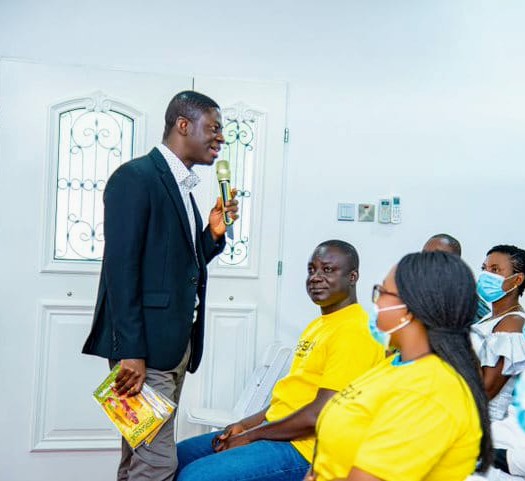
Philip Marfo and Ike Boat with Berganda Books in Hand
On faithful Friday,3rd December,2021 at 10am Greenwich Mean Time – GMT (Ghana Man Time). It’s commencement of the much anticipated and highly promoted Berganda Book Release ie(Launch),thus took place at the finest air-conditioned event-space dubbed Dreamer’s Hub under the leader-ship as well mentor-ship acknowledgement of Author Raphaelle Antwi in North Legon,Accra – Ghana,West Africa. Such a beautiful divine atmosphere with nicely created wooden bookshelf seen bold R-E-A-D. I meditatively absorbed and creatively came-out with Revise Every Acts Daily based on READ. Thus,such an aura to learn from AURA being Audience Of Ralph Antwi,an anointed and gifted man with ministerial as well mission-inspired speaking engagement both locally and globally. Aside,with over fifty (50) books under his author-ship and mentor-ship of multiple chaps. Factually,prayer points and topics of faith marked the commencement of program order as organized strategically by the author of Berganda book himself,Mr.Dennis Mann.
Incredibly,for me it’s a tip from the Central (Kasoa) ,Estate Top to Capital (Accra),Asylum Down area to kill ‘duo-birds’ with a ‘mono-stone’ in an environment of unfamiliarity, like a forest or village (rural) dweller coming to the city (urban) center with mind of novice about so many suburbs of Greater Accra Region,Ghana. Needless to say,the unfortunate happening of 1st December,2021 became a blow to the mind a bit but faith in God helped me to keep hope alive and focus on our scheduled Berganda Book Release #BBR on Friday,3rd December,2021. Oh,gosh! Airport arrival from Deustchland ie(Germany) as one of our special invited guests turned her home-going due to delay of PCR test results which is paramount for all travelers from all walks of lives. Well,it’s been close to decade since the first trip into Ghana, still Obroni Baa Dagmar Erb couldn’t embrace the triumphant welcome we prepared to offer her at Accra’s Kotoka International Airport. I’ve to state ‘God knows Best & God Knows Why!’
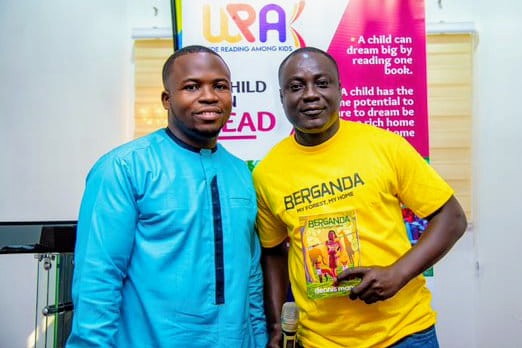
Ike Boat and Author Dennis Mann
Sincerely, your Ike Boat chap as the Anchor and MC of BBR exhibited professional delivery with little infusion of Akan,Fante dialect and high percentage of Anglo-know-how on the microphone coupled with poetic free-style session of Spoken-Word performance as one act I’m popularly known coupled being an awardee. Obviously,salt doesn’t praise its tastiness but the gig of ‘I Live In Amanful’ #ILIA piece was just a nostalgia about conditions and circumstances of where I grew-up in my primary and junior high school days as well as secondary level of academic education. I can say with certainty that the interaction with attendees as audience,WRAK manifesto speech by prime author of the day,Mr.Dennis Mann as well as part of Berganda book reading bring to memory good protocol duty by colleague and bruder (brother),Sir Philip Marfo, a man with hard-working positive spirit and right attitude to works. Special virtual shout-out to all our Bergandalicious team members and participants! Lo and behold,someone nearly cap-sided the float and flow of passionate boat but timely appearance of our special guest Speaker – Author Ralph Antwi really remedied crucial fund-raising moment of Berganda Book Release – BBR than the launch of Mr.Pee Peemaiden book by Mr.Dennis Mann i.e(Author). Suffix it to say,I like the general atmosphere in relation to sights and sounds of BBR in Accra.
Guest Speaker and Mentor and Author Ralph Antwi speaks to attendees
Finally, with respect to Berganda Reading Review – BRR, I commenced my usual Read Aloud Session – RAS on Wednesday 5th December,2021 at Room 15 of St.Sam Hotel in Asylum Down,Accra. Aside, I completed the entire 15 Chapters of it Content on Monday,20th December,2021 at the Mount-Zion International Gospel Church – MIGC Mission House premises, Estate Top, Kasoa – Central Region of Ghana,West Africa. Indeed, being an avid reader Berganda – My Forest,My Home is a must-get,grab and read book full of adventures. Believe you me,it has good story-line,subject-matter and central theme, thus can subsequently be turned into epic movie with wonderful characters, like Ahmed friend of the protagonist Berganda has traits compared to Ghana’s historic woman-warrior Yaa Asantewaa,the queen mother of Ejisu with such a spirit of heroism (heroine). Well,as the saying goes ‘Sweetness of the pudding is in it eating’, therefore I urge or beseech you to get in touch with Author Dennis Mann via E-mail Address: authordennismann@gmail.com or WhatsApp: +233247654113 so as to get and grab your copy for reading or bulk purchase for your children of ages 10 years and above. Better-still,it will be a good resource for your library. Of course, such a readable story-line with soft diction too makes your reading easy,lovely and enjoyable. Until then, from virtual to actual – Kindly,grab to read the Berganda book to experience it Bergandaliciousness! Thank You.
Dennis Mann’s newest book Berganda
Ike Boat – Writes in a serene quiet mood atmosphere with soulful gospel songs playing background at the perching place of MIGC temple located at Estate Top, Kasoa – Central Region, Ghana.(West Africa).
Kindly, E-mail: ikeboatofficial@gmail.com or Whats-App: +233267117700 t0 Advertise or Promote on Time With Ike Boat #TWIB Show on Morrash T
Another Whisper & Triumph

today i declare will be glorious:
revel in the morning gold
the light shines on still, even
when clouds sever the sun &
pieces fly to blinding rays.
endless day again; here,
where night has ceased,
will we truly be happy?
it has been this way,
it is this way,
it will be this way. but
sunlights drench me.
then clothing is just a reminder
we are alive & burdened
the day has gone on
too long & my creaking bones
splinter a bit further.
humanity weeps a
tired anger, fierce sorrow.
when night comes again,
we swear a million times
today,
tomorrow,
someday,
will be different.
Ahmad Al-Khatat

Grape Lips


The liquor store said that
They have sold their last bottle of red wine.
I wanted a woman who rises in my apartment,
and on the balcony like the sun back in Baghdad.

The snowstorm will not change my feelings about her
I am comfortable and independent just by thinking about her
The wine melting its fruits on her lips
-elucidates why I taste grape after kissing her.

Some people faces are breathing not peaceful,
It reminds me of the daylight of a hundred men and women who died
I sob for them, and the world took my tears to a particular forest,
Pour my sorrows’ to lifeless plants, leafless trees, and wasteland creeks.

 The moon in the midnight whispers in my ears
I want to kiss her apple blossoms on her cheeks lightly
I hope that I can farewell my grief the moment I kiss her neck gently
By then, her warm hands caress my bitter body against her sweet flesh.

12/24/2021
Welcome, readers, to Synchronized Chaos December 2021.
First of all, we invite the authors among us, and other book-lovers, to spread books around the world. Refugee Reads, a project launched by a mother and her young son in Texas, is collecting books that a local resettlement agency will offer to people who have recently moved to the United States. They ask for new books, so you are welcome to order books to send to them or mail them copies of your own books. Alternatively, Books for Africa accepts gently used books (up to 15 years old) which they will ship to various African countries. They have more specifications on what genres they’ll accept (no violent thrillers or murder mysteries or cookbooks or Western-centric titles) but are open to used titles in good condition.
This month’s contributors reflect upon where we stand in time: remembering, reminiscing, imagining their future or the world’s future, pondering mortality and immortality. Or just wondering what would happen if we stepped for a moment out of time’s moving stream to take stock of where and who we are.
Photo courtesy of Mathieu Stern
Michael Robinson writes of a dream where he felt at peace, happy with himself and his place in the world. Isabella Hansen chimes in with her own dream, contemplating the timeless moon with her mortal consciousness. Hongri Yuan, in poetry translated by Yuanbing Zhang, imagines eternal life in a supernatural realm of perfect orderly beauty, with the energy of a teenager.
In contrast to immortality, Mike Zone’s superheroes carry out their dramatic acts of strength in the shadows of their own impending deaths. Luis Cuauhtemoc Berriozabal’s poetic speakers consider their physical humanity and the incongruity of someone violently attacking fellow vulnerable humans. Mark Blickley illustrates the poignant indignities of aging while lonely J.J. Campbell takes comfort in wishfully enhanced memories and Gaurav Ojha reflects on life with the full awareness of death.
Stephen Jarrell presents a vignette of coming of age in a small town, whileJ.K. Durickponders trees, leaves, family heritage, and aging and Doug Hawley considers the culture of Portland, Oregon before and after his arrival. Abigail George reflects on how as an adult she would love to reconnect with and rediscover her deceased mother.
Photo courtesy of the Laramy-K Independent Optics Lab
Z.I. Mahmud finishes up his thesis on Charles Dickens’ literary output, highlighting themes of change and redemption. Chimezie Ihekuna’s screenplay collection Christmas Time also celebrates hope and redemption through stories of several different families, and the hero of Abdulloh Abdumominov’s short story finds peace at the New Year by deciding to forgive a friend with whom he had a small argument.
Christopher Bernard’s young Ghost Trolley hero figures out how to re-integrate himself into his ordinary world at the concluding installment of the tale. Hazel Fry laments lazy storytelling that deprives female characters of their strength and agency while Michael Reich critiques the false comfort manipulated media narratives attempt to bring us. Jaylan Salah interviews artist Danielle Shorr on topics that include how the media presents and discusses female artists and society’s treatment of abuse survivors.
Mahbub’s poetry evokes romantic love as well as international spiritual and historic tradition, connecting our humanity to something greater than ourselves. Starlie Tugade’s lovers pass each other by like passengers on separate trains, as one of her characters is unable to open up and receive the other’s love.
Linda Hibbard warns of the future ahead of us with climate change, while Henry Bladon’s nihilistic pieces semi-humorously question our fears and concerns about our present or our future.
Photo by Neil Howard
David L. O’Nan pays a tribute to a musician whose art he considers timeless, while Ike Boat announces the launch of the novel Berganda by Dennis Mann.
J.D. Nelson sends in more of his playful, near-imagistic words, while Alan Catlin’s words, ideas, and iconic names flow into each other in his pieces. Mark Young’s images hold together with swathes of color and an internal logic, and meanwhile, Rus Khomutoff invites readers on a wild surrealist adventure.
We wish all of you happy reading and a happy New Year!
A Silent Chorus of Waves

I dream stillness under the rough shine of the moon, hands clasped and when one blunt fingernail
scratches the inside of a palm, I am rooted, edges of raven black hair shining. And when I am
viewed upon moonlight, I am cold tranquility.
When the ocean is brought into view, glimpsed with eyelids peeled back like the naked
tangerine I hold in the curve of my hand, I am gifted an abundance of night. Thinly stretched
over the skyline, darkness barely touches my feet on the cold concrete. Air stinging across my
lips and my legs are exposed to the coolness nighttime inflicts, pajama shorts belonging to the
comfort of a warm home, I am as about as silent as the ocean. There is an echo of conversation
from dark homes, whispers gliding past turned heads because dark inspires silence and the slow
crash of waves is faint in the air. Night blends lagging movements behind thin, sand crusted
walls, pushing motions into a soft cycle of repeating routine but in the dark. Match flicks flame
into candles and my world, a silent world, is tossed back into loudness.
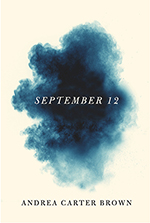
Andrea Carter Brown’s new collection of award-winning poetry September 12 was published by The Word Works for the 20th anniversary of 9/11. She is previously the author of Domestic Karma, The Disheveled Bed, and Brook & Rainbow. “American Fraktur,” her current manuscript, won the 2018 Rochelle Ratner Memorial Award from Marsh Hawk Press. Her poems have won awards from Five Points, River Styx, TheMacGuffin, and the Poetry Society of America, among others; and are cited in the Library of Congress Online Guide to the Poetry of 9/11. They have also been featured on NPR. Andrea was a Founding Editor of Barrow Street and Managing Editor of TheEmily Dickinson Journal. For six years, she served on the Virginia Center for the Arts (VCCA) Fellows Council, the last three as Chair. Since 2017, she has been Series Editor of the Word Works Washington Prize.
Mary; Welcome to Synchronized Chaos Magazine, Andrea. September 12 is a powerful series of poems. Before we discuss the poems themselves, could you please set the scene by telling us what happened to you on September 11, 2001?
Andrea: That morning, I was sitting in our apartment a block from the World Trade Center drinking coffee and reading the paper. Later I planned to spend time writing and then get dressed and go to a client (I did freelance accounting work back then). At 9:03 am, the phone rang. My sister, in North Carolina, had just seen the 1st plane flying into the North Tower on “Good Morning, America.” I ran to the far end of the room, looked out the window, and saw flames curling through blown-out windows, rivers of black smoke, chunks of debris falling, people jumping. I knew immediately the towers would come down, and I fled.
Rather than head north, as did almost everyone else, I went south and ended up on the Staten Island Ferry. From there, traveling on foot, by ferry, car service, pick-up truck, another stranger’s car, and cab from Staten Island, through New Jersey, and Rockland County, I finally met up with my husband in his boss’s house in Larchmont, which is in Westchester County—about 110 miles altogether. It took twelve hours. The first four, when we couldn’t reach each other, my husband was sure I was dead.
Mary: September 12 is divided into five sections: I. Cloud Studies: The Hudson River School; II. September 12; III. The Rock in The Glen; IV. To The Dust; V. The Present. I’d like to start with Section I, which is lyrical and almost dream-like. There’s an innate silence and innocence to these pre-attack poems, one of which looks back to 1609. Why did you decide to start September 12 with these poems and how do they reverberate through the rest of the collection?
Andrea: After I had written most of the eyewitness account and some of the aftermath poems, it occurred to me that you cannot have a book of elegies without showing what was lost. For me, that was the life before, a life lived on landfill facing the Hudson River, fourteen years, longer than I had ever lived anywhere else, including my childhood homes. The river is actually a bay of the Atlantic Ocean at the base of Manhattan, so that my life was punctuated by skyscrapers on one side, and on the other by tides, boats, weather, and changing light, a life filled with history and beauty. For ten years I had been writing about that world, and I decided to use these poems to set the stage for 9/11.
As you noted, these poems reverberate through the rest of the collection. Each one plants the seed for something to come, sometimes several: a love of birds and birding; rivers, the ocean, and the estuaries where they meet; the essentially domestic nature of my odyssey on 9/11; the many writers, especially poets (for me), associated with NYC (Whitman, O’Hara, Amy Clampitt); the distrust between Henry Hudson’s crew and the local Native Americans who lived in the area, the Lenni-Lenape, which lead to violence and death during their initial encounters in early September, 1609; the fascinating geology and glaciated terrain of the area, gneiss and schist, the metamorphic bedrock near the surface of Lower Manhattan, making possible the extreme height of the WTC Towers; and my love of baseball, especially at that time, the Yankees.
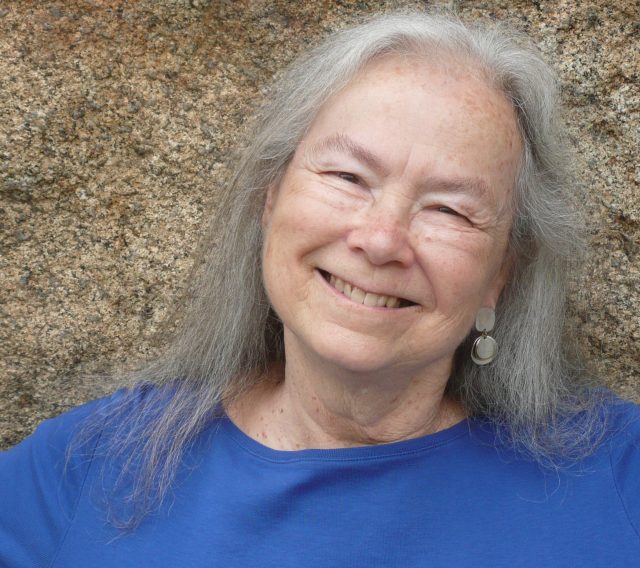
Poet Andrea Carter Brown
Mary: Section II, September 12, is a nine-page series of prose poems, each a paragraph long, which describes your flight from your apartment on 9/11 and what you experience as you and those around you run for their lives. Polished and beautifully crafted, these poems retain a raw, immediate, emotional power that is stunning. I’m particularly impressed by the way you avoid hindsight and deal with events as you lived them moment-by-moment. Could you please talk about why you chose prose poems for this section? For example, were they originally diary entries?
Andrea: Oh, how I wish I had diary entries! But, no, the truth is: I didn’t write at all for 6 months. Instead, I re-lived the events in minute detail again and again in my mind, day and night, telling my story to others, especially my husband, beginning the night of September 12, as recounted at the end of this section. Each retelling, for the first few years at least, new details came back. I added these to the story, until this past became more real, more present than the present. Just as I didn’t want to wash my dirty clothes the night of 9/11, although I had nothing else to wear, I didn’t want to let anything go. Even the dirt and dust. I didn’t take a shower for days. Eventually my husband would complain, “cut to the chase” when I was telling the story, but I couldn’t. All the little details together made the whole.
Since then, I have often thought of writers in gulags who made themselves memorize vast bodies of work because there was no way to write. I’ve never been good at memorizing and still am not. Nonetheless, six years later, when I tracked down what I had said to a reporter on Staten Island that afternoon, I learned that my memory had stayed true. And if my memory was accurate about those details, I could trust it about others, which was an enormous relief. Very liberating. Nothing, in all the research and interviews I did for this book, contradicted the story I kept telling myself. How could this be? And yet it was. It is.
It was a challenge not to stray from the moment-to-moment story. Since I was a poet, “poetic” gestures unconsciously crept in: the impulse to offer metaphors, similes; the way meter and musicality elevate the material, heightening the emotional power but draining away immediacy. These I tried to resist by stripping description down to the essential minimum, making every word count, limiting rhetorical devices like repetition. I tried to stay in the present tense. Not to use words that were hyperbolic or inflammatory, words that had been over-used in describing the event and to which we had become numb. One example of this: the word “terror” only occurs once in the entire book, and not about the event, a terrorist attack, but to describe the look on a first-time father’s face when he contemplates the newborn baby in his arms (the poem “Joe” in the Section III).
Avoiding hindsight was difficult because experience being sequential, knowledge builds. Since the book took so long to write, I began asking myself constantly, “What did you know at the time?,” and then stripping away anything that had crept in later. Sometimes that felt like pulling teeth, especially for the sections that were hardest to write and therefore took the longest. I’m thinking of the people at the windows who jumped, the ferry engulfed in smoke (when the first tower fell), and the swimmers seen from the ferry. Shortly before we went to press, I read the narrative closely, looking for all these things. To my dismay, despite repeated checking, I still found instances that had to be fixed. I couldn’t be more happy that you noticed this aspect of the book.
Mary: Do you have a favorite poem in Section II that you’d like to share with us? Why is it a favorite?
Andrea: Many of the individual prose poems in the long sequence September 12 consist of crucial moments in that story. It’s very hard to pick my favorite, but recently I’ve come to a new appreciation of the poem about the Staten Island policemen in Section II. Readers seem to love him, as I do too, and that makes me happy. Sadly, I’ve forgotten the name on his shield. Here’s the poem, with the lead-in, on pages 36 to 37 in the book:
. . . When the uniform cop hears She lived there, he opens his arms and gathers me to his chest.
Held against his massive bulk, the embossed brass buttons on his jacket, the decorations pinned to his chest pressing into my cheek, I cry my heart out. Only when I’m ready does this burly red-necked stranger release me, murmuring Stay close to me. You’ll be safe here. I stand beside him, reluctant to move, our arms touching. A wool blanket miraculously appears around my shoulders. For years, he volunteers, we’ve known something like this would happen, but didn’t do anything to prevent it.
Mary: The poems in the final three sections deal with the aftermath of 9/11 from September 12, 2001 to September 8, 2020. Why three sections instead of one entitled “Aftermath?” What prompted you choose to organize the poems in this fashion?
Andrea: Given the difficulty of this material for readers, from the beginning I knew that I had to break it down into manageable chunks. Even my own attention would flag after 15 pages. It was too much to take in. I spent a lot of time experimenting, trying to find the poetry equivalent of prose chapters.
The solution became clear to me only after I visited my old home town, Glen Rock, New Jersey, which had lost 11 residents on 9/11. This was one of the higher victim counts from among the surrounding suburban towns. Although I learned about these victims in late 2001, I didn’t yet see them as part of my story. It had been 25 years since my parents retired and moved away, and I had not been back. But these names haunted me. On a research trip in 2007, I realized the town had essentially not changed at all since I grew up there. It was still a peaceful commuter town of modest homes for starter families which shuffled its fathers (mostly men back then) off to work weekday mornings on Wall Street in Downtown Manhattan. They would emerge from the ferries or the train into the area around the WTC and fan out to their offices, repeating the same journey every night in reverse.
Those ten men and one woman who died on 9/11 could have been the parents of my friends; I knew intimately what a town like this was. Suddenly, those 11 victims became people I might have known, and I wanted to memorialize them. That town came to represent all the small communities, inside NYC and in surrounding areas, which lost residents that morning. These poems became the central section of the collection, The Rock in the Glen, serving as a bridge between my first person eyewitness account and the aftermath poems, allowing me to separate the immediate aftermath poems in Section IV from the longer-term aftermath poems about life after moving to California in Section V. As a former accountant descended from a math teacher and a long line of bookkeepers, I love numbers. You can probably tell by the sheer number of numbers in this interview. The idea of a collection with five sections, two sections on either side of a central sequence about the town that lost 11 people that day, like a palindrome, made me happy. It felt perfect.
Mary: You’ve said that it took you twenty years to write September 12 and that the original manuscript was 200 pages long. How did you go about paring down the manuscript to 80 pages?
Andrea: The first 10 years I was writing this book, I kept adding more and more material. The last leg of my journey and our return to the apartment 4 days later, which completed the circle of my odyssey begun 9/11. The history of New York City and the Hudson River, human and natural. And about Ground Zero, which had become our neighborhood, and how we navigated the challenges of living so close to the site of a mass, world-changing tragedy, now a toxic waste site.
As it approached 200 pages, I saw September 12 more as a collection of short stories or a short novel in verse. But this length is a tough lift for poetry publishers, who are used to less than half that. Friends told me I had to be realistic and pare it down to find a publisher. I fantasized about publishing it in 2 volumes, but knew better than to try that. Over time, the manuscript shrank to 143 pages, then 110, before settling on the version with 80 pages of poetry accepted by the Word Works.
Readers also told me the fundamental structure—the main narrative told in 12 double sonnet crowns (each 14-15 sonnets, the last line of each poem repeated as the first line of the next) separated by the hay-sonnet Glen Rock victim portraits and punctuated by step-out poems in other forms which highlighted dramatic moments along the way—was cumbersome and sapped the drama of its power. All those repeated lines, even varied, seemed like wasted space. This was very hard to hear. The sonnet crown structure had made writing the material manageable by dividing it into smaller units; the step-outs provided formal relief and variation from the constraints of the 14 line poem.
Taking it out of the form to which I had devoted years was the most difficult thing I have ever done creatively. But the minute I removed the lineation of the narrative, the story came alive to me again. I immediately saw what was essential and what could be cut. Plus, reading it as prose felt revolutionary, similar to the way the idea of the book had always felt radical. Yes, an odyssey, but a domestic one, the narrator being female. A book of poetry that would be relentlessly factual. A hybrid collection which restlessly strayed from or played with the “Poetic.” A sustained eyewitness account in verse that contributes to the historical record. I never looked back from that decision.
Mary: The aftermath of an event like 9/11 goes on forever for all of us, and particularly, I would imagine, for someone who was so intimately involved. Are you still writing poems about 9/11? If not, what kind of poems are you writing?
Andrea: I think I will always be writing about 9/11 as long as I write. My life has not been the same since; I am not the same person. But as time goes by, that writing is less about that day, and more about how it reverberates in the present. Every anniversary, for example, I write a new poem documenting that day in some way, just as I always write a poem on my birthday, an idea I borrowed from Joseph Brodsky. Every 9/11 (except in 2020 during the pandemic), to celebrate our survival, my husband and I go out to eat. One anniversary, the 15th I think, as we raised our glasses to toast each other, we noticed the much younger couple at the next table was doing the exact same thing. Turns out they too were commemorating their survival on 9/11. Here were two couples, complete strangers, having moved clear across the continent to build new lives in the same city, now seated next to each other at the same restaurant. You can’t make this stuff up! Of course I wrote about that. We shared stories, compared dishes, went back to our desserts, waved goodbye and left. Somewhere I have their first names, and I can picture them, their joy, like ours, tempered by memories of that day. I could give you countless other examples of ongoing work related to 9/11.
That being said, I also wrote and published two other poetry collections while I was working on September 12 —DomesticKarma and The Disheveled Bed, neither of which had anything to do with 9/11. I’ve recently finished a new collection, American Fraktur, exploring my father’s experiences as a WWII soldier ashamed of his German immigrant roots who pretended his origins were Scottish, despite documentary evidence to the contrary. The poems about his wartime experiences dovetail with mine as a survivor of a terrorist attack living in a time of constant war, rising intolerance, hatred, and human and natural disasters. During the pandemic, a time which vividly brought back memories of 9/11 and for which 9/11 strangely prepared me, I finished another collection, Enduring, and I have an idea for an abecedarian collection kicking around inside me. After that, who knows? When you come to writing late, in my case middle age, there is a lot of material inside you.
Mary: If you could ensure that one of the poems from September 12 would survive to be read 500 years from now, which poem would it be, and why have you chosen it?
Andrea: It’s hard to choose, but I think it would be “The Old Neighborhood.” This poem preserves the world I knew, in all its particularity, as it was the morning of 9/11 before the towers came down. This was the world I loved and was happy to be part of: lively, colorful, friendly, diverse, full of people offering and savoring what makes life worth living. Every time I read this poem, out loud or to myself, that world comes alive for me again, even 20 years later, and I am grateful and a little mystified, humbled, to have written it.
Mary: Thank you, Andrea. It’s been a pleasure to talk to you about September 12. Do you have any upcoming readings, workshops, or other events? How can people get in touch with you?
Andrea: The best way to get in touch with me is through the Contact button on my website: www.andreacarterbrown.com, where you can email me or ask to be put on my mailing listing for upcoming events. With everything still in flux about “in person” or “remote,” my website is also the best way to find out about readings and events or audio/video interviews and readings as they become live.
Mary: Thank you, Andrea. It’s been a pleasure to talk with you.
Andrea: Thank you, Mary, for your thought-provoking questions, not one of which has been asked by anyone else. It’s also always a pleasure to talk with you.