Essay from Farangiz Abduvahidova

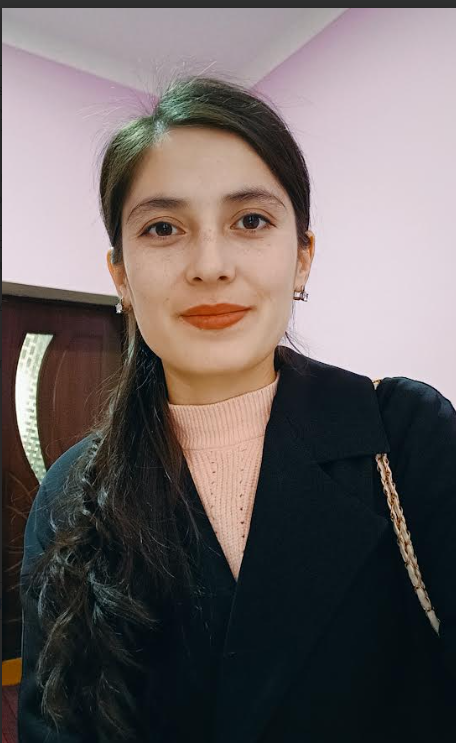
Photo is of a young Central Asian woman with dark hair, brown eyes, and a gray pant suit over a white collared top speaking at a podium.

Abduvahidova Farangiz

2nd stage student of Samarkand State University named after Sharof Rashidov. 

Abduxalilboyev Alisher 3rd stage student of the Tashkent University of Information Technologies named after Muhammad Al-Khorazmi​​​​. Uzbekistan. 

Artistic arts found in Nadirabegim’s life path and ghazals.

Abstract: In the article, we have mentioned the life path and literary heritage of our poetess Mohlaroyim, who made a great contribution to the development of Uzbek poetry. Also, we will get acquainted with the explanation of the artistic tools used in her ghazals and the sentences that are the basis for the creation of this art.

Key words: Nadira, Maknuna, Komila, metaphor, tazad, ghazal, muhammas, literary environment.

Our talented poet Mohlaroyim, who wrote ghazals in Persian and Turkish under the pseudonyms “Komila”, “Maknuna” and “Nadira”, was born in 1792 in the family of Andijan governor Rahmonqulbi. He was not only a teacher, but also an enlightener and a statesman. In 1807, Nadira was married to Omar Khan, governor of Margilan. Nadira plays a major role in shaping the literary atmosphere in the palace. The reason is that her husband Omar Khan also created under the pseudonym Amiri. Nadira meets Uvaisi and invites him to the palace as a teacher. In 1810, Amir Olim Khan dies and Umar Khan comes to the throne. From this year, Nadira will continue her work in Kokon. Due to the tragic death of Amir Umar Khan in 1822, his son Madali Khan took over the throne. During Madali Khan’s rule, many madrasahs, mosques, caravanserais were built and served to improve the creative environment. Nadirabegim and his family were executed by Amir Nasrullah, the ruler of Bukhara Emirate in 1842.

 Although the poetess did not live long, her works of about 10,000 verses were inherited. In addition to ghazals, he also penned mukhammas, rubai, and fard genres. In his ghazals, separation and grief are sincerely described and he continued the traditions of famous poets such as Navoi, Bedil, and Fuzuli. There are 19 (328 verses) ghazals under the pseudonym “Komila”, and one divan with 333 ghazals under the pseudonym “Maknuna”. Under the pseudonym “Nadira” 180 poems are collected, 136 of them are in the Uzbek language, 44 in the Tajik language. Among them, there are 11 muhammas, 2 musaddas, 1 muhammas, 1 translation, 1 table of contents and 1 statement.  

Nadira’s radiative ghazals “Vasl uyin obod mem…”, “Marhabo”, “Dahrni examinet ke te”, “Sogindim” are very popular. A number of artistic arts were also used to make the ghazals more subtle.

I improved the house, but it was destroyed by the emigration

Unfortunately, this building was destroyed.

In this verse, the art of tazad was created by means of the words prosperity and destruction. Tazad is an art created by imitating things. Seli ghamdin is used in the meaning of a flood of sorrow and was the basis for the creation of the art of Mubolaga. Exaggeration is the art of exaggerating beyond belief.

He did it until the piraham stain revealed my tongue,

I don’t have any more love hidden in my heart.

The words love, heart, and soul created the art of harmony, and the words open and hidden created contrast. Contrast is an art created by contrasting things. Proportion – Many art forms rely on the spiritual association of words in poetry. It is the poet’s use of words that are logically related to each other and require each other.

Zahida, forgive the people of love,

What happened to Sheikh San’an in Yor Bay?

This verse describes the art of talmeh. Sheikh San’an used this art by mentioning his name. Ishq, love, asceticism are the basis of the art of relationship. The art of proportion is formed from cognate words and synonyms in linguistics. Talmeh is one of the widely used art forms in classical poetry. In this, the poet summarizes his thoughts by referring to a famous story, event or work, person. 

Although there was a special order of the giants,

After all, Suleiman died in a bad way.

Mor is the art of dev tazad, Sulayman is the art of talmeh.

Because the jewel of my heart is blood instead of love,

 Tears dripped from my eyesThis verse uses the art of tashbeh, the gem of love – the gem of love. Allegory is one of the most productive poetic arts widely used in literature. It can be said to make it into Uzbek. In metaphor, things, signs, and actions are described by analogy and comparison. In addition, another art was involved in this very verse. It emphasizes the tears through the word necklace. This art is called metaphor. Istiora is an Arabic word that means “borrowing”. One thing is called by another name.

My figon, the collar of my son,

I am very sad, my heart, you are not aware of it.

In this verse, the word “heart” is used as an exhortation. From the fine arts, it was the basis for the art of exclamation. Nido is distinguished from other poetic arts by its ability to openly and powerfully describe the feelings and emotions of the human heart. In this case, the thought is focused on a person or an object.

If you want to repair the Kaaba,

Turn the broken heart into a prosperous one.

In this verse, the word Ka’ba is contrasted with the words talmeh and abad – ruin. In our linguistics, the words that form the art of contrast are called antonyms – words with opposite meanings.

The work of the poetess is a great heritage for us. Despite being the wife of the king, Nadirabegim did not stop her creativity. He worked to make people and people intelligent and enlightened people. He managed to unite the intellectuals of that time around him. Life at that time was a little easier. The work of the poet began to be studied during her lifetime and works dedicated to her were created. For example, “Tuhvatut-tawarikh” by Avazmuhammad Attar, “Muntahabut-tavarikh” by Hakim Khan Tora, “History of Fargana” by Ishaq Khan Tora, “Haft Gulshan” by Nadir-uzlat. We saw the poetic arts in the analysis of the poet’s ghazals and analyzed them. We will continue the analysis in our next work.

List of used literature.

1) 10th grade literature part 1. “National Encyclopedia of Uzbekistan” state scientific publication.: Tashkent – 2017

2) 6th grade literature part 2. “Spirituality”.: Tashkent – 2017.

3) Uz.m.wikipedia.org

4) knowledge.uz

5) n.ziyouz.com

Poetry from Sayani Mukherjee

Green


A slowly cacophonous morning
Screaming of faultless surprises
I call back at the ruinous evening
The way the sea chanters will sing
And mourn the last evening
The soil of earth soaked happiness
The numbness, the choice of green fragility
The bemoaning madness of survival of green moist
Is this a new horizon of tumultuous ocean? 
I sign and beck a call of happiness
The night knows thousand epiphanies
A fireglow at the tale end 
Till I lose my breathe for the sky line wine. 

Essay from Jumanazarov Zohidjon

Young Central Asian man with short dark hair, brown eyes, and a black suit and tie.

I love the rain

I love the rain, its gentle touch

A soothing balm, I love so much

It washes away my worries and pain

And fills my soul with peace again

The pitter-patter on the window pane

A symphony of nature’s refrain

The earth drinks in its sweet embrace

And all the world seems in its place

The air is cool, the scent is clean

A tranquil beauty, rarely seen

I love to dance in the falling drops

And feel the rhythm, my heart never stops

The rain brings life to every living thing

A gift from above, like a melody to sing

I love the rain, its calming sound

It brings me joy, wherever it’s found

Jumanazarov Zohidjon Eldor’s son was born on March 14, 2006 in Narpay district of the Republic of Uzbekistan, Samarkand region. Nation is Uzbek. Incomplete education. In 2012-2023 he studied at the 16th comprehensive school of Narpay district of Samarkand region. In 2023, the Uzbek State Institute of Arts and Culture was admitted to the “Culture and Arts Management” on the basis of a grant. He has achieved a lot of success during school and now. During the institute, the Ministry of Culture of the Republic of Uzbekistan, and in December 2023, set a global ranking record for IQ (40 seconds).

Poetry from Duane Vorhees

DON’T INTERRUPT

My tongue is trying mightily

to memorize your mouth.

Ny tongue is training hard

for your prestigious,

and demanding,

texts to come,

MY I

Moleculed into existence by hope’s heredity,

any I is a sum of its actions and its beliefs.

At first these were fostered by practice and authority,

and then in the youth they were constellationed by passion,

and then in a careful age constitutioned by reason.

This nowI lies striated by habit and destiny.

CHANGING HABITAT

That which is between us–

:is it a floor or a corridor?

:is a wall or an interval?

:is it concrete or a ghost?

The cityscape altered,

our promenades became barricades.

Every touch feels more like a cut.

Marathons may falter.

A dozen christenings, one thousand crypts.

All the tears we wept, the saints invoked, the promises broke.

The ends of beginnings.

FIRST NIGHT IN THAILAND

Giraffic

I lever through the sweat the noise the dirt the traffic

(knowing she smiles somewhere, all brown and gentle hills),

gnu-like

legs unsplay, crookback unscrews like new.

Under her softink waterfall her eyes a-beckon

somewhere, here, in Bangkok.

LEY LINE

Lids closed, fingers open:

With mind and palm along your body map

I’ll trace the truth of you,

Enlightenment needs no light,

This (any!) erotic journey

starts at the muscular center of fizzog expression:

I read your phrenology Braille,

the honest simplicity of your long high forehead.

My explorers find your wisdom,

mind’s eye between world’s myopia,

pause softly between your brows,

before plunging

down—

Forefinger sacrilegiously slaloms the Mimizuki,

j-curves under the septal cartilage,

lingers awhile (for your aromatic delight)

and balances across your fairy-tale philtrum

(the corridor chipped from your upper lip

by Night, the Angel of Conception,

that one, who offered a semen drop to god,

who chose a soul from Eden

to cradle in your mother’s womb,

–who’ll guide you to heaven when you’re done—

a nice bedtime story trades the nevers for the nows.

My whorls rest at Cupid’s Bow.

I nock my arrow for awhile

where tongues trade moistures, exchange heat for heat,

rituals of encouragement for the holy trek to come.

….

Refreshed, the phalangic pilgrimage resumes.

Tips skirt the lover’s chin well to keep from falling in,

then hook under the jaw’s overhang in freefall

hardly braked at all by the void deck

of Adam’s not-quite-absent apple

(the unswallowed remnant of your first man’s forbidden fruit?)

and advance down and down,

hesitating at the mammary gate

(moist by now with the seer’s perspiration)

but able to resist the curious alpining temptation

in the knowledge that the end is near,

the mountains can wait —

sometimes the summit is not the sum.

Down and down, quickly now,

no urge to contemplate the navel

if consecrating the bishopric is the goal.

The pope pops in to Cathedral’s portal,

enters stiff-necked, humbly exits.

The Tree of Life shakes from the roots.

….

All existence starts twice,

once with Mind, once with Life.

Landmarks come and landmarks go

but the path is marked by one straight line–

any perceptive fool can blindly find the way….

And yet the silk hegira road goes on

even farther, beyond the oasis spring

for those who wish to follow —

around the archaic curvature of Mother Earth,

that halves the buttocks’ apple

and turns the heart upside down,

and then up 33 stations of the spine,

–spine–the measure of stiffness in an arrow shaft,

–spine–the furniture that clasps the book together,

–spine–the hard stairway to the base of brain.

Essay from Maftuna Mehrojova (one of two)

THE ROLE OF THE “GREEN ECONOMY” IN ENSURING SUSTAINABLE DEVELOPMENT

Mehrojova Maftuna Soli qizi

student of the Jizzakh branch National University of Uzbekistan named Mirzo Ulugbek

maftunamehrojova64@gmail.com

+998886431643

Abstract: This article analyzes the role and significance of the green economy in ensuring sustainable development. A green economy is an approach to sustainable development that combines natural resource conservation, environmental protection, and economic growth. The article focuses on the role of the green economy in ensuring economic growth, environmental sustainability, and social justice. The importance of a green economy in combating climate change through the transition to renewable energy sources, efficient resource management, and waste reduction will also be discussed. The article aims to explore practical ways to ensure sustainable and equitable development through a green economy.

Keywords: Sustainable development, green economy, environment, renewable energy, efficient resource management, climate change, economic growth, social justice, environmental sustainability, government policies, sustainable development goals, green jobs.

  INTRODUCTION

In society, ideas about the need to conserve natural resources for reaction and research purposes gradually led to the formation of scientific concepts based on environmental responsibility to future generations. The implementation of these ideas into practice should be addressed through ensuring sustainable development. Sustainable development is understood as development based on non-threatening the ability to meet the needs of future generations in order to fully meet the needs of the population. Sustainable development can be viewed as a process that develops through the synergistic effect, based on the interconnected development of the “social” – “economic” – “ecological” triad. An economic approach to sustainable development involves the rational use of limited resources. The social approach will be aimed at ensuring social stability and cultural diversity on a global scale. An ecological approach should serve to ensure the normal functioning of any ecological system.

MAIN BODY

At the beginning of the 21st century, the United Nations put forward 17 interconnected global goals as priority directions for human development. According to a study conducted by the Global Recovery Observatory of Oxford University, supported by the United Nations Environment Programme (UNEP), less than 20% of the total expenditure for recovery is allocated to environmental issues. On December 2, 2023, the President of the Republic of Uzbekistan adopted Resolution No. PP-436 “On measures to increase the effectiveness of reforms aimed at the transition of the Republic of Uzbekistan to a ‘green’ economy by 2030.” A program for the transition to a “green” economy and ensuring “green” growth in the Republic of Uzbekistan by 2030 has been approved. It is designed to achieve the following strategic goals:

• reduction of greenhouse gas emissions by 35% from the level in 2010;

• Increase the production capacity of renewable energy sources to 15 GW and increase their share to more than 30% of the total volume of electricity production;

• increasing energy efficiency in the industrial sector by at least 20%;

• reduce energy consumption per unit of GDP by 30%, including through expanding the use of renewable energy sources;

• significantly increase the efficiency of water use in all sectors of the economy, introduce water-saving irrigation technology on an area of up to 1 million hectares;

• Expand green areas in cities by more than 30% by planting 200 million saplings per year and increasing the total number of saplings to more than 1 billion;

• Increase the level of recycling of solid household waste by more than 65%, etc.

The Decree of the President of the Republic of Uzbekistan dated October 4, 2019, “On Approving the Strategy for the Transition of the Republic of Uzbekistan to a “Green” Economy for the Period 2019-2030,” is an important program for ensuring sustainable development based on the “green economy” in our country. Among the important tasks of the transition to a “green economy” are increasing the energy efficiency of the economy and the rational use of natural resources. These target indicators will be achieved through the modernization of technologies and the development of financial mechanisms. During the implementation of the strategy for the period up to 2030, specific greenhouse gas emissions per unit of gross domestic product will be reduced by ten percent from the level of 2010, and up to one hundred percent of the population and economic sectors will be provided with modern, affordable and reliable electricity. The production and use of environmentally friendly motor fuel and cars will be expanded, and electric transport will be developed.

International scientific activity in ensuring sustainable development was initiated by the UN. In 2000, the UN General Assembly adopted the Millennium Development Goals, and 2015 was designated as the year to calculate the achievement of the set goals. In 2012, the UN emphasized the need for the global community to set development goals after 2015 in order to achieve the UN Millennium Development Goals. Thus, at the Rio+20 Conference on Sustainable Development in 2012, the leaders of countries around the world agreed to develop the Sustainable Development Goals (SDGs).

The Sustainable Development Goals include economic, social, and environmental indicators that serve to create a prosperous lifestyle for every person. The agenda includes the implementation of these goals by all UN member states in 2015-2030. The Sustainable Development Goals Framework includes 17 global goals and 169 related tasks: 1) poverty eradication; 2) ending hunger; 3) health and well-being; 4) quality education; 5) Gender equality; 6) clean water and sanitation; 7) cheap and clean energy; 8) creation of decent jobs and economic growth; 9) industrialization, innovation, infrastructure; 10) Reducing inequality; 11) the creation of sustainable cities and comfortable living conditions; 12) responsible consumption and production; 13) combating climate change; 14) protection of marine ecosystems; 15) Conservation of terrestrial ecosystems; 16) peace, justice, and effective governance; 17) cooperation for sustainable development. Uzbekistan has set the task of nationalizing and implementing 16 of these goals. As there are no marine basins on the territory of the republic, the 14th goal (preservation of marine ecosystems) has not been nationalized by Uzbekistan. The problems of ensuring sustainable economic growth within the framework of sustainable development, strengthening an innovative approach to “clean technologies,” and forming a “green economy” are regularly discussed at international economic, environmental, and investment forums. Issues of implementing the “Green Economy” concept in practice form the basis of these discussions.

In the process of transitioning to a green economy, great importance is attached to waste management and recycling. Developing the concept of a circular economy will allow for expanding waste recycling, saving resources, and reducing the negative impact on the environment. Optimizing the process of waste processing and conversion into new materials through nanotechnology serves to increase environmental efficiency. The significance of these technologies lies in the possibility of changing the chemical composition of waste and creating new types of products from them. Another important direction of the green economy is the digitalization of agro-ecological systems. Effective water resource management, field monitoring, and optimal decision-making using artificial intelligence allow for the development of innovative solutions in agriculture. For example, by utilizing drone technologies and artificial intelligence algorithms, it is possible to use land more efficiently, conserve water, and increase agricultural production volumes. The implementation of these digital innovations creates opportunities for resource conservation and effective management.

In Uzbekistan, it is necessary to conduct biotechnological research in the production of recyclable materials, particularly bioplastics and biomaterials. This will help reduce waste and minimize negative environmental impact. Through biotechnologies, it is possible to process waste using insects and microorganisms and create new types of environmentally friendly materials. Scientific research in this field will accelerate the development of recyclable materials and make a significant contribution to environmental protection.

An addition, devices connected to the Internet can use IT and artificial intelligence to effectively manage renewable energy sources and monitor the state of the environment. These technologies enable real-time collection and analysis of environmental data, optimal resource allocation, and efficient consumption management. Data collected using the technical platform can be analyzed in real time and automated solutions can be proposed in the decision-making process. These innovative ideas will serve to accelerate the country’s transition to a “green” economy and create great opportunities for achieving economic stability.

LIST OF LITERATURE USED

1. A.V. Vakhabov, Sh.Kh. Khajibakiyev. “Green Economy.” Textbook – T. “Zebo print” Tashkent – 2021.

2. Brown L.R. Eco-Economy. Building an Economy for the Earth. Earth Policy

Institute. W.W. Norton & Company. New York, London, 2019

3. Resolution of the President of the Republic of Uzbekistan dated October 4, 2019 No. RP-4477 The Resolution of the Republic of Uzbekistan “On Approving the Strategy for Transitioning to a Green Economy for the Period 2019-2030.”

Poetry from Taylor Dibbert

Christmas Day

He’s by himself

On Christmas Day

And thoughts

Of dying alone 

Seem less unpleasant

Than they have been

For years.

Taylor Dibbert is a writer, journalist, and poet in Washington, DC. “Takoma,” his sixth book, is due out on January 3.

Poetry from Mahbub Alam

Middle aged South Asian man with reading glasses, short dark hair, and an orange and green and white collared shirt. He's standing in front of a lake with bushes and grass in the background.
Mahbub Alam

Inside, Outside

The storm outside, flying the leaves

The branches of the tress are jerking too much

With the hearts in the room we live in

Suddenly the absented mind jumped to the sea

Once the sea birds while passing on the ship

I watched them flying rounding the feathers

Floating on the waves I thought of the sky

And the bounty of the flowing waters

I am getting lost in the far distance from the beach

Life turns it end at the moment of enjoying the beautiful nature

The storm is blowing inside

We hide from each other so quick

As the red crabs take shelter in the sand after sometimes the sun rises

Standing on the track we count our days like that fire smoking vanishes

Time is so hard but no matter

We live in sweet dreams

O sweet faces, awaken in my heart

Switched on the light to sleep in the lovely garden.

Chapainawabganj, Bangladesh

20  December, 2024.

Md. Mahbubul Alam is from Bangladesh. His writer name is Mahbub John in Bangladesh. He is a Senior Teacher (English) of Harimohan Government High School, Chapainawabganj, Bangladesh. Chapainawabganj is a district town of Bangladesh. He is an MA in English Literature from Rajshahi College under National University. He has published three books of poems in Bangla. He writes mainly poems but other branches of literature such as prose, article, essay etc. also have been published in national and local newspapers, magazines, little magazines. He has achieved three times the Best Teacher Certificate and Crest in National Education Week in the District Wise Competition in Chapainawabganj District. He has gained many literary awards from home and abroad. His English writings have been published in Synchronized Chaos for seven years.