
Paris the touch of OomphDr. Emdadul Hoque MamunOh Paris!your sparkling of light yoursNobility draws me like a drug alwaystowards you, the impersonation slender aspectAnd its hypnotic appeal to put me to sleeplessnight, Your drunken drinks continue to mesmerize myself in the land of dreams.I feel the touch of your Love and I am Enjoying this sinking, And Drown willingly,Your young ladies Plump breasts soakedin red wine, find out Juicy taste of genitaliaTo swimming in the lake of love! You are the cityof sex, you are the city of taste, I know your arethe Pilgrimage of all Art and Literature. All theglittering beauty that bears is on you body youLike a fantasy city my lover! Your acridity ofOomph touch me and and drug me from thedistance of thousand of miles. The pride of Eiffel Tower, Paris Gate, Bastille Fort, Night Clubs,Being lost in the story at the sleepless night cafe, By the Sipping champagne Creation poetry of a Poet,If God give me the option,What do you want? Paris or Heaven?I will put Paris ahead.Here is everything in life receipts are hidden.Paris is your tasteI am still spending sleepless nights in hope, evergreen Paris,keep me in your touch to get the touch of Love and Oomph.
Category Archives: CHAOS
Art from Thomas Riesner
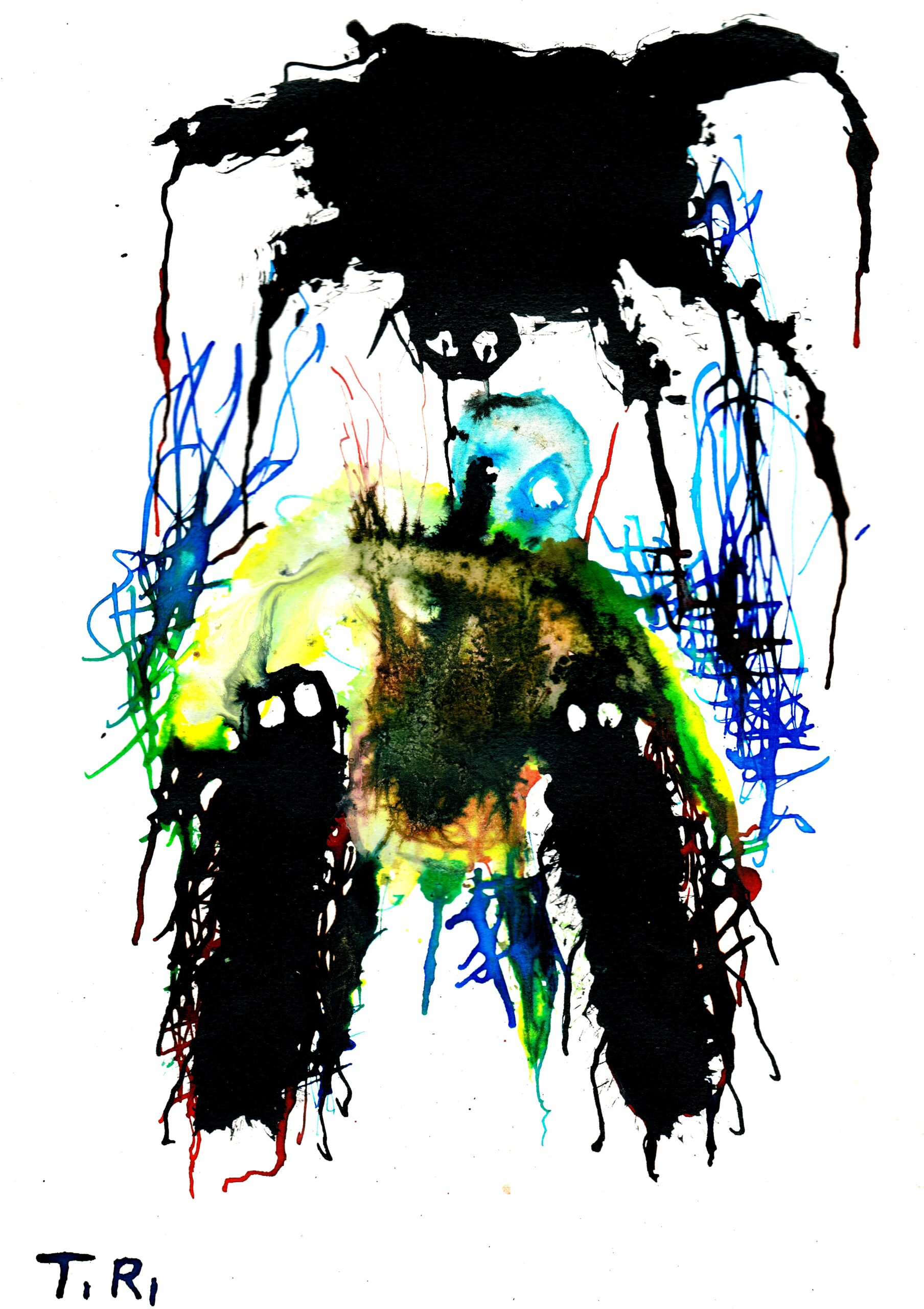
Danger from Heaven
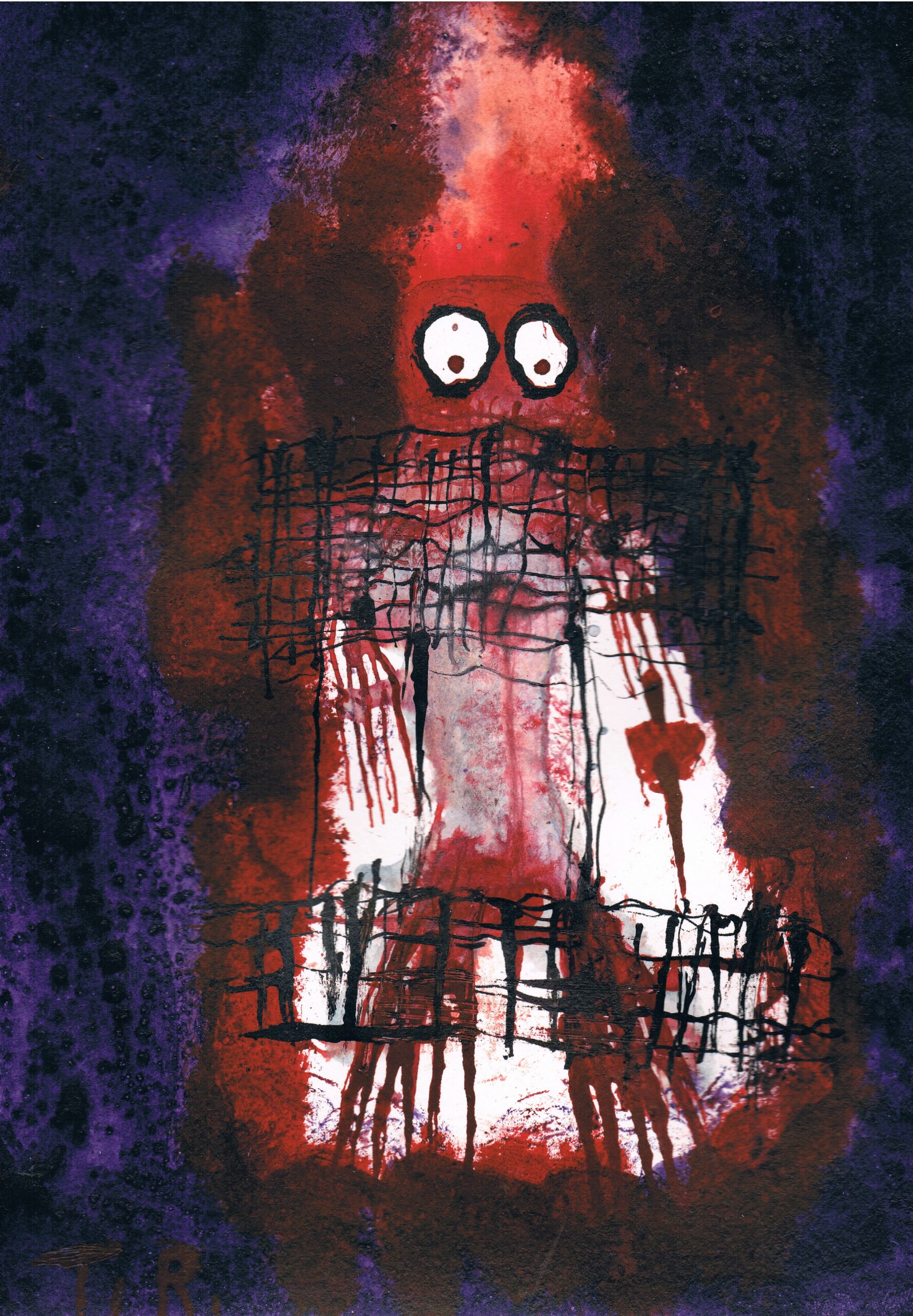
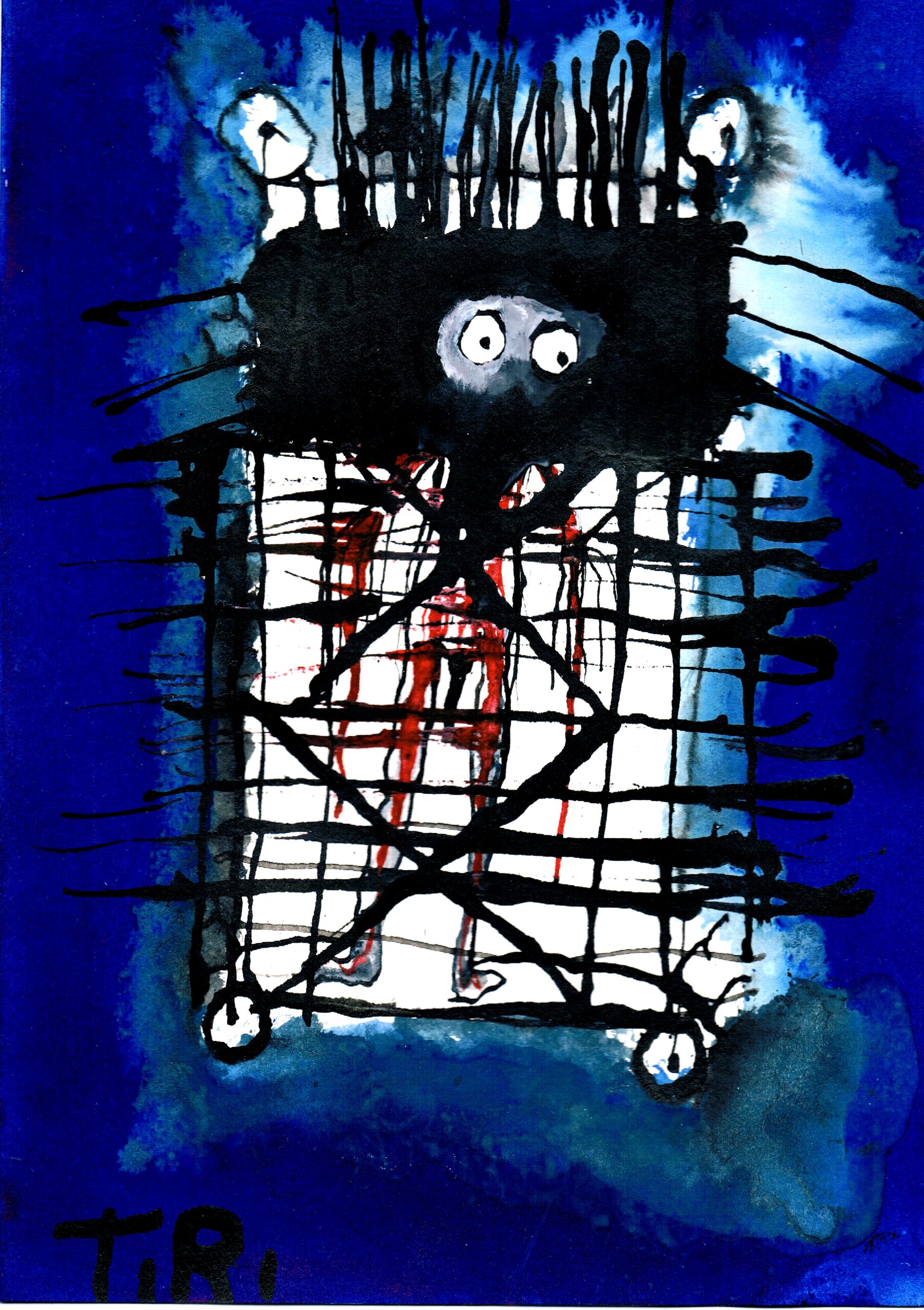
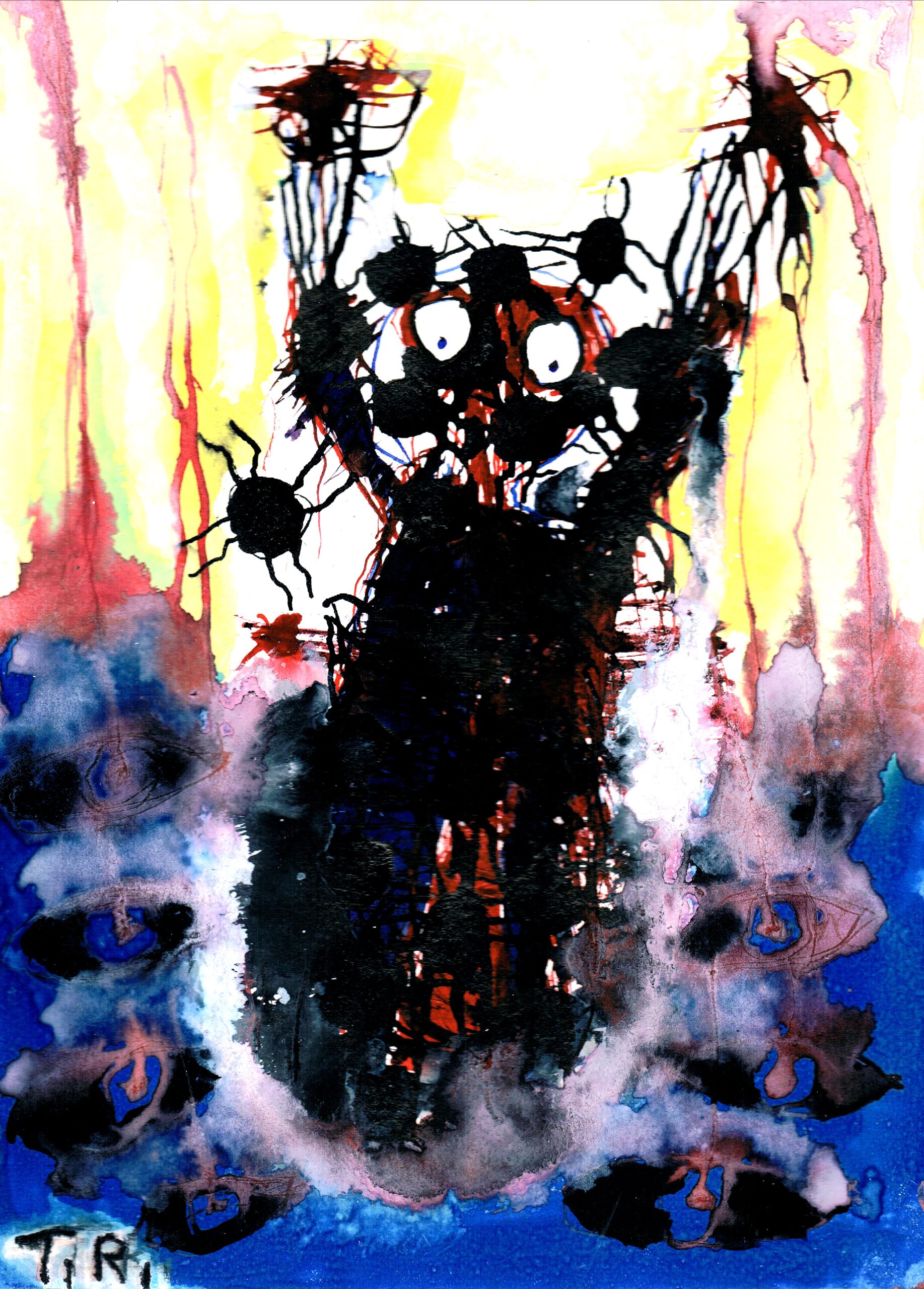
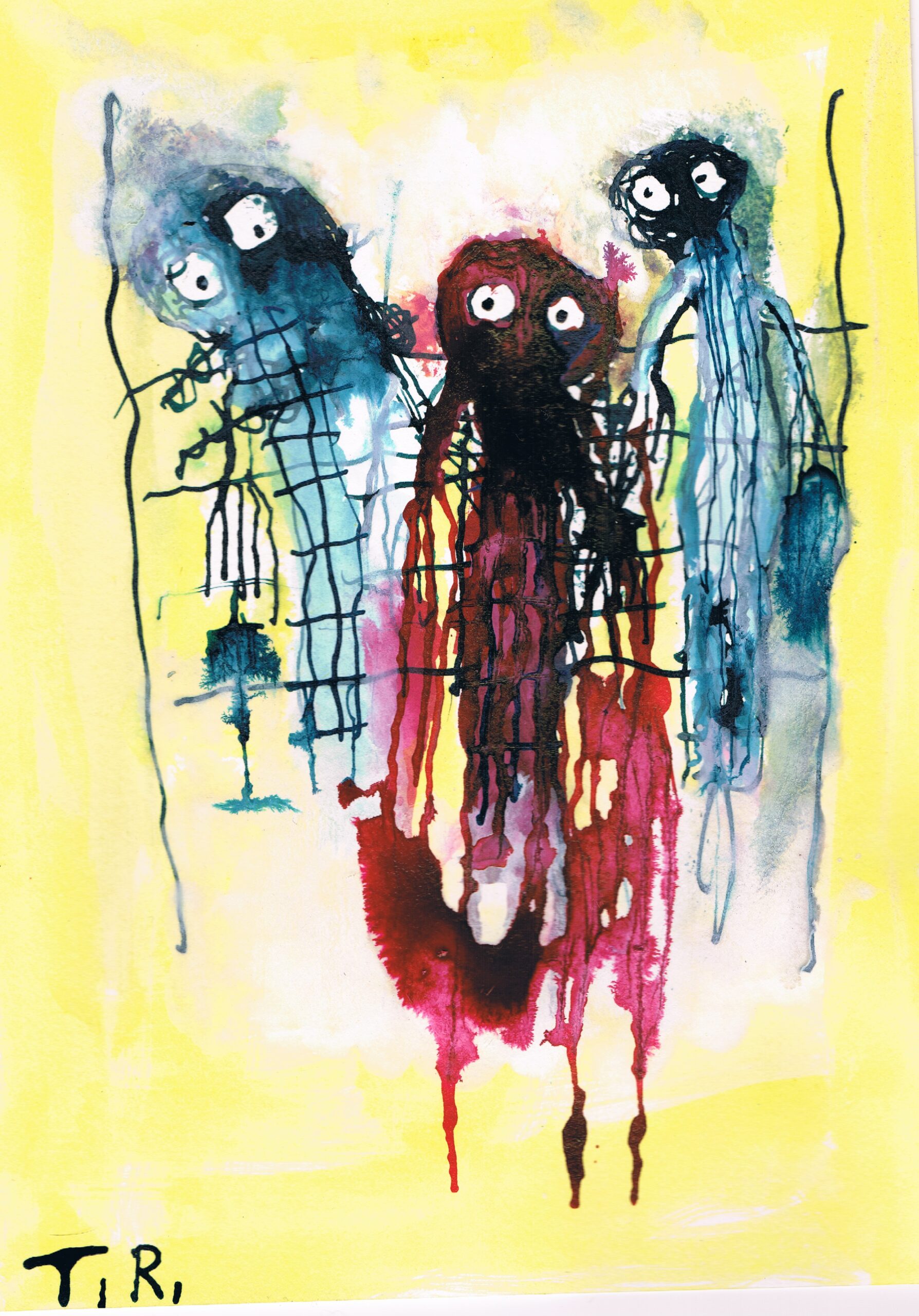
I was born in Leipzig in 1971 and I still live here today. Already in elementary school I often painted "abstract "instead of the given concrete drawing. I later retained this style or changed it to "abstract figuration." painted a lot at home, always without professional guidance, I didn't have any specific role models. When I start a picture, I only have a certain idea, but often something completely different emerges. I would describe myself as an outsiderart artist.

Width:30 cm
Length:41cm

All painted on Paper with ink

https://www.facebook.com/thomas.riesner.de
http://www.thomasriesner1.wordpress.com
Story from Jim Meirose
Slow Day Shoe SalesmanSandy stood behind Dell’s checkout counter, idly rubbing a forefinger back and forth over the bills in the open register drawer. Her eye firmly set on the recently hired junior shoe salesman serving a customer; a boyish young man, with an unhappily tight line of a mouth, and an overall tense look. In the chair next to him towered an impressive-looking woman in unnaturally neat clothing, whom Sandy took to be his mother.As the salesman took the young man’s measurements, she spoke to her son loudly enough for Sandy to hear. There, see—I told you that you had your shoe size all wrong, I mean—look, there. Look at that. You were off by a whole size! Too small! Imagine if you’d come down here alone and told this nice salesman, There’s no need to measure. I need spiked track shoes in a size nine—that would have been wrong in some measure, but then—what if you then said you did not need to try them on at all. Said you knew they’d fit, you’d bought that brand and size before, so measuring and trying, in this case, would just be a waste of the shoe salesman’s time, so—and so forth, and so on, is what you’d have said, if alone, and unguided.But I pushed you, and now, well, here you go; you’d have been a whole size off. How does that hit you, son? I bet you feel silly now—then, she said to the salesman, Look at him. Just look. Doesn’t he look surprised, confused, and afraid? What do you think sir, of this whole thing?The salesman said, I really don’t know, except that Dell’s has a policy that shoe sizes are to be checked each and every time, even for regulars. Because; the feet change imperceptibly over time—even from one moment to the next.But, here, he said, rising and picking up the track shoe they’d taken off the rack—I know we’ve got these in your size in the back. Just one minute.The young man turned watching the salesman walk off.At the register, Sandy gently slid the cash drawer shut, watching the mother and son sit fixed and erect, as though the silence around and between them was a rock-hard mold, within which they must stay fixed for some scientific reason—possibly to be observed—which was a fact, because Sandy—but no, yes; wait, clatter, rush; the salesman came out from the storeroom carrying three boxes.Before the two even had time to turn and look, he was seated before them on the bench. The mother leaned in, about to say something, but the salesman spoke first, somewhat strongly; in a firm, yet pleasant tone and cadence, designed carefully to allow no interruption. Fine. Yes, here it is. Your size—this is a fine choice, young man. You have excellent taste. Let’s try these on, now. Here. Your foot.As the salesman began fitting the shoes to the young man’s feet, the mother said, Oh, no, no. It’s not about taste. The team coach told us what color and style to buy. I mean, really, I can just imagine what kind of shoes he’d be trying on now, without the coach’s guidance and my supervision here in the store.He’d pick some outlandish style, I know—and, they would also be the wrong size—like we said before—might not even be track shoes, if I know him—and we’d end up coming right back here to return them, and, well—then his Father—his Father—The salesman deftly tied the left shoe snugly to the son’s foot, then shifted on the bench to repeat the process with the right.—yes, his Father would lay into him, yelling and shaking his fist, and not just at him, but at me also—you, he’d yell—just an inch from my face—you need to be teaching the boy better. Why did you let him go to the store alone?You know how he is—and though a lot of his behavior is totally his own fault, you’ve made it worse. Too easy, too easy. Yes, son, you know that’s the kind of thing you’ve caused to happen over and over. Lord, I swear.The young man hadn’t moved a muscle since the salesman brought out the shoes.The salesman slipped the new shoes onto his feet while he simply nodded his head signaling politely to his mother, I am listening, I am hearing, but; my, these shoes look good. Lace them, here make the knot, do the job, tighten them up tighten them up as she picked up steam with, Your father’s always nasty anymore now, because of you! Yes! I have to suffer through his crap because of you!But, that’s all right, she said, leaning back, her tone softened. It is my job to raise you, no matter what, for better, or for worse—having a child’s like a roulette spin. It’s a crap shoot, and once the child’s on the way, you’re all the way in. for better, or for worse.At the counter Sandy grew more and more impressed with this new substitute salesman, as he never flinched as the woman’s bizarrely offensive monologue twisted ‘round ‘bout him, as he secured the shoes to the young man’s feet, and then—he rose, stepped aside, tapped a foot and beckoned the boy to rise, which he did; the boy rose and stood silently, with a faraway gaze leveled at some point higher, and further, past the walls, and away.Do they feel good? said the salesman—they look good, and, it seemed to me, as I was fitting them to you, they fit really good too. What do you think? Sandy watched. The young man gazed wordlessly. Once more his mother leapt in with, Well? You’re going to be rude today? The nice salesman asked you a question. Why do you not answer the question? What, you’re in one of those sulky moods of yours now? Because I came with you after you said not to?After the nice man measured you after you said he didn’t have to? Because the coach said exactly what shoes to get, when you wanted something different? Because I told you to come out of your head, and get out and join the track team and then of course, mister contrary, as you always are, you said, No, I’ll do baseball—not track, it’s baseball it must be, and then again, your father—again your father came in and again, God, the scene—all because you would not obey me. You need to learn.Life is easy when you obey. Life is better for those who obey. So—the nice man just asked you what you think of the shoes. You’re going to give the nice man a bad day, too? Like you give me every day? And your father? And yourself? Which of course, you will never admit—the bad days you have that you always whine about, well—you give them to yourself.Answer the salesman! Answer! Answer now! Sandy’s eye remained set on the salesman, waiting, smiling, relaxed and professional, like the two he was serving were acting a show before him for his entertainment—answer, mother insisted—answer! Answer!Answer now—The taut air split down in a near-audible rip, and the young man abruptly, but gracefully and in full control, walked across past his mother, and marched steadily, stiffly, to the door and left the store, never looking back. The woman had watched him go, seeming completely unfazed, then remained watching the door through which her son had disappeared.Sandy tensed—what to do? What would she do? And now—what will he do?The mother slowly turned, once more facing the rudimentary substitute salesman.They’re good, sir. We’ll take them.Fine. They look like a fine choice. Good fit, too. Please step over to the register.He ushered her to the register, and crisply told Sandy, Be a dear, Sandy, and step aside. I need to ring this up for the lady. You will not regret this purchase, ma’am. Those track and field specials are among the finest Dell’s has to offer—cash or credit? Uh.Credit.Fantastic!Transaction concluded, the woman left the store. As she cleared the door, the salesman said to Sandy, Another sale down. My, but it is a slow day, isn’t it? Hey—how about I go back and get us two coffees? It’s so darned slow—I’m asleep on my feet. Cream and sugar for you, right? Like always? Yes. Like always. Stunned.
Short story from Christopher Bernard
The Man Who Talked to the Sea
By Christopher Bernard

            He stands, hour after hour, at the edge of the surf, staring at the sea.
            In an old battered suit and scuffed shoes, he looks as if he just walked out of an office on Main Street. He sometimes wears a hat, a businesslike fedora, though usually his head is bare, the tufts of thinning whiteness stir like grass in the sea breeze.

            His eyes are watery blue, his skin pale despite hours in the sun. Every so often he takes a deep breath of air briny and ion-charged from the churning waves, then slowly exhales with a look almost of happiness.
            At times he focuses on small craft: a sailboat, motorboat, jet-skiers, wind surfers. Or surfers near the beach’s heaviest waves, a quarter mile off: he watches them with detached interest as the young men – and increasingly young women – lurch up on their boards and shoot the swells as they rise and collapse one after another, hour after hour.

           Or he gazes at the sky: a biplane with a banner advertising hair dye or a new movie, a police helicopter like a spider swinging down from the sky’s rafters, a commercial air carrier lifting off from a local airport like an aluminum cigarillo, a high-flying air force jet leaking a contrail over half the sky – that disappears in an instant or spreads across the azure, becoming an ice cloud as it expands until it looks like the wing of an enormous dragonfly.

           What he most loves are the freighters and cruise liners coming and going from the mouth of the nearby harbor, piled with oblong containers like boot boxes, or tall and white, striped with balconies or spotted like a colander with portholes, keeping their grace despite all attempts to ruin it for the sake of profit. They even retained a little of the old-fashioned romance of sea voyages, as they appeared on the horizon, small points or dirty smudges, and slowly grew, their bows sharp and high, their bridges straight and cool as a captain’s gaze, their smoke stacks saluting as they passed down the shoreline like the bodies of great whales – or leaving the coast at whose edge he stands and, heading out to sea, their sterns turning toward him as they faded to dots, the smoke turning into rust and ash on the horizon as the ships disappeared over the horizon.

            And of course, there are the birds: terns; sea gulls; crows flapping up now and again like black flags of anarchy; sandpipers nibbling nervously; ragged lines of pelicans, with their awkward bills and heads cocked like triggers and wings angled for either a long, leisurely drifting or a sudden plunge to surprise a fish for dinner.
            He never tires of watching the sea’s commerce: infinitely various, never the same yet always the same: sea and sky like an old married couple with the same quarrels and the same needs, even the stars and moon over the night sea reflections of shells and sand, foam and flotsam that lay at his feet. Just as they seemed reflections, as in a small mirror, of moon and stars and sun.

            Sometimes, after taking a furtive glance around him, he talks to the ocean. He speaks quietly, almost caressingly, for a long time, sometimes nodding or shaking his head or shrugging, as he might when speaking with a friend, and sometimes he pauses and appears to be listening for a response.
            After a time he turns away with a vague smile and quiet look of satisfaction, as though he has gotten whatever it was he was looking for and, his face bent to the sand, slowly walks away.

            The local children sometimes watch him while playing fort or catch, digging wells in the beach or dribbling sandcastles. They stop and stare, wondering briefly to themselves or passing rude jokes before going back to their games.
          More than once a few crept up behind him and tried to hear what he was saying to the sea. They crouched down and listened, hitting the one who threatened to giggle. But they couldn’t catch his words, soft as they were against the noise of the surf, and they got bored and crept away. One time they beat a retreat in full cry, and the man turned to them, a look of surprise on his face that turned instantly into a rueful smile. He shrugged and glanced back at the sea as at a wise and sympathetic friend, as if sharing a quiet joke and relishing it, even if the joke was at his own expense.
*
          One day a young couple was walking barefoot down the beach. They were silent, avoiding each other’s eyes, their faces grim, a wide distance between them. The beach was otherwise empty: the sand showed only their footprints, parallel lines of spoor disappearing in the distance. The waves fell with unusual quietness, and the tide was out leaving a wide swathe of bright wet sand.
            A breeze stirred the hair of the young woman, slender and soft, though angry and hurt. She let the wind pull the hair across her eyes as though wanting to hide behind it, from the light and the young man beside her.

            He looked exasperated and glum, his mouth twisted, and walked with exaggerated emphasis, his footprints emphatic, like gashes, the woman’s softer, as if she hardly wanted to touch the ground.
            She seemed to want to disappear. He seemed to want to hit something with all his might.
            They walked in silence beneath the morning sun and an almost cloudless sky.
            Neither of them noticed the man gazing out to sea till they almost walked into him – or rather, the young man did, who was walking near the water.

            They stopped, a little disconcerted. The man didn’t seem to notice them. He was staring intently at the waves, his face full in the brilliant sunlight, his eyes seemingly blind in the glare. He seemed far away, in his own world. And he was speaking, softly, and – given the quietness of the waves – just audibly. They listened.

            “Thalassa, thalassa,” the old man said, “sea, o sea, you who murmur across the world’s seasons, who bear life in the cup of your seabed, who bore life from the beginning, who crash and swirl along every coast, who are both thing and symbol of the thing, of being and destruction, life and death and love and birth, of joy and suffering, ecstasy and despair, ephemeral, perpetual, in change and permanence, water and crystal and gold and ash and mud and wine and earth and sea, o sea, thalassa, thalassa, you are the comforter and destroyer, the ever-kind and ever-ruining, lover and demolisher, betrayer of promise, builder of promise, creator of hope, betrayer of hope, image of the eternal, image of God, thalassa, thalassa, o sea, o sea, speak to me with your tongue of many voices, chant to me your music, and grant me ears to hear and know, with love and awe and patience and faith, as you give me being and take it away, thalassa, thalassa, o sea . . .”

            And the old man murmured on in the same fashion, and the young couple stood there listening and wondering, the man is crazy, he’s talking to the sea, astonished and a little repelled but frozen to the ground. He paid them no heed. He spoke to the sea as if he were, as usual, alone, as to an intimate friend.
            The couple, almost despite themselves, turned to look to the sea as well, and listened to the waves
And it was almost as though they could hear words in the ocean sounds, as though the old man and the ocean were speaking together, even though the old man never stopped to listen; they seemed to have an understanding, seemed tender together, one might almost think they loved one another, and the young couple was curiously moved.

After a time longer than they knew, as the sun rose higher and the wash turned back at the turning of the tide, a wave rushed up and crashed against their legs. The woman stumbled, cried out, fell . . .
The young man leapt over and tried pulling her away, but the wave yanked her from his hands and dragged her, choking in the foam, down and out toward the ocean. He dove after her, slipping, falling in the wash as a second, even bigger wave, crashed over him. He bobbed up, spitting and choking, and saw her arm flailing a dozen yards away in the swirling foam as more rollers swept toward them.

He lurched again toward her, grabbing her hand just as it disappeared under another wave, and reached out just in time to catch the elbow of her other arm and, managing to get a grip on the sand, pulled, almost lost his hold, then pulled and dragged again with all his might in a brief lull between the backwash and the next wave. The young woman appeared out of the water, sputtering and frightened, like a naiad, half drowned as she was born from the waves.

The two struggled and stumbled up the slick tract of sand just as another big wave raced in pursuit of them.
Once back on dry sand, the couple, drenched to the skin and shivering, turned to each other, their frightened eyes darting, opening, deeply, each into the other, and a moment later they fell into each other’s arms.
“I almost thought . . .”
“I know . . . “

They slowly caught their breath, then wiped the water out of each other’s eyes, and, still wrapped in each other’s arms, walked slowly away, keeping just out of reach of the tide as it washed up the beach like a violating hand or an invading army.
“Where did the old man go?” the young woman asked, stopping and, smoothing back her wet hair and peering across the now empty shore.

	The young man shrugged. “Who knows? Maybe he was just a hallucination!” He laughed, nervously. But the woman kept peering, worriedly, out to sea. . . .
	Perhaps he had been caught in the same waves they had. The riptide here, at times of the tide’s turning, was known to wash the unsuspecting off the beach, sweeping them a mile out to sea, drowning them and sweeping their bodies miles away down the coast.

Or maybe he had walked away just in time. Maybe he had grown tired of staring at the sea and talking to the waves. All good things come to an end, they say.
Or maybe he had accomplished his task and he could go home with a good conscience. It was the right time for him to move on.
For whatever reason, he was never seen again after that day.
But according to some, if you listen closely to the surf, you can hear the words, “Thalassa, Thalassa, sea, o sea . . . .”

____

Christopher Bernard is a poet, novelist and co-editor of the webzine Caveat Lector (www.caveat-lector.org). His books include In the American Night and Other Stories (where this story first appeared in a slightly different version), A Spy in the Ruins, Meditations on Love and Catastrophe at The Liars’ Café and the award-winning poetry collection, The Socialist’s Garden of Verses.
Poetry from Nathan Whiting
LOOK ⎬ MOON ECLIPSES MOON
Dry fingertips ⎯ kiss each other, ⎯intimacy shared→ by opposite
⏐ ⏐
alter alert Our origins ⎯have given us hands
⏐ change ⏐
nerves, ⭣ which
↓ fidelity ⏐
when close. silently; interchangeably grab
caress air-fibers ↓
| nearself.
lyrical — lovely — level
Pearls Pearls, ↓
🡙 balance.
can change be united [?] yet at times
time
wants a reaction,
a rush felt → transferable
among zesty fingertips
⏐
clasp thin-jointed sensitivity belonging
⏐ to butterflies —?— instars.
how
touch — subtle in progress — brushes flightful wings.
↓
lives in each person: puppet play.
OUTDOORS: A SHELTER
Ice
ice light-caverns enter ice. untired …
⭡ ice … nuthatch ⮍
Diamond clear ⭣ 🠁
a brutal atmosphere … pine shivers, junco quakes ⭢ wonderful
frost glares enthusiastic … or not in unison.
⭣ I (ice)
where …→ bears …→ confirm …→ winter.
|
flames … → burst
⭣ ⭣
illuminate treachery dreams.
manipulate how snow
is traded;
⭣
We know death …🡢 wonderous ! We see the Perfect Forest.
{in our slumber} but perfection
bites in earth-mouths must never
bites bites bite such food
bites ↘ ↘ bit
bites bites ⮏ {the word moves} ⮍
bites bit asleep
bites too many bites ↘
bites awake,
for ideal bears ⭢ hidden from moods.
FRUIT RINDS — FRUIT SEEDS — PROTECT THEM
I invite fruit flies fruit flies fruit flies she would expel.
I ⎯comb obsession.→ No!
⏐ ⏐
worry, A need
Lately ⎯old—she warily concerns→ routine
⏐ another (my) holds ⏐
which ↓ ↓ rituals
⏐ mind ⎯could confuse→ her ⏐
crumb with
⏐ pears ⏐
goes garbage,
↓ ↓
with which wraps it
scrap? ⎯ Shared decades flit higher→ with care.
⭥
Instinctive → then trained
⏐ by
I take in — air, our breaths tour
↓ ↓
the room the world
with fruit flies where trash
↓ deepens, more complex.
more room ↙
taken — we a pair long close,
tolerance a location
the inches forgiveness allows — for life.
FEBRUARY 1 ≡ POWER BEYOND 2021
As I write this
a blur ↓
converges over snow ⮇
and from the blizzard I watch
↓ ⮡ our window.
flows ⮆⮆⮆ fiercely raged ⮆ over the words,
↘ ⮇
and I streaks
↘ ↓
believe of white
↙ ↘ ↓
suddenly these across
↙ ↘ ↓
in my are not gray
eager ↘ ↓
insignificance, the best white
↓ ↘ ↙
terrible when eyes letters! ⮆ air-engraved : : : :
can not adjust
within calm importance.
Snow pours 🢫 imagination → faster → faster ⮆ faster.
I
α cannot see
vast need how the storm works ⮆ flake darts ⮆ self-bloom, twirled
astutely ⮇ ⮏
found ζ decisive → brings obscure wonder – – – – – wisdom.
Essay from Z.I. Mahmud
What is narration?

Narration refers to the action of performance as in chronicling story-telling and choric odes or hymnal recital in the form of episodic events, anecdotal antecedents, incidental reportage; that embody, portray or sketch different genres of narrative such as tragedy, comedy, romance, satire, folklore, folktales, myths and legends, lyrical ballads and metrical romances. Narration is prolifically effective method of commentary delivery of emotions and conflicts through dialogue and action associated with film and movie adaptation, television sci-fi documentaries, sitcoms, drama serials and theatrical performance or stagecraft.

First person narrative is autobiographical in accord with author's temperament, sentiment, personae as in noteworthy Dickensian Victorian classic fiction David Copperfield, therein heroic bildungsroman protagonist, autodiegetic narrator, David recounts the treasure archival of nostalgic reminiscences, memories and memorabilia. While the second -person narrative is interpreted by unspecific characters' (imaginary literary voice) or specific characters' point of view to the audience. In Emily Bronte's classic masterpiece novel, Wuthering Heights, Elis Bell acquaints readers with different point of views as narrative techniques fostered by first person diarist Lockwood and third person narrative tone of Nelly. The epical and alliterative narrative poem, Beowulf, is told from a third person-omniscient narrative point of view; therein the narrator encompasses the interior feelings and thoughts of the cast and crew including the mythical dragon.

Frame Narrative or narrative within a narrative pioneered by English Polish novelist, Joseph Conrad, is incredibly fascinating narrative technique to expose the power dynamics, immorality, colonial exploitation, imperialism and racism. A fallible or unreliable narrative emanates the perceptions, interpretations and opinions of the narrator which does not correspond or coincide with that of the author, who is or purports to be the controlling force in the narration. In The Adventures of Huckleberry Finn, the American novelist, Mark Twain employs dramatic irony through adopting unreliable narrative technique, wherewith, Huck's misreading of situations juxtaposes with the cynicism and hypocrisy of adults.


In Wikipedia and the dictionary, illustration of a novel refers to the fictitious prose narrative of book length and typically representing character and action with some degree of realism as in the novels of Jane Austen and Charles Dickens.
The authorship and publication of the literary canon today emerge with the printed paperback  or hardback ;and as best-sellers novels possess the most adaptable of all literary forms.  Novels cater as the harbinger of ‘a piece of news’ and literally heralds the genre as an extended work of fiction in prose and romance. Origins of novels trace hallmark of 16th and 17th century in the chronicles  of the history of English Literature.  Henry James pointed out, “What is character but the determination of incident?” and “What is incident but the illustration of character?”.  In aphoristic maxims novels encompasses characters, incidents, actions and perhaps a plot distinctively and holistically.

“The subject-matter of the novel eludes classification, for it is the hold-all and Gladstone bag of Literature”. The quotable quote excerpted from the treasured  archives of Penguin Classics A Dictionary of literary terms and Literary Theory; therein J.A. Cuddon illustrates a survey of novel as a genre through voluminous encyclopedia.  A literary genius like him showcase a mammoth of sub-divisions or categories in this ‘novelty’ realm “….. epistolary novel, the sentimental novel, the novel of sensation, the condition of England novel, the campus novel, the Gothic novel and the historical novel; we have the propaganda, regional, thesis ( or sociological), psychological, proletarian, documentary and time novel; we have the novel of the soil and the saga (or chronicle) novel, the picaresque novel, the key novel (see LIVRE A CLEF) and the anti-novel; no.t to mention the detective novel, the thriller, the crime novel, the police procedural, the spy novel, the novel of adventure and the novelette.” [pg no. 620]

Short stories were the pioneers and forerunners of modern novel because of their method of narration and development of characters. Epical and romantic novels intended to portray entertainment literature in the form of pastime preoccupations and leisurely indulgences. Eventually verse narratives supplanted prose narratives and amalgamation of diversification soon dawns. If romances work wonders then the feat with novels delight. In highlighting the traces of evolutionary strains of novels, we should engross envisioning of John Bunyan’s Pilgrim’s Progress (1678) and Daniel Defoe’s Robinson Crusoe (1719).

Pilgrim's Progress is quintessentially an allegorical novel satirizing Christian Salvation through manifolds of microcosmic biblical allusions echoing theological fables and parables. Christian epitomizes Everyman and struggles lionheartedly through the trails and tribulations whilst he undertakes a toured force entourage through the City Destruction towards the Slough of Despond, the Interpreter’s House, The House Beautiful, the Valley of Humiliation, The Valley of the Shadow of Death, Vanity Fair, Doubting Castle, Delectable Mountain and eventually the Celestial City. In the second part of the narrative Christian’s family journeys the Celestial with the accompaniment of noble, virtuous, tenderhearted souls and graceful personified characters such as Mercy and Great Heart; Mercy and Great Heart shields the wrecks of deplorable monsters such as Legion Apollyon.

On the note of Robinson Crusoe, Daniel Defoe curates the adventuresome stories of Desert Island Fiction.

Jane Austen and Sir Walter Scott are prolific fiction novelists of their heyday having annus mirabilis accomplishments and achievements. Jane Austen fictionalized the English society in rapturous vigor and splendorous witticism. A plethora of drama adaptations, movies and films resonate theatrical production as interpreters and critics of novels alike cherish passionately the timeless classic ‘Pride and Prejudice’ and the universality of the dramatic irony in “It is a truth universally acknowledged that single man in possession of a good fortune must be in want of a wife.” Furthermore Elizabeth Bennet’s blind, partial, prejudice and indiscriminatory attitude can be heartwrenching when Mr. Fitwilliam Darcy proclaims, “In vain have I struggle. It will not do. My feelings will not be repressed. You must allow me to tell you how ardently I admire and love you.” Similarly the lyrical and metrical romance ballads of historical fiction authored by Sir Walter Scott fascinates audience as in the case of Ivanhoe. The Era of Victorian England undoubtedly reigned to glorify anonymity governess feminist novelists as the Bronte Sisters: Charlotte, Emily and Anne and their classic masterpiece “Jane Eyre”, “Wuthering Heights” and “Agnes Grey”. Afterwards regional and picturesque landscape novels springs to life with the Tess of the D’Urbervilles by Thomas Hardy.

Tolstoy, whose epic novels War and Peace (1865-72) and Anna Karenina (1875- 6) remained unsurpassed in Russian literature. This demarks the migrational drift of European phenomenon concerned with associated novels. Picaresque and bildungsroman genre such as the Adventures of Huckleberry Finn and the Adventures of Tom Sawyer have paramount significance in the revolutionary American antebellum popularized by the father of American narrative novelist Mark Twain. In the twentieth century remarkable crises notably World War and the Great Depression have centered the thematic discussion amongst existentialist admirers of fiction. Journal entries, dairies, travelogues, memoirs, biographies and autobiographies have been printed in voluminous paperback editions including Samuel Beckett’s stalwart masterpiece “Waiting For Godot” and Anne Frank’s “The Diary of a Young Girl”.

In farewell noteworthy accolade  of alchemy and magical fantasy of the world of Hogwarts wizardry coalesced in communion with the realists family of maggots, J.K. Rowling is the surreal incarnation of spatiotemporal and time travel science fiction; if children and teenagers panel’s  verdict of nomination and votebank for the Nobel literature laureateship assessed, it  will spellbindingly cast in the Harry Potter collection.
Poetry from Rose Knapp
Adams’ Hill Walkabout

Dreamscapes dart into
Mosaics of marble
Triune streak on streak


Cocaine Codas

Cocaine waves of codas code walkabout
Fire escapes within Firestorms
Of diamond glistening utopias of the mind

Λήθη

Sanguine Spiritus mundi amor faux fati Fatima
Five fath Omniscient Oms Osiris thy
Father in Paradiso lies to us

Oeuvre of Isaiah Patmos revelation
Revealing Lotus Set Sethian Loki

Awaiting thee sol in Lethe lake of diamond
Damnation pure pulsating numinous Eros

Roses Danse singing Cathar Cantos
Inner eternal and ephemeral Fluxus


Where did gods and goddesses come from?

Are they mere mirror representations, shadows of
Ourselves, our own psychological states
Anthropocene amplified to mythological heights?


Time

Is time progressive and linear or
Circumambulating Recurring and circular?

Why can’t time be both? History repeating
Itself but making progress too?