Chidimma Ewelukwa is a Nigerian writer whose work explores memory, belonging, identity, and the quiet tensions of everyday life. She has been published in Writer Monk Literary Magazine.
Yesterday about 9:00 AM I was walking under the Russian olive trees on the north side of our house and noticed something black lying on the ground. I investigated and found it was a baby magpie still alive, half feathered out. He must have blown out of the nest about twenty feet above me in the old Russian olive. I felt helpless. I knew he would die if I left him there, but I couldn’t get him back into the nest because it was so high up and difficult to climb the Russian Olive tree with its thin, spare limbs and haphazard branches. A magpie pair had worked on repairing that two story condotel nest for months. It had a front and back door on the first floor, and this little guy must have got shoved out. Already it was hot and dusty in the high desert, and the little guy didn’t have much of a chance in the baking sun.
I fixed him a small cardboard box lined with grass and tied his home to a low hanging tree limb under the high up magpie nest, hoping the parents would notice. He wasn’t responsive. I felt bad knowing there was little I could do. The fall from the nest must have knocked the wind out of him. He needed to recover. I checked on him during the morning. He wasn’t responsive.
I consulted the Internet and Marta, my animal savvy neighbor, as to what to do. I kept checking on him.
When I checked in the early afternoon he started chirring his head off. I mixed up some food for him garnered from three websites: cat food soaked in water, hard-boiled egg, and cooked oats. He ate it up. Marta came over with a big, two foot long rectangular, open wire cage that I lined with newspaper and fresh cut grass. His new home.
He eats and sleeps. I feed him with a blue plastic tweezers. He’s had two moths and four flies plus his special food. He’s eating more. Then he sleeps. Marta and John think he should be covered. So, I put a hand towel over him for the night. He is still alive. I’ll cover him at night because the nights are cool, and he doesn’t have his siblings for warmth. We take one day at a time. This is a very special experience. The flow of life.
July 5, 2022, Tuesday, 80 degrees, partly sunny
Magpie baby made it through the night. Got some bugs for him today to eat plus his special food: softened cat food, hard-boiled egg, and soft oats. He eats and poops well. Likes his blankie which he sits under sometimes. He’s hopping more.
July 6, 2022, Wednesday, 80 degrees, sunny and breezy
Magpie baby still alive and growing. John caught some moths today for him. I added mashed banana to his special food.
July 8, 2022, Friday, 80 degrees, sunny
Magpie baby still alive and growing, feathering out. Going to town today. Marta will come to feed magpie baby.
July 10, 2022, hot, breezy
Feeding magpie baby. His two siblings are roosting outside their nest. They are all feathering out.
July 11, 2022, Monday, 90s, sunny
Magpie baby spent from 8 AM to 4 PM outside on the limb above her cage. Twice I saw her parent visit and sit on the limb beside her. The second time the parent jumped to the ground, pecked around, and fed her. My heart was thrilled. Bubbie fell off the limb twice. So, after 4 PM feeding I put her back in the cage because we’re going to a picnic in town tonight. She did well today and sits on the branches in the cage now. I say she’s a female because she has four fat siblings who are bigger and are brighter black and white than her. They jump around on the branches outside the nest. So today she became female. I call her Bubbie. The Power is working to help her. Thank you.
July 12, 2022, 99 degrees, breezy, hot
Bubbie, the magpie, did well. Didn’t eat much in afternoon maybe ‘cause of the heat. Put her in the safe house (cage) when we went to town. She hopped over on the limb when I couldn’t reach her and got a bite to eat from the blue, plastic tweezer I use. John found her some moths. I got two flies. Her siblings seemed interested in her getting fed. But they haven’t come to investigate. They watch from above.
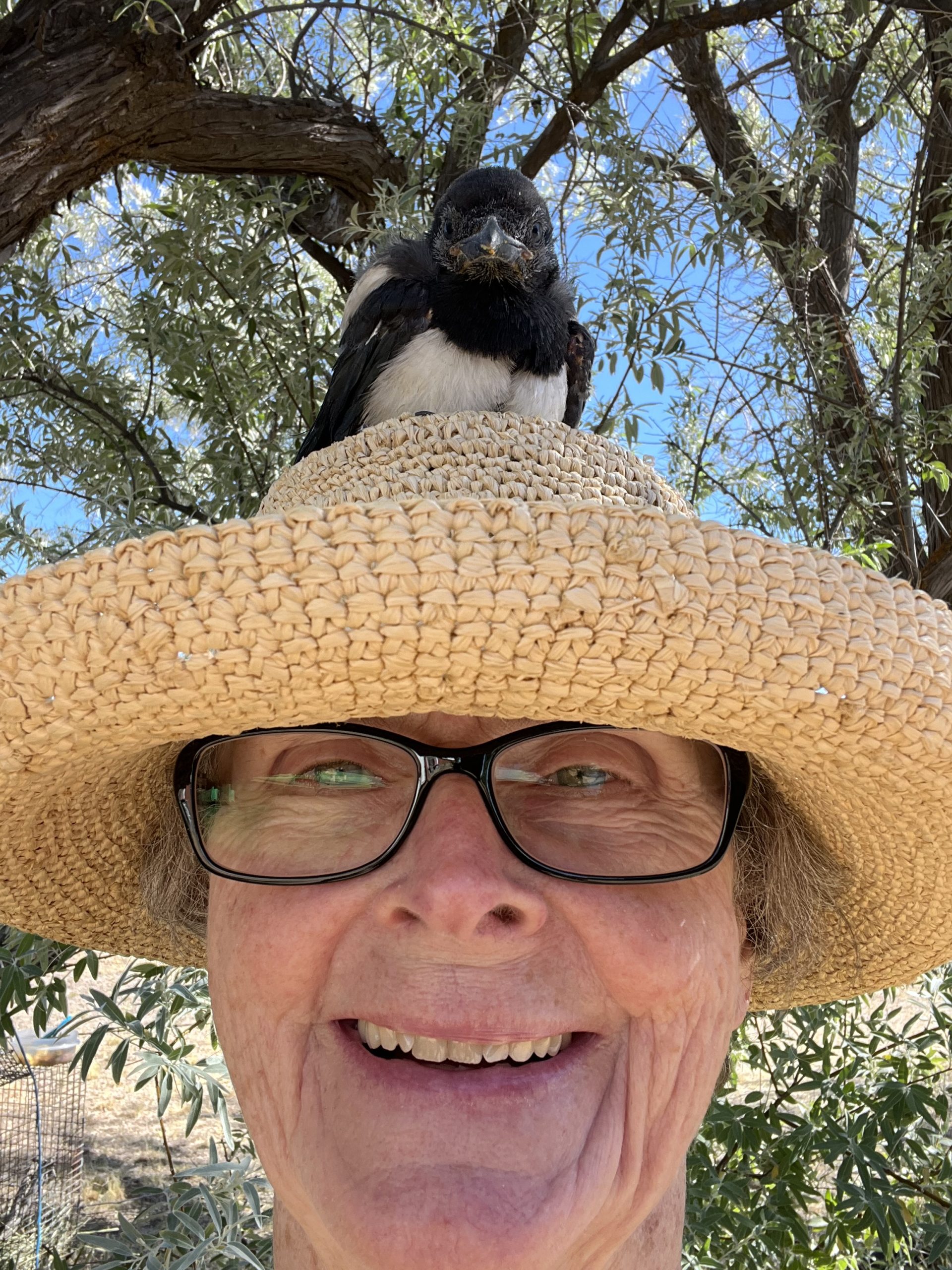
I wear a floppy straw hat when I go to feed her. Today she was sitting on a limb about the same height as the top of my hat. She decided to jump over on top of my hat and turn around. As luck would have it, I had my iPhone with me and snapped a photo of us, her on top my hat like that’s where she belonged. I will always treasure that photo.
July 14, 2022, my best friend’s birthday, hot, sunny
Baby magpie rejoined the wild today. She flew by herself past the pump house, past the garage and chicken coop. She’s sleeping tonight in the west Russian olive trees on the far side of our fenced property on the west side of our garage where two of her siblings are. One looks like her, so I think she is a female like Bubbie. I fed her the last time about 6 PM. At 8 PM I went out and stopped about mid garage. She was on the ground but made her way up to the limb about midway where another sibling was sitting. Parent magpie visited that one and may have fed Bubbie. So tonight she spends in the trees reunited with her family. I felt so grateful and happy. Bless her, bless her, bless her.
July 15, 2022, Friday, hot sunny, 94 degrees
Bubbie the magpie made it through the night with her five siblings in the west Russian Olive tree that grows along the wood and barb wire fence with a line of other Russian Olives. At 9 AM, noon, and 6 PM I checked on her. She hopped out on a branch to be fed. The other five are in the tree, on the fence, on the ground. Bubbie seems to like being on the ground. I think she’s looking for bugs. She was hungry tonight at 6 PM, not as much the other times. Hopefully, she’s getting something from the parents.
July 17, 2022, Sunday 6 AM, 47 degrees, sunny
Friday evening when I fed Bubbie at 6 PM I teared up. I somehow knew I would be the last time. I told her I loved her and asked blessings upon her life. After I worried I shouldn’t have fed her, that her parents wouldn’t, and that she’d still be dependent on me.
Saturday I avoided going to the western Russian Olive trees. I didn’t want her to see me. Yes, all the magpie family was still there. I could hear them. About 7 PM I took the watering can filled with water to replenish the big bird water saucer on the ground by the picnic table that sits under a Russian Olive. I stopped by the garage because the magpies were on the table and taking a bath in the water pan on the ground. I was thrilled.
I only counted three magpies at first. Two were sitting on the barb wire fence under the Russian Olives. My worry was back that Bubbie wasn’t with them. But then I counted six. I was thrilled and gratified again. I waited until everyone had had a bath then walked with the water can, food container, and red plate to the picnic table. Three magpies were there and looked at me. One came forward with the magpie greeting, a loud squawk. It was Bubbie! She didn’t open her mouth to be fed. She watched me fill the water pan on the table. Then I put on the picnic table the red food plate and placed some of her food on it. She looked but didn’t eat.
I talked to her but didn’t reach out. She watched. Then I left. After the parent came several times to the picnic table and fed Bubbie at least once. She likes bugs better. She took a splashy bath in the water pan on the table as did one of her fat siblings.
I watched sitting in a chair by the cat nip growing along the garage wall well back from the magpie drama. I was petting Midnight, our black long hair cat, as I watched the magpies. She jumped down and went to investigate something on the ground. I did, too. It was a tiny, featherless baby sparrow that had fallen out of the bird house high on the garage wall. It was still alive but felt cool to the touch, so I put it into the hole in the bird house. This time I could reach the nest.
July 17, 2022. Sunday. Hot. Hot. Hot. 98 degrees.
July 26, 2022, Hit 102 degrees. Heat Advisory
Early morning I’m out filling bird water pans by the picnic table under the elm tree. No magpies this morning or evening. The family of California quail are grateful for these offerings.
July 27, 2022 8:30 AM Heat advisory.
No magpies this morning, last evening or yesterday morning.
July 28
No magpies
July 31
Water to bird pans morning and evening.
The magpies are gone. I think they come to nest in the Russian Olives in the early spring and then are gone by summer. I wonder where they go. Maybe to the basalt cliffs to the north of our place, since it’s cooler there. I miss them. They will always be my favorite bird.
I have a photo of Bubbie sitting on my garden hat on my head. I keep it on my nightstand. She hopped up on it one day when I was feeding her, and she was on the limb across from me. We were pals. We will be forever friends. What a special experience to share one’s life with a baby magpie.
September 2022
We pack the truck to go cross country to Pennsylvania for a long sojourn. I’m walking around in the yard. A lone magpie flies to our Russian Olives, calling. I watch. It’s unusual for a magpie to be here this late in the year. She flies back and forth in the Russian Olives, calling. This continues for several hours. Then she’s gone. I like to think it was Bubbie, come to say goodbye.
The sea Once a sailor asked a dove, how is it to fly? and the dove answered, you ask me because you are every day at sea and with your strong boat you tear the waves in two. You have a brave crew and you are not afraid of storms.. Meanwhile I just fly, sometimes low, sometimes high, but I always meet clouds and planes, nothing exciting. You tell me about your adventures… So said the dove and the sailor, who was the captain of a boat, began to tell about the nights with the full moon and the mermaids crying on the reefs burnt with orange and red coral, to weep for their sisters or for the fortunes of travelers
and the stars twinkle merrily high up there in the firmament of heaven. Years ago there lived a dolphin in the waters of the Atlantic and sang and played with the other dolphins of his tribe, until one day he woke up and nothing was the same as before. Everything changed in his neighborhood, they were found to have plastic bottles and tons of tires in every coral cave, the algae got sick and the dolphins got stuck in the deepest caves. -But what’s going on? The sea became sick, the ocean became infected, the mullets answered him as they also passed by, looking for better and cleaner waters. – The sea got sick, but that doesn’t happen, the sea is a living organism
with the power of self-healing, it has iodine and phosphorus and salt, thought the dolphin… deciding to rise to the surface, to go and see up close what exactly happened. As soon as he climbed a little higher, he saw a terrifying sight, plastic bags and bottles were floating, and tires from cars and another pile of garbage. The dolphin started swimming back and forth restlessly and doing somersaults. It’s all true, he said over and over again. The sea became sick and filled with rashes and sores. I have to find a solution, but how can I? I’m small and ….. as he thinks he saw the careta careta turtle carelessly swimming around, looking for food. I will ask about this careta careta turtle..
she will be able to help me, since she often rises to the surface to give birth to her young, he thought and quickly made hasty movements with his tail, to reach her.. – What are you saying, did Thalassa get sick? the loggerhead turtle grimaced as he munched on a seaweed, Since when; Does he have a high fever? Let’s vacuum her, he replied and continued swimming towards a more fertile ground that also had plankton. – Suction cups, what is that again? These elders talk with incomprehensible words and never explain the inexplicable to us… all their philosophies and then… we , the new generations we are lost and we don’t know what we should do to find solutions!!!!
Lady Turtle Caretta – Caretta , I don’t want tips or suction cups, i need help….The Sea got sick and filled with rashes, and sores . We need to find a medical help, look around you, and stop chewing.
..The loggerhead turtle stopped munching and looked around, facing a macabre sight, with plastic bags on every coral reef and plastic bottles lying on the bottom, and car tires blocking the entrance to the main door of homes of the Smyrna, of the crabs and the starfish and a chaos was everywhere… .
Those aren’t viruses, the turtle said flatly and continued munching on her seaweed. – Isn’t it a virus? and how do you know that, wondered the dolphin – I just know it, and I also know who is responsible for this downfall… Probably the people are responsible!!!
– People?
what is this, swamp fish? asked the dolphin in wonder – No, they are not swamp fish,
people are people.
They are different from us because they can stand and walk with their feet and move outside the water, they breathe and live by eating each other.. but also us , the fishes and other animals, but they don’t know how to hide their garbage, to recycle it, like we do , and they just through their carbage into the sea. They did that.
I have a bad experience with them, I see how they treat me and my children when I go to the surface to give birth. They are monsters!!!- The dolphin was scared but said determinedly, monsters or dragons, I will go fight them and send them back their garbage. The dolphin said and swam angrily towards an unknown direction.
after months it was heard in the dolphin family that a small gray dolphin was caught in a fisherman’s net and died like a hero. They said it was found, swimming on the surface and very close to coasts and cities.
They said that every night he carried plastic bottles with his snout and left them on the beach, in the morning the people who went to the beach found mountains of plastic bottles and plastic bags waiting for them and they frowned and shouted and made faces and were very annoyed because they couldn’t bathe or sunbathe and they went to the beginning and asked the Municipality to clean up the waste, because some unconscious people threw it on the shore, and it prevents them from sitting comfortably or drinking their coffee, they couldn’t from the stench .
The municipality called the garbage trucks and collected 3 truckloads of plastic, and he didn’t know where to take it, since he himself knew that plastic doesn’t dissolve easily and takes thousands of years to decompose, but wherever he throws it or buries it , it will be harmful to the environment.. .However the whole story was, he ordered the trucks of waste to be taken to the dump and melted down. . Every night the dolphin continued to carry whatever plastic bag or other plastic he found thrown on the bottom and in the yard of the dolphin’ s house.
He also carried bottles and tin cans of soft drinks, he had also found friends, and the caretta-caretta turtle, and a couple of octopuses were coming to help him in this whole business. But no matter how much they emptied the bottom and how much they tried, the next day, they still found empty plastic bottles buried in the sand and mixed with their food. Yesterday, the Whale almost swallowed a soft drink cap and a small plastic spoon, they didn’t know where all this dirt was coming from, until one day, the loggerhead turtle, who was around the world, explained to them that this was garbage of the human and throw all into all the seas.
All the fish have moved out of their caves and gone to other coral caves to stay. The loggerhead turtle said that the seas have no more plankton and much of the algae has been poisoned. – But we can’t live like this, in uncertainty and misery, said the dolphin angrily. We have to show them, that we are down here living with our families and the sea is getting sicker day by day. – And what should we do? Asked the turtle,
they have destroyed everything the forests and the air. They will never stop …now they will destroy the sea.
– Should we act, should we send a message to these people? – But how; The turtle once said. There are many of them and they don’t speak the same language as us. They don’t understand us. – They understand us, insisted the dolphin. There are some of them, the little people who understand us. I feel it. We need to alert the little people to help us. To stop throwing their garbage into our sea. We will find a way. We have to if we want to stay alive and with clean seas. – How are you so sure? Caretta-caretta turtle replied. – Some time ago I traveled with my family to see distant relatives,
– our dolphin cousins, who live on a piece of land that is washed by the sea. There I had a strange encounter with a small man, I guess, I didn’t know what kind of animal it was, because I didn’t understand his speech and he didn’t come to the sea, only I was approaching the shore… – You’re still alive, you were lucky. People usually kill dolphins and all other fish, either for food or to make fertilizers for their skin. Monsters I tell you, I know them well, who am forced to wait long nights for them to leave, so that I can go lay my eggs and then I quickly run away and leave the unfortunates to their fate… They are all monsters, continued the Caretta turtle
– -I believe in this little man, he didn’t hurt me, nor did he try to imprison me. We played very often and he taught me many tricks too, I will try to find him and give him a message, the dolphin continued his thoughts optimistically.
.If I manage to get to shore again, there will be a way to send him a message. So I’ll tell you, people spend hours at the sea, on days when it’s always sunny. They sit lying down, and sometimes they turn to the right, sometimes to the left, on huge quilts, I often see them, said the turtle-caretta-caretta. It will be your only chance to send them a message, but only to the little people. I will tell you what you will do, you will find a glass bottle, it will surely be there near the coral reefs, you will bring it here and tell the seahorses and the cuttlefish to come to my house. –
. – But for what reason? He asked the surprised dolphin.-I have an idea, the turtle said meaningfully and continued to chew her seaweed. So it happened, when the sun’s rays were no longer visible, they all gathered in the coral cave of the caretta-caretta turtle. She opened her desk and took two feathers and a piece of paper, she told the cuttlefish to put as much force as she could and blow her ink over the feathers, she began to write and write on this paper and when she had finished folded and put them in the glass bottle that the dolphin holds for them. He turned to the seahorses and told them in a determined voice, now you know what to do.
The sea-horses galloped away with the bottle fastened between them, they swam for some time, until it was daylight when they reached a shore. With an acrobatic figure, they threw the glass bottle towards the shore and it went and got stuck, between some deckchairs, where a family was. A child who was carelessly playing with his buckets a little further, went to collect stones and shells and found the glass bottle. He took it and took it to his grandfather, look what I found, grandfather, a glass bottle with a message inside, it must be a treasure. Grandfather took the bottle, opened the cap and carefully took out the note and read aloud:
Here in this blue land that we inhabit, and you call the sea, we live before you are even born, before you even learn to walk, before you even know what you are? We not disturb you ,you not care.
We demand
Stop throwing your trash here,
stop throwing your plastic waste in our yard and poisoning our food. Stop right now!»
Blackwater Drowning’s frontwoman Morgan Riley carries herself with the kind of grounded ferocity that comes from years of carving out a place in a genre that demands both brutality and vulnerability. Her band, a five‑piece forged in North Carolina’s metal crucible, has become one of the most distinctive voices in modern melodic death metal by refusing to obey the stylistic borders that define so many of their peers.
As Riley puts it, “We’re not trying to fit into one specific little category. We want to just kind of take all of our bits of inspiration and make it into something kind of unique. And we’re not trying to fit some mold of, ‘we got to sound like this’. We just write what we feel. And I feel really passionate about that.”
Her origin story with guitarist Jeremy Bennett is one of parallel trajectories finally converging. “Jeremy and I had been in separate bands, and we played several shows together over the years,” she recalls. “Those bands ended up breaking up. I was in more of a hard rock band, but I always wanted to be more metal, and he was in a really good death metal band, and he wanted to do some more melodic stuff—because we’re both really big fans of Swedish melodic death metal.”
Their chemistry was immediate. “He started sending me stuff, and I started writing over it, and then Aria came into the picture. And several years later, Ron came in… and then Eamon joined, and he’s Ron’s little brother, so it just made sense.”
Looking back at the early EPs, Riley hears the band becoming itself. “When you first start a band, you are trying to figure out what your identity is,” she says. “We started out, I think, with a pretty strong identity, and I still really like a lot of those old songs, but now I feel we’re just more in focus to kind of the concept that we want to be. And I feel we don’t really sound a whole lot like anybody else… I don’t really hear anything that sounds exactly like what we’re doing. So, I love that. I love being a little bit unique.”
Her vocal journey mirrors the band’s evolution. Riley didn’t come up through metal; she came up through musical theater. “I actually came up in more of a musical theater household,” she says. “And I still love musical theater and singing big notes and all that stuff. So, I came upon a lot of that. And it definitely influenced the power.” Her first encounter with heavy women’s voices was transformative. “I think the first metal or hard rock woman that I heard was probably Amy Lee, as a lot of women in my generation did,” she explains. “And that was really big for me. She can sing beautifully, and then there’s this heavy music behind her, right? And then I discovered Flyleaf. And that first song ‘I’m So Sick’, where Lacey does that little scream—‘Oh my God, a girl does that! I want to figure out how to do that.’”
From there, she plunged deeper. “I went down a rabbit hole and found Arch Enemy, and became a big fan of that, just because it’s very brutal,” she says. “And Otep was a big one for me as well, because she does a lot of different things vocally. And I love the emotion that she puts into her voice. I draw inspiration from a whole lot of places. Lamb of God is a big one too. A lot of nu metal stuff.”
Her technique came the hard way. “When I first started, I literally just screamed along to Arch Enemy records,” she admits. “Messed up my voice for a few days trying to figure out how to do it, and I did it until I figured out how to not hurt myself with it.”
That duality—brutal and beautiful—is the core of Blackwater Drowning’s sound. Riley describes their motif with clarity: “If I had to describe us or kind of summarize, I always want to keep the heavy and some breakdowns. We don’t have to have breakdowns in every song—to show off our technical chops, because that’s fun—but never lose the groove of the music, and then keep the dichotomy of having the heavy, brutal stuff along with the beautiful melody.”
Their new album Obscure Sorrows—out now—is the band’s most collaborative work to date. Earlier releases were largely steered by Bennett, but this record opened the creative doors to everyone.
“We had the precedent that Jeremy was our main writer for those first two EPs and half of Sonder Satori,” Riley explains. “This is before Ron had joined the band. He joined at the very tail end of us recording our second EP. We had already had a whole bunch of stuff already written for the next one, and he contributed to that a lot, don’t get me wrong. But this time, we all kind of wrote together.”
The shift happened because the environment changed: they recorded the album themselves, with Bennett engineering. “We recorded this album actually ourselves,” Riley says. “Jeremy was the main engineer for all of that—well, the only engineer for all that. So, it was a little bit more relaxed than when you’re in the studio, because obviously when you’re in the studio, you are on the clock, and we don’t have a lot of money, so we’re not trying to waste our time, or their time, noodling around and figuring stuff out. You want to have everything ready to go, for our budgets. So, it gave us more space—I feel—to be spontaneous and creative, and with less pressure behind it.”
The orchestral elements that thread through Obscure Sorrows came from a trusted ally. “It’s actually our really good friend David,” Riley says. “He had been working on doing orchestration stuff for fun, and then also to put on albums. And Ron and him have been friends for a long time, and we’ve all played shows together. He’s a fantastic drummer, and we contracted him to write the orchestra parts. We’d send him the half‑completed song and be like, ‘Here, do your thing’, and we gave him some notes. And I think I’m really proud of the final product. I think it sounds really cool, and it’s something that we hadn’t really done before.”
Conceptually, the album began as a folklore‑driven project. “Originally, for the album, we had the idea that it was going to be a concept album where every song was going to be about a piece of folklore,” Riley explains. “And as we went along, there were some songs that I didn’t relate to any piece of folklore. I didn’t want to just write something and force it out, because that’s against my entire ethos. It’s got a… a song has to call for it.”
Still, folklore remains a strong thread. “The Sixth Omen was based around the legend of La Llorona,” she says. “And we did another song that was about a giantess—maybe her husband got killed, and no one has any sympathy for her, and she’s just a monster to them. And then ‘Incubus’ is… I mean, we knew what an incubus is, and it’s really just about that subject of, you know, you run into these people who are just an energy suck, you know? Drain you of everything.”
The album also reaches into depression, betrayal, generational curses, demons, and the afterlife. “I think obviously depression and stuff—that is always a strong theme in a lot of heavy music, and just music in general,” Riley says. “I think we all experience it to some degree in our lives. And then the afterlife—I think we all are really curious about what happens after, because nobody really knows.”
One of the album’s key tracks, “Storm,” is rooted in feminism—though Riley refuses to be heavy‑handed. “I have another song that’s more about feminism, which is ‘Storm’,” she says. “Because that’s a subject near and dear to my heart. But I didn’t want to be too on the nose with it, because that’s not really our thing, but I still want to say what I feel.”
Her feminism is grounded in history, not celebrity. “I feel I’m inspired by not necessarily any one person in particular, but just the body of work that feminism has done,” she explains. “And just when you look at history and how new some of these rights are to us—even in my grandmother’s day, we didn’t have some of these rights—and that’s wild to me. Just all the women who have come before me who have paved the way for the things that I have now… there’s so many of them, I don’t know if I could really choose just one or even a couple.”
For Riley, the most powerful part of being in a band isn’t the technical achievement—it’s the human connection.
“We did a tour, and we’re going up north, and a guy drove three hours to see us at this… we’re playing at this sushi bar,” she remembers. “And he has continued to follow us. He’s been following us since our first EP, and the fact that someone cares enough about what we’re doing to keep up with us… he actually got his very first tattoo was our band logo. That’s so cool.”
Then there are the quieter testimonies. “People tell me sometimes how a song helped them through a hard time,” Riley says. “And that always really touches me. I just love the human element of being in a band and affecting people’s lives in ways that you don’t even expect that you’re going to.”
She writes with that in mind. “When I write this music, when I write my words, I am talking about things that I’m going through, and maybe something a little bit more esoteric sometimes,” she explains. “But I always try to keep some element of relatability in there, so that despite the brutal setting, you can still empathize with what’s going on, and maybe it speaks to you. And if it helps you through whatever bad time you’re having—that’s really awesome to me, and that means a lot. Because as a metal band, you don’t expect someone’s going to be, ‘This helped me through my depression. You’re screaming.’ Well, it was really cool when that happened.”
Her conclusion is simple and devastatingly true: “It’s so rewarding as an artist to know that something that you created out of your heart and mind touched someone else’s heart. You connect with people on a deeper level that you’ve never even met. And that’s such a cool part about any kind of art. And that legacy carrying on is what makes artists immortal.”
Blackwater Drowning’s music carries that immortality: a fusion of personal history, theatrical instinct, metal lineage, and emotional honesty. Riley stands at the center of it—calm, powerful, grounded, evolving. She is part of a new generation of metal vocalists who understand that heaviness is not just sonic; it is emotional, intellectual, and spiritual. And with Obscure Sorrows out now, she and her bandmates have crafted a work that feels poised to carry them far beyond the borders of North Carolina’s metal scene, into a space where folklore, feminism, horror, groove, and brutality coexist in a single, unmistakable signature.
About the Author: Alex S. Johnson
Alex S. Johnson is a novelist, poet, editor, journalist, and cultural historian whose work threads the dark fantastique, bizarro surrealism, punk lineage, and countercultural satire into a singular voice. His fiction and poetry has appeared alongside Allen Ginsberg, Charles Bukowski, Edward Lee, Joe Hill, Caitlín R. Kiernan, and Poppy Z. Brite, and he has been hailed by John Shirley as “the Baudelaire of our time.” He has performed with such legends as Punk Rock Royalty Iris Berry from Lame Flames and Ringling Sisters, 2.13.61 (Henry Rollins) authors Tricia Warden and Ellyn Maybe, and SPIN magazine featured poet and cult author Danielle Willis (Dogs in Lingerie).
A veteran of the underground press, Johnson has written for Metal Maniacs, Zero Tolerance, Brave Words & Bloody Knuckles, and Metal Hammer. He is the founder of Nocturnicorn Books / A Collective Paw and curator of the Pawsie Awards. He is co‑writer (with Nicole H. Sixx) of the dark‑comedy slasher screenplay Serial Date.
This month’s issue addresses the Unfinished Business of Living.
The Talmud states: “Do not be daunted by the enormity of the world’s grief. Do justly, now. Love mercy, now. Walk humbly now. You are not obligated to complete the work, but neither are you free to abandon it.” This quote emphasizes the importance of taking action and doing good, even in the face of overwhelming challenges. No one can do everything that should be done, but we can all do something.
We look at different types of human ventures, including literal business and entrepreneurship, but expanding out to art, literature, cultural preservation, maintaining relationships, living within nature, peacebuilding, and just figuring out whom to be, how to exist in the world. Perhaps the deepest work of a human life is learning how to belong, to land, to history, to one another, to the difficult truths we carry, and to the dreams we still have the courage to pursue.
First, an announcement: our regular contributor Rui Carvalho invites readers and contributors to submit poetry to the next annual Nature Writing Contest.
Our contest, Nature 2025-2026, is a new opportunity that we, as organizers, create to reach the rest of the world. Every Contest is a challenge for authors participating and to people that make it happen. This year we invite all authors to write poetry about: (i) Flowers; (ii) Trees and wind; (iii) Water; (iv) Nature Conservation; (v) Turtles; (vi) Love for people and nature; (vii) Hope and Happiness.
Ismoilova Madinabonu Jaloliddin qizi reminds us of our need for and connection to the rest of nature, and this single insight threads through nearly every voice gathered here. We are not isolated atoms; we are woven into a living world.
Business leader Safwan Ahmed outlines mind-shifts that can assist entrepreneurs in his upcoming titles The Solo Founder’s Kite and the Maverick Strategy, suggesting that how we orient our thinking determines what we can build. Dr. Jerry Olivas reflects on how, like sports, life sometimes doesn’t allow do-overs—a bracing reminder that presence and intention matter now, not later. Shah Jehan Asrafi reimagines silence not as absence, but as a latent, creative force, pushing back against the modern terror of quiet. Ananya Guha loves the difficult, noisy, demanding parts of life, even barking restlessness, insisting that vitality lives in the friction, not the ease. UmidaSayfulloyeva encourages society to look at stress and social pressure as we would any other epidemic.Elmaya Jabbarovacaptures the spark between people when love could have started, and the feeling after the moment passes. Amonboyeva Shahnoza reminds us to notice and reach out to lonely people around us—a small, radical act of repair in a disconnected age.
Mark Young playfully alters the color and texture of Australian geography to craft unique landscapes, showing that the ground beneath us can be reimagined, not just endured.Priyanka Neogi relates a trip to colorful Guayaquil, celebrating the beauty and culture of the developing Ecuadorean city. Su Yun’s Chinese elementary school students’ poetry, which he translated into English, focus in on ordinary, relatable experiences. Abdukarimova Farangizdiscusses strategies for helping Uzbek students learn English as a foreign language, bridging worlds through language. Timothee Bordenave finds Jesus Christ within his ordinary life: in legends, in his craft, in his quiet room, not as a doctrine to be believed, but as a reality to be lived—a spirituality of the everyday, not the cathedral. Amina Sunnatullayevaunderscores the importance of remembering and teaching history to maintain one’s cultural identity, a thread that runs through several contributors here. Dr. Reda Abdul Rahimtraces the history of Palestinian political and military uprisings, grounding memory in the specific, contested weight of lived experience. Lan Xinacknowledges the long and rich history of the Dongba culture in China and her partnership with Dongba elders to preserve the culture through education. Rushana Shomurodovapays poetic homage to Uzbekistan’s scientific, medical, and literary history with her tribute to the works of historical writer Abdulla Oripov.
Saymurodova Madinakhon Zokhidjon kizi discusses the cultural associations given to the sound of various languages, revealing how hearing itself is shaped by belonging. Gulyor Matchonova highlights the importance of reading for personal education, the quiet technology of becoming. Maftuna Rustamova encourages steady work towards our goals and consistent study in order to learn, in a manifesto that attempts to empower ordinary people to achieve aspirations. Elmurodova Charos also notes the importance of history and national memory to Uzbekistan’s young people, so that they can appreciate the sacrifices of their ancestors and the value of hard-won peace—a generational chain of gratitude and awareness.
Silke Heiss reviews Abigail George’s novella Did You Get Married To Her While I Was In the Mental Hospital? which is a fierce, boundaryless fusion of mental illness, womanhood, and political rage, where survival lies not in being a “writer” but in being a woman who lives, acts, and cares for others. Abigail George’s new poem relates the experience of family life shaped by addiction, illness, and the commandment of silence, the things we are told not to say, and the cost of keeping them buried. J.J. Campbell writes from the trench of a life lived hard, with no romanticism, no filter, and no apology. Yet his poems are acts of resistance: he’s still here, still writing.
Mahbub Alam’spoem reminds us of the power of a simple word or bit of attention from a friend or loved one. Nidia Amelia Garcíareflects on a love that has healed her, not through rescuing, but through consistent and tender presence. Maja Milojkovic draws on elements in nature that balance and complete each other as metaphors for romantic love. Sumana Bhattacharjee describes love as both otherworldly and grounded in reality, a spiritually grounded physical journey. Gaurav Ojha’sessay brings a philosophical perspective to the experience of falling into romantic love as Milena Pčinjskievokes a quiet, tender, and sacred rhythm of romance unfolding away from the world’s eyes.
Christina Chin’s haiga presents a simple, yet tender, image of departure and separation, the ache of distance rendered in few strokes. Tanja Ajticportrays the anguish of intimate loss and grief. Milka J. Šolaja acknowledges the grief intertwined with the beauty of aging, losing physical and mental prowess even as we develop wisdom.
Duane Vorhees’ work explores false promises and hidden costs: sometimes we don’t get what we expect or bargain for in life. Rehaan Khan’s piece is a plea and prayer for a visit from the divine, or from a departed loved one—the hunger for presence beyond the veil. Joseph Ogbonna’ssimple yet profound piece reminds us that life and death are paths traveled by all. Graciela Noemi Villaverdeweaves a vision of loss incorporated into future life, transformed into future growth. Dr. Debabrata Maji’s poem shows that togetherness transforms losses that would break you into something you can carry. Bahtiyar Hidayet mourns the devastation of war and longs to return to the days when people and animals were cared for and respected—a vision of peace that includes the whole created order. Danijela Ćukinsists that peace is not a distant ideal but something we give each other, moment by moment.
Alan Catlin’s poetic portrait illuminates the humanity of school shooting survivors. Stephen Jarrell Williamssuggests that humanity has a last chance to wake up, speak up, and choose sanity over destruction, both personally and globally. Christopher Bernard’sstory portrays young children caught between idealism and the betrayal of national institutions.
Saeed Koushan’s work illuminates love that arrives and departs in the same wet night, leaving nothing behind but the memory of something that briefly, impossibly, shone. Noah Berlatsky’s piece speaks to the gap between spiritual ambition and clumsy, human reality—the comedy and tragedy of trying to be better than we are. Hassan Ismail Adekunle shows how one doesn’t build a bridge only by laying steel, but through asking, listening, leaving room for mystery, and honoring the ones who cross with courage and return with compassion.
Jacques Fleury’s poem brings humanity together in solidarity against injustice: it’s always a fresh new morning for someone on the planet.Marjorie Thelen’sshort story “The Alien Jazz Band” is about found family, identity, and escape from a broken system, while also serving as a cautionary tale about AI, surveillance, and the loss of human agency, a warning that the technologies we build can sever the connections we need. Bill Tope’s short story is about the gap between what people see and what a person is really like, and how, for some, allowing the gap to remain is a refuge, strategy, and quiet form of grace. Saymurodova Madinaxon Zohidjon qizi points out how ownership of the English language has shifted from a small group of native-speaking nations to the global community of users, a democratization of voice that mirrors the broader themes here.
Chidimma Ewelukma illustrates what it means to be there for someone: to witness their difficult moments even when you can’t solve their problems, and to stay with them through the different seasons and versions of themselves over time. Srijani Dutta’s collection of poems and paintings embrace questioning, resilience, and self-discovery as a way of living, through recurring images of light, water, wind, dawn, journeys, circles, and flames. InPatrick Sweeney’s monostich poems ordinary moments, memory, faith, and imagination constantly intersect, revealing how people search for meaning amid imperfection, mystery, and everyday life. J.K. Durick’s poetry captures the feeling of being a tourist in one’s own life: perpetually out of place, unable to change situations, and curious about the mysterious lives of the locals around you.
Photini Karamouzis Chalkias’work reflects a journey through deprivation, survival, and a desperate attempt to find meaning and connection in a world where truth is veiled by blood and silence. Cyril Etchev’s work highlights the power of the dreaming, loving, creative spirit to rise from the grounded, the silent, the ordinary and transform both self and world into light. Mykyta Ryzhykh depicts a reality in which time melts, language fragments, bodies decay, love becomes entangled with violence, nature becomes contaminated by human suffering, and death seems to be the only stability—a counterpoint that makes the acts of connection elsewhere in this gathering all the more urgent.Türkan Ergörexpresses a nostalgic wish to return home where she feels she belongs, although life has inevitably changed her. Alex S. Johnson’s interview with musician Militia Vox highlights how for her, authentic artistry is forged in the stubborn refusal to abandon the raw, relational reasons you started, and reclaiming that impulse is itself an act of rebellion.
Dr. Jernail Singh’s piece argues for ethical action on a broader timescale, regardless of visible consequences in our lives. Sayani Mukherjee’s speaker seems to ask: What truly makes a nation? The answer is not simply borders or governments, but the memories, emotions, songs, cultures, and stories shared by its people. Shlok Pandey explores the weight of generational trauma and impossible social expectations through a mother-daughter story, the inheritance of wounds and the possibility of healing. Thi Lan Anh Tran’s piece suggests that childhood is often happy because then we know how to be fully present, wonder at small things, and love without condition.
Brian Barbeito offers a meditation on authenticity, simplicity, and the harmony that exists when humans, animals, and land live in honest relation to one another, circling back to the opening note from Ismoilova Madinabonu Jaloliddin qizi.
Shannon Scoates speculates through a tone poem on a decaying piano on what remains of our art and creation as natural cycles and time pass.
Finally, Madina Shodmonova encourages us to summon up all our courage and live our dreams with gusto.
What emerges from this constellation is a single, insistent truth: we are beings whose survival and meaning depend on the quality of our connections—to nature, to history, to language, to the divine, to the lonely, to the difficult, to the departed, to the dreams we have not yet lived. The work of being human is not to transcend these ties, but to deepen them, to show up for them, to carry what breaks us together, and to keep writing, making, and loving through the wreckage and the wonder alike.