Essay from Robert Thomas

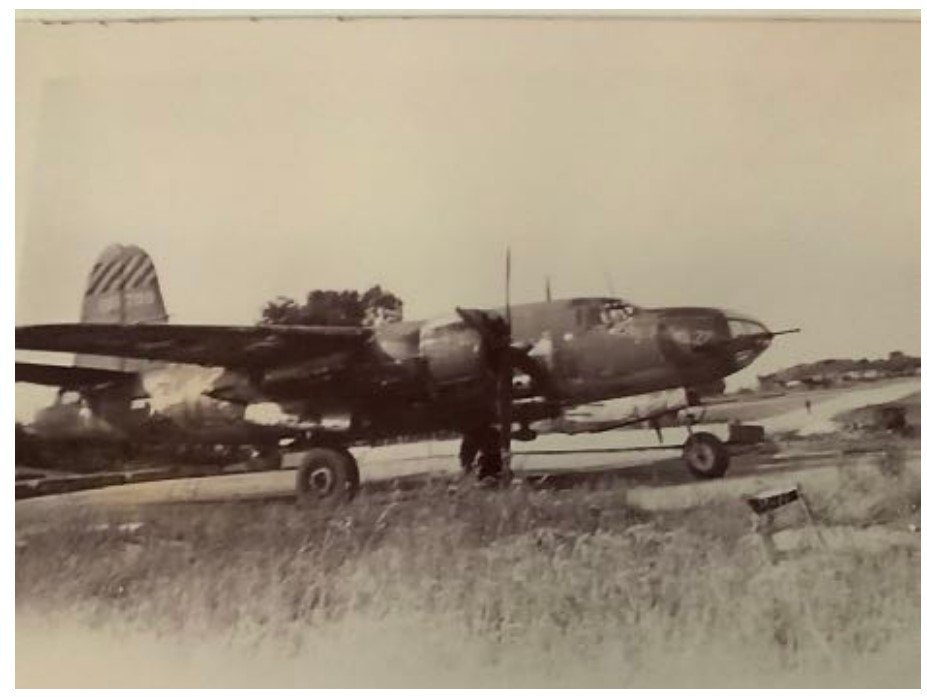
B-26 plane taking off in a field.

My father, Technical Sargent Stanley F. Thomas flew a total of 60
missions as a bombardier and tail gunner on a B-26 Marauder, twin
engine bomber in World War II. The minimum Air Force requirement
of missions to be served was 25-30. Since my father never
discussed the war with his children, I never knew whether he
exceeded the mandate out of patriotism, or he was just an adrenaline
junkie. In either case, along with an Air Medal, he was awarded the
Distinguished Flying Cross. The medal bracket on his uniform also
held numerous unit citations with oak leaf clusters. Along one side of
the front of his leather jacket, a number of bombs were stenciled
indicating direct bombing hits, while an adjacent row of swastikas
evidenced enemy planes downed by his unit in combat.

The B-26 Marauder was designed and put into production a number
of years prior to the bombing of Pearl Harbor. The Army Air Corp 1
(AAC) prepared itself for any possible contingency. Specification for
the plane included a speed of between 250-350 mph. Because the
plane was to be used as a strategic bomber, the plane had to be able
to out pace the then known top airspeeds of German and Japanese
fighters. The plane also had to have sufficient arms to repel any
attack by fighters as it performed its mission. Thus, both nose and
rear 30 caliber machine guns, as well as a top turret gun was
mandated. Later, the 30 caliber guns were replaced by 50 caliber
weapons. Additionally, the plane had to carry a sufficient load of
bombs, enough to cause significant damage to designated targets.
This meant that weight was of crucial importance. The desire for
maximum bomb load resulted in a short wing span. A shorter wing
meant greater takeoff and landing speeds. Since the landing gear of
the B-26 were in a tricycle-like position, particular attention had to be
paid to making sure the rear wheels touched down first, with the nose
wheel gently allowed to touch down last. This was no easy feat when
coming in at 150 mph or better. Doing so in a damaged plane made
the task even more difficult.

Crews treated their planes as if they were their own possessions.
Nose art with pet names became a standard, giving the crew and
plane a personal identity. My father’s crew named their plane, Kizio
Pofoth 2nd, Eaglet. The name consisted of the first letters of the last
names of the all the crew members (See airplane above photo).
Strategic bombing was considered crucial to any successful outcome
in a war. Before any major offensive (D-Day) the enemy’s ability to
counter attack had to be thwarted. This meant destroying war
materials factories, to limit their production of armaments and
supplies; bombing the enemy’s airfields to minimize their dominance
of the airways; and to knock out transportation venues such as roads,
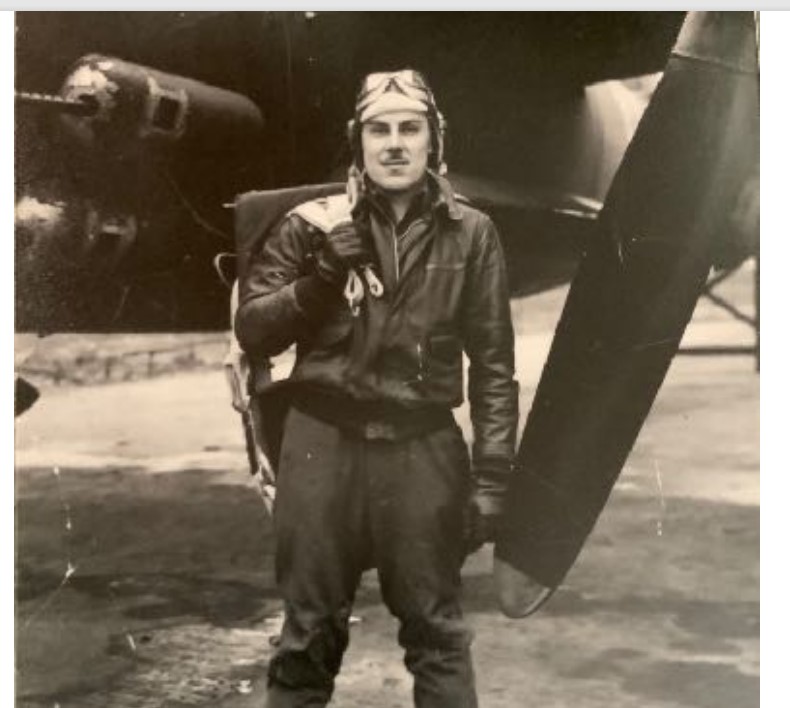
The author's father in his flying jacket in front of his plane.
Devon Francis, Flak Bait (Duell, Sloan and Pearce, New York, 1948), xi-xvi 1
10T Sgt Stanley Thomas

bridges and rail yards to keep them from moving supplies and troops
into areas of combat. However, at times, given unforeseen
circumstances, other targets may have to be considered a priority.
This proved to be the case when Germany began implementing the
V-1 rocket attacks on England. The V-1 emplacements were
scattered across the coastal areas of France and the Netherlands,
and had to be taken out, diverting the B-26s from other strategic
targets.

The mission of the B-26 units in WWII was to provide strategic
intervention, both prior to and after D-Day. The 387th Bombardment
Group to which my father was attached, was eventually based in
10various areas of England. A total of 36 or more planes from this
group flew out each day. My father’s squadron, the 557th was
stationed in Chipping Ongar, located thirty miles northeast of London.
From Chipping Ongar, daily sorties of planes flew out over the English
Channel to areas of France, Belgium and the Netherlands.

Every mission was fraught with danger, not only from possible
mechanical problems that might render the plane unable to fly, but
also from enemy fire. Anti-aircraft guns protected many of the target
areas. These guns sent up shells that exploded at a given height.
Many of the B-26s were damaged and or brought down by barrages
of flak exploding at the height of the planes. B-26s often came back
to base riddled with holes, their crews sometimes injured or dead
from shrapnel wounds. While less frequently encountered, enemy
fighters were also a challenge. In cases of fighter attack, the skill and
dexterity of the gunners was crucial to the crews lives. Although,
occasionally, the Americans had friendly fighter escorts run
intervention for them. These escorts extended only as far as the
fighters range, which were far less than the B-26s flew to reach their
targets. Luck also played a part in the crew’s survival. My father had
to abort one mission due to severe illness. His replacement came
back deceased from a flak hit.

In addition to operating the tail gun on a B-26, my father had the
responsibility of preparing the bombs for deployment. A safety fuze
pin had to be removed from each bomb before release. The fuze pin
consisted of a cotter pin, to which a paper tag was attached. A short
safety notice was printed on one side, while the other side of the tag
was blank. For each mission flown, Sgt. Thomas saved one tag,
upon which he wrote notes related to the mission. Each tag indicated
The number of mission; the name of the target; sometimes the
weather conditions; enemy fighter encounters; amount of flak;
number and size of bombs dropped; and occasionally other personal
comments. The tags became a diary of his missions.

I sorted all of the fuse tags in order from his first mission to his last,
with only five tags missing. Rather than describe his experiences in
narrative form, I have decided to let my father’s own words tell his
story. Below are his notes as he wrote them for each mission:

1) August 16, 1943, Bernay-St. Martin airdrome, first mission, James
Michael’s first gift (New born 1st child), more to come.
2) September 3, 1943, Lille-Nord Airfield, fighter airdrome, heavy to
medium accurate flak, all safe. Dropped 6, 500 lb. bombs.
3) September 14,1943, Lille-Nord Airfield, fishing trip, plenty of flak,
target under cloud cover.
4) September 14, 1943, Lille-Nord Airfield, turned back when over
target-weather bad, went fishing, light flak
5) September 25, 1943, St. Omer-Longuenesse Airfield, target
under cloud cover, couldn’t see results, cold as hell, 6, 500 lb.
bombs dropped.
6) September 21, 1943, Beauvais-Tille Airfield, two ships hit by
fighters, one lost, one made belly landing on airfield. Also one single
engine landing. We were jumped by 18 FW 190s. Engineer of one
ship bailed out when ship was hit and set afire. Dropped 10, 300 lb.
bombs.
7) October 3, 1943, Woensdrecht Airfield, inaccurate flak, bombed
alternate target on coast. Dropped 10, 300 lb. bombs.
8) October 22, 1943, Evreaux-Fauxville Airfield dispersal area, direct
hits, beautiful morning takeoff, Little flak, no fighters. Sweated out
landing, sick as a dog. Dropped 6, 500 lb. bombs.
9) October 22, 1943, Cambrey-Epinoy Airfield, raining-fog-soup, did
not drop bombs, rear 18 shot down, FW-190, could not see 100 yds
in front, Cambai/Epinoy. 4 1000 lb. bomb load.
10) November 3, 1943 St. Andre de L’Eure Airfield, flak intense, lost 2
B26s and 1 Spitfire. Saw FW 190, Got in some potshots. Dropped 4,
1000 lb bombs.

11) November 5, 1943, Mimoyecques V-1 site, excavations between
Calais and Boulogne, France, flak intense and accurate, one B26 lost
from 386th. Six boxes of 36 planes on this target- secret
12) November 26, 1943, Cambrai-Epinoy Airfield, target X, overcast,
just got into the coast.
13) November 29, 1943, Cambrai-Epinoy Airfield, target X, Buildings
of workers, good hits registered. Typhoon cover, short trip in and out,
pas La Calais, flak heavy, bomb stuck in bay.
14) December 1, 1943. Cambrai-Epinoy Airfield dispersal area, hit her
right on the button, flak over target-light, fighters on way out, spitfires
engaged same. Dropped 6, 500 lb bombs.
15) December 1, 1943, did not drop bombs, in over coast and out.
16) December 2, 1943, Did not Drop bombs?
17) December 30, 1943, Le Meillard-Bonniers V-1 site, target 2X, tour
of France over the Pas De Calais area. Had a good dose of light flak It
was terrifying. Could not locate target. 6, 500 lb. bombs.
18) December 31. 1943, Cormette V-1 site, Pas De Calais
construction works no bombs dropped 6, 500 lb. bomb load.
19) January 23. 1944, Le Grismont V-1 site, no ball (Code for V-1)
target in Pas De Calais area, no flak, no fighters, spitfire escort fair
bombing. Dropped 5, 500lb. bombs.
20) No tag?

21) February 9. 1944, Belleville en Caux V-1 site, no ball in Pas De
Calais , cloud cover, made two penetrations, bomb not dropped,
landed at Friston-emergency-weather bad. 6, 500 lb. bomb load.
22) February 10, 1944, Poix Airfield, no ball in Pas De Calais, cloud
cover, hit airfield no flak, milk run. 6, 500 lb. bombs dropped.
23) February 11, 1944, Amiens marshalling yards at Amiens, France,
cloud cover over target, hit no ball in break through clouds-12 bursts
of flak only in rear of formation. 6, 500 lb. bombs dropped.
24) February 24, 1944, Leeuwarden Airfield, Holland, base of 60
single, and 60 twin engine fighters. Good bombing results. 10 miles
from German border, light to heavy flak. 30, 100 lb. bombs dropped.
25) February 24, 1944, St. Josse Au Bois V-1 site, no ball Pas De
Calais, St Josse Au Bois, dropped 8, 300 lb. bombs, no flak, no
fighters.

26) February 25, 1944, Venlo Airfield, Holland on German border, first
glimpse of Germany, light- heavy flak. Lost 4 B26s over north Sea to
fighters. Box in back of us saw whole show 5 miles back. Dropped
10 250 lb. bombs.
27) No tag?
28) February 28, 1944, Ray sur Authie V-1 site, no-ball Pas De Calais
cloud cover did not bomb. 8, 500 lb bomb load.
29) February 29, 1944, Behen V-1 site, no-ball Pas De Calais hit
target, no flak milk run. 8, 500 lb. bombs dropped.
30) March 3, 1944, Montdidier Airfield, hit field, flak accurate,
received 8 holes, pilot hit by flak in arm. Really sweated on this one.
14 250 lb. bombs dropped.

31) March 5, 1944, Ray sur Authie V-1 site, no-ball Pas De Calais.
1032) March 6, 1944. Bois de Huit Rues V-1 site, no-ball Pas De Calais,
no flak, no fighters.10, 500 lb. bombs dropped.
33) March 20, 1944, Criel marshalling yards, France, flak inaccurate,
fighter-none attacked, Saw Paris Eiffel tower. 14, 250 lb. bombs
dropped.
34) (no date) Criel marshalling yards hit target perfect, light flak, no
fighters. 10, 500 lb. bombs dropped.
35) March 23, 1944, Haine St. Pierre marshalling yard, hit target
perfect, light flak, no fighters, 10, 500lb. Bombs dropped.
36) March 26, 1944, Ijmuiden E-Boat pens, Holland, Marauders drop
600 tons of bombs. Flak intense, 2 men killed in lead ship, 4, 1000 lb.
bombs dropped.
37) April 10. 1944, Le Havre coastal defenses, gun emplacement, hit
target right on the button- flak intense and accurate, no fighters, 4.
1000 lb. bombs dropped.

38) April 11, 1944, Bonnieres V-1 site, no-ball, hit target, flak intense
and accurate, lost first ship in our squadron, Lt. Pratt- 2 chutes seen,
14 250 lb. bombs dropped.
39) April 12, 1944. Dunkerque coastal defenses, gun emplacement,
hit target, flak intense and accurate, lost lead plane-colonel Caldwell,
no flak holes, really prayed on this one, 4, 1000 lb. bombs dropped.
40) April 30, 1944, Bois d’Enfer V-1 site, no-ball Pas de Calais, Good
bombing, flak accurate, aileron shot up, no fighters, 4, 1000 lb.
bombs dropped.
41) April 30, 1944, Somain marshalling yards, didn’t release bombs,
tour of France, no fighters, no flak, 4, 1000 lb. bomb load.
42) May 1, 1944, Monceaux-sur-Sambre marshalling yards, bombing
fair, no flak, no fighters, 4, 1000 lb. bombs dropped.
1043) May 1, 1944, Louvain marshalling yards, good bombing, no
fighters, flak on bomb run, 8, 500 lb. bombs dropped.
44) May 11, 1944, Hardelot coastal defenses, short of target, flak
hole in right wing, no fighters, 4, 1000 lb. bombs dropped.
45) May 12, 1944, La Parnelle coastal emplacements, short of target,
no flak, milk run, no fighters, 4, 1000 lb. bombs dropped
.

46) No tag?
47) No tag?
48) May 20, 1944, Benerville coastal guns, direct hits on target, no
flak, no fighters, visibility poor at take-off, 2, 2000 lb. bombs dropped.
49) May 20, 1944, Fecamp coastal defenses north of Le Havre, no
flak, no fighters, P47 area cover, 4, 1000 lb. bombs dropped.
50) May 22, 1944, Barfleur/Panelle France coastal gun emplacement,
short of target, bombed on pathfinder, flak moderate, no hits, no
fighters, P 38 escort, 2, 2000 lb. bombs dropped.
51) May 24, 1944 Barffleur/La Parnelle gun emplacements, France,
direct hits, flak, no fighters, pathfinder tech, P 47 cover, 2, 2000 lb.
bombs dropped.

52) May 24, 1944, Etaples-St. Cecily coastal gun emplacements,
direct hits, no flak, no fighters, P47- cover, 2, 2000 lb. bombs
dropped.
53) May 26, 1944, Chartres Airfield, France, hit dispersal area, flak
heavy-accurate, lost Smith, #199 road-on single engine, no fighters,
2, 2000 lb. bombs dropped.
1054) May 28, 1944, Liege-Renory bridge, Belgium, hit north span, flak
accurate, nose hit at gun, no fighters, long haul, 4, 1000 lb. bombs
dropped.
55) May 28, 1944, Maison La Fitte R.R. bridge, Paris, France, missed
bridge, flak terrific-several holes, prayed like I never did before, No
fighters, 2 2000 lb. bombs dropped.
56) May 31, 1944, Bennecourt highway bridge. R.R. bridge France,
Seine, overcast did not bomb, no flak, no fighters, 2, 2000 lb. bomb
load.

57) June 2, 1944, Eperville-France, coastal gun emplacement, fair
bombing, no flak, no fighters, 2, 2000 lb. bombs dropped.
(June 6, 1944, D-Day)
58) No tag?
59) June 10, 1944, St. Lo troop concentrations, St. Lo R.R. bridge
France, invasion area, hit target area, meager flak, no fighters, 14, 250
lb. bombs dropped.
60) June 11, 1944, Pontaubault R.R. bridge, France-invasion area fair
results, no flak, no fighters, 2, 2000 lb. bombs dropped.

I have no information regarding whether my father returned home
after his 60th mission, or if he remained in England participating in
other duties until the end of the war.


Poetry from Marjorie Thelen

   
 Poetry on a Rural Theme:
 Living in the Middle of Nowhere & Wondering Why
  
 by Marjorie Thelen
  
 The Ditch Witch Blues 
 after helping John again
 with some impossible task
 in her estimation
 this time trying to load 
 a 600 pound piece of equipment
 a ditch witch
 its big wheels 
 spinning in the mud
 onto a trailer covered with snow
 that fell overnight, predicted
 that the ditch witch slid off of the first time
 nearly smashing into John
  
 she's thinking a modest apartment
 with an alley view
 in a liberal, progressive community, 
 cultural venues by the boatload, 
 surrounded by people who have been in therapy
 no concern about running out of water
 or neighbors shooting at the devil
 or rabid extremists
 or fulminating fundamentalists
 is beginning to look appealing
 her country gal era may be over
  
 chorus
 oh, she's singing the ditch witch blues
 yes, she's crying the ditch witch blues
 time might be right to hit the road tonight
 because she's singing the ditch witch blues
  
 but
 the silence is nice
 mountain views spectacular
 you can see the stars
 John has plenty of space for his treasures
 but 
 the roads are abominable
 the dust never ends
 and there's the water problem
  
 chorus
 oh, she's singing the ditch witch blues
 yes, she's crying the ditch witch blues
 time might be right to hit the road tonight
 because she's singing the ditch witch blues
  
  
 Damn Coyotes
 I can't believe she left the radio blaring again.
 She thinks it keeps the coyotes away.
 Well, I can't sleep.
 Stop complaining. The treat bowl in the morning makes it all worthwhile.
 It was skimpy this morning. 
 Oh, shut up. Quit complaining. I hear she's going to butcher this fall. 
 You might be on the list. I notice you aren't laying like you used to.
 Ha, neither are you. God, I hate NPR. You'd think she'd at least put on the country and western station. 
  
 Little blind duck
 Little blind duck
 bumps into doors and fences
 but knows the way to the pond
 if John's fire truck isn't in the way
  
 Scarlett is her name
 old Indian runner duck
 now covered with mostly
 white feathers that used to be black
  
 Her favorite foods are tomatoes,
 watermelon, and cooked pumpkin
 she has one duck friend left
 a short, squat mallard
 who sometimes looks out for her
 sometimes not
  
 A turkey gobbler mistook her 
 for a turkey hen
 insisted on humping her
 squashing her into the ground
 and bloodying her head
 he went into the freezer
  
 Then the two hen turkeys did the same
 bloodying Scarlett’s head again
 which caused her blindness
 they went into the freezer, too
  
 Moral of the story:  be careful who you hump
  
  
 Guido
 how can you eat your pet?
  
 because we raised him
 because he got back rubs every day
 because he got orange peels, corn cobs, and cabbage treats
 because he had girl friends
 because he grazed green pastures, ate alfalfa
 because he had nice shade to chew his cud
  
 we nourished him
 he nourishes us
  
 we wouldn’t do it again
  
  
 Purple Potatoes
 We could make a potato dish
 to take to the potluck
 like potato salad or casserole 
 that would be easy
  
 I don't think the guys 
 would like purple potatoes
  
 what? 
 are you embarrassed
 to take something that 
 has been grown in our garden
 organic, local, non-GMO?
  
 no, no, it's not that
 it's just that the guys around here 
 aren't used to purple potatoes
  
 Shooting at the Devil
 the devil flies around the sagebrush at night
 shouting
 the neighbor shouts back
 and orders him to go away
  
 the trouble started 
 when the new people moved in
 when the neighbor comes home 
 stuff is moved around
 they hexed the place
 they grind up animals and
 throw them raw against her house
  
 she called out the sheriff twice
 he was no help
 so she shoots at the devil instead
 scaring the neighbors to death
  
  
 Obituary Notice for the Oregon Frontier
 Burns and Hines 
 old frontier towns in southeast Oregon, 
 died a slow, agonizing death 
 after refusing to acknowledge climate change
 and that they were using water
 faster than it came into the basin. 
  
 The residents of Harney County 
 were among other rural Oregon communities 
 that launched a sustained effort 
 to defeat every carbon emission reduction bill 
 that came before the legislature,
 that squelched every voice that said
 the way they used water
 was unsustainable.
  
 Well, they got their way. 
 They kept their diesel farm equipment 
 and old gas hog trucks. 
 They kept their methane-producing cows. 
 They kept their water devouring pivots. 
 They watched the Harney Basin Aquifer dry up. 
 They scratched their head when their domestic wells went dry 
 and their cows died for lack of water. 
  
 No water. 
 No alfalfa. 
 No cows.
 No way to live. 
  
 You drive through two ghost towns today. 
 Front doors stand open 
 on long deserted homes. 
 Grass grows 
 through the pavement of the main streets. 
 Traffic lights hang dead, unblinking. 
 Tumbleweed is the only thing moving. 
 No one home. 
  
 But they won all those battles 
 to keep fossil fuels cheap 
 and polluting their environment. 
 They won the battle 
 to keep their center pivots operating 
 and guzzling water. 
 But they didn't win the battle 
 to preserve their way of life.
  
 One Hundred Feet Down
 are snail shells
 under layers
 and layers
 of black sand
 remnants
 of an old lake
 thousands,
 millions of
 years ago
  
 then clay rock
 and then clear water at last 
 at 220 feet
  
 how old is that
 water we drink?
 how long has it been 
 down there?
 are we drinking ancient swamp water?
 what have we disturbed 
 with our modern technology?
  
 maybe three toed horses
 will coming galloping out of the well
 or ancient rhinoceroses
 or gigantic cockroaches
  
 The only evidence
 I have
 of ancient life
 below
 from our newly drilled well
 are tiny snail shells
 that were sleeping, undisturbed
 one hundred feet down
  
 Gnats
 on the road from Burns to Bend
 Glass Butte rises to the south, full of obsidian
 that oozed up and hardened into beautiful black glass
 millions of years ago
  
 between Hampton and Bend south of the highway
 lies the Brothers fault swarm
 that runs southeast to northwest across Oregon
 patiently waiting to move again
  
 to the west rise the Sisters, Newberry Crater, Mt. Bachelor
 Mt. Jackson, the resplendent Cascade volcanoes
 to the north across the Columbia River
 lie Mt. Rainer and Mt. St. Helens
 sleeping, waiting
  
 even further west 80 miles off the coast 
 lies the Juan de Fuca fault which last moved
 January 26, 1700 about 9:00 P.M. 
 a 9.0 on the Richter scale
 crating a tsunami
 that left dead cedar trees still standing
 on the banks of the Copalis River in Washington
 and waves recorded in Japan
  
 the Juan de Fuca plate gets unstuck
 on average every 243 year
  
 we think we have problems now
  
 We average 80 years here on planet Earth
 from baby to elementary to high school
 maybe college, maybe marriage, maybe kids
 then old age and we're done
 80 years
  
 The earth is 4.54 billion years old
 we are gnats on the back of time
   

Poetry from Frankie Laufer

 
  Apocalypse Now:
  
 Just like Apocalypse now, heavy breath - 1,2,3, controlled and focused.
  
  Descending steps sounding loud and crisp, only deep reflection floating on top.
  
  In the mind a painting appears, dark, mysterious, Black and Tan.. light too in the center. Don’t disturb this.
  
  A heavy white page is now turning, a story in its own right with no explanation or talking needed.
  
  A sudden revelation emerges but it’s too sudden and too revealing . 
  
 Turning another page now. 
   
 
THE GRACIOUS ROAD
  
 They would talk now. The time had finally arrived. He had gotten what he desired, a chance to express all the hurt and confusion caused by her reckless behavior, a betrayal. She often told him he was so gracious and kind. He would not be today. He would hold her accountable now. 

 The heart in hiding was now unexpectedly stirred by her voice. A meek hello as she answered the phone. Damn, where were the notes he had meticulous jotted down, his shopping list of topics to be covered? Each point meant to be delivered with just the right tone and effect, causing some uneasiness in her, and yes, some hurt, too. He found his pace and words poured out in a frenzy like rapid brush strokes he applied in one of his paintings. He wasn't just saying it, he was reliving the whole relationship. Her silence indicating she was finally taking him seriously. Then he heard a small groan from her, followed by tears. This did not bode well for his script. 

 It felt good...no, it felt bad. This was not his nature. 
 This was a love lost, but not forgotten. Now he did what he had always done in her time of distress. His heart rose to take the wheel, his intellect pushed to the backseat. His voice, his words, comforted them both like a bird's sweet song. She felt better now. He did too, finally. 
 He suddenly located his notes, but realized they were not needed on the gracious road. 
   

Mahjabeen Rafiuddin reviews Michael J. Robinson’s poetry collection From Chains to Freedom

Michael Robinson’s poem collection in his book From Chains to Freedom depicts genuine and authentic lived experiences of many black males in the United States. These poems are timely reminders of how far we have to go in our fight for equity and justice for Black people. He has been writing for a long while. Many admire Michael’s courage, voice and determination to tell his story and open other’s eyes and minds. I love his poem “Moving on with Life.”

After the murder of George Floyd, many of us who have been fighting for justice and equity for many years, want to ensure this is not just a moment of reckoning for racial justice in the United States, but that the momentum continues and becomes a movement. That is my prayer and hope after I read Michael’s book. These poems are great reminders of how we should keep fighting and never give up. Thank you Michael for this five star poem collection to hold us accountable and urge us to be responsible allies and advocates for many who are voiceless.

Middle aged Black man with short hair and brown eyes. He's got a hand on his chin and is facing the camera.
Poet Michael Robinson

Michael Robinson’s book From Chains to Freedom can be ordered directly from the author. Please email Michael at mjrobinson@rollins.edu to ask him about a copy!

Poetry from Hongri Yuan, translated by Yuanbing Zhang

Middle aged Chinese man in a tan jacket and black pants and a scarf standing on a city sidewalk in front of some trees and a tall red sculpture
Poet Hongri Yuan
Five Poems
Words by Hongri Yuan
Translated by Yuanbing Zhang
 
A Mysterious Giant
 
There is another sun in the body of earth,
it is the light of lights, cool flames.
Where the palaces and pavilions are golden and transparent,
houses a mysterious giant.
 
Last night I heard a call in my dreams
and came to his vast hall.
His smile made you to forget yourself,
reminded me of a ancient poetry—— “the rising sun has just risen”.
2.12 10.2015
 
神秘的巨人
 
大地的体内有另一轮太阳
它是光之光 清凉之火焰
那儿的宫殿楼台金色透明
住着一位神秘的巨人
 
昨夜我梦中听到召唤
来到了他那巨大的殿堂
他的笑容让你忘了自己
令我想起古人之诗 旭日始旦
2015.2.12上午10时
 
 
Gold Civilization in Prehistoric
 
Fifteen million years ago,
there was a civilization of gold on the earth.
The sun wrote the words of gold,
the moon wrote the words of silver;
all things on earth had its own language.
Where do the gods live in now?
They have never disappeared,
they house still on the earth,
just you aren't able to see them.
5.19.2013
 
史前之黄金文明
 
一千五百万年前
大地上曾有过黄金的文明
太阳写下黄金的词语
月亮写下白银的词语
万物皆有自己的语言
那些神人们现在何方
他们不曾消失
他们仍然在大地之上
只是无法看见
2013.5.19
 
 
Giants' Homes
 
The fleets of stars were speeding towards me,
They came from the distant galaxies.
In prehistoric times, they were the ancient gods,
their ancient kingdoms existed in the depths of the earth.
Oh, they gave me the rolls of gold books,
let me to seek the swords of gods.
The ancient earth will be golden and transparent,
hold up the newborn homes of giants.
2.3.2015
 
巨人的家园
 
星辰的舰队向我驶来
他们来自遥远的星系
在史前 他们是古老的诸神
在大地的深处 有他们古老的王国
哦 他们赠我一卷卷金书
让我去寻找那一把把神剑
这古老的大地将金色透明
托起新的巨人的家园
2015.2.3
 
I Saw a Golden City
 
I saw a golden city
made itself invisible in the earth.
Those ancients were still alive.
I often visit them in my dream.
 
Their eyes were very bright.
as if they did not know the passage of time.
I saw myself in ancient times,
he told me that the world just was a phantom.
 
He gave me an ancient golden sword,
let me to go and kill the greedy Python.
These demons ruled the world.
let the mankind forget the ancient ancestors.
6 .23, 2011
 
我看见一座金城
 
我看见一座金城
隐形在大地之中
那些古人还活着
我常在梦中去做客
 
他们的眼睛格外璀璨
仿佛不知时光的流逝
我见到了古代的自己
他告诉我人间只是幻影
 
他赠我一把太古的金剑
让我去击杀贪婪的蟒蛇
这些妖魔统治了人间
让人类忘记了古老的祖先
2011年6月23日
 
He is My Immortal Soul
 
The eyes of years are the maze of stars.
In a gigantic  palace,
I have seen the God of Gods.
He is smiling at me in heavens.
I'm thousand years in the world, which is just his moment.
He is my immortal soul,
and the universe——transparent crystal ball, in the palm of his hand.
6.6.2016
 
他是我的不朽的灵魂
 
岁月的眼睛  是星辰的迷宫
在一座巨大的殿堂
我见到了  那诸神之神的上帝
他在天庭之上向我微笑
我在人间的千年  只是他的瞬间
他是我的不朽的灵魂
而宇宙  透明的水晶之球  在他的手掌之上
2016.6.6
 
Bio:Hongri Yuan, born in China in 1962, is a poet and philosopher interested particularly in creation. Representative works include Platinum City, Gold City, Golden Paradise , Gold Sun and Golden Giant. His poetry has been published in the UK, USA ,India ,New Zealand, Canada and Nigeria.
 
Yuanbing Zhang (b. 1974), is Mr.Yuan Hongi's  assiastant and translator.He is a Chinese poet and translator, works in a Middle School, Yanzhou District , Jining City, Shandong Province, China. He can be contacted through his email-3112362909@qq.com.
 
Email:3112362909@qq.com Hongri Yuan Phone:+86 15263747339
Address:No.18 middle school Yanzhou District ,Jining City, Shandong Province, China
 
Asian man with glasses and short brown combed hair, wearing a black coat.
Yuanbing Zhang

Christopher Bernard’s installment of The Ghost Trolley: A Tale for Children and Their Adults

The Ghost Trolley

A Tale for Children and Their Adults

By Christopher Bernard

Chapter 3. A Girl in a Red Jacket Under a Green Sky

As the trolley clanked noisily down the tracks, it suddenly emerged from what looked like a tunnel, but no – it was an old covered bridge, of the kind seen in the woods near Halloway, and that Petey always thought looked “romantic,” like his mother said, to a guffaw from his father – even eerie and haunted, though in a way that wasn’t scary. He had always liked the bridges, with their rumbling, uneven planks as the family car slowed down to drive across them with long shadowy interiors dotted with sunlight peering through cracks and the smell of damp, decaying wood. But this one wasn’t rumbling at all. Nor was there any sign of sunlight.

For the sun was only just now rising through the trees ahead of the trolley.

But Petey noticed something strange. It made his heart skip a beat. The shadows on the other side of the bridge looked all wrong: rather than falling from right to left across the trolley rails, which they should be doing, the shadows now fell from left to right. The trolley had been running north, unless they had made a weird turn when he was asleep. But that was impossible; they would have been back in Halloway by now if that had happened, not in the forest at all. If they were still in the forest, they had to be north of the town. And they were definitely in the forest.

At that moment the trolley moved across a break in the woods – a meadow cut through by a racing stream – before moving back into the forest darkness.

And above the meadow was the sun. And it was blinding him.

Petey had to throw his hand over his eyes. This was crazy – not that he had to cover his eyes against the sun, but because he shouldn’t have had to do that in the first place: the sun shouldn’t have been on that side of the trolley  It was in the wrong position. It was rising in the west, not the east. Petey pushed close to the window and looked up, past the blazing patch where the sun silently roared.

The sun was rising into a sky without a single cloud across its vast and shining expanse.

And the sky was pale green.

And not only that: it wasn’t winter anymore.

Petey pinched himself. Yep, he was awake all right, unless you could pinch yourself in a dream and still stay asleep.

There was no ice or snow anywhere, not on the ground, not in the trees, not in the crevices of the trolley’s windows. The banks along the trolley tracks were covered with a thick blanket of ferns and brush and wild flowers – a blossoming tapestry with a complicated blend of fragrances so strong and lovely he pressed his nose against the window crack so he could smell it better. It looked like, and smelled like, a drowsy, dewy morning in late spring. He pushed the window open as wide as he could.

Not only was the sky green, but some of the vegetation – the long grasses, for example, and some of the weeds – was blue. He could see clover (also blue) on the banks of the trolley cutting, and, on a sudden zephyr, several blew through the open window into the trolley. He picked one up from the seat next to him; it was a four-leaf clover! At first he felt “hella lucky,” as his dad would say, then he picked up two others that had blown in beside it: they were all four-leaf clovers! For some reason, this made him shudder.

He peered more closely at the forest the trolley was passing through. It also was different: the trees had pale gray bark, as he was used to seeing, but the boughs didn’t start till high up, leaving the lower trunks smooth and bare, and the roots started several feet above the ground, forming little, cozy cage-like shelters at the base of each tree. And the leaves looked strange: each tree had leaves with many different shapes, some of them like the wings of birds, others like seashells, others like palm fronds or banana tree leaves, some like oak or maple or sycamore leaves – but they were all on the same tree, which was definitely not how he knew trees grew back home.

Back home! But if this wasn’t “back home,” where in McGillicuddy’s bean patch (another favorite “dad phrase”) was he?

He heard what he thought was birdsong, as it was coming from the trees, but it wasn’t like anything he’d ever heard: there were long sharp hisses, then chattering and ratchety crackles, followed by a little, spiky shrieks. And then he saw the little furry animals that were making the noises; they were flying through the trees, though they were definitely not birds!

They sailed through the treetops like flying squirrels, though these looked more like chipmunks, one of them like a possum, another like a rat, another like a bright red fox; they spread their arms, the skin spreading out from their torsos like little sails or wings as they flew from bough to bough. There was even a monkey or two hanging out in the upper branches, but quite tall and with less fur, and they stopped and watched the trolley intently and seemed to notice Petey and watch him with an especially alert look on their wizened faces. The forest here looked like a jungle!

Petey tried to crouch out of sight when he saw the monkeys watching him, though he was immediately mad at himself: so what if the monkeys saw him, let ’em look! He had nothing to fear from them – did he?

Other mysterious eyes were watching him from the dense foliage of the trees: large round eyes in small round heads, bracketed by curiously stirring wings. One pair of wings took off heavily to follow him as he rode past, followed by another, then another, and another . . .

Not long afterward, the trolley came to the edge of the forest. At first the brightness of the sun dazzled the boy’s vision and Petey held his hand above his eyes like a hat brim until he could focus again. The first thing he saw clearly was something lying on the ground near the tracks just ahead of the trolley. 

It looked like the body of a man. He seemed to be sleeping. He lay with his face in the grass, with one arm stretched forward as though he were trying to hold on to something that was no longer there. Maybe it was one of the homeless people Petey sometimes saw in Halloway, usually from one of the big cities not far away – Portland or Burlington. Petey felt a spasm of pity for the man as his body passed beneath him and to the rear.

The boy, his eyes fully adjusted to the stark morning light, suddenly looked at the landscape surrounding him.

It was partly hidden by what looked like brown fog, that blew away here and there to reveal patches of blackened, in some cases still burning houses, barns, sheds, stables, granaries, silos, whole farmsteads, charred woods, fields pocked with craters like holes punched out by a crazed giant; and villages were burning in the distance, and the waves of smoke moved across the land like ghosts.

The boy was at first too astonished to be frightened. It looked too awful to be real, and he felt at first a certain detachment, as though none of this was happening to him; it was like being thrust without warning someone else’s nightmare.

A solitary bird was winging slowly above a dead tree. But it was flying upside down.

Then the boy saw something that made him shiver: the driver’s seat had changed – before, it had been on the left-hand side of the trolley, as it always was; but now it was on the right. He still couldn’t see any sign of the driver: just the tall back of his seat, and his coat, now on a hook on the other side of the driver’s cabin, swinging back and forth. The mirror above the driver’s head, in which he could usually see the driver’s face, was blank.

The bell clanged three times, and the trolley moved onward. Petey squeezed his face against the window and stared as they moved across the vast desolation. What had happened? Why had he heard nothing about it? Something like this would surely have been broadcast on the news – wouldn’t it? What was this? Where was he?

Then he saw her. It was a little girl dressed in a red coat, though the coat was covered with black streaks like stains; she was standing in a field next to the trolley tracks, watching the trolley come toward her. She started waving frantically.

The trolley stopped and she got in, mechanically put a coin into the coin box, and walked back with head down toward Petey as the trolley moved forward. Petey watched her intently as she sat in the seat across from him, without apparently noticing him.

She was a small girl, with frizzy hair and honey-brown eyes, from what he could see; her skin was smooth and brown, like cocoa; like the skin of Sambene, the little African American girl in the other fourth grade class, who Petey had a crush on.

The girl heaved a sigh. Her cheeks were stained with tears and ashes.

Petey wasn’t sure what to do. His parents had always warned him against talking to strangers. But, under the circumstances, wouldn’t it have been terribly rude to say nothing at all?

“Hel-lo,” he said shyly, his voice breaking between the syllables.

“Oh, hallo!” the girl said in a small, startled voice, seeming to notice him for the first time. She turned toward him; yes, her eyes were as brown as honey.

Petey’s heart skipped a beat, for the second time that morning.

“What happened out there?” he asked, after hesitating for almost a full minute.

The girl stared at him with large, sad eyes that hardly seemed to see him. They shone with tears.

“They come for us!” she said, in a curious accent Petey had never heard before.

“Who came for you?”

“The Korgan of Ramora! It part of the big battle last night. You must see that!” And bursting forth from having been pent up so long, her words came tumbling out. “They come in middle of night and take me father and me mother and me sister and me brother, and they take me if I not hid under bush at back of our garden, and they set our house on fire, and I have to wait all night, watch our house burn down, and I ken’t believe it so I look at it when it all over, and I slip and fall in the ash, then I run away as sun rise till I see the yellow trolley that cross the middle of Otherwise when there be a blue moon, like there be last night, and here I am . . . ”

Petey tried to take all this in, without quite succeeding.

“Why did they want to take you?”

“It part of the war . . .” The girl looked at Petey closely for the first time. “Don’t you know? Not you from here?”

Petey shrugged uncomfortably.

“No, this is the first time I’ve ever been here. I got in the trolley to go to school and I fell asleep and I missed my stop and I waited for the trolley to take me back but it took me here instead.”

“Oh,” said the young girl, still sadly. “That must mean you from Howtiz.”
            Petey, who had never heard of “Howtiz,” looked doubtful, but felt it would be impolite to contradict someone who looked so upset.

“This be Otherwise,” said the girl, wiping the tears from her eyes (telling her story seemed to have relieved her a little). “You can see the different destination on front of trolley. When it go back from here it say ‘2 Howtiz.’ In Otherwise, things be different from Howtiz, completely different, but not all at once, which why it called Otherwise. Anyway that what me deddy tell me. I only know Otherwise, I never be to Howtiz. I always want to go there, because Otherwise not exist without Howtiz—at least that what me deddy tell me some of our philosopher say, though other philosopher claim otherwise. Me deddy say that so like them. They never make up their mind about anything.”

Petey blinked at that. Philosophers claimed otherwise about Otherwise? The thought gave him a little brain spasm.

“Anyway, I always want to see for meself, by going there on yellow trolley. But me parents never let me go. And a blue moon be rare anyway.” She sighed again. Speaking clearly made her feel calmer, so she continued. “We live, I guess not anymore, in Forest of Paal. Me deddy  a teacher. Me mommy a doctor, and there be three children. We live peaceful before the war and the Korgan from Kingdom of Ramora across Mountain of Sleeping Noor invade we. Everyone force to join one side or other, either Korgan or Paona, who be largest group who live on the plain. It easy for we to choose, cause Paonas gentle and honest, but very poor, and there not be many of them, and Korgan, though they be rich and powerful and strong, and there be many of them, not content with what they have but think they must have ever’thing. They probably not even be content then!” she sighed

The girl paused, as if uncertain whether to tell the boy from Howtiz any more.

“You couldn’t just stay out of the fight between them?”

“No,” said the girl positively. “You do that, everyone turn on you. ‘Whoever not enemy of me enemy, be enemy of me.’” She said the last in a detached singsong voice, as though reciting a school lesson she had become profoundly and bitterly skeptical of.

Petey looked uncertainly at the girl. He was thinking about what he saw altogether too often on the news back home. Back home! Sigh . . .

“Are you sure we are in Otherwise?”

“Yes, of course! Why you ask such a question!”

“Because what you say sounds an awful lot like where I come from.”

“The world Korgan and Paona fight for not just world of Otherwise,” she continued, ignoring Petey’s remark, “it be world of Howtiz, too. Whoever win will take over Howtiz as well. The two world come together then into one world – for better or worse. At least so some of our philosopher say . . .”

“When they aren’t saying otherwise?”

“Exactly right!” She gave a little laugh. “I doubt anyone know, really. But that what me parents tell me.”

The boy felt rather solemn after he heard all of this.

The girl looked straight at the boy.

“But,” she said, leaning in toward him; seeming finally to make up her mind to tell him everything, “there be another reason Korgan invade.”

She stared hard at him with her honey-brown eyes.

“They invade to find Spell.”

Petey gave her a blank look.

“So, what is ‘Spell’?”

“Spell be secret of Otherwise. Or one secret,” she added conscientiously.

The two children looked gravely at each other as the trolley moved quietly onward. The sun was just behind the young girl’s hair, making it glow.

“Me deddy tell me the story. Spell discovered many generation ago by the Paona. At first it make them happy, because it give them power over whole world, me deddy tell me. But it soon come clear such power can also destroy world, and so it too dangerous to keep. It too much for Paona to know. And so they bury it in a distant, hidden place and try to forget it. But my father say fact they once have that power can never be forgotten, never utterly entirely. Every so often someone break down and try, in middle of night, because it against law and every commandment of our religion, to dig up Spell, but no one ever able to find out where it buried.

“Then one day me deddy, who also like to invent things  – mostly toys for childers, but sometime big important things for adults – thought he had worked out – completely by accident, he say, but I think he just modest – what Spell be. Last night he tell me mommy. And I overhear them.” The girl’s face looked almost frightened. “I not sure I hear everything, but I remember everything he say.”

“But what was this ‘spell’ all about?” asked Petey impatiently. “Why was it so dangerous somebody would start a war because of it?”

“First of all, you must know Otherwise only exist because different things happen in all kind of different ways, but by chance,” said the girl. “Anyway, that be what me deddy say though I don’t really understand it. What Spell do be this: it make possible to go back into past and change into future – What Be. Even more: What Is. That why it be so powerful. It possible for you – for anybody – to make another Otherwise, and then another, and then another . . .”

Petey stared at her.

“If you have Spell, you have power over all of time. And therefore over all of world. So.”

And the possibilities this suggested to him swirled through Petey’s mind in a flash of intoxicating wonder.

Chapter 4. The Exploding Trolley

“What be your name?” the girl asked politely.

“Petey,” said Petey, coming back from his momentary trance.

“Me name be Sharlotta.”

For some reason Petey blushed, and the girl lapsed into silence. She seemed a good deal less upset now.

“Our home so beautiful,” the girl said quietly as she stared across the ruined landscape outside the trolley windows. “It not big, like a gookor, it be more like a gimpy, but it be roomy enough, and cozy. We live there long as I remember. Me mommy say I born there, but I think that can’t be so. After all, my little sister born in a gorpal in town.” She was silent for a moment, then continued dreamily, “We have two kerdles, and we have a bumble who think he a kerdle, and we have a goffney out back where we grow cispies and prunables and gerk trees that unleave in the fall and flourish all winter until the kerries turn many colors in sprang, and we have a wintry house where we eat when it not rain, above a custer with a pearly so fresh and cold you can kneel at the bank and cup your hands and drink it whenever you thirsty, it be most delicious beverage in the world, me deddy say.” She stopped, as though the dream had abruptly ended, and her face again crumpled. “Now it all gone . . .”

Petey had hardly understood a thing that Sharlotta had said, but her words sounded so heartfelt he too felt deeply sorry that it was gone, and he sighed.

It was then he heard an angry series of shouts from in front of the trolley, which came to an abrupt halt. The two youngsters were thrown from their seats to the trolley floor.

Petey scrambled up and peered around his seat toward the invisible driver. The jacket had fallen from the hook.

Sharlotta stayed down behind the seat in front of her.

“It be them!” she whispered in a terrified voice.

The trolley’s back door, which was right in front of them, had been thrown open when the trolley halted. Petey took the girl’s hand and, without a word, they scurried down to an embankment thick with tall ferns and other brush, and hunkered down among them out of sight.

Two large males, dressed like soldiers from a bygone era and holding weapons that looked to Petey like a weird blend of crossbow and machine gun, their skin as pale as milk but looking like they hadn’t washed in months, walked up to the trolley’s front door, looked inside and waited.

The driver didn’t emerge. Petey, who had never gotten a good look at the driver, was curious to see more, but Sharlotta tugged his sleeve to keep down.

Petey could hear the Korgans talking in the distance, but could neither see them nor make out what they were saying.

“Maybe we should get away from the trolley,” he whispered, suddenly feeling queasy.

 They crept through the brush quietly up the bank to several curious-looking trees at the top – their canopies of leaves were broad at the bottom and narrow above, twisting up in a shape like a flame. From there Petey could see clearly into the driver’s cabin: there was no one in the driver’s seat! His father had said that driverless trolleys and busses were only a matter of time – but he had never seen one before.

In front of the trolley several Korgans were conferring. Then one of them walked to the trolley’s open front door and threw something inside. The Korgans then ran hell bent for leather for cover behind a stand of tree fifty feet away.

“Hold your ears!” Petey had just enough to say when there was a flash, a rush of air and a boom as the trolley exploded.

Dust and gravel and shattered fragments of metal and glass, shreds of plastic, rubber, straps, handles, fixtures, stuffing from the seats, bits of wire, lights, piping – all rained down as the two children sat with their hands over their ears. Papers and fragments from Petey’s backpack and the things inside it scattered in the air, which was suffused with the smell of burnt gasoline and oil.

They sat paralyzed as the noise from the explosion echoed away in the distance.

How will I get home now! Petey thought. His backpack and notebooks and homework and lunchbox, and – gee whillickers! – his new smartphone, his very first one, which sure would have been useful to have right now – were all gone in a blast of smoke and noise that made his ears ring.

After a moment, Sharlotta brushed away a large piece of plastic seating that had fallen lightly on top of her, and whispered to Petey, “If I follow them, they lead me to me family.”

Petey didn’t need to ask who she meant by “them.”

“Aren’t you scared they’ll catch you?”

“Of course I be. But how else I find them?”

The girl raised herself a little.

“Are you going by yourself?” Petey asked.

“Yes. Unless you want come with me.”

“You know, it’s too bad you’re wearing a red jacket,” he said, after a moment, still in a whisper. “They’ll see you a mile away. Like,” he added, shyly, “my hair.” Fortunately, he was wearing a little, dark blue watch cap, as it was still winter in Howtiz; his orange hair peeped through in a narrow halo around the edge.

Sharlotta nodded ruefully.

She couldn’t just take her jacket off. She had only a thin nightie on underneath.

“But if you wear it inside out . . .” Petey said.

The girl’s face brightened. Then she whispered, “Don’t look!” took off the red jacket, turned it inside out, and put it back on. The lining was a blue-green and would blend in with the landscape quite satisfactorily, at least from a distance.

“There!” said Sharlotta. “Now you can look.”

“Who talking up there?” called out a voice from below.

They heard sounds of climbing and took the plastic seat cover Sharlotta had brushed aside and, curling up together into a little ball, covered themselves up.

A pair of muddy boots moved through the grass toward Petey, stopping a few inches from his nose.

There was silence except for the sound of the wind and the shrieks of flying animals in the trees.

“Strong smell of Paona!” The voice came from behind Petey’s head; it took a deep breath. “Some find it repulsive, but I find it likes me. I smell it can here.”

Petey felt something touch the seat covering himself and Sharlotta. It felt as if one of the Korgans had raised his foot and was resting it casually on the seat.

“Humph. No doubt explosion scaring them off.”

The voice above the boots spoke. “I need interrogate the leader Laghdin dragged in last night. I have word he knows more than he has a right to. Laghdin found paper before they burned house that tells he may have it. Or part of.”

“Hm! That be a lucky find indeed!”

“Or not . . . ”

 “It mean quick end to war,” the other said, almost ruefully.

“Or not! We keep it to ourselves till we have more fun with Paonas. Why spoil the game when our boys just start to enjoy themselves?”

“Ah, now you thinking like true Korgan!” said the other.

And the two laughed and ambled away down the embankment.

“He be talking about me deddy!” whispered the girl.

Petey met Sharlotta’s eyes in the shadow of the cover.

“Well,” said the boy, “I guess we’ll have to follow them now.”

He saw in the shadows a complicated look on the girl’s face: a knotting together of fear and sorrow and determination and gratefulness.

They quietly pushed the plastic off and peeped above the grass. A half-dozen Korgans were walking down alongside the trolley tracks, their strange weapons cocked over their shoulders. Petey and Sharlotta followed at a distance, through the trees above the tracks.

“One thing I don’t get,” said Petey quietly. “You said your family joined the Paonas, but the Korgans said your father is a ‘big shot.’”

“We not Paona,” said Sharlotta, “we be Creel, related to Paona going back many a generation. Me deddy become a Paona leader after we join them in the war, so they consider him Paona too. They consider anyone who join the Paona Paona. It just one more way they be coarse and stupid.”

“And the Paonas don’t do that?”

“No, of course not. They not lump everybody together the way Korgan do. Everyone be different, be treated differently. Anyway, that what Paona believe. And we Creel believe that too. But we should not talk. The wind blowing from us to them. They might hear.”

The two children followed the Korgans until the latter walked past the tracks, down a twisting stream, then turned out of the woods to the edge of a wide plain. Petey gasped a little at what  he saw: an immense encampment going for miles and made up almost entirely of tentlike structures, spread across the landscape like a living quilt, swarming with thousands of living beings – “Korgans,” said Sharlotta to Petey’s unasked question.

Pocked with open spaces, parade grounds and sturdier constructions of wood and even stone, and divided up by a network of roads and pathways, and surrounded by a belt of fencing punctuated with bannered towers, it was the main camp, as Sharlotta explained to Petey, of the invading Korgans. Far in the distance, a range of mountains crowned with snow seemed to float above the horizon in the image of a sleeping woman, and a blue moon hung in the eastern sky.

“That,” said Sharlotta, gesturing toward the mountains, “be land of Korgans. From there they come to conquer us, to seize Spell, and conquer world.”

Synchronized Chaos June 2021: Observer and Observed

Welcome to June 2021’s issue of Synchronized Chaos. We extend care to the regions of the world where Covid still rages and hope for the world to become safe and healthy.

This month, our writers and artists are seeing and being seen, observing and being observed.

Nondescript person in the shade observing a dolphin underwater in an aquarium.
Image from Paul Brennan

One of Robert Thomas’ pieces presents a narrator in a cafe who eavesdrops on others’ conversations, only to find someone else commenting on him at the end. Thomas’ other piece is a character sketch of someone who presents himself in very different ways based on the setting.

Z.I. Mahmud contributes the first installment of his thesis on Charles Dickens. He explores the symbolism and images of life, death and disease in Dickens’ work and makes a comparison to today’s fear of disease.

Zara Miller, author of young adult historical novel I Am Cecilia, also analyzes literature, pointing out that one-dimensional, less complex characters worked in Shakespeare’s plays because everyone has some people who only seem to play one role in their lives. Although we are all full three-dimensional human beings, we don’t fully experience the inner life of everyone around us, and Shakespeare’s work reflects that.

Meg Freer presents a travelogue from the Republic of Georgia where she visits sites from the country’s Stalinist past.

Christopher Bernard writes a more fanciful kind of travel story, and this month brings us the moment when the little boy traveler realizes that he’s going somewhere unexpected.

Group of silhouetted people of varying ages and heights watching a sunset through trees over a lake.
Paul Brennan

Abigail George observes her own past, reflecting further on a past relationship. J.J. Campbell also writes of the many times and ways romantic attachment can miss its mark. Jerry Durick’s poetic speakers also self-reflect, thinking on how they’re aging, running out of space, and never quite living up to their dreams.

Chimezie Ihekuna spotlights a screenplay version of his reflective memoir Experiences, sharing his early life in Nigeria with a facial deformity. Another piece of his praises the editor of this magazine 🙂

Jack Galmitz contributes some vignettes concerning how we relate to our world, how major events filter their way down to our consciousness.

Charlie Robert’s poetic speakers are immersed within one singular moment, unconscious of being observed. John Culp writes of the ecstasy of losing himself in the moment, dissolving his past and present into love and creativity.

Christine Tabaka writes of our search for our place: within our families, within our social groups, to each other and to ourselves. We want others to fully ‘see’ us and include us.

White swan on a pond, sitting on clear water and staring at ice.
Lubos Houska

J.D. Nelson’s pieces play with form and style while Mark Young speculates on the evolution of word meanings and poetic structures.

Mahbub ponders the fragility of life and the beauty of nature amid the coronavirus pandemic.

Hongri Yuan and translator Yuanbing Zhang voyage again to a mystical kingdom of order and beauty in the sky while Andrew Cyril MacDonald reflects on passing eras of our lives and of human history.

Mickey Corrigan shines a glaring light on Jeffrey Epstein and others who abuse their money and powerful positions. Sheila Henry calls for the world’s police forces to show empathy for the communities they patrol and the people they arrest.

Fay Pappas, attorney and former editor of Brushing, the literary magazine of Rollins College (Winter Park, FL), reviews Michael Robinson’s latest poetry collection From Chains to Freedom, which examines the Black male experience in the urban U.S.

Please enjoy this issue.