Poetry from Tony Beyer

loaves & fishes 

lower-case because 

not the biblical miracle 

but the Anglican lunch bar 

behind the cathedral  

in Wellington in the 80s 

where you selected your comestibles 

and the good ladies of the parish 

rang up the till 

and dispensed coffee or tea 

sometimes nearly all the staff 

of the Correspondence School 

were there queueing up 

with writers and artists 

and even occasional RC clergy 

from the parallel concern down the road 

I remember the cheaper 

raw carrot and crackers- 

and-cheese option 

never so much 

exponentially multiplied 

as available in abundance 

Drops 

attention to detail 

is a measure  

of becoming older 

now 20 Pansy needs 

anti-thyroid ointment 

in an ear each morning 

also a steroid eye drop 

to reduce inflammation 

to say nothing  

of her special diet 

hot water bottle and  

earth box for the night 

all of these aids 

to enduring feline 

geriatric life appear 

naturally delegated 

to my responsibility 

as a fellow pilgrim 

through this late 

not entirely disagreeable 

phase of being 

who once held her 

in the palm of a hand 

when she was new 

Perimeter 

every day with reasonable weather 

our neighbour Val 

pushes Gemma her Pomeranian 

around the block in a pushchair 

Gemma is about eleven now 

on medication for cancer 

and needs to wear dark goggles outside 

to protect her eyesight 

when we pass their house on foot 

she is often vigorous and vocal 

but there are also days 

we don’t catch sight of her  

the pushchair is of an older style 

and has obviously transported decades 

even generations of human 

members of the family 

Val’s granddaughter who is a friend of ours 

believes the old lady wouldn’t long 

survive anything happening to Gemma 

her only companion 

for now they define their perimeter 

Val by sight and memory and Gemma 

by sound and smell and the feel of wheels 

on the not always even footpath 

Tony Beyer writes inTaranaki, New Zealand. Recent work has appeared online in Hamilton Stone Review, Mudlark, Offcourse and Otoliths. Print titles include Anchor Stone (2017) and Friday Prayers (2019), both from Cold Hub Press. 
Essay from Norman J. Olson

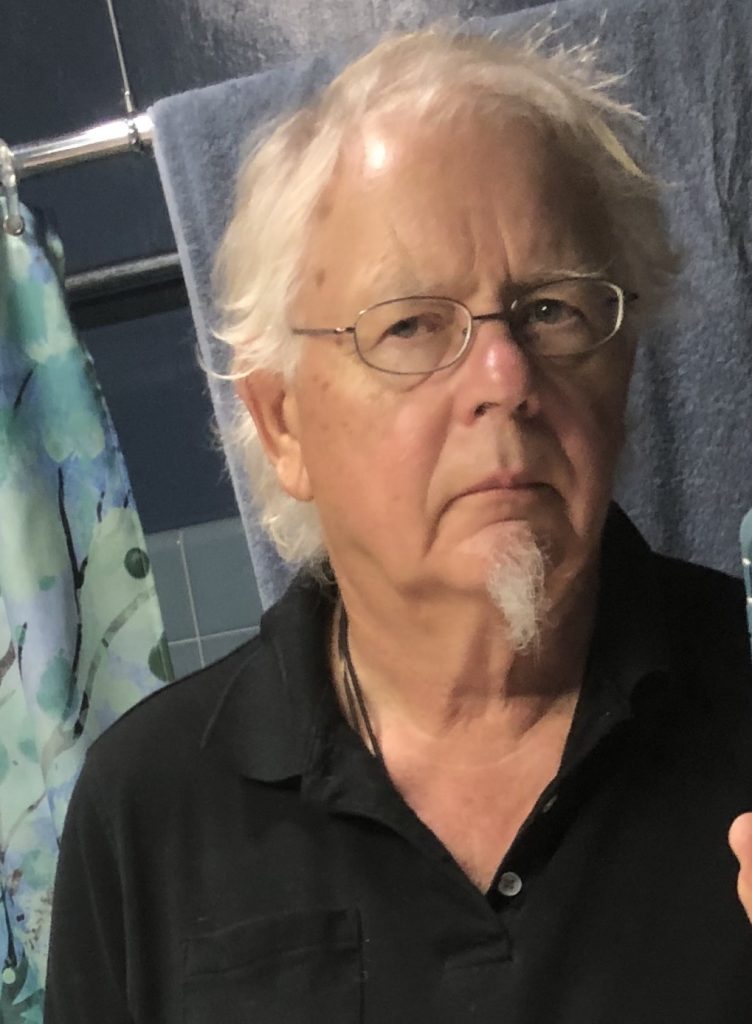
Picture of an older white gentleman with thinning hair, a small beard, and glasses, wearing a black shirt.
Norman J. Olson

Michelangelo and Me

By:  Norman J. Olson

I am almost finished with a new biography of Michelangelo by distinguished art historian William E. Wallace…  this book is, as the cover blurb suggests, “a good read”…  a book that discusses this fascinating and complex artist by carefully considering his own words, the views of his contemporaries and the historical context of his life and times…  Michelangelo was a prolific letter writer as well as a poet…  especially in his later years…  and this book looks carefully at his letters to give the reader a look behind the veil, so to speak of the artist’s public persona to give us a glimpse of the private man… 

Michelangelo saw himself as an aristocrat, tracing his ancestry back to the Medieval Counts of Canossa… modern scholars are skeptical about this link but, of course, the modern student of art could care less if Michelangelo was of aristocratic lineage… but for the artist himself, his being of noble lineage was a massive part of his self image and to some extent, the reason he was able to so completely transcend the simple business arrangement, to for example decorate the ceiling of a chapel… Michelangelo’s view of himself as an aristocrat put him on a different footing than other renaissance artists in that he did not see himself as a hired hand doing a piece of work for a fee…  even though that is what he ultimately was…  in this sense, he was much more like a modern artist doing art for personal reasons and only being paid as a sort of courtesy… whereas the typical renaissance artist produced pictures to order for a client…  Michelangelo agonized over art not to please a patron, but to please himself… his aristocratic self…

Michelangelo was by most accounts, a surly and difficult person to deal with…  he was easily offended and thin skinned…  he did not worry much about his personal hygiene, famously wearing his boots to sleep in for weeks at a time so that when he finally took them off, a layer of dried skin came off with them… he loved his work and spent long hours carving marble, painting and drawing…  he was also a talented architect who was able to organized a building project…  when he took over as architect of St. Peter’s, he was an old man, but still, he took over a building project rife with corrupt suppliers, do nothing workers, mismanagement and poor design…  he redid the design, had the work crews disassemble much unnecessary building that had been added on to the original design and then redid the design…  the design he inherited was poorly engineered, so he had to reengineer the building so that it would not collapse and then he redesigned the dome…  he hired managers, stone carvers, mule drivers, wagoneers, blacksmiths, rope workers, etc…  and saw to it that the work was carried out to his design efficiently and using the best materials obtainable…  so not only was Michelangelo able to draw, paint and sculpt as no other had ever done, he was a genius for organizing and building… 

Michelangelo’s family was large and almost totally dependent on him…  he supported his siblings and his aging father and worked hard to see that his family was able to keep up the appearance of their aristocratic lineage…  with nice houses etc…  he set his brothers up in businesses and farms and his letters are full of his instructions to them about buying property and investing the money he sent them…   from the letters, they seem like kind of an annoying bunch…  but even as an old man, he was constantly writing back and forth with them…

the book makes much of Michelangelo’s friends…  in fact, he had a number of close friends who did not see the surly and difficult artist but rather the guy who was a witty dinner guest…  as he grew older, he wrote poetry which he often sent to his poet friends for proofing and correcting…  and his poetry is surprisingly modern in that it is about himself and his struggles with art, and very confessional, as so much modern poetry is…  he was sincerely religious, especially as he grew older…  according to Wallace, Michelangelo was a pretty good poet and would have been more known except that the plan to publish a book of his verse fell apart when the friend who was helping with the project died… 

anyway, a few years ago, I was in Rome…  I visited the Sistine Chapel which I had not seen in about 40 years…  it is an amazing experience to walk through the door into that space and see those amazing paintings on the ceiling 130 feet overhead…  the figures so amazingly painted on that ceiling are so much more than the bible stories they illustrate…  in fact, I find it more interesting to look at the paintings as figures and fabrics…  I love the way the bodies are portrayed, the gigantic muscular men in all their writhing poses and the swirling of multicolored robes emerging from shadow…  for me, seeing that art work is a life galvanizing event…  I have studied and looked at pictures of this art all my life, but seeing the originals in all their size and glory is truly amazing… 

I also have made the trek to San Pietro in Vincoli church, up the hill from the coliseum in Rome to see Michelangelo’s masterpiece carving in marble titled Moses…  words fail me in describing this statue, but to me, it is a magnificent piece of art…  and a story about it is that the Jewish community in Rome used to make pilgrimage to the Christian church to see this statue because it portrayed Moses…  a major figure in the Hebrew religion…

I recently read a post from an artist of my acquaintance with a saying by somebody that a “provincial” artist is one who passively waits to be discovered…  this post inspired a facebook discussion among the artist’s vast number artistic and intellectual “friends” about how to make sure one’s work is “discovered” and just what that means…  it seems that the consensus was that being “discovered” meant obtaining an international reputation and that one had to hustle to do that by leaving Minnesota and going to New York, or someplace like it and getting your work in museums of modern art…  having representation of an important gallery was the way to make this happen although, getting into the museums of modern art was agree to be tough, because as one person said, the museums are running out of storage space…  but, if you do not get discovered or at least try by selling art, you are an amateur or even worse, a hobbyist and in any case, hopelessly provincial… 

well, Michelangelo certainly had and has, an international reputation so, I guess we must qualify him as “discovered…”  so, does that mean that I, as an artist who likes Michelangelo and considers myself to be a serious artist should try to be discovered?  or what? I will be forever provincial, an amateur and a hobbyist…  geeze…  what a conundrum… oh well, fortunately, I have my small press audience and although I am not an aristocrat, I also am not Michelangelo…

William Wallace's art history book Michelangelo: God's Architect, The Story of his Final Years and Greatest Masterpiece.

William Wallace’s history Michelangelo: God’s Architect is available here.

Poetry from Ian Copestick

Middle aged white man with glasses lying on a bed next to his dog. He's wearing a plaid buttoned polo shirt.
White man lying down next to a dog

This Heat

the heat is up in
the 30’s, and even
after a short time
outside you’re
dripping water as
if you’ve stepped
out of the shower.
It’s bloody brutal,
I’ve got ginger hair
( well I used to ) and,
I can’t take this heat.
I’m not made for it,
I’m used to drizzly,
dull, overcast, grey
days. I must be one
of the only people to
have had sunstroke
in Stoke on Trent. It
happened when I was
about 7 years old, I’ll
never forget it. I was
so fuckin’ ill. Throwing
up like you wouldn’t
believe. Pink, strawberry
milkshake pouring from
my nose as I puked like
I’d never puked before.
Sorry to disgust you,
but no, I’m no good in
the heat. I think what
maybe it’s my Irish
heritage. I’m damn
good at drinking, but
I can’t stand the sun.
No, I just can’t take
this heat.

So Boring Again

Life seems so boring
again today. Last night
about half a mile from
where I live, there was
a hostage situation.
The whole area was
full of police, some of
them with submachine
guns. There was also
ambulances, riot vans,
police dog units, and
anything else you could
think of. Apparently, some coke dealer had gone nuts, and kidnapped his missus with a samurai sword, and an air pistol.
Today there was nothing,
not a fuckin’ thing.
Life seems so boring
again.

My Yearly Complaint

It’s so stuffy, and
so humid.You can
hardly take a breath,
but I know from the
time of year that
summer’s heading
towards it’s death.
It always makes me
feel so sad, as my
September birthday
draws near that
another summer is
nearly gone, and
Autumn is once again
here. Don’t get me
wrong, I think Autumn
is great. It’s a riot of
colours, and smells.
Its winter that I really
hate, to me it’s like
fuckin’ Hell. When it
kicks in, you know it’s
gonna be six months
until you feel warm.
I hate the snow,
I hate the cold. I hate
its function, and its form.
You might think that
living in England, I’d
be used to this shit.
But every year as it
comes around I want
to get away from it.

Poetry from Joan Beebe

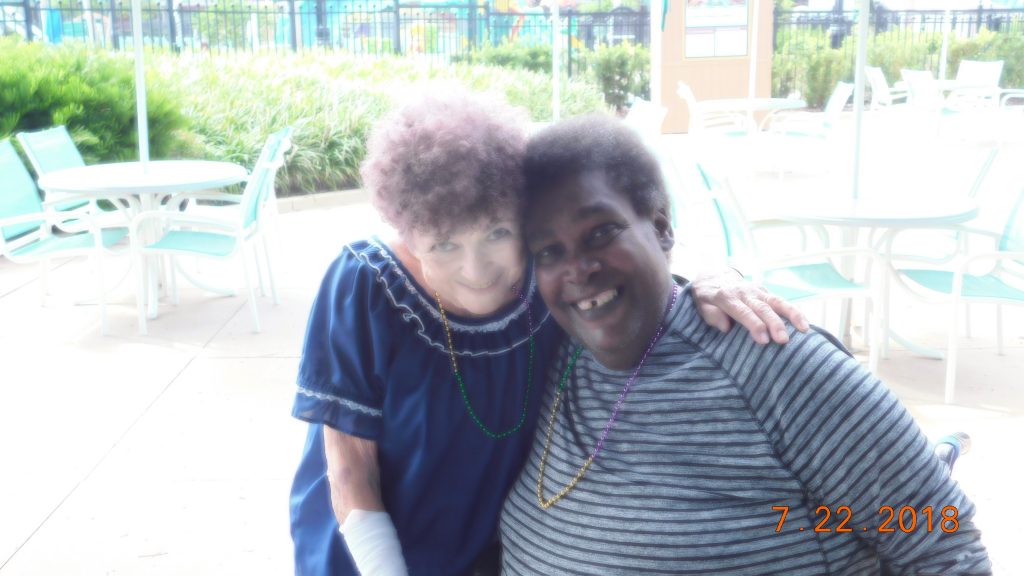
Middle aged Black man wearing a tee shirt hugging an older White woman, fellow contributor Joan Beebe, to his left. They're standing on concrete in front of some bushes.
Michael Robinson (right) and fellow contributor Joan Beebe (left).
MEMORIES


I look back at the years behind me and wonder where have they gone. Beginning with grammar school and then high school, I was given many opportunities to explore many facets of the world around me.


Singing in choirs, acting in amateur theater, being a part of the Civil Air Patrol which is a civilian help to the Air Force (in uniforms). Horseback riding through the woods and streams in the Adirondack Mountains.


Eventually getting married and having two babies (daughters).  Taking trips with the girls -- Disney World and also back to the Adirondack Mountains.
Celebrations at Christmas with Mass first.  Birthday parties, New Year's Eve parties and so much more.


Sometimes all this seems like a dream of long ago -- but it was real.  Looking back, I wonder - did I accomplish everything I should have and did I always do the right thing.


When you become a "Senior", you sometimes long for that time past. Now you have to take pills, you ache everywhere at times.  But, you know, I wouldn't change it for anything.  Each of us have a time of growing, loving and longing.  I am grateful for that time and will always nourish and also be happy for those days long ago.


Synchronized Chaos August 2020: In All Of Our Humanity

Sometimes some of us feel like this

Welcome, readers, to August’s issue of Synchronized Chaos Magazine.

First off, we have an announcement from regular contributor and nature poet Rui Carvalho, about the annual international nature writing contest we co-host with him.

Also, another regular contributor, poet and novelist Christopher Bernard, has established a podcast.

This issue reveals and explores different dimensions of our humanity: our bodies and looks, our emotions, our intellect and creativity, our life transitions and hopes for our futures, our personal relationships, and our broader societies, our quests for justice and how we treat each other and the natural world.

Norman J. Olson narrates the first professional gallery exhibition of some of his paintings, artistic nudes.

Judge Santiago Burdon paints a portrait of the looks and personality of a captivating woman, while Bangladeshi poet Mahbub’s work probes the mysteries of the human heart.

J.J. Campbell offers up moments of happiness and acceptance rendered through his trademark cynicism.

Shruti Iyer conveys and explores the panoply of human emotions through her variety of poetic female narrators.

Michael Steffen depicts the strength of the human personality in response to circumstances: humor, sauciness, existential curiosity, fury, and resolve.

Other days like this

J.D. DeHart’s pieces reflect the power of words and ideas. In Mark Young’s poems, the ideas as well as the words seem to hang together, even when they don’t make sense in a linear way.

Henry Bladon presents gently humorous creative frustration, where losing one’s ideas and work-in-progress becomes a kind of ‘little death.’ In a similar vein, Rachel Grosvenor contributes a sestina about the struggle of creativity over sorrow and despair.

Mike Zone writes of our epidemic of loneliness, how sometimes we try to possess each other rather than truly connecting. Syrian author Raghda Mouazen crafts pieces about isolation and enclosure, and her speakers retain the desire to comfort others.

Or even like this, with too much Zoom

J.K. Durick offers up a humorous lament on growing old.

Ghanaian performance poet Ike Boat’s pieces depict coming of age, figuring out what to do in life, and overcoming obstacles such as bedbugs. He also contributes notes from his travels, ‘On the Road with Ike Boat.’

In her monthly Book Periscope column, Elizabeth Hughes reviews Gini Grossenbacher’s Madam in Silk, a historical fiction tale of a woman immigrant from China during California’s 1850s gold rush.

James Thurgood’s poetry also expresses personal growth: the need to let go and not hoard items from the past, the inevitability of loss in life, and how, like the writer or the bird out of his comfort zone, we can make room for new ventures.

Federico Wardal extends himself creatively by allowing the development of a virtual rendering of himself who can act in films and plays, some of whom he’s written himself.

But we can aspire to this

Spanish writer Daniel De Culla renders in verse a medieval Spanish tragic tale of two timeless human concerns: love and death.

U.K. author Mark Murphy presents a set of poems about love, fascination and the inexorable force of history.

Michael Robinson opines on religion, how greed and selfishness among both the leadership and the congregation do as much as the coronavirus to drive people away from church.

Mickey Corrigan satirically criticizes those who prize their own aggrandizement over compassion for other people and the natural world.

Michael Robinson’s poetry honors the legacies of Christian faith and American Black culture as a way to survive the past and present violence Black Americans endure.

Egyptian writer Jaylan Salah writes of the gradually expanding portrayal of Black manhood in cinema, how Black men are now being shown as more complex and fully human.

Dave Douglas’ heady thoughtful poems urge us towards love for one another, while Chinese poet Hongri Yuan creates a vision of order, wisdom and beauty in his fantastical Golden City.

Nigerian author Chimezie Ihekuna’s poem expresses hope that we will overcome coronavirus.

Joan Beebe shares her waking dream of a ship, of traveling through life’s losses with an inner sense of peace.

We hope that this issue leaves you with peace, resolve, and creative inspiration.

And treasure moments such as these.

Poems from J.J. Campbell

Middle aged white guy with glasses and a face mask with facial hair and a tee shirt standing in a bedroom with posters on the wall and a dresser behind him.
at any given moment
 
she had the look
of a woman that
would shatter
you into pieces
and you had
nothing but
time
 
she liked her
whiskey neat
and to be
showered
with love
at any given
moment
 
thankfully,
all that time
came in handy
----------------------------------------------------------------------
twenty-seven years
 
a little rain on a
tuesday afternoon
 
twenty-seven years
after a woman got
famous for cutting
her husband's penis
off
 
life was much simpler

back then
--------------------------------------------------------------------
in the nude
 
purple sunshine
as the horizon
fades
 
you once knew
a woman who
used to smoke
cigarettes in the
nude on her front
porch
 
you always thought
she would be an
amazing lover
 
turns out she was
just lazy and wanted
a lover that also
did her laundry
 
needless to say
 
we didn't last long

together
--------------------------------------------------------------------
to die in a war
 
i never have asked
for forgiveness
 
and i quit asking for
permission as soon
as i was old enough
to die in a war
 
i've been socially
distant for the
majority of
my life
 
so, staying away
isn't that big
of a deal to me
 
and the mask reminds
me of every bad guy
i cheered for in the
westerns i watched

as a child
--------------------------------------------------------------------
finding a twenty on the ground
 
happiness is a bet
on the winning
horse
 
a woman sleeping
in your arms after
a night of ecstasy
 
finding a twenty
on the ground
 
watching it rain
after the grass
has been mowed
 
listening to coltrane
after the spoon has

been emptied

Poetry from Raghda Mouazen

The Silence

Raghda Mouazen, Syria                   

A gentle beat of emptiness is heard

Among the hush that dominates all

But my ears are full of echoes,

A sharp arrow would fall

Over the heart that’s full of scars.

Arrows of hollowness they are,

Of the everlasting silence they are,

Of the hopeful heart and hopeless scar,

Of the soulless dumpness they are

And I weep, weep, weep

Till I see only blur.

A breath weighs a ton over my chest

Packed with trivial harsh memories

With senseless words of senseless beings

Aiming their arrows well for braggings

And they ache, ache, ache

With every breath and they are many!

Blood is dried and it turned snow white

No soul to break this silence, silence, silence

And replace those worthless arrows

With roses red and echoes of fluffy words.

Oh the noisy silence is the loudest, I say

But still, with hope it lulls

And I sleep on the lulls of an idle heart.

Dark Ocean    

Raghda Mouazen, Syria                         

Diving down into the deep

To lay some of the ocean’s weight,

I pick up poisounous, pale clouds

From the moonless, starless

Night like darkness.

Breathless with heaviness,

The surface I reach.

Similar souls I offer a cloud each

For I wish them not to decay.

They leave with relief

Unaware of my grief.

Heaviness still lays

Upon my deep.

Sore Jewels

Raghda Mouazen, Syria               

Wearing her man’s gifts,
The red, blue and yellow jewels,
She walks among the wondering eyes,
Hiding them all except the gray diamond ring
But the pearls he adores
And for him preserved
For the fatal reunion
When his gifts are fearfully received
From his merciless ‎monstrous hands.

A Woman’s Reflection

Raghda Mouazen, Syria            

In a mirror she looked
Frozen locks on her head
With a colorless crown
Dark brown eyes filled
With utter hollowness.

No wrinkles were visible
They only dominated the unseen part
Of her thin body
And most of her heart.

Pure white lilies she held
Watered nearly everyday.
Withered trumpet vines
Grew heavy all over her body.

Closed her eyes to flee
But pain conquered
And seized her dreams,
Leaving her bewildered.

Her voice may save her
But the sobs took over
And it would only tremble.
Again, there was no anchor.

A veil over what was left
Of her colorful hair
Cruelly stripped their color
Still, they think it is completely fair.

She had to accept it with palor
For in the end it was a gift
From her trustful amor.
It was a curse no one could lift.

Misty existence

Raghda Mouazen, Syria                

Cold white walls

Could hear a thought of vengence,

Conquering me.

A warm breath,

Various expressions,

Colour, I need.

I have waited decades

For them to decay.

On ruins I behold

Greenless, soundless, sunless being,