
Poetry from Allison Grayhurst, set to music by Diane Barbarash

Musical collaboration between poet Allison Grayhurst, whom we’ve published several times in Synch Chaos, and musician Diane Barbarash.
Animal Sanctuary
© 2017 Allison Grayhurst (lyrics) and Diane Barbarash (music vocals and arrangement)
he turns his hawk head to view
the shells of turtles streaking
the still-shroud of water in tanks
as blue as sky
he lifts a leg and talons tensed
pivots to defend
against an enclosing shadow
with whitish eyes and an impossible urge to fly
he hops along his man-made perch
toward the cages where squirrels leap from metal to wood
scattering like leaves in unpredictable flurry
scattering like leaves in unpredictable flurry
spring, he will never experience again
nor know the scent of a pent-up life
released like sunflowers blooming or the feel of the moon
colder but more comforting
than being touched
with whitish eyes and an impossible urge to fly
he hops along his man-made perch
toward the cages where squirrels leap from metal to wood
scattering like leaves in unpredictable flurry
scattering like leaves in unpredictable flurry
bridge
he is without time or tribe
and like fire
he haunts
by just
being
with whitish eyes and an impossible urge to fly
he hops along his man-made perch
toward the cages where squirrels leap from metal to wood
scattering like leaves in unpredictable flurry
scattering like leaves in unpredictable flurry
scattering like leaves in unpredictable flurry
scattering like leaves
Poetry from J.J. Campbell
——————————
go explore your new world
look at the bright side
you figured out long
before the death bed
that god doesn’t give
two shits about you
that dread you feel
is actually freedom
the exact moment
where you have the
opportunity to shit
out all you were
brainwashed with
as a child
and go explore
your new world
with two experienced
but released eyes
or continue
to suffer
for a cause that
has become an
embarrassing
display of
zombies and
rich assholes
Poetry from Aremu Adams Adebisi
A Love Poem:
When we are in love, we do not whisper,
we do not talk too much, we forget poetry
easily and all it represents in imageries.
We watch an elocutionist stutter in utter
shock. We see a bird sitting on an olive tree
look beyond the grove, look beyond the road,
far into the sea and we stare into the sea
and find deserts in waters. No sea waves
slapping at the shore, no boats, no sailors,
no mullet smoked on a wood oven, no child
building a sand-castle. We wonder why this is
only to see a rice field blighted with diseases,
a child in Maiduguri whorled in shackles
because he is found at the European shore,
running away from war, away from shadows.
Why, Beloved, say I do not love you as you want
but I have sworn upon my mother’s frets
that I do. For what better way I will say you
remind me of poems unwritten, books I wish
to leaf through unopened and words
at their silence? What better way to say
each time I think of your bed, I am gripped by
the hands of a little boy with eyes plucked
out by scavengers? Let the sun set and I will
smoothen your back with musk and saffron,
grab your waist, send chills down your spine.
But I see them still, eating into my sleep,
seated in my eyes— young boys from Aleppo,
old men in Afghanistan spared by bullets.
I love you, Beloved— Amen. Till death do us part.
Elizabeth Hughes’ Book Periscope
Rosetta by Stephen Patterson

Rosetta by Stephen Patterson is a must have for the sci-fi fan. Tom Palermo is a maintenance tech who is sent to Providence to retrieve Rosetta, an ancient Martian language. Only problem is, there is no translation known. With a mix of humans, meta-humans, A.I.’s and others, Rosetta is action packed from beginning to end. I absolutely loved it and hope it will be made into a movie. With Christmas just around the corner, this would be an excellent gift. Enjoy!!
Poetry from Mahbub

Sleeping Beauty
O my darling, don’t be so silly
how long will you be silent
in this sleepy world
I am very hungry
burning my heart, am always trembling
all the beauties are hidden in this dark light
falling down and dying, find me no more
I know your silence calls me
to move, touch your body
please look at me, a helpless poor lover
my broken heart always fails to do any task
please look at me, burning my soul and body
there no response without kissing
then started kissing and waking up from bed
you held me with your beautiful eyes.
Tony LeTigre reviews Richard Brautigan’s Trout Fishing in America
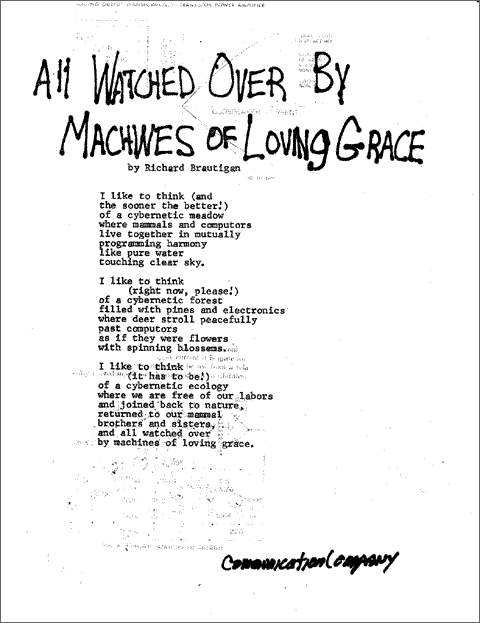
Image attached: Scanned copy of original broadside publication of the poem “All Watched Over By Machines of Loving Grace,” Richard Brautigan, 1967.
Review of “Trout Fishing in America,” by Richard Brautigan
Yesterday I finished Trout Fishing in America. The Mayonnaise Chapter closed it out. What a beauty! What a truly unique work of literary art! There is one short chapter that’s an homage to Leonard da Vinci. Most wonderful. Most amusing, throughout.
The final, magisterial sequence, concerning a “used trout stream” sold by lengths in a used merchandise warehouse, is like a pattern connecting a small galaxy of dots, representing the anterior chapters, & bringing them all into sudden comprehension, a whole formed of Lite-Brite pegs.
Brautigan’s attitude is an interesting composite of backwoods, hardscrabble, drink loving fisherman meets beatnik / proto-counterculture era San Francisco. But it was written in 1961, six years before its publication in the year of San Francisco’s eponymous Summer of Love.
Trout fishing runs like a surreal mosaic river through this text, whose chapters & chapter-lets, of different sizes & colorations but of the same general make, glisten up like rainbow trout from their creel, constructed of a lattice of fake recipes (‘Another Method of Making Walnut Catsup,’) oblique film appreciations (‘The Cabinet of Dr. Caligari’), hilarious anecdotes of poverty (‘The Kool-Aid Wino’), & themes of mutants marginalized by society, yet delicious to the author’s curious taste (‘The Hunchback Trout’).
One section lampoons communists, conflating them with police, as likewise agents of state control. I pursued this 113-page poetic jewel of prose like a fisherman overcoming the resistance of a fierce catch, packaged along with The Pill Versus the Springhill Mine Disaster, & In Watermelon Sugar, in my reading volume.
It bears a photograph on the cover, black & white, of Brautigan posing with his lady friend in SF’s Washington Square. The text takes up this photograph for contemplation at intervals, many times. The figures on the cover appear selfconscious, stiff, slightly awkward — yet maybe this is charming.
If I were to select a single passage that moved me most, a strong contender would be “The Last Mention of Trout Fishing in America Shorty,” which I quote in full here:
______________________________
Saturday was the first day of autumn and there was a festival being held at the church of Saint Francis. It was a hot day and the Ferris wheel was turning in the air like a thermometer bent in a circle and given the grace of music.
But all this goes back to another time, to when my daughter was conceived. We’d just moved into a new apartment and the lights hadn’t been turned on yet. We were surrounded by unpacked boxes of stuff and there was a candle burning like milk on a saucer. So we got one in and we’re sure it was the right one.
A friend was sleeping in another room. In retrospect I hope we didn’t wake him up, though he has been awakened and gone to sleep hundreds of times since then. During the pregnancy I stared innocently at that growing human center and had no idea the child therein contained would ever meet Trout Fishing in America Shorty.
Saturday afternoon we went down to Washington Square. We put the baby down on the grass and she took off running toward Trout Fishing in America Shorty who was sitting under the trees by the Benjamin Franklin statue. He was on the ground leaning up against the right-hand tree. There were some garlic sausages and some bread sitting in his wheelchair as if it were a display counter in a strange grocery store.
The baby ran down there and tried to make off with one of his sausages. Trout Fishing in America Shorty was instantly alerted, then he saw it was a baby and relaxed. He tried to coax her to come over and sit on his legless lap. She hid behind his wheelchair, staring past the metal at him, one of her hands holding onto a wheel.
“Come here, kid,” he said. “Come over and see old Trout Fishing in America Shorty.”
Just then the Benjamin Franklin statue turned green like a traffic light, and the baby noticed the sandbox at the other end of the park.
The sandbox suddenly looked better to her than Trout Fishing in America Shorty. She didn’t care about his sausages any more either. She decided to take advantage of the green light, and she crossed over to the sandbox. Trout Fishing in America Shorty stared after her as if the space between them were a river growing larger and larger.
______________________________
On this simultaneously lachrymose & liberating note, with the image of a potential prey item (a baby, a fish) breaking free of the bait (sausages, salmon eggs), while a marginalized outsider is left in the dust, this beautiful book achieves a poignant crescendo.
And the cryptic Mayonnaise chapter which finishes the book is accompanied, on the final page, by another memorable black & white photograph: of a young woman with long sun kissed hair parted cleanly in the middle, sitting like a disheveled faun amidst what looks like the wreckage of a derelict or demolished building.
I hear that Mr. Brautigan, depressed by the lack of acclaim for his final novel, went out to a beach & quietly shot himself some years ago. I am sorry to hear that, for his work, Trout Fishing in America, deserves to live forever. My hate is off to Mr. Brautigan, who ought to be fishing the best trout stream imaginable right now in the posthumous author lounge of that better world which may or may not exist someplace. That which is now old may be new again; but that which is immune to aging is haute littérature!