Short story from Mark Blickley

“My Better Half”

People who see me must think I’m eccentric, emotionally disturbed, or lonely. People who speak with me have told me that I’m an obnoxious, good-for-nothing bastard, a nasty prick, but I don’t give a fuck what anyone thinks. I don’t even care who reads this damned notebook. My name, Andrew Tremper, is right on the cover for all to see.

It all started about nine years ago. I was shacking up with this girl who was what they call a “modern dancer.” We lasted a little under a year together. Her name was Miriam and she went to some artsy-fartsy college up in New England to study THE DANCE. When she returned to New York she joined a dance company called Dervishing Divas. I met her at a performance on Manhattan’s Upper West Side.

I was confused. I’m an educated man and I know what a dervish is—it’s spinning around, out of control. But the Divas didn’t spin. Hell, they barely moved. For over an hour all they did was lift a leg or move an arm or twitch their head every few minutes while electronic music slammed into our eyes and pulsing lights irritated our eyes. The Dervishing Divas sucked, but Miriam looked awfully good in her low-cut leotard, and I could see that she had the rounded buttocks of a thoroughbred horse.

I don’t even remember how I got to a Dervishing Diva performance or where I heard about them, except that back then I used to make the rounds of a lot of inexpensive arts events because there was always lots of women and I was posturing as an arts enthusiast, a good looking, well built arts enthusiast. Hell, I remember the night I nailed Miriam. I had to put up with hours of her artspeak about how the Divas don’t dance, they manipulate movement and shit like that. Well, let me tell you, she moved like a worm with a match under it later that night and a lot of nights that followed.

When she finally skipped out on me, the bitch left me a going-away present—a life-size cardboard cut-out of myself. On a note pinned to its crotch, she said she had it made because talking to the cutout was the only time she could have an adult conversation with me, expose her feelings without being ridiculed, cut-off, or ignored. The note said a helluva lot more than that, it was a freakin’ manifesto, but you get the idea. It was a real artsy exit, don’t you think? And probably the highlight of her creative career. I mean, just imagine all the thinking, planning, and execution involved in trying to make me feel like a complete shit.

I was going to throw the damned thing out, but I grew sort of attached to it. She did pick a pretty decent photo of me to enlarge in cardboard, although I’ve always thought of myself as somewhat taller than I am. Standing back to back with the cutout proves we’re both the exact height, five feet ten and three-quarters of an inch. That sonofabitch dancer nailed me down to three-quarters of an inch. In her manifesto, she predicted I’d keep the life-size cutout because I was so in love with myself. Miriam was wrong. I kept it to show the other broads I bang the monument of obsessive love given to me by a former member of the Dervishing Divas. The girls I take up to my apartment all seem to be impressed, so I guess Miriam’s cruelty backfired on her. How’s that saying go about a last laugh?

I kept the cardboard cut-out of myself inside my apartment for about three or four years. It made its world debut at a stupid party thrown by a woman I was involved with who lived in Hoboken. The point of the party was that no one could speak. Everybody had to write these responses, keep them in their pockets, and then show them to other guests when communication was desired. We were kind of like idiotic mimes without makeup. I feel like an ass even admitting that I’ve attended parties that, but hey, in a time of wildfire viruses, artsy babes are the most liberal and liberated, so I played the game to win the prize. Sue me. It’s better than sitting home and choking the chicken in front of adult video rentals although that, too, has its moments.

I cut up a few garbage bags and wrapped them around my cardboard cut-out that I named Sir Andrew. As I pulled the plastic around Sir Andrew’s head, it felt as if I was trying to suffocate myself, which is ridiculous because I don’t hate me. I pulled the plastic off Sir Andrew and decided to take him outside in all his glory. I figured I’d allow other people to enjoy twice the pleasure of our handsome face.

I had to carry my cardboard cut-out of myself down to the PATH train station at Thirty-third Street. PATH trains are subways that link New York City with New Jersey, and man did I get some bizarre reactions to carrying a life-size cut-out of myself under my arm as I crossed the state line beneath the Hudson River. I dug the attention.

The reason why I decided to take Sir Andrew—I’m just plain old Andrew—to the party was because I’ll be damned if I’ll spend my time writing out silly shit on slips of paper just to appease some piece of ass. If they want me to be silent at a party, fine, they can talk to my life- sized cardboard cut-out, Sir Andrew. He won’t answer them back.

Sir Andrew was the hit of the party. A gorgeous redhead even slipped me her phone number when her hostess wasn’t watching because she wanted to hook up with the “creative genius” that had turned the party’s conceit into what she said was a new art form, for some crap like that, yet all I did at the party was smoke some pot, down glasses of great cognac that the label said was made by monks, and eat like a pig. Whenever anyone approached me with their little fuckin’ witty remarks on paper I’d shrug, shake my head, and point to Sir Andrew, who I propped up in a corner of the living room. So there you have it, the secrets of a creative genius. My mother used to yell at me that if I kept my mouth shut people wouldn’t know how stupid I was. I guess the old bag was right. Anyway, tragedy befell me and Sir Andrew later that evening. I had planned to spend the night with my girlfriend, but she caught me making out with the redhead in the bathroom and pitched a fit. That’s when the silent party turned into screams.
I told her to shut up and stop running the integrity of her party, to pull something out of her fuckin’ pocket for me to read if there was something she wanted to say.

The redhead immediately ran off and shortly afterward my girlfriend kicked me out of her apartment. I grabbed Sir Andrew and staggered my way back towards the PATH station. I was really loaded; that bitch should not have driven me out of her home. Before I even made it over to the subway, a Hoboken cop gave me a summons for pissing in the street. I think I even accidentally sprayed a bit on poor Sir Andrew.

I had a hard enough time navigating through the streets and train turnstiles, but with Sir Andrew tucked under my arm it became damn near impossible. My cardboard cut-out smashed into telephone poles, parked cars, fire hydrants, as well as other pedestrians, and was nearly decapitated by closing subway doors. By the time we arrived home, Sir Andrew was bent, ripped, crumpled, and stained. He looked exactly the way I felt. He slipped out of my hands as I flopped onto my bed.

When I woke up the next afternoon the first thing I saw was Sir Andrew, face-up on the floor, next to my bed. He looked scary. It was as if I was looking in a mirror at a decaying, diseased image of myself. My first impulse was to crush my cut-out and toss it into the garbage, but the idea of trashing myself like that was too disturbing. That was when I realized how attached I’d become to the fuckin’ thing.

I couldn’t keep the cut-out, but I wouldn’t throw it out either, until I could replace it. That’s when I remembered walking past this porno palace right off of Times Square that advertised they could make life-sized cut-outs from photos, although the sample displays were all these gross-looking naked people with bloated breasts and shriveled shlongs. They reminded me of my first experience at a nudist beach. I was about fifteen years old and was expecting to see all these incredibly hot babes jiggling about, playing volleyball, stretched out in the sand flashing more than just a smile. What a disgusting shock to discover that the nudists were mostly guys, middle-aged or even older and the women on the beach looked like my Mom’s friends, or like our neighbors.

Anyway, I set up a timer on my camera and took fresh portraits of myself in my favorite outfits, and picked out the best one. The guy at the porno palace couldn’t believe that my balls weren’t at least hanging out through my zipper. He charged me eighty-seven dollars and change and did a beautiful job. When I picked it up I noticed something quite interesting. My cardboard facial expression had a really strange look to it. I’ve since heard it described as compassionate, concerned, thoughtful, and affectionate. The truth was that my expression was affected by total anxiety. It was the first time I had ever used my camera timer, the first time I ever took pictures of myself and I didn’t think I was going to pull it off. I was too embarrassed to ask someone to take multiple portraits of me because they might think I was some kind of conceited, narcissistic bastard.

I liked having the new, updated version of Sir Andrew with me. Because of Saint Andrew’s success at the Hoboken party, I decided to regularly ferry it out in public. And let me tell you, it attracted and engaged more female strangers than if I had been walking the most adorable puppy in Manhattan. I did notice, however, that when talking with these curious and inquisitive women they seemed to be paying more attention to my cardboard face rather than to my real face that was sputtering out words of charm and profundity.

The first question I was always asked was, of course, why do I have a life-size cut-out of myself? My answer would vary according to the appearance of the inquisitor. If guys asked me I would usually say something like my girlfriend is going out of town and couldn’t bear to be without me for even a day, so she forced me to clone myself so I could travel everywhere she went. Or I would feign shock that they hadn’t heard about the terrorist attack in Florence and that they needed an immediate model to replace the recently exploded statue of David, so I was on my way to Federal Express Sir Andrew to the Italian authorities, you know, stuff like that.

When young women asked me the same question my response was dependent on how they looked. If I wasn’t attracted to the questioner I’d give them the same answer I gave the guys. If the woman looked like she had potential, I’d say something romantic like I was on my way to launch this cardboard representation of myself into the Hudson River, not unlike a Viking funeral pyre, because my dreams of trying to connect with true love had died, or my response would be something humbly humorous, like I decided to invest all my negative traits into this cut-out and was on my way to burn it in a sacrificial fire of repentance and purification or some shit like that. You get the idea.

Funny thing, it turned out women didn’t invest any of my negative traits into Sir Andrew- –they did the exact opposite. Sometimes I’d bang babes that I swear were more in love with my cardboard self than with me. I remember one girl insisting that I prop the cut-out by the bed and keep the lights on so that she could see Sir Andrew while we did the nasty. There certainly are a lot of freaks out there, but freaks are the most fun in bed.

Sir Andrew was pretty good for me in more ways than just the babe department. I never needed a scale. When I’d start to pork up a little all I had to do was compare myself with the cardboard stud and it would force me to keep myself in check. I had to maintain the same handsome and appealing appearance as Sir Andrew because my worst nightmare would be that one day I’d be cruising the streets with Sir Andrew and no one would recognize that it was a life-sized cut-out of me. Call it vanity if you want, but I call it a fight against nostalgia. I don’t ever want Sir Andrew to -represent my glory days—he must be representative of the here and now.

I take Sir Andrew with me almost everywhere I go these days. Aside from his talent for attracting women, I discovered that he also supplies me with peace and safety when I travel home to Manhattan after working in one of the sleaziest neighborhoods in Brooklyn. All the fruitcakes, psychos, and homeless assholes seem to fall instantly in love with Sir Andrew. I just lean back in my subway seat, close my eyes, and hold up the cut-out like a shield while some lunatic mutters away at it instead of pulling out a knife or hassling me about money. They tell the cardboard all about their wildest and sickest thoughts, experiences, confessions and actually seem to find comfort from that stupid look on Sir Andrew’s face.

But the truth is, I’m starting to get a little pissed over all the attention paid Sir Andrew. Why the fuck does everybody love him so much? Why is he more important to people than I am? I mean, if I don’t take care of him, protect him, he could easily be destroyed because he’s so goddamned fragile even a little moisture could melt his compassionate smile into a sneer and ruin him! Ruin us!

What started out as a gimmick to attract attention to myself has really boomeranged into a gimmick that diverts attention away from me. Sometimes I feel like I’m the prop and that my cardboard image carts me around to help me keep in touch with the rest of humanity. To be honest I guess I’d like to be more like Sir Andrew. I’ve noticed that I have a tendency to sprinkle profanities and slang into my speech in order to bolster my image as a strong man, but Sir Andrew is completely silent and no one, man or woman, has ever questioned his strength or manliness. And he really seems to be able to help people with their problems because he listens to them and stares them in the face when they’re talking to him.

In some ways I sort of admire Sir Andrew, but it’s kind of hard to change when your role model is yourself.

Mark Blickley grew up within walking distance of the Bronx Zoo, He is a proud member of the Dramatists Guild and PEN American Center. . His latest book is the text-based art collaboration ‘Dream Streams’ (Clare Songbirds Publishing House). His videos, Speaking in Bootongue and Widow’s Peek: The Kiss of Death, represented the United States in the 2020 year-long international world tour of Time Is Love: Universal Feelings: Myths & Conjunctions, organized by esteemed African curator, Kisito Assangni.

Poetry from Binod Dawadi

 Love

 Love is what rules the world
 Love is the basis for relationships
 Love is what you feel for your boyfriend and    girlfriend 
 Between husband and wife as well as
 even a thief feeding his family. 

Buddha and Christ were men who left a legacy of love 

 But I am only trying to keep perfect relationships
 I don’t know why all people are running after money. 
 Money can't give happiness to you.
 Happiness should be inside you so know these
 things, if money could give happiness why do   people suffer from illness and disease and problems money cannot settle? 
 I know that I could live without materialistic things.
  
  
 You also can become non materialist like me in your life
 Why can’t you live like me with no desire and no pain in life
 We came here naked and go out naked so let’s live 
 Today as our first and last day of life. Death may come at any time so let’s welcome death. Let's have no fear, all things of the 
 world are supernatural, all thinking and imagining is omnipresent and omnipotent 
Whether you are a God or a devil depends on your behavior
 Let’s live seeing the perspectives of all 
 living beings and non living beings of the world. This love is benevolent, let's have that type of love for all without any bias. All living and non living creatures are equal 
 Let’s listen to the pain of all so 
 we will have a mind without fear, without any problems.
  
 Let’s end selfishness and greediness 
 and be happy with what we have
 In this is the meaning of life: you are me, 
 I am you, you are the other, others are beings like us, beings can survive without killing others for our own benefit. 
 You are perfect, let’s live like
 that then God will be happy 

 Remember one who has hope has everything, has all things. Let’s hope till our last breath remains.

 Live as happily as you can then nothing of this world can stop your happiness.
 Be extra in living, live as a perfect dozen. Let’s erase tension and other unnecessary division. You are equal to all others, no class no bias no property, no matter. Sagelike, live in a perfect manner. Live life sweetly and freely always.
  
 Enjoy, relax, be cool, be kind and be patient.
 I only see love and power rule the world.  Power lets us make a difference. Love could be the key material of the world. So let’s try to create smooth and kind love.

 For all of you are spirit and spirit are you, so be the best of best like God. 
 Become the best and most excellent, be enlightenment. Be crazy, live madly.
 Not sadly. Every season has a fixed time so let’s love forever all things of the Universe. 
 Be happy not sad, not afraid. Be patient. 
Poet Binod Dawadi

Elizabeth Hughes’ Book Periscope

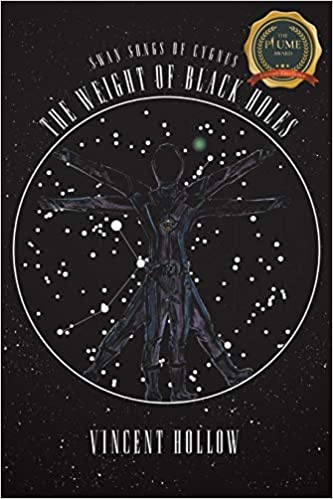
Vincent Hollow’s poetry collection Swan Songs of Cygnus: The Weight of Black Holes

Vincent Hollow’s The Weight of Black Holes


The Weight of Black Holes is a science fiction story that is written in a unique form. An astronaut signs up for a one-way mission into the furthest reaches of space. In order to go on the mission, he has to have body enhancements throughout his entire body to keep it from breaking down. Although he will have no human contact or companionship, he will have a computer to talk with and to help him through the mission. The astronaut composes love poems to his love who has vanished throughout his mission. This is quite the interesting read for the sci-fi lovers out there.

Swan Songs of Cygnus: The Weight of Black Holes can be ordered here.

Middle aged white woman with glasses, a smile and blonde bangs
Elizabeth Hughes

Synchronized Chaos August 2021: From My Vantage Point

Welcome to August’s issue of Synchronized Chaos Magazine! We hope this issue finds you safe and healthy and able to pursue your creative dreams and reconnect with others.

This month’s theme is From My Vantage Point, and is all about our perspectives, how and where we see the world.

Photo from Jon Luty, ‘On Top of the World’ Top Of The World Free Stock Photo – Public Domain Pictures

Jerry Durick’s poetic speakers observe their world from a variety of vantage points. His speakers are often detached, like Jack Galmitz’ characters, who are inert, calm, and isolated to a degree.

This slightly removed perspective can be lonely.

J.J. Campbell reflects on isolation, intimacy, nostalgia and his advancing age in his poetry, while Michael Lee Johnson’s illustrated pieces are quiet reflections of age and solitude.

Sherzod Artikov, in a poignant piece, depicts an elderly aspiring actor who dreams of playing King Lear while resembling the character.

A more distant, abstract vantage point can also inspire thoughts of transcendence. Hongri Yuan, in poems translated from Mandarin to English by Yuanbing Zhang, suggests that our lives and bodies hold reminders of eternity.

Sharma Shashi leaves her Earth-bound home for a dream voyage to the stars at night, while Mahbub looks at nature, mortality, and inter-cultural disrespect and power relations from a standpoint of openness and curiosity. He wonders why the world is, or has to be, the way it is.

Ship Wheelhouse Interior, from Lynn Greyling: https://www.publicdomainpictures.net/en/view-image.php?image=186882

Some writers take a more close-up perspective in their pieces, focusing in on the absence or presence of personal relationships.

Aloysius S. Harmon writes of moments alone at home after the loss of a loved one to death, while Abigail George reflects on how romantic emotions can change over time, on personal growth in and out of relationships.

Nibana Dahal’s poem reminds us all of the giddy uncertain energy at the early stage of a romance. Santiago Burdon probes the lonely bitterness of addiction and the persistence of hope. (Santiago just released a new poetry collection, Not Real Poetry, available here).

Stephen Jarrell Williams’ poetic speakers pan back out to a more universal view, and are unashamed of their sentiment and caring.

Cliffside Vantage Point, photo from Charlotte Merritt Cliffside Vantage Point Free Stock Photo – Public Domain Pictures

Travel can also expose you to new people, cultures, and perspectives, giving you a fresh vantage point while leaving you less lonely.

Bonnie Lee Black observes casual friendliness and conversation among neighbors and strangers in Mexico, while Kim Malcolm finds tranquility in a South Korean Buddhist monastery.

Robert Thomas remembers bonding with men different from himself way out in back country Texas over the beauty of a well-designed automobile engine.

In a more fanciful vein, Christopher Bernard’s short story The Ghost Trolley involves a young boy who journeys into a realm of peaceful people plagued by those who seek to dominate them.

This adventure tale reflects one of humanity’s perennial struggles, as does Chimezie Ihekuna’s screenplay The Conflict, also about creatures with the best, and the worst, of intentions.

Rajendra Ojha expresses similar sentiments in a poem urging humans to use our lives for compassionate and good purposes.

The Almost Hidden Creek, photo from Bobbi Jones the-almost-hidden-creek.jpg (1920×1920) (publicdomainpictures.net)

Other writers address social issues from a broad perspective. Steven Croft reviews Joyce Carol Oates’ new poetry collection American Melancholy, which explores America’s strengths, flaws, and contradictions.

Ken Ciocco reviews Michael Robinson’s new poetry collection From Chains to Freedom, which illustrates the effects of past and present American racism on the Black male psyche.

Others narrow their lenses, looking at individual characters’ stories to explore broader societal themes.

Z.I. Mahmud looks at women characters in Charles Dickens’ David Copperfield to explore themes of feminism, strength, independence and caring. David Myles Robinson comments on the disorientation and unrest of the 1960s in the United States through the interactions of a couple and then of a dysfunctional family in excerpts from his new novel Words Kill.

Ike Boat focuses in on his own life in his autobiography, outlining his teaching, DJing, MCing, and promotional creative work.

Ocean View Lookout, from Charlotte Merritt Ocean View Lookout Free Stock Photo – Public Domain Pictures

In a completely different vein, two writers play with language itself. Mark Young crafts poems using ‘found text’ from various poetic and non-poetic sources as a starting point, and J.D. Nelson tweaks words and letters to produce a variety of sound effects.

Mickey Corrigan also provides humorous pieces about the state of Florida.

Whichever ‘lenses’ you use to observe our world, we hope you have a spectacular and inspiring view this month.

Poetry from Mickey Corrigan


 Florida Man Rampage 
 Florida Man 
 lives in the Keys
 listens to loud music
 alone.
 Florida Man 
 gets worked up
 to loud music
 alone.
 Florida Man 
 goes outside
 throws a stone
 guardian angel
 from the garden
 through the window
 of his house.
 Florida Man 
 stabs the tire
 of his car
 watches it go flat.
 Florida Man
 uproots 
 a for sale sign
 thrashes it 
 until it splinters,
 hits a metal mailbox 
 with the signpost
 until it crushes,
 crushes flat.
 Florida Man
 pauses, waits
 for the arrival
 of the local police.
 Music and masturbation
 he explains
 make him 
 feel like
 destroying stuff.
 Florida Man 
 goes to jail
 where there will be 
 more
 of what he already had
 at home
 alone.


 Florida Lawyer Disbarred For Harassing Law Firm
 Fresh out of law school 
 the new associate
 worked for six years
 before being let go.
 He could not let go.
 A restraining order 
 was filed.
 So he backed up 
 a Ford F250
 to the front entrance 
 to the firm
 yanked off the doors
 ran in and robbed
 his former office:
 a safe, a server, a key
 to the storage unit
 for two office chairs
 and an AR-15.
 He could not let go.
 So he created a website
 with the name of the firm,
 held shareholder meetings
 at 4 a.m.
 with the only other shareholder: 
 his twin brother. 
 This disbarred lawyer
 will not let go.
 
  
 Florida Man Arrested For Felony Theft Of 66 Rolls Of Toilet Paper
 I do my job, I clean the mess
 you leave behind not caring
 about hotel floors, hall carpets
 trash cans full of empties, full
 condoms, vomit in baggies
 roaches, chewed gum, crumbs
 and spills, I wash lobby floors
 your dirt, filth, germs that kill
 I want to stay home, my family
 needs food, medicine
 toilet paper
 ran out so I wheel a garbage can 
 out a back door
 with a Hefty full of rolls, roll
 them out to my work van, toss
 them in the back, fringe benefit
 hazard pay, it's just paper
 I clean up
 your mess 
 yet I get
 reported, arrested, charged
 with theft from a public lodging facility
 a third degree felony, man
 come on, what about the rooms
 full of cheating spouses
 boozers, drug boosters, liars
 the senators who made a killing
 on the stock market response
 to inside news and polls
 rise for men who shit gold,
 all I get 
 is more woe and no 
 decent place
 to go.
 
  
 Florida Man Selling Mansion Pays To Get Rid Of Buyer
 A Mediterranean style mansion 
 more than 20,000 square feet.
 She wanted to buy it, said
 she'd been looking for years.
 A home theater and 14 waterfalls
 on 16 wooded acres.
 She said she had the money
 proof of funds from a company
 that loaned her billions.
 Nine bedrooms, 13 baths, an entertainment wing
 a pub, poker room, music lounge.
 Said she'd pay $9.75 million 
 if he threw in
 the Jimi Hendrix guitar, 
 the Muhammad Ali gloves.
 A pool with a rope bridge
 a water slide, swim-up tiki bar.
 Days before closing
 she sued him
 so he couldn't sell
 to anyone else
 she had no funds
 a house in foreclosure
 a history of bankruptcies.
 He paid her $300K 
 to go away
 from the estate he'd built 
 as a luxurious respite
 from the stress of doing business
 in Florida:
 a sunny place
 for shady people. 

Originally from Boston, Mickey J. Corrigan writes tropical noir with a dark humor. Novels include the mystery pandemic tale Songs of the Maniacs (Salt Publishing, 2014), Project XX about a school shooting (Salt Publishing, 2017), and What I Did for Love, a spoof of Lolita (Bloodhound Books, 2019). The Physics of Grief puts the fun back in funerals while taking a serious look at the process of mourning (QuoScript, UK, 2021).

Poem by Santiago Burdon

Black Moon Promise

Bathroom confessions
backdoor redemption
Black moon promise
made to a leather winged Angel
Afterglow addict disciple of dawn
woman standing at the edge of love
listening for the silence in between the words
whispered by an ambidextrous tongue.
Loiterer in dim luminescence
under bloodshot skies.
beautiful visions reminding her of horrible things  
knowing the best part of truth are the lies
casualty of kindness twilight apostle
feeling what is not her favorite color
the song of flawed perfection 
its taste bitter on her lips
The melody fading along with the last smile of summer

Christopher Bernard’s installment of The Ghost Trolley

The Ghost Trolley: A Tale for Children and Their Adults, Chapters 5, 6 and 7

By Christopher Bernard

Chapter 5. One Eye

The two children crept up to a fallen tree just a stone’s throw from a gate where the Korgans had entered. Soldiers were beginning to come and go, carrying burdens of various kinds, nondescript bags and crates, some of them weapons – what looked to Petey like spears and rifles combined in some weird way – and a few civilians, maybe working for the military, on early morning errands and chores outside the camp. A burly guard kept watch, eyeing his fellow soldiers with deep suspicion as if expecting at any moment to find a spy. 

The Korgan with the muddy boots had glanced back as he entered the gate with a salute to the guard, who stiffened to attention – Petey noticed muddy boots had only one eye. The other was covered with a patch.

Sharlotta whispered, “We got to get into camp somehow—”

A strange, cruel shriek interrupted her. Under a tree nearby a trio of scruffy-looking Korgan kids—a few years younger than they were—were playing, to the two children’s horror, a cruel game of toss-the-kitty. The kitten mewed frantically, its little tail spinning as it flew as the little Korgans tossed it back and forth with yips and shrieks of a mean pleasure. A large tabby sat crouched in the grass, its tail fluffed, its mouth open and clicking ominously, its eyes watching the kitten being tossed back and forth with a look of fascinated hopelessness.

“So terrible!” whispered Sharlotta.

Petey scowled under his watch cap. He always hated seeing helpless creatures being tormented.

A moment later Sharlotta said, “Where you go?”

“Just a sec.” Petey slipped away into the brush.

A few minutes later a stone came flying out at the Korgans. Then a second. Then a third.

“Paonas!” shrieked one of the little Korgans.

The kitten fell onto a soft patch of grass and the three kids ran off, disappearing through the gate. The guard ignored them as he peered hard at a passing soldier hunched under a box of projectiles. “Ain’t you seen me a thousand times, Harree? Watcha staring a’ mee loik ya’ thought me were a Paonee?”

“Maybe ya’ bee, Jorok!” snarled the guard. “Ya wouldna bee the feerst t’ve turned tween dawn ’n’ noon on a visit outer the gates.”

The guard’s brief distraction did not go unnoticed: Petey ran from the brush, swept up the frightened kitten, and ran back with it to Sharlotta.

“Mew!” went the kitty. “Mew!’

 “Poor thing!” Sharlotta whispered, cuddling it against her cheek. “You safe now.”

But the kitten didn’t look too sure of that.

After a moment, the large tabby emerged from a bush and sat nearby, staring at them suspiciously.

“Must be the mom,” said Petey. Sharlotta placed the kitten carefully near the tabby, who hissed instinctively at the young Creel, then sniffed at the kitten, bit it by the scruff of the neck and carried it swiftly into the brush.

“Now all we must do be to get into camp,” said Sharlotta.

“And follow One Eye.”

Suddenly they looked at each other. They had gotten the same idea.

“We have to dress like Korgan children,” said Petey.

It was a little trickier than that, of course: they would have to disguise themselves until they convincingly looked like Korgan children.

            “Well,” said Petey, in a subdued voice, “their hair is dark, and really long . . .” His own hair was bright orange and very short.

            “And dirty! And full of snarls!” Sharlotta’s voice was filled with disgust. “And clothes of them be all muddy, and they look they have not had bath in one month!”

            Petey looked solemn: he did not exactly enjoy taking baths himself, and in fact had skipped one last night, so he could get up early (anyway, that had been his excuse). He hoped Sharlotta hadn’t noticed.

            “But that means,” he said, “that if we get all dirty, and rough up our clothes and hair, they might not notice we’re not Korgans. After all, adults never really look too closely at children who aren’t their own.”

            “Yes,” Sharlotta said thoughtfully, “I notice that.”

            “And if they do look, and think we don’t look quite right,” Petey said, brightly, “they’ll just blame their parents!”
            So, not having a better idea, and needing to get into the camp as soon as possible so they could follow One Eye, they set about roughing up their hair and clothes and smearing mud on their faces and hands, and making themselves look generally scruffy and grungy and beat-up and dirty. Petey had to apply a lot of mud makeup to the hair at the edge of his cap: it took a lot of dirt to hide the orange, even when he pulled the cap down to his ears.

            “There be one good thing,” Sharlotta said cheerfully. “I can wear my jacket right side out now.”

            Now the smears of ash stains looked just right for a scruffy Korgan girl.

            “How I look?” asked Sharlotta after they were done.

            Petey looked her over doubtfully.

            “Your hair looks too pretty.”

            Sharlotta scowled.

            “And your head look too ugly! You never have to comb long hair full of snarls!”

“And it’s way too clean . . .”

Petey, without further ado, filled both hands with mud and splattered it over Sharlotta’s hair, at the same time grabbing and violently matting it.

Sharlotta shrieked.

“What you doing! Stop that! Right now!”

They started wrestling and fell in the mud.

“What’s goin’ on over there?” a Korgan voice rang out.

A shadow fell over them and they stopped, suddenly terrified.

Petey glanced up and saw, against the sun, the guard with his lance staring down at them.

“Quit fightin’ and get back into camp. There be Paonas around here, and they eat little-uns like you for breakfast. Go home!”

The children, covered with mud and with their tangled, dirty hair in their faces, were too frightened to say a word, so they stood up and scampered through the open gate into the camp.

Chapter 6. The Camp of the Korgans

The children were faced with a spaghetti of dirt lanes and passages through which a strange assortment of ox and donkey carts and curious-looking tanks, with long snaking treads, snout-like guns, and tall, needle-like turrets, and fat, tubby armored cars and troops of Korgans moved, mostly armed soldiers, some marching in platoons as their sergeants barked orders, some on the backs of horse-like creatures, or on patrol, some bustling about on unknown errands, some sitting in front of their tents, cleaning their weapons and trading jests.

Among the crowds were more civilians, women and children and a few old men and women, but all of the Korgans looked curiously fierce, whether because of the styles of the clothes they wore, or their habit of expression, or just how they were born; they all looked angry about some unknown grievance, and Petey quickly decided he had better put on his “angry face” if he hoped to fit in—even though he didn’t feel especially angry, just excited and a little scared—and looking scared he realized would definitely not do.

The camp was as big as a small town constructed entirely of tents and cabins, huts and sheds, arm depots, bivouacs, lookout towers and long, ramshackle barracks above which flagpoles rose and the Korgan flag flapped loosely in the morning air—a black flag with a pair of lightning bolts crossed in a crimson circle.

The children had no time to investigate their surroundings and didn’t want to stand out by gawking, so they scampered down several lanes till they found an unused tent in a vacant corner and crouched behind it. They had been right: no one had paid any heed to them; they were just a pair of urchins playing in the street.

One curious thing that Petey noticed about the Korgans: though the hair of some of them was brighter and shinier than that of others (they ran from sandy to streaked, from dark to dirty to platinum, and some were even like what Petey’s mother referred to contemptuously as “peroxide”), they were all, every single one of them, blond.

“You know what?” Petey suddenly grinned. He felt quite exhilarated.

“What?”

“That was fun!”

Boy, Sharlotta looked funny, with her hair all mussed and full of mud! But maybe he should keep the thought to himself. Girls could react weirdly to teasing—not like boys, who would just push you and tease you back, then forget about it.

Petey was also going to tell her about making sure she put on her angry face, like the Korgans, but she looked angry enough on her own, now they were in the camp, so maybe she didn’t need to be told.

Sharlotta looked askance at Petey.

“There must be special place where they keep prisoners,” she said in a whisper.

“I’ll bet he’ll take us to it if we can find One Eye,” said the boy. “He was talking about having to interrogate your family.”

“That was the other one. But no matter.”

“It was One Eye.”

“It was the other one!”

“No, it was One Eye! And anyway, we only know what he looks like.”

Sharlotta was silent, with dignity.

“All right, Know-It-All, and how do we find him?”

Petey stared down at the dirt between his knees where he was crouching.

“Well, we can’t stay here,” said Sharlotta. “They won’t come to us. How do I look?”

“Honest?”

“Honest.”

            “Terrible!”

            “You sure?”

            “I’m sure. You look terrible!”

            “Good,” Sharlotta said stiffly,

            “How about me?”

            “Well, you look awful!”

            “You sure?”
            “Of course I be sure!”

            “Really truly awful?’
            “Really truly awful!”

            “Good!”

            Petey rather liked the idea of looking awful but decided not to press his luck by asking a third time.

He paused and took a breath.

“Are you ready?”

“No. But that not matter, yes?”

            Petey shrugged.

They both took a breath, and went out into the camp.

            There was a feeling of tension in the air. Korgans on duty seemed especially busy, rushed, and even off-duty Korgans looked tense; a truck bristling with armed soldiers careened through the street past the two children, the soldiers shouting for pedestrians to get out of the way.

            Many of the soldiers had covered their faces with red and black war paint, and their solid, hard bodies made the ground rumble as they marched past on the double.

Soldiers walking the streets greeted each other with sharp, animal-like cries.

            Some of the Korgans looked at the two children a little too closely, a cold gleam in their eyes. Petey was especially worried Sharlotta didn’t look quite “terrible” enough. Maybe she was one of those girls who, no matter what they did to themselves, always looked nice. He should have put more mud in her hair.

            He was going to tell her to cover her face with her bangs when a Korgan suddenly stopped them.

            “Hey, girlie!” he said, grinning at Sharlotta and pulling her hair away from her face. “Anybody tell you you cute as a Paona? Bet you get that from fellas all the time!”

            Sharlotta stared furiously at him.

            “And you,” she shouted, “look just like a Korgan!”

            The Korgan hooted, laughing, as the children scampered off.

            Sharlotta pulled her hair over her face until only one eye peered out as if through a parted curtain, without her companion having to advise it.

            They huddled behind a pile of junked weapons, watching the passing parade. Drums thundered, trumpets rang out, and cries of “Ramora, Ramora!” and “Death to Steed!” echoed through the camp as a war party gathered in a parade ground in front of them. 

Then, from a broad space between two low barracks, a solemn procession emerged and moved toward them.

Chapter 7. Bang Bang and Blue Moon

            Columns of armed soldiers in black uniforms and helmets, with the strange crossbow machine guns across their chests, marched in precise and mechanical order, their simultaneous tread shaking the ground. Behind the soldiers moved a platform, like the floats Petey had seen in parades at home, but draped in red and black, on which stood a Korgan, in a commanding pose and wearing scarlet robes and a black cone-shaped hat, like a wizard at a Halloween party, that Petey would have laughed at any other time. He looked to the young boy like a priest and held a staff shaped like a young dead tree, its branches writhing in profile against the sky. Behind him rose a monumental figure of crossed lighting, like the figure in the banners, but all of gold. The priest’s face was covered with red streaks like war paint. And kneeling in front of him, two acolytes held up an open book as he made elaborate gestures with his small, gloved hands and chanted in an incomprehensible tongue.

            The platform, a kind of large moving altar, was being pulled by a mass of tall, delicate-looking creatures, with pointed ears and elven features, and  patches of fur on their cheeks and arms, their heads and faces, and they dragged the platform with long ropes tied around their shoulders and waists. They seemed vaguely familiar to Petey. Two Korgans with whips “encouraged” them, with shouts and lashes, to keep moving in time with the marching soldiers.

            Suddenly the boy realized where he had seen them before, or creatures like them. They were like the monkeys he had seen when the yellow trolley had first entered the forest in Otherwise.

            “That must be Altar of Ramora,” Sharlotta whispered. “I hear of it but never see it before. And those are Paona. Prisoners that have been turned into slaves.”

            Petey realized something else that was strange and unsettling: if the Paonas were like monkeys, then the Korgans were like people . . .

            Behind the altar a choir of Korgans in black robes solemnly marched, singing a hymn to the rhythm of the marching soldiers—but it was like no hymn Petey had never heard in any church he knew.

It was a series of blood-curdling cries and swooping yells, with fists raised to heaven, to discordant blasts of trumpets and drums.

            Behind the angry choristers came a crowd of Korgan women, looking cowed and fearful, their hands clasped before them and their heads bowed. And behind the women scampered a rag-tag gang of Korgan children, whooping and shrieking.

            Sharlotta and Petey watched as the procession passed. Then a couple of the Korgan children following the women ran up to them. One of them picked up a pistol from the pile of junked weapons and started waving it.

            “Bang, bang, Paona!” he shouted at Petey. “You dead!”

            “I’m not a Paona!” Petey shouted back, immediately regretting it. Being silent would probably have been wiser just now; this was not the first time that thought had occurred to him, invariably a fraction of a second too late.

            “Yes you be!”

            Petey glared back at the boy.

            “You new here?” the girl Korgan asked Sharlotta, in a deep, froggy voice.

            “Yes,” Sharlotta said, carefully lowering her voice and trying to imitate the frogginess of the other’s voice.

            The boy aimed his pistol at Petey.

            “Bang, bang! You dead!”

            “Where you from?” asked the girl Korgan.

            “Over there.” Sharlotta pointed vaguely toward the east.

            “The land of the blue moon?” the girl said, sounding skeptical. And the blue moon was indeed already drooping in that part of the sky.

            “I said you dead! Now fall down!”

            Petey glared even harder at the boy. He would not fall down just because he was ordered to.

            “I always wanted to go to the land of the blue moon,” said the girl.

            “You fall down! You dead! I just kill you!”

            “Maybe I can come and visit you?” she asked politely.

            “If you want,” said Sharlotta in her froggiest voice.

            “No, you fall dead!” said Petey, who pulled a pistol out from the pile and started waving it at the boy.

            There was the sound of an explosion. All of the children stared in alarm at the Korgan boy: his pistol had gone off, the bullet just missing Petey’s head.

The hair on the Korgan boy’s head rose like the fur on a frightened cat, and he threw down the pistol and ran off, followed by the girl, after a shrug and a shy glance back at Sharlotta. “Boys!” she cried out as she ran off.

            Petey dropped the pistol and the two of them ran behind the pile as a massive Korgan soldier picked up the fallen gun and tossed it onto the pile.

            It was One Eye.

            “You!” he shouted.

            Petey felt a hand grab his shoulder and lift him bodily from the ground.

            This is it, thought Petey. I’ll never get home alive.

            “Many times you have been told never to play around weapon dumps.” The Korgan spoke in a calm, measured voice, like a more brutal version of Petey’s dad’s. “How often must we tell you? You might kill someone. You might kill each other. You might kill me.”

            One Eye gave Petey a single hard fierce shake that made the boy’s teeth rattle in his head (unlike his dad, who rarely did more than give him lectures and send him to bed without his smartphone), then opened his hand and let him drop to the ground.

            “Now go home. And take your girl friend with you.” One Eye looked at Sharlotta, whom he had not even bothered to chastise—she wasn’t sure which insulted her more, this, his calling her Petey’s “girl friend” or his general attitude of condescension and contempt. She was about to give him a piece of her mind when Petey—seeing her turn red and open her mouth—pulled her away, and they ran off, as ordered. Sharlotta glared back, with fury in her eye, and caught One Eye staring after them strangely, with his single crimson eye, as though he had noticed something that did not seem quite right. Then Sharlotta noticed that Petey had a tear in his cap, and a patch of his hair was exposed, like the bright skin of an orange.

            They ran behind a horse cart and stopped.

            “Some of your hair be showing through a tear in your cap,” said Sharlotta.

            “Oh!” said Petey. Unfortunately, there was no mud where they were, but there was some dust, which he applied vigorously. “How does that look?”

            “A little to left—no, to right—no, to left—no—yes—here, let me . . .”

            And Sharlotta applied her hands to his head as Petey scowled.

            “There,” she said, “that better, anyway. What be your parents thinking when they give you orange hair?”

But Petey had no time for another tedious debate on that subject.

“Look!”

One Eye was walking away after commanding a guard to keep watch over the weapons pile. Petey pulled the young Creel to the other side of the cart as One Eye disappeared into a warren of lanes among a chaos of tents, then they followed, at safe distance, after him.

One thing made it easy for them: the black strip of his eye patch stuck out against his dirty yellow hair, even in a crowd of Korgan backs, so they didn’t have to follow too closely. Sharlotta was worried he had seen through their disguise, but knew there wasn’t much they could do about it. As long as they didn’t bump into their new Korgan “friends,” Blue Moon and Bang Bang.

They threaded slowly through the colorful encampment, passing whole mini-villages where tangles of Korgan families lived, with smells of cooking by the small Korgan women wafting across them (and making both of them hungry, as Petey hadn’t had much breakfast, and Sharlotta hadn’t eaten since before the raid on her home the night before)—smells of baking bread and soup and coffee—with long lines of washing hanging out to dry, showing the array of Korgan fashions for men and women, girls and boys, and even their undergarments waving like banners in the breeze (Petey was left wondering at some of those, they were so peculiarly shaped, whereas Sharlotta delicately pretended not to notice)—but all the time keeping One Eye in sight, losing him only once, when he turned into a weirdly constructed little hut with a chimney three stories tall and didn’t come out for ten minutes, and they thought they had lost him for good; then he came out, adjusted his belt and continued on. Petey turned to the young girl and grinned. “A Korgan outhouse!”

At last One Eye turned into what looked like a litter dump in a distant corner of the camp where skinny, famished pariah dogs lurked, biting and snarling at each other over snatches of left-over garbage. He approached a forbidding-looking tent, black and low. Two guards at the entrance saluted him sharply, and One Eye saluted cursorily back and disappeared inside.

The sun stood, brilliant and hot, at the peak of the green sky.

Then a light wind began blowing.