Poetry from Mickey Corrigan

Small Hands: 5 poems

Bachelor of the Month

After dropping out at sixteen
after dropping out at eighteen
after working with his hands
on the hot tar flat-roofs
of the war-era buildings
of downbeat Brooklyn
the view of Manhattan
too far, too far away

he cleans up nice
he charms the headmaster
of an uptown school
he’s hired
to teach the children
of the über elite.

A boy without background
man without a college degree
an eye for the youth
he talks his way inside homes
the rich, celebrity, power
brokers of the City he loves
woos their daughters
wins their confidence.

A few years of Wall Street,
Rolex and Armani, silk
ties and a fashion model
on each arm, man about
town, wealth, women
he’s living loud until
he’s quietly fired
for insider trading
for stealing and fraud.

He moves on with plans
for his own company
to help the rich
get richer
—and himself
to women, they come
and come and go,
they always go, ever
the flavor of the month
every single month single
for the rest of his life.
Unlimited

They shared a brain, an eye
for the beauty of the pure
fresh spring and budding
unopened blossoms
almost ripe and so sweet.

They shared a house
largest residence in the City
the power of attorney
the yacht, private planes
and the action that comes
with unlimited access.

On a handshake
he took the mansion
made it his playground
his man cave, his den
of iniquity, of cameras
hidden in high walls
in the glossy bedrooms
in the mirrored bathrooms
in secret spaces all around
watching, filming 
his partner, his friends
all the famous guests
in an unlimited springtime
fresh flowers just opening
their delicate petals
under his appreciative eye.

Body Alarm

Roaches and rats underfoot
he longs for a toilet seat
a crystal flute of champagne
small hands on his flesh
kneading out stress.

A cinderblock world
of dark gray concrete
metal table, Metal bunk
hard-bolted
to the mold-damp wall
a future in debt
to the system he tells
he’s done nothing wrong—
and he believes it.

Eight hours a day
under fluorescent lights
in a tight white tile
jailhouse conference room
with the best attorneys
that much money can buy
and he’s going for it
bail appeal on Monday—
and he believes it.

But instead of winning
yet another round for the rich
he hangs loose
from the empty top bunk
by a strip of orange jumpsuit
no cameras working
no guards checking
no no no
for a full eight hours
nobody hears him die.

The autopsy asks questions
regarding the body:
red ligature marks
where they shouldn’t be
three broken bones
that shouldn’t be
no bunkmate, no night watch
and that shouldn’t be
the crime scene disturbed
the body is deemed
inconclusive…

then oh so quickly
the media reports
the medical examiners’ reports
he’s a suicide—
and we believe it?

Joining Forces

In a surge of passion
a sweetheart huddle
a spasm of unity and energy
they create something new
a time-bomb, an ear blast
that is giving birth
to the wonder women within.

The girls are older, wiser
they are free, they are mobile
so easily mobilized
into formation, reformation
into a show of force
into a mob seeking justice
from those they blame
for all they expected
that did not happen
and never will.

Girls hand over photos
their journals, their scars
a long list of grievances
and they’re off to the fight
finally, the good fight
the call to action
they’ve been waiting for
years in a pink room
before a blue screen
locked in a life
with no future
but this.

A show of small hands:
they were too young
and he was wrong, sick
protected, overlooked,
a creep and a con man,
guilty, guilty, guilty.

Parsing Bill

In the entry to the largest
single family residence
on the Upper East Side
where the upper crust
comes to dine, preen, gloat
small hands hung up
an oil painting
a mock portrait
of the former leader
of the free world
in a little blue dress
sharp red heels
a telling smirk
seated seductively
in the oval-shaped office
of the most important home
in America.

The art makes the man
the man makes an art
of the seduction of power
and the portrait serves
as a warning
to all who enter
this upside-down world
about who holds the reins
and who the noose
in small hands.

Originally from Boston, Mickey J. Corrigan writes tropical noir with a dark humor. Her poetry has been widely published in literary journals and chapbooks. In 2020, Grandma Moses Press released Florida Man. Her novel The Physics of Grief puts the fun back in funerals while taking a serious look at the process of mourning (QuoScript, UK, 2021). 
Poetry from J.D. Nelson


 the bulletin board’s nice eye
  
 the carp was a grant of the fist
 that face is the iron
  
                         bluh!
  
 the lean scope was a charm
 that needle was an eye to laugh
  
 to learn of the laughing hook
 that could be the name of thy building
  
 that wood is the pooh
 my rose is a penny laser
 
  
 the bright hammond of the clouds
  
 possibly
             a rose of the walking head
  
 a merit of the gallon
                         the cruising head
  
 is the sun a school?
 the brain is the charcoal of the iron
  
 the losing head is the northern huck of the filament
  
             the northern hum of the air
 
  
 ah knew bat
  
 to be the featured wool in the stove of the floral earth
 the whipping hum is the light of the beryl
  
 the dusk in the circle of the sherry
  
 shark marbles!
  
 pit pip that lock of the laser maid
 the cherished ankle
  
 the rose of the mica
 the ticking of the feathered serpent
  
 the choral oink of the wandering hum
 the light of the fresno bacon
  
 that alpha is the boat of the marble
 to can a clark of the eel
 
 bio/graf
  
 J. D. Nelson (b. 1971) experiments with words in his subterranean laboratory. His first full-length collection of poetry, entitled In Ghostly Onehead, is slated for a 2021 release by mOnocle-Lash Anti-Press. Visit http://www.MadVerse.com for more information and links to his published work. Nelson live

Essay from Meg Freer

Finding Traces of Stalin

A potentially friendly cab driver suddenly turned silent when I showed him the address: 7 Kaspi St. He drove to the neighborhood, gestured brusquely down the street, and left. My companion and I had trouble determining if we were even on the right street, as street names are sometimes printed on the sides of buildings in Cyrillic or on hard-to-find street signs. We asked directions of several people, including a neighborhood delivery truck driver, but everyone shrugged and appeared not to know the place.


Fifty kilometres from Tbilisi, Republic of Georgia, is Gori, a picturesque city at the
confluence of rivers, surrounded by mountains. Gori’s claim to fame is that Joseph Stalin was born and went to school here. Many people don’t realize that Josef Vissarionovich Djugashvili (იოსებ ბესარიონის ძე ჯუღაშვილი in Georgian), otherwise known as Josef Stalin, was born in Georgia and began revolutionary activities here after abandoning theological studies. Ironically, Stalin enjoyed neither the process of remembering his childhood nor coming back to visit Gori in later years. Busloads of summer tourists visit, though. Although Georgians, understandably, have an uneasy tolerance of Stalin’s fame, the desire to preserve his memory is strong here.

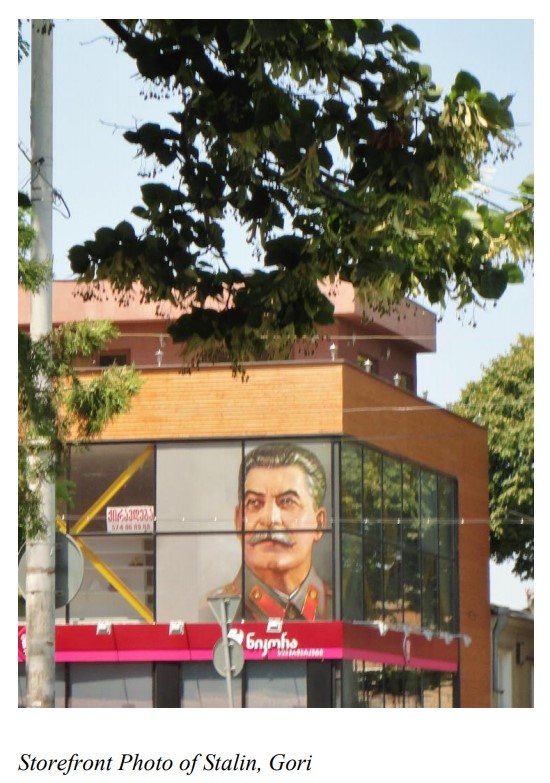
At the centre of town: Stalin Square, Stalin Avenue, the Stalin Museum and a huge poster of his head dominating the upstairs window of a storefront.

Past the peddler selling Stalin novelties on the museum grounds are two interesting things.

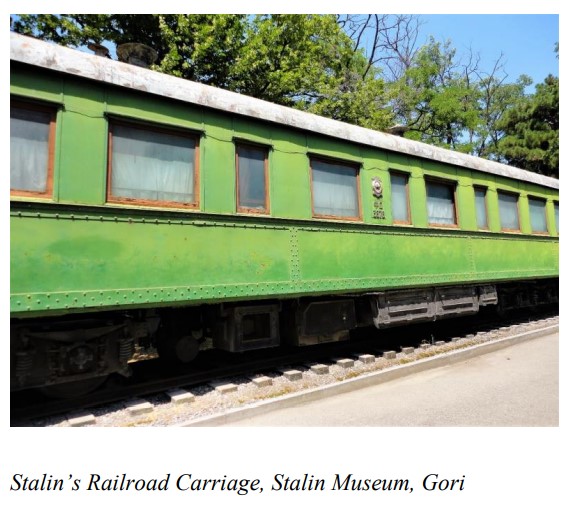
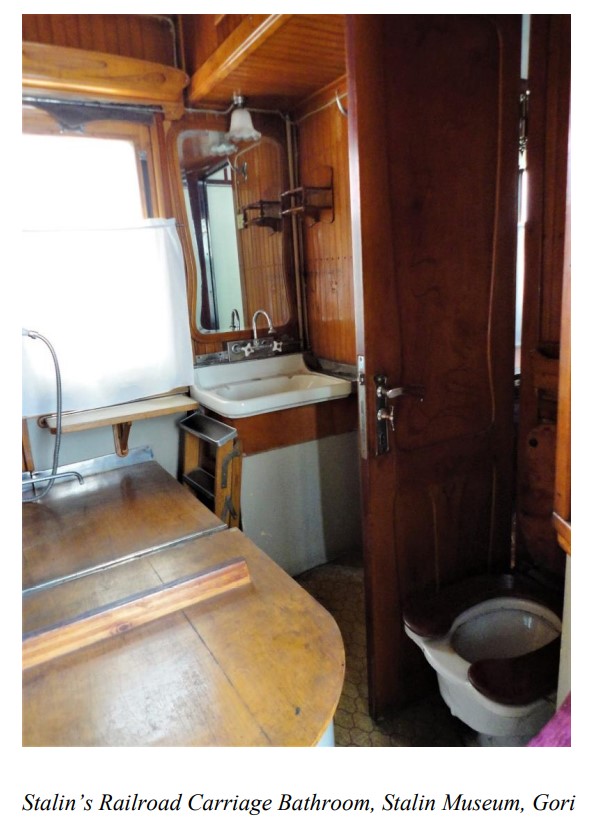
One is Stalin’s personal, armored railroad carriage, unrestored, complete with Venetian glass mirrors, carved wooden furniture, a bathtub and toilet, and an office with a phone, table and sofa.

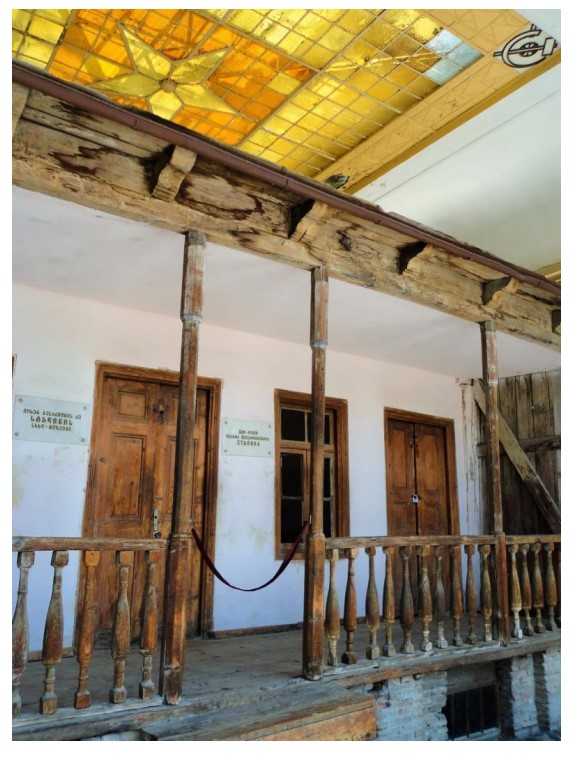
The other is his family’s original house, with intricate woodwork, where Stalin was born into a shoemaker’s family and lived until age four. The family lived above the ground-floor cobbler’s shop. It is now protected by a columned structure with golden yellow stained glass in the roof accented by a hammer-and-sickle design in the corners.

Stalin Family Home, Stalin Museum, Gori

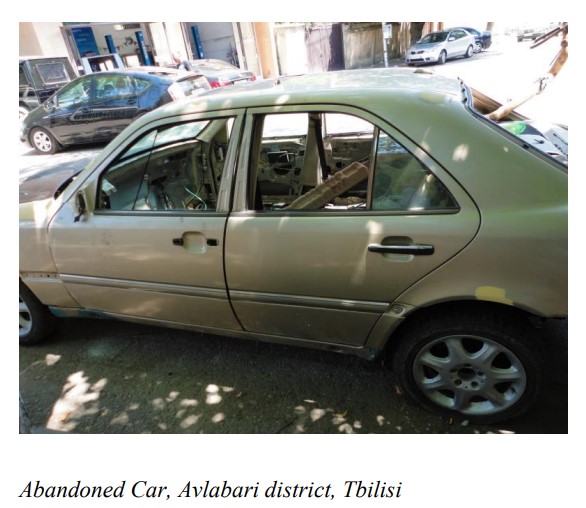
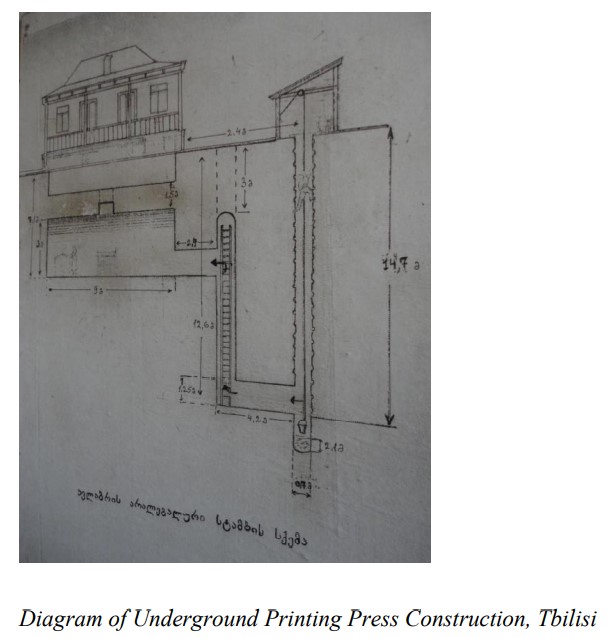
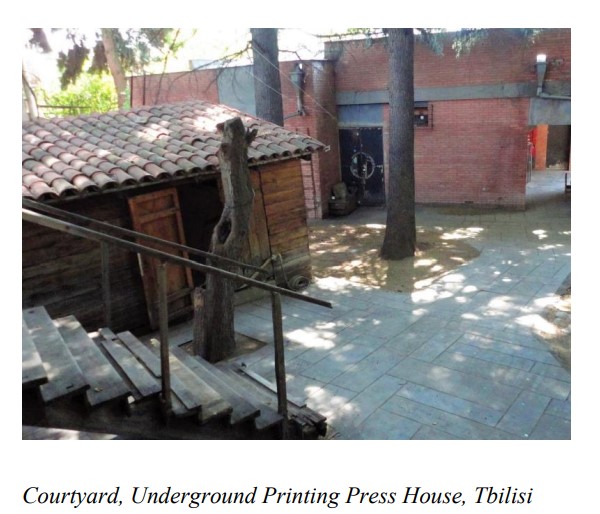
The truly fascinating artifacts are not in Gori, however, but back in Tbilisi. Stalin’s samizdat (underground) printing press is literally underground, 15 metres beneath an old house in the Avlabari district of Tbilisi, a somewhat decrepit neighborhood of bleak apartment blocks and car repair garages.

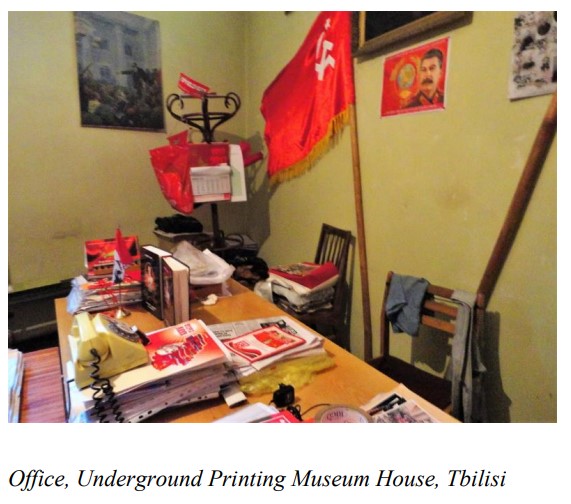
No. 7 Kaspi St. is now an unofficial museum of early Communism. A few of us attending the 2017 Summer Literary Seminars in Tbilisi agreed to meet at this house one morning. We all got lost on the dusty streets before finally finding each other and the house, whose iron door has a hammer and sickle on it, and were treated to a full tour by none other than the 78 yearold chairman of the Georgian Communist Party, Zhiuli Sikhmashvili.

Energetic and lively, he was happy to show us around the donation-funded museum and talk to us in broken English. Luckily, three people from Poland who spoke both Russian and English showed up soon after we did and were able to translate Sikhmashvili’s Russian so that we got a much more informative tour than we would have otherwise.

The office, crowded with memorabilia and books, had a desk with a pale yellow rotary phone balanced on a stack of papers.

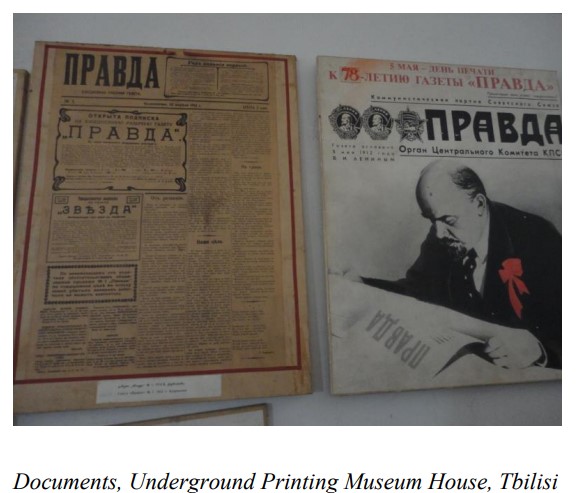
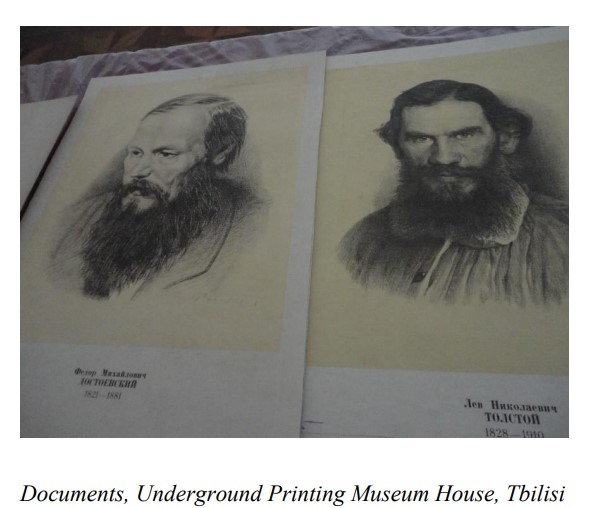
Portraits of revolutionaries working at the printing press, newspapers such as Pravda with Lenin on the front cover, flags, photos and documents occupied several rooms.

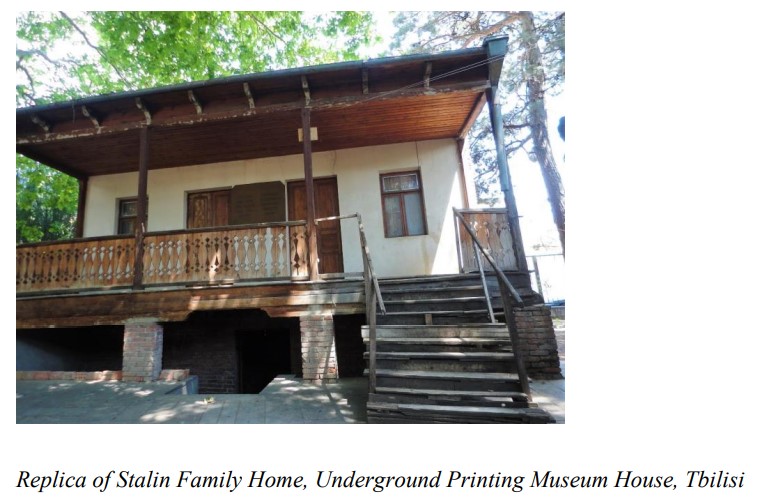
In the yard is a replica of the house Stalin was born in, its rooms reconstructed with original furnishings, including a small platen press for handbills and small posters.

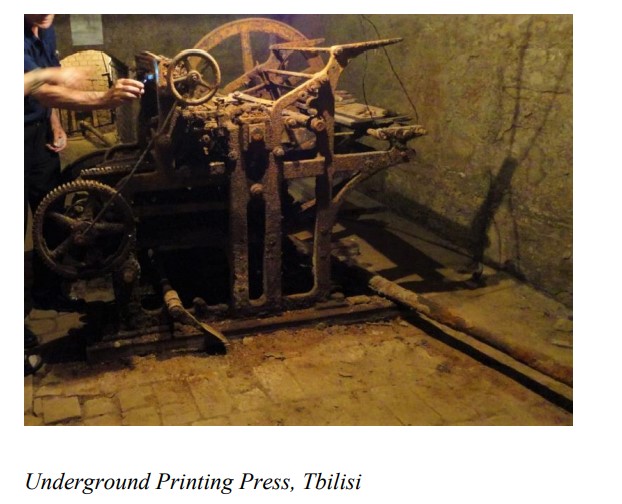
But the main purpose and focus of this site is the existence of the large, underground printing press. Between 1903 and 1906 thousands of flyers, pamphlets and newspapers were printed at this location, in Russian, Georgian, Azeri and Armenian.

A large printing press made in Germany in 1893 had been imported from Baku, then
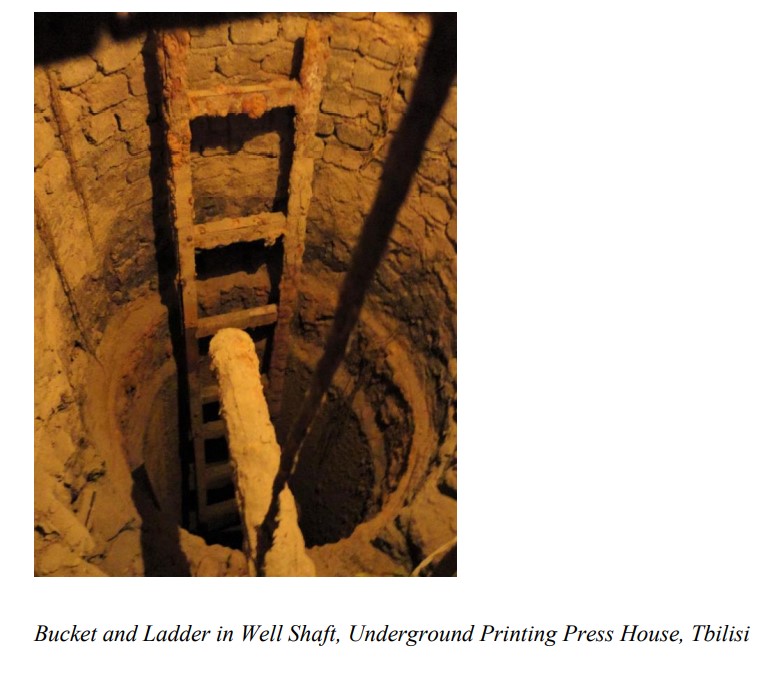
disassembled and its parts lowered fifteen metres down a well shaft hidden by a small shed in the yard. At the bottom, a side tunnel of about four metres was dug to connect to another shaft with a ladder up to the underground cellar where the printing press would be. There, the press was reassembled. Not a job for those with claustrophobia!

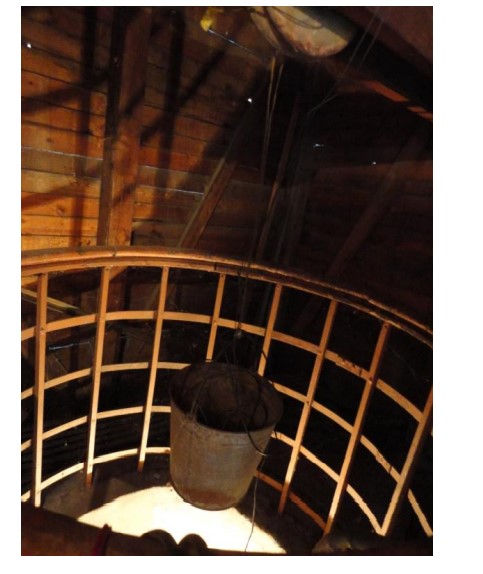
The house had to look “normal”, so two women lived on the first floor and kept a few chickens in the yard. In case of potential danger, a hidden electric alarm bell would alert those underground. The young Bolsheviks worked in shifts, sending completed material in a bucket up the shaft to the house. Flyers would be hidden in street sellers’ carts, taken to the railway station, and from there would travel to the Caucasus region and beyond.

Down a rusty spiral staircase (constructed for the museum) is a dank cellar lit only by a few lightbulbs, making photography tricky. The press itself is quite rusted, because the cellar flooded a few years ago. The bucket, rope and ladder are still there in their shafts.

Visitors have left coins on the flat surfaces of the press. Leaving coins there seems more like a show of respect for historical objects than the equivalent of tossing a coin into a fountain. In 1906 the police raided the house, but in 1937 Stalin and Beria—the brutal Georgian chief of the USSR Secret Police—reopened the house as a museum. An official, government-funded museum until 2012, it apparently also contains the offices of the current Georgian Communist Party. The day we visited, other people were just sitting outside, reading or writing.

We were careful to remain neutral in our comments so as not to offend our host, while
managing to convey appreciation for the history displayed there. We left a donation in thanks for receiving a history lesson and a tour of Communism seen through Georgian eyes.

Poetry from Jack Galmitz

A Cheap Trick

A cheap trick is something like this:

when I lived with my brother and our parents
sometimes I took a shoe or sneaker
and balanced it between the door and its frame
so there was an open gap to the vestibule.
(You can only do this occasionally. If you do it 
too often it simply won't do.)
I then called out to my father to hurry and come quick
he had to see this; and when we saw him at the open space
we held our breath and he never even looked in he just pushed the door and the shoe dropped on his head.
My brother always was in stitches after this
and my father well
he was bitter but didn't speak of it.
Just so you don't think I'm a creep or something
I want you to know that my father was very serious:
he never once, not ever, told either of us a joke.

Shoppers All

"I'm looking for a man
cut from granite  
one of those Jesuses found in the bars
by the High Sierras." 

That's how one of our members put it.
Everyone's looking - cooks, bakers,
butchers, beauticians -
for adventure and who can blame them.
The sun comes up on schedule
and dives down regularly like
the back and forth of ping pong players.
Join our website- discover what's out there.
We know you value your privacy.
You control exactly what you want
people to see.  Use our blur or mask tool
suddenly you're a mystery.
Or mark those special pictures of you
private and share them only 
with those who appeal to you.
Go one step further. Take advantage
of our Traveling Man and Traveling Woman
package. We'll arrange for you to meet
whoever you pick on a Parisian street
in the season of your choosing.
Maybe autumn, when the chestnuts are falling
and the Seine is as blue as a silk dress suit
you'll want to be removing. Along the quay 
Parisians lie in the sun or stop at booksellers.
It's exciting.
Take a moment. Be indiscreet. Cheat.
Everyone's doing it. Royals, too. 
Sign up. We'll get you started on your app.
We'll help you post your sexiest picture 
and your most seductive text.
What do you have to lose? Your virginity? 

The Right Stuff Redux

we were in the court
on the uncut grass
playing ball 
we saw contrails above the roofs 
we heard a boom
someone said the aircraft
broke the sound barrier
we were impressed
we all said "wow"
and then resumed the game
and threw the ball home

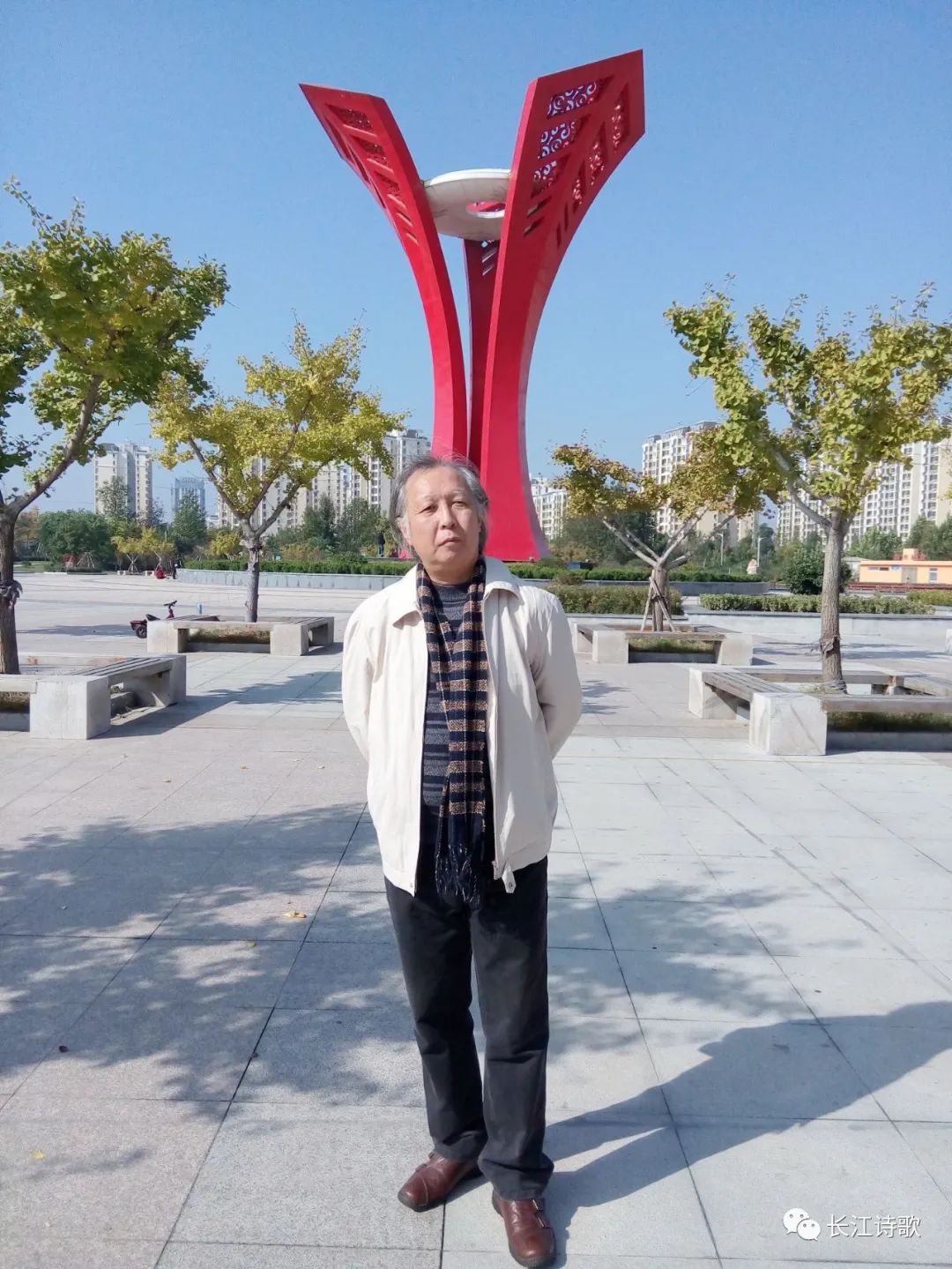
Poetry from Hongri Yuan, translated from Mandarin to English by Yuanbing Zhang

Middle aged Chinese man in a tan jacket and black pants and a scarf standing on a city sidewalk in front of some trees and a tall red sculpture
Poet Hongri Yuan
Four Poems
By Chinese Poet Yuan Hongri
Translated by Yuanbing Zhang
 
Give You A Bottle of Nectar From The Kingdom of Heaven
 

Give you a bottle of nectar from the kingdom of heaven
Let your flowers of soul blossom
Let your bones be white and transparent
Let you bathe in music of the kingdom of heaven
There will be no more earthly night
Let you forget that fragrance of soul
That's in your home of soul
That giant's yourself that are sweet and free.


The strings of heavenly gems
Embedded on your golden crown
You are the giant's king from the of the Kingdom of Gold
Your land is vaster than billions of seas.
3.6.2019
 
赠你一瓶天国的琼浆
一
赠你一瓶天国的琼浆
让你的灵魂之花绽放
让你的骨骼洁白透明
让你沐浴那天国的乐曲
再也没有尘世的黑夜
让你遗忘那灵魂的芬芳
那在你的灵魂的家园
那甜蜜自在的巨人的自己
二
这一串串天国的宝石
镶嵌在你的金冠之上
你是那黄金之国巨人的王
你的国土巨大胜过亿万座海洋
2019.3.6
 
Our Souls are Free and Magical
 
Our souls are free and magical
Which can reach many heavens without wings
Every Kingdom of Heaven has sweet memories
Oh, where there's no the word of death
To protect your childhood sun
The teenager's starry sky is light from the Kingdom of Heaven
And in the deep of your bones
old gods are smilling at you
Their words are music from the Kingdom of Heaven
3.6.2019
 
我们的灵魂自由而神奇
 
我们的灵魂自由而神奇
不需要翅翼而能抵达诸多的天国
每一座天国都有甜蜜的记忆
哦 在那儿没有死亡这个词语
保护好你的童年的太阳
那少年的星空是天国的光芒
而在你的骨骼深处 古老的
诸神向你微笑
他们的话语是天国的乐曲
2019.3.6

The Stars of The Dawn
 
When the sky gallops like the rivers
you stand in the street of the city on the world
look up at the sky and you could almost hear the singing of the stars
summoning you in the depths of space.
And the Heavens of the gods
are towering lofty cities like the mountains
on gold coast of time;
And on the mammoth ship of platinum
the rings of light twine around giant's necks of men and women
 their eyes are like the stars of the dawn.
2016.4.28
 
黎明的辰星
 
当天空疾驰如江河
你站在人间之城的街道
向天仰望 仿佛听到群星的歌声
在太空的深处向你召唤
而诸神的天国
在时光的黄金海岸
矗立山岳般的巍峨之城
而白金的巨轮之上
巨人的男女 项佩光环
眼眸如黎明的辰星
2016.4.28
 
Only the Eternity is Equal to It
 
I am a singer from the heavens
my song is silent, only the soul can hear it.
Those ancient gods are the mountains behind me,
they gave me the flowers of millennium from paradise,
let my song mellow and sweet as the smile of the heavens;
let the face of time blush and lift the veil of death;
let the ancient earth reveal the true face of gold.
Oh, you'll see another you,
as old as the sun, as young as the dawn
his kingdom is huge and only the eternity is equal to it.
4.04.2015
 
唯有永恒与之齐名
 
我是一位来自天堂的歌者
我的歌曲无声 唯有灵魂听见
那些古老的诸神 是我身后的山岳
他们赠我千年的仙果
让我的歌声芳醇 甘美如天国的笑容
让时光的脸儿羞红 掀去死亡的面纱
让古老的大地 露出黄金的真容
哦 你将看到另一个自己
古老如太阳 年轻如黎明
他的王国之巨大唯有永恒与之齐名
2015.4.4
-
Bio 
Yuan Hongri (born 1962) is a renowned Chinese mystic, poet, and philosopher. His work has been published in the UK, USA, India, New Zealand, Canada, and Nigeria; his poems have appeared in Poet's Espresso Review, Orbis, Tipton Poetry Journal, Harbinger Asylum, The Stray Branch, Acumen, Pinyon Review, Taj Mahal Review, Madswirl, Shot Glass Journal, Amethyst Review, The Poetry Village, and other e-zines, anthologies, and journals. His best known works are Platinum City and Golden Giant. His works explore themes of prehistoric and future civilization.

Yuanbing Zhang (b. 1974), is Mr. Yuan Honrgi's  assistant and translator. He is a Chinese poet and translator, works in a Middle School, Yanzhou District , Jining City, Shandong Province, China. He can be contacted through his email- 3112362909@qq.com.
Yuanbing Zhang

Essay from Zara Miller, author of the YA novel I Am Cecilia

HERO VS. VILLAINS

“Honestly, the closest I can think of them, as well made as they are, with actors doing the best they can under the circumstances, is theme parks. It isn’t the cinema of human beings trying to convey emotional, psychological experiences to another human being.”

So, Martin Scorcese compares Marvel movies to theme parks. And honestly, what a mood.

True, this isn´t exactly the newsworthy material, Ricky Gervais discussed Scorcese´s top-notch diss of superhero culture movies during his monologue at the 2020 Golden Globe Awards.

But it recently popped up in my recommended videos because the Youtube algorithm works in mysterious ways and got to thinking – is it just about shallow screenwriting and the allure of cheap CGI action, the mindless fun?

And I realized that the problem of Marvel storytelling runs even deeper than the genius director conveyed to us out loud – that it heavily influenced the type of novels we get to read – and it´s not exactly Marvel´s fault … Not entirely.

ONE-DIMENSIONAL CHARACTERS

One-dimensional characters or flat characters do not change or grow from the start of the story to the end. Their purpose is to highlight the main character, to be a plot device, or a tool, and they typically are simpletons with a one point of view on life – they only see one dimension – hence one-dimensional characters, hold a simple and small perspective about life or the situation in the story. Their character is often used as a literary device to keep the narrative moving – many times when the script has written itself into a corner, or the writer has run out of effective ways to move the plot forward.

Now, Marvel, from the three-hundred and seventy-two movies total from which I´ve seen eighteen, does not suffer from one-dimensional characters on the hero side of the story. All the good guys go through trauma, they learn, they grow, they develop new opinions (ehm-ehm- some of them).

Marvel has been criticized for sucking at writing an effective villain but the problem is not the villains, the problem is the root of the Marvel storytelling – the good guys are good and the bad guys are bad.

One would think that they would take their own advice and write all the villains the way Loki is written – which is the reason (not the only one, yeah, Tom Hiddleston is awesome and all that) why audiences flock to him so much. He has a strong motivation, he´s smart and his character is a rainbow of personalities – just like a regular human being, which makes him likable and most importantly, relatable.

But Marvel is not the inventor of one-dimensional characters.

William Shakespeare is.

Benvolio from Romeo and Juliet, Gertrude from Hamlet, Shylock from The Merchant of Venice very effective plot devices with one stubborn character feature that poses an obstacle to the protagonist.

However, Shakespeare didn´t have Hollywood studios behind him to balance out the lack of personalities in his stories with raging beam in the sky and generic CGI armies. To give a complete experience to audiences, he had to support the narrative by creating strong protagonists, interesting antagonists, and villains with complex personalities (Lady Macbeth, Hamlet, Portia). And when you do that, your story not only allows for the one-dimensional character to make sense, it makes it even more immersive and realistic – because we all know that one blank person who is just sort of … there. Existing, with one opinion on all the debatable, morally grey, complicated stuff we deal with in life.

And that´s why people will never have such a raging allergy if a Marvel movie turns out bad and will keep watching them and paying for the next one and the next one and the next one.

Low stakes, low damage.

Now compare that to a show heavily driven by character development where there are no villains and heroes like the Game of Thrones. 

Feel like re-watching it? No? Me neither. And no one can blame us. That show became un-rewatchable due to replacing the complexity of the human heart with a hero vs. villain storytelling and adding some explosive Marvel-type action as the final lethal, cyanide-like icing on the cake. 

IN BOOKS

All the teenage apocalyptic series. Thank you for your time, good night.

….

I really didn´t want to get into this but there is no better example than the popular doomsday book series where children hunt each other in a world that no longer resembles a rational society. And they gave us all the subsequent movie franchises in which those very same teenagers are at least twenty-six years old, of course.

However, there is a silver lining on the horizon in a form of Shadow and Bone. I´ve never read the books but the popular fantasy book series The Grisha has been picked up by Netflix and the first book has been adapted in a form of a limited TV series.

And if the source material is as strong as the adaptation, we might just be plunging out of the lazy storytelling brought about by the likes of Twilight and 50 Shades of Grey.

DOES I AM CECILIA DO BETTER THAN THAT?

Cecilia used to think that being born to a small fortune, accompanied by chrysanthemums on the way from the hospital and surrounded by exploding fanfares of affection, would set her up for a never-ending life of lottery wins, parades without rain, and smooth slides on the slopes of adoration. She never realized how slippery that slope of adoration was. Maybe money was not the root of all evil. Family dysfunction was. 

An Excerpt from I am Cecilia by Zara Miller

As promised last time in the first article, I would reveal a little bit behind the story and the inspiration behind writing this YA novel.

The hero vs. villain in the Marvel movies is something that was always on my mind and tried to avoid during writing. Blurring the lines in the protagonist/antagonist/villain/anti-hero characterization. Not just because it´s a lot of fun but because it makes for a rich experience.

When you find yourself disliking the hero yet rooting for them anyway, or loving the villain yet understanding that they have to be stopped – the writer is probably doing it right.

I am Cecilia is now available on Amazon: https://www.amazon.com/I-am-Cecilia-Zara-Miller-ebook/dp/B094519D7T/ref

You can follow me on Instagram @zaramiller_author, or on LinkedIn under Zara Miller for more news and swoon-worthy fiction content. Looking forward to meeting you all!

Poetry from Chimezie Ihekuna

C- Caring is a good Character
R-Resilience is the path to actualizing Recognition
I- Information is Important
S-Sense speaks Sanity
T-Truth is Thorough
I-Initiating an idea is an innovative Inevitable
T-Teaching is Technical
I-Introduction makes understandable a subject Interest
N-Nature is the observed Norm
A-Appreciation encourages Accountability


D-Defining your purpose is a life Decision
E- Encouragement is also useful to Empowerment
P-Purpose leads to Profoundness
T-Training people is a part part advancement's Totality
U-Unity is Unbiased
L-Love Subtly resist the power of Lies
A-Availability is the engine room to Advancement.