Wikimedia Commons, taken on an OLYMPUS DIGITAL CAMERA
Fabricated Ruins:
The Palace of Fine Arts and the Californian Dream


“No more land! We can't go any further
‘cause there ain't no more land!”
—Jack Kerouac, On the Road

	I am writing to determine what it is about the Palace of Fine Arts which led Reyner Banham to remark: “I went to see it more or less on a ‘duty’ list of San Francisco monuments and was staggered by an impact, comparable to that of the Basilica of Maxentius.” Bernard Maybeck begins his pamphlet, Palace of Fine Arts and Lagoon (1915): “In discussing a subject such as that of making plans for a World's Fair, it is necessary to assume that the hearers admit there are mental processes not to be expressed in language.”1 He omits the Palace’s construction, referring only to its effects upon the mind. Stone and wood relate to architecture as keys and strings to music. What compels an architect to say this? What crumbling testament to Californian endurance could he build, which led us for a century to preserve it?

	Maybeck spent his earliest years as a furniture-maker’s apprentice in Greenwich Village, then to the École des Beaux-Arts at nineteen. He went by Ben. There, in the atelier of Louis-Jules André, he learned the heft of form. He made a neat drawing on clean Whatman paper. “Beautiful,” André said; “Now study it.” Maybeck wondered what he meant. André worked over the lines with a soft pencil until the paper was black.3 T-squares, rulers and calipers practically disappear from Maybeck’s work thereafter. He planned according to a French principle: if the form “were reduced in scale to the size of a golden brooch…in Venetian cloisonné jewelry, that brooch thus made would pass as the regular thing in jewelry without causing the suspicion that it represented a plan for a World’s Fair.” It is a temple borne of space and mass rubbed, erased, and molded, a hand-hewn stage set in classical balance. Frank Morton Todd deemed this costume-jeweled manse “the most divinely beautiful building ever reared in America.”4 How could a vainer aim yield a nobler form?

	Predictably, Maybeck was excluded from the planning board and rejected from all competitions. He’d never so much as built a warehouse. He was fifty and destitute. At the pleading of his wife, his former student Willis Polk hired him as a draftsman. Polk chaired the board. Displeased with his design, he held an in-house competition for the most important building of the fair. He awarded Maybeck the job on the basis of a single charcoal drawing. His wife held, more realistically, that Polk was too busy to do the job himself. He set to cast Piranesi’s etchings of Roman ruin. From every angle men wither, worlds molder, outlines marred by sure hands. Beauty alone endures, time-stripped of its maker. He set the Palace behind a bog which Polk had planned to cover, and carved from the bog a lagoon. It gathers and reflects a light—at plum dusk and red dawn, in clearness and in haze—which moves “sadness to content.”5 It was, after all, a fair. Gloom would not serve its goers. Funds denied a bridge; you take an oblique and winding way around the shore, between hot columns and under cool trees. In his later years Maybeck would cite the absence of a straight path to the Palace as the reason for its success.

	It is among the last buildings erected for the 1915 Panama-Pacific International Exposition in San Francisco and the only one which survives. The fair celebrated the opening of the Panama Canal and the city’s recovery from the earthquake and fire nine years prior. It saw 19,000,000 people in ten months, among them Teddy Roosevelt and Woodrow Wilson, Charlie Chaplin and the Liberty Bell. Funds comprised six million dollars in donations, five million in state bonds, and five million in city taxes. Engineers lay a 635-acre site from bay mud flats where the posh Marina now stands; if not for the fair, the district would not exist. The Palace was a transient space of transient stuff, plaster and burlap on a frame of laths intended as respite from the strain of galleries and popcorn barkers. Upon seeing it, Thomas Edison declared that “The man that designed that building is a genius.”6 It is as popular now as it then was: it is always a strenuous and usually an impossible task to contemplate the most divinely beautiful building ever reared in America without appearing in the background of a wedding or family photo. People walk through this staid suspension of boom and waste as they have done for a century, wondering at the folly of men and the brevity of life with ice cream in hand.

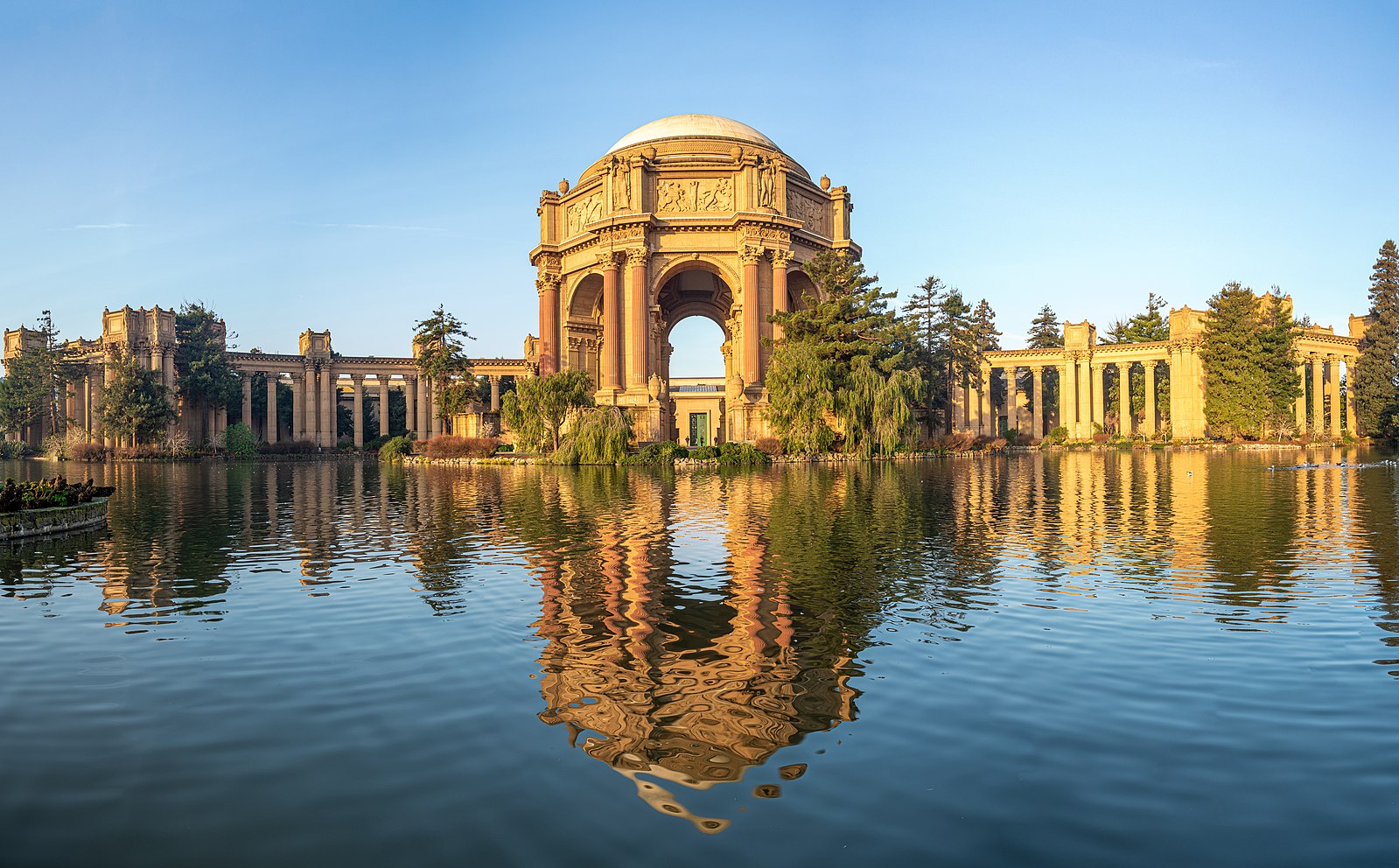
	It is a Greek temple in the Roman style: a 100-foot rotunda (never mind that the Greeks did not have domes) held by eight Corinthian columns and framed by colonnades arcing toward a 1100-foot pergola. Planter boxes mount them. Weeping women mount each corner. Maybeck wanted vines watered by their tears and ringed by redwoods; funds allowed for neither. At each corner of the attic stands a large and largely nude woman peering inward with arms akimbo and offering a sotto in sù of her buttocks. Broken pediments cap the niches, with clay urns above and behind. Beneath and around the dome, battle friezes in Greek relief by Bruno Zimm. Behind it a crescent-shaped gallery of 114 concrete rooms, from Renaissance to (to public horror) Futurist. The trash cans and fire alarms were painted ochre.

	Cypress, acacia, and willow line and shroud the temple. It is a dignity overgrown and gone in the teeth, a Versailles half-marble and half-shrub. A brief bright smell of lilies and a mute play of swans about the lagoon strays the senses from children and cars. Plaster allowed for any finish, hewn stucco or smooth marble, but doomed the whole to rot. Signatures were gathered (33,000) and money solicited ($350,000) to preserve it before the Exposition closed in December. The original demand was its duplication in Golden Gate Park. Phoebe Hearst—William’s mother—led the effort. When the fair cleared, the Palace alone was spared. A visitor remarked that it was impossible not to see it aright:7 even as it cracks, placid blues above and wavering shades about relieve the form from its tautness. The city sent armed guards to prevent demolition. Maybeck insisted that it was the most he could have done to build something that wouldn’t get in the way of the water and trees; all else “the public was bribed to like.”8 Once, in Paris, mounting a white sheet, André stopped his pen: “You will never do better.”9

	Professional criticism was as unanimous as public support. Architects used a two-slide technique to expose the influence of one building upon another. The whole begged the very origin of European architecture but reflected no particulars: the columns are squat and piers lanky, the proportions are nearly Greek and the forms nearly Roman, the radius is not the rotunda but the lagoon, so that the Palace seems to widen into water. The stage-set classicism was tawdry enough to belie Maybeck’s Beaux-Arts training and eclectic enough to resist recognition. However sound the Palace seemed “on the ground,” there was “nothing to show on the other screen.”12 Form did not follow form. Others, with better intention and worse consequence, argued that precisely because the form was meant to spoil, it should not be judged by permanent standards. But despite its brevity, the form is as sound as any classical or modern ideal: what led Banham to proclaim the Palace, on the basis of these corpulent ladies, crafted friezes and curving colonnades, “the truest ancestor on American soil of Mies van der Rohe's essential buildings of the 1950s”? Only “the discipline of their use and location”:10 as Mies structures form around its negative details, so Maybeck builds a ruin that he may center the land around.

	He wrote, in a 1957 telegram to Governor Knight, that “The Palace of Fine Arts is probably the last of the traditional pieces of architecture to survive the modern age.”11 He died that year. Public opinion held that the ruin should remain one permanently. Maybeck held that “the main building should be torn down and redwoods planted around—completely around—the rotunda. Redwoods grow fast, you know. And as they grow, the columns of the rotunda would slowly crumble, at approximately the same speed. Then I would like to design an altar, with the figure of a maiden praying, to install in that grove of redwoods. I should like my Palace to die behind those great trees of its own accord, and become its own cemetery.”12

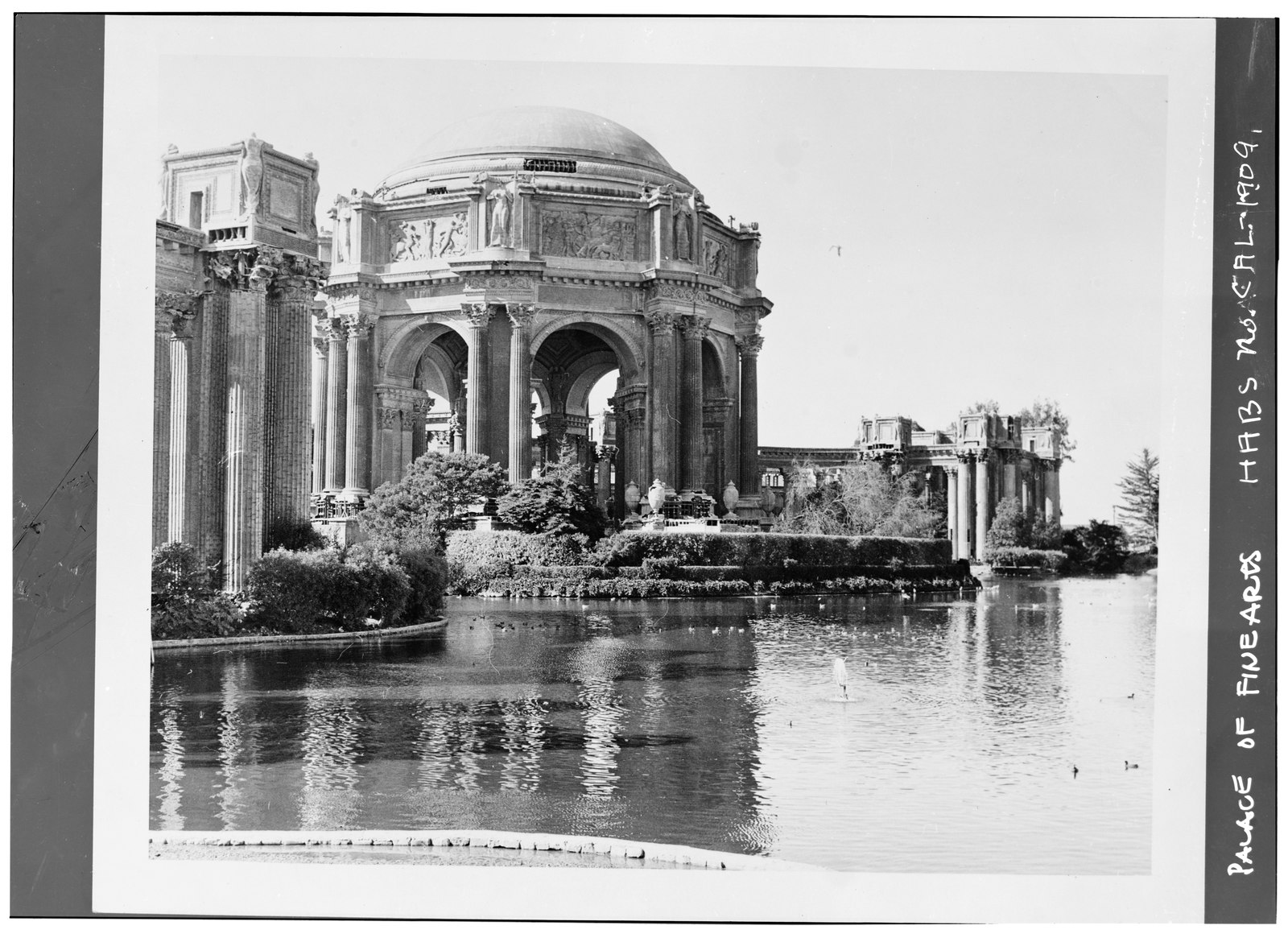
The San Francisco Art Association maintained the Palace. It was a city park after World War One. It became a Park Department warehouse, then a phone book distribution center, then a flag and tent depot, then a fire station. Statues fell and murals faded; the W.P.A. commissioned artists to repair it. Vines grew to cover the planters left bare. The weeping women were meant to represent the subjection of Art to materialism. Vandals beheaded them. The gallery held eighteen lighted tennis courts from 1934 to 1942. The Army used it as a motor pool during World War Two. It crumbled. The city fenced it off as a public hazard. In 1959, the state offered $2 million for restoration if San Francisco would match it. The city faltered. A philanthropist, Walter Johnson, donated and did not stop donating until his death in 1978. He wed his wife Mabel the year before the exposition; the Palace was their favorite spot. The contract was signed in 1964.

	Molds were made of every detail, concrete casts of every form. Steel l-beams held the Palace. It cost ten times the original. It opened with several days of “concerts, folk dances, organ recitals, films, lectures, and sound-and-light shows” in 1967,13 ten years after Maybeck’s death. A theatre was built behind it, an echo of the gallery. It has hosted everyone from Timothy Leary to Henry Kissinger and Akira Kurosawa to the Clancy Brothers, everything from the 1976 Presidential Debate to the Cerebral Palsy Telethon. It was a slated homeless quarantine during the shelter-in-place orders of 2020; after a few too many press releases with thread-and-tape floor mats and nary a bathroom in sight, the city reneged. It is a monument to 107 years of industry misnamed, pragmatism misplaced, and fortune misspent.

	Maybeck concludes his pamphlet with his belief that the Palace expresses “the life of the people of California” and has California as “its geographic reason for being.” The form could not have held “in Boston or in India”14 because it echoes what holds it. But this seems odd. The prior twelve pages describe it as a sad lone ruin, deliberately excluding mention of place or time. Why the abrupt transition from ephemeral gloom to permanent glory? One has only to see the Palace to know that ruin is as much the limit of its survival as its condition. No wonder Maybeck wanted redwoods planted around the columns, which would grow at the same rate that they crumbled. The frontispiece is a marble Muse finding the head of Orpheus, who charmed stones with his music and coaxed cannibals to live on fruit. Art in its purest form was for him abstinence from murder. For all the dreams which Maybeck sets in stone, above the facts of life which help and hinder mere survival, this dream is survival. This is indeed a very a Californian belief: that survival lay in one’s doomed commitments, in one’s attempt, like Orpheus, to retrieve the dead, which slip inasmuch as we try to seize them. It is a wagon-trail pathos, with removal the only panacea one has to employ against time. A four-panel mural depicted the birth of Art on the dome’s underside. It begins with the four golds of California: wheat, citrus, poppies, and gold. Each has seen its crisis. The panels end with a Ming legend of earth wresting visions from air. The dream endures; the forms by which we hold it do not.

	It is not these—not “the object or the likeness to the object” which Maybeck sought—but “a portrayal of the life that is behind the visible.”15 It is a specious stubbornness which takes as much stock in the dream as it denies the forms by which one holds it, a deliberate doggedness which sets its sights to the far and wide for fear that basements would burn and skyscrapers fall about one's ears. All cures and no disease to belie them. The colonnade bears nothing, the rotunda shelters no one. Todd could not see the Palace “without feeling an onrush, an assault, of ideas. And they were not orthodox ideas, no conventional, parlor ideas, but rough, brutal, Darwinian, evolutionary ones.”16 The men fight and muse, the women hold and mourn. It is a peculiarly Western incapability of sundering design from dream. In the rest of the country people know that if yours doesn’t grow where it’s planted, it begs a new frontier. Precisely because California is the culmination of that perpetual clean slate, people stay because nowhere else remains. When there is no more land to cross, you settle or go backward.

Many a Californian has explained to me something about the will to move on and endure. I had always taken it as a will to flee and forgo, and still cannot distinguish between the two. Louis Mullgardt, a member of the planning commission, recalled as many San Franciscans who foresaw a renaissance of the city on the eve of its destruction as those who “hastily bade farewell to the still smoking ruins of the City That Was, firmly believing that it should remain forever buried in its own ashes.”17 It is a frontier ethic which resorts to optimism in the trails and cannibalism in the passes, bearing children and planting wheat in the troughs with no time and space apart for rest and remembrance. While one forgets the nearness of everyday things amid these urns and yews, they stand only that the everyday may hold.

	Maybeck knew that “the artist began his work a long time ago in a nebulous haze of whys”18 and he must work a long time before he realizes that he does not seize the object at all but the reason he wrought it. An architect finds beauty as readily in the face of wood as a painter does the face of man. He confessed that he had never been an architect, that he had only liked one line better than another. The Palace was borne of lines smudged, smeared, and sculpted; like the Basilica of Maxentius it betrays the clean of the chisel only from afar, and even then blurred in fog. Todd writes that if we could “stand there a hundred years while swamp growth swathed its piers and plinths, while willows and acacias choked its portals, grasses dug into its urns and ivy over-ran its cornices and dimmed its lines,” the beauty would hold “above all other physical possessions.”19 None would see it now and think him wrong. It bears the worlds of fact and dream alike, elevating brute survival above the forces which would threaten it. But it is as much a dream that one can endure only in decay as that one can endure apart from decay. It is by its ruin that this monument to Californian survival still stands.

This is the reason for its hold, and is itself the dream, and as a dream an illusion. The real causes of Californian survival—eastern commerce, federal subsidies, native genocides—were clean absent from the Palace and subsequent accounts. Although it commanded the most support of the fair, no artwork garnered more applause than James Earle Fraser’s The End of the Trail. It depicts an Indian with endurance worn and bowed; he, on a horse as weary as he, searches in vain for a clear path. No wonder that a monument to Western self-reliance should evoke the ruins of Rome. Where else remains to go?


Endnotes

1 Reyner Banham, “The Plot against Bernard Maybeck,” Journal of the Society of Architectural Historians 43, no. 1 (1984): 37.
2 Bernard Maybeck, Palace of Fine Arts and Lagoon, introduction by Frank Morton Todd (San
Francisco: Paul Elder and Company, 1915), 4.
3 Peterson, Charles E. “A Visit with Bernard Maybeck,” Journal of the Society of Architectural Historians 11, no. 3 (1952): 31.
4 Maybeck, vii.
5 Sara Denise Shreve, “A History Worth Saving: The Palace of Fine Arts and the Interpretation of History on a Reconstructed Site,” MA diss. Cornell University, 2006, 7.
6 Keith L. Eggener, “Maybeck’s Melancholy: Architecture, Empathy, Empire and Mental Illness at the 1915 Panama-Pacific International Exposition,” Winterthur Portfolio 29, 4 (1994): 218.
7 Banham, 36.
8 Richard Reinhardt, “Bernard Maybeck,” American Heritage 32, no. 5 (1981).
9 Ben Macomber, “The Palace of Fine Arts and its Exhibit, with Awards” in The Jewel City, San Francisco: John J. Newbegin, 1915.
10 Ibid., 37.
11 Shreve, 76.
12 Ibid., 75.
13 Reinhardt.
14 Maybeck, 13.
15 Eggener, 217.
16 Ibid., 221.
17 Alexander Ortenberg, “Joy in the Act of Drawing: Maybeck’s Palace of Fine Arts,” Journal of the Society of Architectural Historians 70, no. 1 (2011): 42.
18 Maybeck, 6.
19 Ortenberg, 40.


Works Cited

Banham, Reyner. “The Plot against Bernard Maybeck.” Journal of the Society of Architectural
Historians 43, no. 1 (1984): 33-37.

Eggener, Keith L. Maybeck’s Melancholy: Architecture, Empathy, Empire and Mental Illness at
the 1915 Panama-Pacific International Exposition.” Winterthur Portfolio 29, 4 (1994):
211-226.

Peterson, Charles E. “A Visit with Bernard Maybeck.” Journal of the Society of Architectural
Historians 11, no. 3 (1952): 30-31.

Macomber, Ben. “The Palace of Fine Arts and its Exhibit, with Awards” in The Jewel City. San
Francisco: John J. Newbegin, 1915. http://www.books-about-california.com/Pages/
The_Jewel_City/The_Jewel_City_Chap_12.html.

Maybeck, Bernard. Palace of Fine Arts and Lagoon, introduction by Frank Morton Todd. San
Francisco: Paul Elder and Company, 1915.

Ortenberg, Alexander. “Joy in the Act of Drawing: Maybeck’s Palace of Fine Arts.” Journal of
the Society of Architectural Historians 70, no. 1 (2011): 38-63.

Reinhardt, Richard. “Bernard Maybeck.” American Heritage 32, no. 5 (1981).
https://www.americanheritage.com/bernard-maybeck.

Shreve, Sara Denise. “A History Worth Saving: The Palace of Fine Arts and the Interpretation of
History on a Reconstructed Site.” MA diss. Cornell University, 2006.
Palace of Fine Arts, photographed by Joseph A. Baird Jr., Historic American Buildings Survey, 1956.
MOMENTS

For those who leave us too soon.


At that moment, when the cup is full of warm tears that flow.

Flowing from my heart in that moment it is the tears that keep me.

Moments when the tears flow into my cup of sadness at night.


It is in that moment when the world falls away and there are tears.

Tears keep me company into the night into the morning sun warms.

These are the moments when there makes no sense to my senses.


Listening to your voice come to me you fall asleep in my arms.

Tears are for that moment, and you are not gone for a moment.

You are not gone from me more than a moment in my life.


FAITH THROUGH THE SNOW


Heavenly Father through Jesus your son.

Faith has not ceased in the winter snows.

Snows of disappointment of life’s bitterness.


Through the loss of hope in the world of man.

During confusing times of doubt, he came.

Carrying me to El Shaddai your mountain.


Your mountain in which lies above the clouds.

Above the mighty seas that would cover me.

Jesus comes to carry my soul gently into eternity.


Sorrows would swallow me without thy mercy.

Thru thy mighty breath life shall return to me.

Your light shines upon me by your love and grace.


Grace giving thru your tender mercy for my soul


ALONE with GOD one AFTERNOON

For Olga Shearer


My heart rest sitting in the Sanctuary alone.

A cross reminder of Jesus’ Resurrection.

An afternoon when there is contentment to live.


It is the solitude of devotion to the Heavenly Father.

Quietly smelling the sweetness of life come to me.

This sweetness has touched me many times.


“Heavenly Father, alone with you there is peace within.

A fragrance of Heaven in the air this afternoon with you.

An aroma that humbles me in solitude only found with you.

A reminder of your grace and mercy have given for my soul.”


LIGHT FROM A DISTINCT STAR


For Ms. Sherly, you have given me comfort.


My merciful Father has given me grace since the beginning.

A soul gave contrition for life which was grace seen or unseen.

This penance is given by me for gratitude in Jesus’s name.


My pleas were heard by you and deliverance came upon me.

Heavenly Father there is silence in my whole being for you.

Never did my soul forget your loving spirit imparted in me.


Your grace with mercy for a life-giving for me.

Silence to remember what it was like before time.

Connected to all that was of grace for me to live.


Now heaven has been restored and peace comes

A chapel in which Jesus comes giving me comfort.

Jesus’ resurrection allows me to be covered in eternity.
With the state of the world, we’re inviting Synchronized Chaos writers and readers to support various charitable and mutual aid- supporting projects, including efforts to support international writers and anthologies to benefit organizations. Please feel welcome to send in your writing, to purchase these anthologies, or to spread the word on social media.
Support Ukrainian Writers (listing of living authors from the country and their books which can be ordered)
Snow Leopard Publishing’s call for short story submissions to anthologies benefiting different nonprofits related to justice and equality, care for veterans, healthcare, and wildlife/ecology.
Amazon wishlist for an organization led by Afghan women (nationals to the country who want to shape their own destiny free of warfare and imperialism and with equal educational opportunities and safety for all).
Beaupre Anthologies (seeking submissions of work related to indigeneity, neurodiversity, or horror, for separate anthologies).
This month’s issue attends to matters of the heart.
Abdulquadir Ibrahim Worubata’s work expresses sorrow at a deeply felt personal loss, while Ian Copestick renders the angry stage of grief, indignation at loved ones’ being taken. Aloysius S Harmon renders the extreme emotions of mourning in his grammatically understated piece.
The two protagonists in David A. Douglas’ short story dream their way into connection with deceased siblings, finding peace at last over their passing.
Sidnei Silva’s piece explores the varied and beautiful dimensions of rain and draws upon them as a backdrop for love between two people. Mahbub also turns to nature as a metaphor for romantic, familial and spiritual connection among people. and pleads for interpersonal peace and understanding.
Ahmad Al-Khatat’s work also cries out for an end to violence among nations and people groups, while also reflecting on love and insomnia. Steven Hill issues a lengthy literary clarion call for racial justice while Chimezie Ihekuna relates the story of an impoverished Nigerian boy determined to get an education. Pathik Mitra explores and advocates for gender justice in a creative short story while Kellie Scott-Reed probes the extent of our responsibilities to protect others in danger as well as our assumptions on the sources of the danger.
Allison Grayhurst’s poems speak of places where we find spiritual nourishment: through practicing faith, compassion, and mindful care of the land and its inhabitants through gardening. K.J. Hannah Greenberg contributes some gentle photos of animals and natural scenes.
Christopher Bernard pokes fun at the popularity-driven culture of social media to contrast with his low-tech, undying love.
Norman J. Olson describes his artistic creative process, most poignantly how his subjects become portraits of people he cares about, seemingly of their own accord.
Robert Fleming writes of love in an unusual way, in a piece where he juxtaposes romantic attraction and calculus. Another of his pieces links the earth’s rotation with that of a disco ball.
Jim Meirose contributes an intriguing tale that consists of internal dialogue and captures place, character, and time. J.J. Campbell presents a photograph in words of middle age and his speaker’s philosophical attitude towards his decline. George Economou reminisces about hazy past days of heavy substance use, old movies and ill-fated romances.
Steven Croft reviews William Walsh’s young male coming of age novel Lakewood and Federico Wardal offers up a preview of the historical film he’s creating about Cleopatra. Wardal’s intent is to portray the ancient queen as an authentic woman of her time with real human feelings and desires.
Bulletproof Glass Smeared with Grease

He checked his watch. The face of it scratched from the repetition, the in and out, of his hand between the bullet proof glass of the KFC cash out window and the silver dish where the money was exchanged. Three years of unstable employment had landed him in the fast food giant’s bowels. Taking “an alternative career track”, he would explain to those who knew him as a 45 year old, recently divorced, up and comer.
Sometimes, between customers, he would forget where he was. He’d be a long way back with a girl he thought he’d had a chance with (but didn’t). A job he was offered but gave up (never happened). Maybe a he should be a lawyer. Why not? He was smart enough. But he knew the discipline he lacked was what pushed his raft further and further from where he thought he was and more towards exactly where he stood. Behind bullet proof glass smeared with grease, and a taste in his mouth that had become almost unbearable.

The place was empty, still early. Yet he barely noticed the woman when she walked in. People’s features and orders ran so seamlessly together, that they became a premonition. The sound of the voices became white noise, an atmospheric suggestion of a need. She set a bee line right to his window.

“Yes m’am, welcome to KFC how can I help you?” She raised her eyes to his. They were deeply sad with a glassiness that seemed permanent. There was a crust, he could just see it, just at the corner of her eye, driving him mad.

“Help me.” Her lips trembled as she spoke in halted English. He couldn’t tell if she had an accent, her voice barely above a whisper. She reached into the right pocket of her overcoat. Her hand seemed to reach down endlessly until she finally hit the pocket’s bottom, elbow deep. She pulled out a white and pale pink slip of paper. He recognized it as a lottery ticket. He waited for her to reach back in to get what she really went in for. Instead, she hesitantly slid the ticket into the hollow belly of the silver dish, her fingers slightly going under the glass. “Read”.

“I’m sorry, did you need a menu?”

“No!” She shook her head violently side to side, sending her loose grey curls springing out from all sides. Medusa, Hydra, he couldn’t pinpoint the ancient creature that she most resembled in her frustration. She pushed the ticket in deeper. “READ!”

The ticket in hand, he looks down at the numbers and reads each slowly. He whispers for no reason. She imitates the movements of his mouth with hers . She isn’t asking him to read these very rudimentary numbers because she doesn’t know the language or what the ticket says, it’s that she wants confirmation. “Thirty six” she is moving her fingers over and over each other; “Fifty, six, fourt-nine”. He continued on at a steady and careful pace, until the last two numbers, which he said quickly, as to barely register the impact.

“I win…..” she hissed and leaned forward pressing her forehead to the scratched and flighty glass. She rocked her head back and forth, relieved. She suddenly reached her hand back into the silver dish for her ticket’s return.

He hesitated for a moment. He held the ticket in both hands now. He shifted his eyes between the woman and the ticket. Caught in the fantasy of camera angles and culpability, he felt the suck of air that comes when the double glass doors open at once. Two men, wearing Ronald Reagan masks, slide just inside the door. Dressed in cliche black with coordinated shoes, they don’t make a sound. The woman whips around like she was electrocuted, then stands stock still, curles making a halo around her head, still moving. The two men initiate motion towards her with synchronized steps, and grab the woman under the arm.  She looks at one and then the other, as if one would suddenly realize that they had it all wrong. Someone would realize the mistake. They drag her silently away from the counter. Quietly forgotten behind high metal shelves where the heat lamps popped and hummed, the cooks' heads had popped up like prairie dogs, one by one standing on their toes to catch what the hell was going on.  They lowered their heals and slowly walked away from visibility. Maybe to call the police, maybe to save themselves.

As the woman was finally dragged to the double doors, she craned her neck, lifting her chest and heaving her tiny body backwards . She was saying something to him but he couldn’t tell what language she was speaking. Then she gave up on direct communication, and in her helplessness, let out a yelp.

Those men looked like they came in for a reason and found it. What had been secreted into his possession, those men wanted. From all appearances, they think they have found it. They’d probably shake her down for it out of public view. She would insist she didn’t have it. They wouldn’t believe her. She would plead and tell them she gave it to him. They would never believe someone would give their winning lottery ticket to a stranger. They would interrogate her for hours. A smile crept up behind the face he showed

Maybe they would kill her.

Of course, he understood that she could use his help, but she had asked a lot of him already and so he felt no obligation. They locked eyes, the urge to wipe away the crust in her eye appeared once again.. With his smile no longer hidden, he turned away from her terror and walked to the back office. He took his coat from the hook, punched out, and headed out the back door with his future in his pocket.

Kellie Scott-Reed is the AEIC of Roi Faineant Press. She writes songs for the band Fivehead that can be found on ITunes or Spotify.  You can find her work all round, scattered about. She is a very happy person, and therefore loves dark things.
a Night long gone, forgotten, erased

with the substance-abuse of years gone,
it’s a wonder I’m still breathing; a miracle I
still recall precious little moments from imperfect
nights of snow and glacial gusts penetrating the room
through windowless frames on crumbling walls.

dozing off next to strangers of the night, fallen angels
dissipating with the first ray of sunlight; spending
months hidden in attics and shooting galleries,

struggling to maintain the few traces of soul left alive
by putting it in airplane bottles of booze.

acid-eating time-travelers visit dreams and hallucinations,
spaceships land atop tall buildings dwarfing skyscrapers and human shells.

early morning hours never were, lost in the crepuscular mist of yesteryears,
hollow moments vanishing inside drained (and broken)
bourbon bottles—forevermore, the eternal broken promise of hundreds of lying lips,
falsifying experiments in the grand scheme of today’s societal degradation;


erased, forgotten, completely and utterly
dead. dead
like the night, like the morning, like the
sun and the galaxy, like the dream-
less nights.

Emily

we effortlessly drained a fifth of bourbon while
watching old movies on the television;
we could barely follow Citizen Cane, and laughed with Casablanca,
then had a blast with The Treasure of the Sierra Madre.
in our high, we discussed future travels, how we’d
become, too, treasure hunters and adventurers.
then, we cracked the second bottle and the moment the glasses were filled,
we forgot about exploring Bolivian jungles.
it was alright, we told ourselves during hangover mornings
and cruel early evenings; we were still young (merely 20)
and had the whole world sitting at the palm of our hands.
every night the moans of pleasure kept the neighbors awake
and I’d use a kitchen knife and my crazy look to drive them away
whenever someone bold enough knocked on the door to whine.
we’d never step outside the door before 7 in the afternoon, and when
we did, it was only because we had run out of booze.
I can’t even remember how long it lasted; I remember her name all too well:
Emily. both foreigners, both belonging exclusively in the most lugubrious voids
of permanent midnight. bottles emptied, broken, and we fucked amidst the glass.
how long ago? when did it all happen?
here I am, swilling bourbon nightly and, sometimes, I see
her smile painted in the stars and a tear runs down
my thick beard. I lost her,
lost it all; she liked my stories when I read them half-drunk, now, I can’t
find solace in the yellow pages residing under the worn-out
mattresses of the cheapest brothels.
it’s alright, I keep lying; I was too drunk at her funeral and cannot even
remember the spot she rests. I wish to go and leave a rose
on the ground, all I have is this lowly poem, insufficient as it may be to do justice
to what she could have been. took me a week of
constant drinking to come back to life after her premature demise,
I’m still drinking and recalling her radiant smile; she’s the only one I wish I had taken
a picture of when I could. I didn’t, my memory deteriorates one glass at a time.
she, I, the world, ashes waiting to be tapped in a dirty ashtray.
nothing remains; only the smile painted in the stars.
the empty bottles on the floor remind me of former nights, when history
no one will know of was made;  the first poems written only for her,
masterpieces hurled over the coffin; true words no one needs to hear.
I can’t remember them, too drunk, but I know, one day we’ll reunite, even in the absolute nothingness, and she’ll forgive me for all the others that lay on the couch
she once used to call bed; I watched Casablanca recently and laughed.
for one magnificent second she was there, laughing with me; I had to
drink for two weeks without a pause just to forget the soft
sound of her giggling, the kisses she planted on my cheek whenever
I was too hungover to breathe.

down by the creek

we swilled fortified wine and stared at the putrid moon;
we had nothing else to do but

hold each other, assassinate the
sickness with strong wine, annihilate the
hangover with powerful junk.

you used to say we’ll make it, you claimed

the future held grand things.

wonder if you ever glimpsed at the bleak reality;
if you saw the
monsters lurking
right around the corner.

we failed to evade them; succumbed to
everything. you left
early, no chance for your
future to withhold great things.

as for me, I still sink well liquor, using rotgut to destroy

whatever’s left of my soul and hopes. dreams already dead,

the pallid moonlight’s forever gone, even the creek
’s all dried up and dead

like you and the
future you once envisioned during the drug haze.

I’m at other creeks, with new bottles and the same old cigarettes.
chasing down the blue dragon all around its flaming meadow

with nothing but my trusted butterfly net.

Sea of Empty Bottles

harrowing nights of a hollow past
I can’t forget, nor wish to erase;
every sin is repeated as
I try to maintain sanity
by crawling through
the empty broken bottles scattered on the floor
searching for a place to vomit.

the wails of former ghosts reach my ears
every night, turning me into a somnambulist;
I don’t care when I wake up
holding the kitchen knife.

one day, I’ll do what I so many times thought of
during cold turkey nights of suicidal desires.

the mornings are always the harshest, until the first two
lowballs are poured and drained, when
the beer is still warm and tastes like a sick fox’s piss.

it gets better, for a while;
darkness returns,
encapsulates the world like an impenetrable veil,
the garter belt of a virgin princess and the
moments I remember are scarce and vague, nothing
substantial except for that rainy afternoon at
the graveyard where I saw the love of my life
lowered into the ground, therein to remain
forever.

in acid hallucinations I encountered colors
and during a junk OD I was in the Bar.

I hunkered down on the barstool, almost had a sip; brought back to
this world by the second, and
last, woman ever to drill a hole in the
stony exterior of my heart.

the keyboard always dances,
it barely works, it’s
alright, the dance is loud and wild and meth-fueled.
21st century junkie and alcoholic,
the new millennium did not make me extinct.

for now, I’m on coffee, cigarettes, and novocaine
(sometimes, I go vintage, searching for dead spirits of the damned).

the night falls, gin is poured.
someone’s making margaritas
wearing nothing but a tiny sheer dress.

she smiles, we drink,
we smoke pot and pop some uppers.

we’re here, there, everywhere,
nowhere; no more dragons for tonight,
I’ve put them to sleep.

she kisses me, I refuse to obey,
still a couple of lines to finish;

I won’t polish the cruel words,
won’t edit the mistakes.

let them be,
remind you some
hone their skills by endlessly typing,
drinking rejection slips away,
fucking the nights and injecting the mornings to oblivion,
before returning to the keyboard so the dance can
commence all over again until one
lambent sunny day

darkness engulfs them and they
gain admittance to the Bar.
GOD VS FEMINIST

Pathik Mitra


Neera opened her eyes slowly. The buzz in her head had ceased. There was a strange sense of peace and tranquillity around her that she had never sensed before. The sense of pain and the deafening sound of blasts, and ambulance sirens all were surprisingly stopped. She blinked her eyes twice and looked around the empty room. A warm white light seemed to gently pacify her nerves. A piece of soothing music was comforting her tensed mind. She could not guess the source of this soothing light or music though. The room was empty other than a table and two chairs placed at the centre. What is this place? Where has Neera landed? Is she kidnapped? As she got back on her feet and started walking toward the table she started remembering her day.

She was on an assignment to cover the riots at Marufganj village in Uttar Pradesh. Two days back communal riots broke out at Marufganj as a Muslim girl was stripped of her burkha in the village school. Soon communal tensions soared high and by the evening there were 5 deaths and an imposed curfew. People were in a panic, antisocial elements ruled the roads, shops were burning and supreme hara-kiri reigned. Working for her independent news portal Neera visited ground zero. In the course of her investigations, she discovered too many dirty secrets of the local political leaders and how they had meticulously planned for the riots. But then they also found out about Neera and her findings. She was chased by a gang of thugs before she took refuge in a deserted building. The last thing she could remember was one of the thugs hurling a hand grenade at her. There was a deafening noise. But after that it was calm. Supreme calm. Trying to arrange the random chain of thoughts in her mind, Neera pulled her hair behind her head and tied it with the band.

Then a sudden realization dawned upon her. There was no escape. Her leg was injured and she could barely move when the grenade was hurled at her. So where was she? Is she dead?

Before Neera could further streamline her thoughts, she saw a lady approaching her. She was dressed in a very formal black suit and knee-length skirt. She wore black high heels and dark lipstick. The top two buttons of her shirt were open. She had a silver metallic briefcase in her hands. Just like her she had done her hair and also wore black frame glasses. With beaming confidence, she trotted towards her in her high heels. Neera could not help but admire her dressing sense and demeanour.

“Welcome, Neera! Welcome to Judgement stop” announced the lady formally.
Neera seemed to be least bothered by her presence. Being her usual self she casually asked, “So I am dead?”

“Yes Madam! Technically yes. But it will be confirmed after you get the tickets for your next destination?” She replied pertinently.

“That means I am neither dead nor alive? Kind of in-between?” Neera enquired again.

“You are in transit. Just like if you have done the check-in but not boarded the flight yet” The lady explained patiently with a smile.

“Ok Ok. Let it be. But who are you? God?” Neera asked.

“I wish I could be someday. But for now, I just keep accounts for Him. I am Chitra Gupta.” She replied.

“What you Chitragupta? But I read he was a guy, but you seem to be a woman” Neera looked confused.

“He is Chitragupta. I am Chitra Gupta. There is a space character. You see it's all about perception.” Replied Chitra.

“Wait wait. What did you say you're being a man or a woman depends on my perception? This seems to be pretty confusing. Care to explain?” Neera was excited now.

Chitra had her modest plastic smile pasted on her small lips.

“You are a true feminist Neera. You presume the world would have been a lot better if women were in charge. So how can a man be in charge of your accounts? Perceptions and notions are very powerful you see, at least over here.”

“Ok fine. So you are just the accountant! Where is the Big boss? Where is God? I have a few questions for him?” Neera replied curtly.

“Generally it’s the other way round madam. But I presume your case is unique. God had warned me earlier. Plus you are a journalist, that too an honest, unbiased one. You represent a very rare endangered species on earth. My data says you are more endangered than the Emu or the platypus in the present day. Probably that’s why God is taking so long.”

Soon there was a squeak in the door and they could see a silhouette stealthily walk toward them.

Chitra cleared her throat and pulled the chair. As the silhouette materialised into a human shape, Neera could not help but laugh. The man who had approached them was barely 4 feet at least 1.5feet shorter than her and had a bald head with surprisingly just two streaks of hair standing tall on his head. He wore a yellow Bermuda with red socks and pink oversize jogging shoes. He had nothing but just a floral printed violet tie on top which was resting on his paunch. He had a disgusting Hitleresque butterfly moustache hanging on his lips just below his flat nose. Even Neera felt bad for his catastrophic fashion sense.

“Welcome, Neera! Sorry to keep you waiting. I hope Chitra madam has already briefed you.” Spoke the man in a heavy voice.

“Don’t tell me you are God?” Neera asked trying her best not to laugh.

“I am afraid that’s what most people call me. But please don’t laugh at me. The way I look is nothing but a perception. Your perception.”

“I am sorry I am an atheist. I don’t have any perception of God. I always thought it was a convenient hoax” replied Neera defiantly.

“That’s precisely the point. The cumulative summation of your ideas of me, your curses, and allegations overall culminate into this poor fashion sense of mine. This is how you perceive God. I am sorry I never thought you were so mean.” God was almost weeping.

“Wait wait so you don’t look like how they show in our serials?”

“I know you underestimate me and my capability. But trust me I don’t have such wretched fashion sense that I will put tonnes of old fashioned gold jewellery on my bare body for nothing. Again it's their perception. A perception that I quite hate.” God replied.

“I am sorry. But still, the confusion exists. If your clothes or lack of them is proportional to my faith then you should have been naked. Not that I want it though”

At this Chitra giggled which earned her a stern gaze from God. Then He forced a smile and said, “That's not funny madam. We have some decorum and minimalist dressing guidelines here. It’s not a nudist colony you see.”

This jib kind of aroused the feminist in Neera. She had not subscribed to the idea of God from an early age and God himself was in front of her, she was in no mood to spare him.

“You are sure this is no nudist colony? Then what about the concept of 72 virgins waiting for a pure soul, the concept of dancing Menkas & Apsaras, and the concept of seducing sorceress. The very concept of heaven objectifies and belittles women. If the idea is to reward a pure soul with virgins then it should be gender-neutral at least. You are a torchbearer of patriarchy.” Neera was excited.

“You just called God Male Chauvinist” Chitra blurted.

God opened his specs and adjusted them. He looked sad. He took up the glass of water from the table and took two sips.

“You are a feminist madam. I get it & I don’t have any objections to that. But the grave accusations that you thrust on me are unjust and unfair. Have you seen any of the so-called virgins or dancers around here? Chitra my respectable assistant is dressed modestly and I offer her my utmost respect despite her ridiculing gestures. So can you kindly reconsider your allegations against me?” God seemed to be hurt.

“It’s true I can’t see any around. But you only told me whatever I see is my perception. So how do I become sure that it's real?”

“Precisely madam. There is no reality here. Reality is all down there. Here it’s all your perception. So if lust is what all your men perceive, then their heaven indeed needs virgins, fairies and nymphs. You can’t blame me for that. I am in no capacity responsible for that.” God replied.

“Even if I buy your argument that all ideas of heaven, swarg, Jannat, religion as a whole is man-made and all reality is on earth, still that does not help your case much,” Neera argued.

“You just said man-made and not woman made?” God asked.

“Ahh, that’s just a general figure of speech. Come on” Neera looked irritated.

“But I did not generalize it. You did. You people generalized everything. What a woman should not wear, how she should talk, what part of the body she should cover, when she should fast, which temple or mosque she should not enter, whom she should not marry! I have no role in it. All this generalisation is done by Mankind rather than humankind.” For the first time, God looked satisfied to have pushed Neera on the back foot. He looked up at Chitra expecting a smile in His support. But sadly Chitra did not oblige.

“So just like our elected government, you take no blame for the bloodshed going around in your name. You put all the blame on the poor public. You can’t just sit and watch the mad circus. Then you are not fit for the role of God.” Neera said sharply.

“Did she just question the competency of God?” Chitra could not resist. Again God exchanged a fiery glance.

“Do you believe that you all are just puppets in hands of God? All is pre-destined”.

“Surely not I take my own decisions. My life, my rules. When I am not sure what my life will be like in the next hour why will You be in charge? I want to be free. Free will, free spirit”

“I too want the same. That’s why I have given you all the control. Then when you mess up on your own you blame me. Yet to assist you I have given you the power of thinking, sense of good, empathy, joy, happiness, poetry, music and whatnot. Yet ignoring all that you resolve to bloodshed. You blame me for that?” God was almost in tears.

For the first time, Neera felt bad for God. She was a bit too harsh on the poor fellow. He must be under a tremendous workload. It is not bad to break down at times. Even men do cry and women can console them.

“Just a moment, so you say the raging lust leading to rapes and brutality among men is also developed by them? But if lust is a basic instinct then indeed you are responsible.” Neera was not giving up.

God blinked twice & replied slowly, “Now again this is my problem. When I created man and Woman I never gave them any guidelines for not eating any apple. I wanted my creation to self-create and take civilization forward. The conjugal instincts were given to all creatures for the same reason. But for humans, I decided to spice it up a bit. Rather than being a mundane repetitive process, I added lust and love to it. I wanted the process to be an experience to be enjoyed. It's just like a pizza bread with tasty toppings. But how would I know that the humans will eat the toppings out of turn without caring for the base.”

Neera was impressed by the Pizza analogy. But she was here to combat fire with a fire extinguisher.

“But in your great process, women to suffer menstrual cramps, women to go through unbearable labour, while men will just enjoy the pizza? And you say you are not partial?”

“Did you just call God...” Chitra could not complete this time.

God snarled at her, “Yes she called me Partial. We all can hear that without you repeating it.”

Chitra bit her lip in apology and put her head down.

“See Neera I had entrusted the superior species with the greater responsibility. Naturally, women deserve to have it. The Period thing is just a part of the process. Period. Just as ATV vehicles are designed with superior suspension mechanisms I designed the woman bodies meticulously so that they can sustain the pain. Women are way stronger than men you see” replied God.

“I caught your bluff sir! Women are stronger than men. Are you in your senses or on marijuana?” Neera retorted relentlessly.

Chitra was ready to repeat if Neera called God an addict. But realising the gravity of the situation she ate her words.

“Neera I did not expect this from you. Do you think physical strength is the greatest power? I am afraid in that case Dinosaurs, gorillas, crocodiles, and elephants would have ruled the earth. Strength is in the mind and Women are designed with greater mental strength. I can bet on my creation. It’s your empathy that makes you powerful” God replied with diction.

God is Smart. Not as dumb as she thought. Neera was searching for her next question.

“So if you put all blame for violence and worldly disturbances on humans, what about natural catastrophes like Tsunamis, earthquakes and cyclones? You like it shaken, not stirred?”

“I am no James Bond, Neera. But first, you tell me what happened to your scooter last week?”

“The air pressure was not accurate in the back wheel and the brakes were not serviced. It skidded.”

“So can you blame the makers for the same?” God paused.

Neera realized she was stumped.

God had just delivered his glory lines with panache.

“You humans ticker and disturb the wonderful nature designed by me with pollution, global warming, hazardous chemicals and your overall Greed. In place of doing the regular maintenance of nature, you relentlessly exploit my system. Now you blame me?”

Neera could not reply. Chitra clapped in appreciation. God was happy. Finally, he made sense.

“Just a small clarification if you don’t mind?” Neera asked sheepishly.

“Again? Shoot” God thought he had nailed it but still some action was left.

“Hindus, Muslims, Christians, Jews, Jains all perceive you differently and shade blood for the sake of their difference in perceptions. Yet you don’t clarify them? Does the devil play his cards?” Neera asked.

God pulled out a box from under the table & put on a pair of black aviators & a pair of cheap lighting horns on his head. “Talking of the Devil, the Devil is here”. He grinned. Then he looked seriously into Neera’s eyes and replied.

“I told you I am not their controller just their creator. The diversity in thoughts is what makes them so beautiful and colourful. Just imagine Cakes for Christmas, Laddoos for Ganapathy, Biryani for Eid- it's all their creativity. If there was no diversity or difference in perception world would have been a boring place. I know they are stupid. They treat me often as a traffic constable whom they bribe every time they break the signal. But I ignore them. They can love and that’s the secret ingredient that helps them to fight the hardest of challenges.”

“Huh, love is too overrated for me” Neera shrugged off.

God smiled and exchanged a glance with Chitra.

“Ok, I guess your questions are done with. I so wish your prime time TV news anchors borrow a page from your guide to fearless journalism. Time to get back to work. So Chitra Madam what do we have for Neera?”

“She has an impeccable spotless sheet, Sir. It's confirmed Heaven” Chitra replied with excitement.

“Then Heaven it is” declared God.

Neera was silent. Her head was bent down and all of a sudden the excitement to have defeated the God in an argument seemed to die down. All the euphoria in her seemed to mould into a lump that had settled in her throat. Her nose felt heavy & her weather forecast was cloudy skies and rains. Before she could realize the first teardrop left her eyelids and landed on the ground.

“I miss mama, papa and that idiot too! I don’t want Heaven. I want to go home” Neera spoke trying her best to hold back her tears.

“And you say love is overrated my child,” God spoke softly.

There was awkward silence & God broke it.

“Chitra send her back! Convert the grenade hurled at her into a rotten egg. Delete the timeline.” God announced.

“But that is not as per protocol” Chitra reverted.

“Then understand that she has just forced God to break the rules” God smiled.

Neera was very happy after a long. But even at this moment, she was a lady after all.
“Thanks, Sir! But cant you change the rotten egg. It stinks & is bad for hair and skin” requested Neera.

God and Chitra just kept staring at each other.

Meantime the poor thug who had hurled the hand grenade could hardly believe his luck as the rotten egg crashed beside the journalist & police sirens approached them.
Threnody

i have felt my heart weighing down in me
the other day it held the  silence of a cemetery.

some wounds will crack your bones & escort you in the mock for cremation,
but boys were taught not to fall when they are heavy.

i held mine in my chest
the water faucet in my kitchen leaks water the same way my eyes do.

i witnessed tears leaving holes in my cheek bones & each day there were
 maps that broke through me.

all i have ever felt was learning to die with my eyes wide open.

Aloysius S Harmon Jr is an emerging Grebo Liberian writer and poet. Many of his poems have appeared on Eboquills, Eve Poetry Magazine, We Write Liberia, Synchronized Chaos, and elsewhere. He is one of the co-authors to the 'Breaking the Silence Anthology', Thoughts In Words, and 'Weep No More Liberia'. He is the winner of the Thort’s poetry competition.