Christopher Bernard’s installment of The Ghost Trolley: A Tale for Children and Their Adults

The Ghost Trolley

A Tale for Children and Their Adults

By Christopher Bernard

Chapter 3. A Girl in a Red Jacket Under a Green Sky

As the trolley clanked noisily down the tracks, it suddenly emerged from what looked like a tunnel, but no – it was an old covered bridge, of the kind seen in the woods near Halloway, and that Petey always thought looked “romantic,” like his mother said, to a guffaw from his father – even eerie and haunted, though in a way that wasn’t scary. He had always liked the bridges, with their rumbling, uneven planks as the family car slowed down to drive across them with long shadowy interiors dotted with sunlight peering through cracks and the smell of damp, decaying wood. But this one wasn’t rumbling at all. Nor was there any sign of sunlight.

For the sun was only just now rising through the trees ahead of the trolley.

But Petey noticed something strange. It made his heart skip a beat. The shadows on the other side of the bridge looked all wrong: rather than falling from right to left across the trolley rails, which they should be doing, the shadows now fell from left to right. The trolley had been running north, unless they had made a weird turn when he was asleep. But that was impossible; they would have been back in Halloway by now if that had happened, not in the forest at all. If they were still in the forest, they had to be north of the town. And they were definitely in the forest.

At that moment the trolley moved across a break in the woods – a meadow cut through by a racing stream – before moving back into the forest darkness.

And above the meadow was the sun. And it was blinding him.

Petey had to throw his hand over his eyes. This was crazy – not that he had to cover his eyes against the sun, but because he shouldn’t have had to do that in the first place: the sun shouldn’t have been on that side of the trolley  It was in the wrong position. It was rising in the west, not the east. Petey pushed close to the window and looked up, past the blazing patch where the sun silently roared.

The sun was rising into a sky without a single cloud across its vast and shining expanse.

And the sky was pale green.

And not only that: it wasn’t winter anymore.

Petey pinched himself. Yep, he was awake all right, unless you could pinch yourself in a dream and still stay asleep.

There was no ice or snow anywhere, not on the ground, not in the trees, not in the crevices of the trolley’s windows. The banks along the trolley tracks were covered with a thick blanket of ferns and brush and wild flowers – a blossoming tapestry with a complicated blend of fragrances so strong and lovely he pressed his nose against the window crack so he could smell it better. It looked like, and smelled like, a drowsy, dewy morning in late spring. He pushed the window open as wide as he could.

Not only was the sky green, but some of the vegetation – the long grasses, for example, and some of the weeds – was blue. He could see clover (also blue) on the banks of the trolley cutting, and, on a sudden zephyr, several blew through the open window into the trolley. He picked one up from the seat next to him; it was a four-leaf clover! At first he felt “hella lucky,” as his dad would say, then he picked up two others that had blown in beside it: they were all four-leaf clovers! For some reason, this made him shudder.

He peered more closely at the forest the trolley was passing through. It also was different: the trees had pale gray bark, as he was used to seeing, but the boughs didn’t start till high up, leaving the lower trunks smooth and bare, and the roots started several feet above the ground, forming little, cozy cage-like shelters at the base of each tree. And the leaves looked strange: each tree had leaves with many different shapes, some of them like the wings of birds, others like seashells, others like palm fronds or banana tree leaves, some like oak or maple or sycamore leaves – but they were all on the same tree, which was definitely not how he knew trees grew back home.

Back home! But if this wasn’t “back home,” where in McGillicuddy’s bean patch (another favorite “dad phrase”) was he?

He heard what he thought was birdsong, as it was coming from the trees, but it wasn’t like anything he’d ever heard: there were long sharp hisses, then chattering and ratchety crackles, followed by a little, spiky shrieks. And then he saw the little furry animals that were making the noises; they were flying through the trees, though they were definitely not birds!

They sailed through the treetops like flying squirrels, though these looked more like chipmunks, one of them like a possum, another like a rat, another like a bright red fox; they spread their arms, the skin spreading out from their torsos like little sails or wings as they flew from bough to bough. There was even a monkey or two hanging out in the upper branches, but quite tall and with less fur, and they stopped and watched the trolley intently and seemed to notice Petey and watch him with an especially alert look on their wizened faces. The forest here looked like a jungle!

Petey tried to crouch out of sight when he saw the monkeys watching him, though he was immediately mad at himself: so what if the monkeys saw him, let ’em look! He had nothing to fear from them – did he?

Other mysterious eyes were watching him from the dense foliage of the trees: large round eyes in small round heads, bracketed by curiously stirring wings. One pair of wings took off heavily to follow him as he rode past, followed by another, then another, and another . . .

Not long afterward, the trolley came to the edge of the forest. At first the brightness of the sun dazzled the boy’s vision and Petey held his hand above his eyes like a hat brim until he could focus again. The first thing he saw clearly was something lying on the ground near the tracks just ahead of the trolley. 

It looked like the body of a man. He seemed to be sleeping. He lay with his face in the grass, with one arm stretched forward as though he were trying to hold on to something that was no longer there. Maybe it was one of the homeless people Petey sometimes saw in Halloway, usually from one of the big cities not far away – Portland or Burlington. Petey felt a spasm of pity for the man as his body passed beneath him and to the rear.

The boy, his eyes fully adjusted to the stark morning light, suddenly looked at the landscape surrounding him.

It was partly hidden by what looked like brown fog, that blew away here and there to reveal patches of blackened, in some cases still burning houses, barns, sheds, stables, granaries, silos, whole farmsteads, charred woods, fields pocked with craters like holes punched out by a crazed giant; and villages were burning in the distance, and the waves of smoke moved across the land like ghosts.

The boy was at first too astonished to be frightened. It looked too awful to be real, and he felt at first a certain detachment, as though none of this was happening to him; it was like being thrust without warning someone else’s nightmare.

A solitary bird was winging slowly above a dead tree. But it was flying upside down.

Then the boy saw something that made him shiver: the driver’s seat had changed – before, it had been on the left-hand side of the trolley, as it always was; but now it was on the right. He still couldn’t see any sign of the driver: just the tall back of his seat, and his coat, now on a hook on the other side of the driver’s cabin, swinging back and forth. The mirror above the driver’s head, in which he could usually see the driver’s face, was blank.

The bell clanged three times, and the trolley moved onward. Petey squeezed his face against the window and stared as they moved across the vast desolation. What had happened? Why had he heard nothing about it? Something like this would surely have been broadcast on the news – wouldn’t it? What was this? Where was he?

Then he saw her. It was a little girl dressed in a red coat, though the coat was covered with black streaks like stains; she was standing in a field next to the trolley tracks, watching the trolley come toward her. She started waving frantically.

The trolley stopped and she got in, mechanically put a coin into the coin box, and walked back with head down toward Petey as the trolley moved forward. Petey watched her intently as she sat in the seat across from him, without apparently noticing him.

She was a small girl, with frizzy hair and honey-brown eyes, from what he could see; her skin was smooth and brown, like cocoa; like the skin of Sambene, the little African American girl in the other fourth grade class, who Petey had a crush on.

The girl heaved a sigh. Her cheeks were stained with tears and ashes.

Petey wasn’t sure what to do. His parents had always warned him against talking to strangers. But, under the circumstances, wouldn’t it have been terribly rude to say nothing at all?

“Hel-lo,” he said shyly, his voice breaking between the syllables.

“Oh, hallo!” the girl said in a small, startled voice, seeming to notice him for the first time. She turned toward him; yes, her eyes were as brown as honey.

Petey’s heart skipped a beat, for the second time that morning.

“What happened out there?” he asked, after hesitating for almost a full minute.

The girl stared at him with large, sad eyes that hardly seemed to see him. They shone with tears.

“They come for us!” she said, in a curious accent Petey had never heard before.

“Who came for you?”

“The Korgan of Ramora! It part of the big battle last night. You must see that!” And bursting forth from having been pent up so long, her words came tumbling out. “They come in middle of night and take me father and me mother and me sister and me brother, and they take me if I not hid under bush at back of our garden, and they set our house on fire, and I have to wait all night, watch our house burn down, and I ken’t believe it so I look at it when it all over, and I slip and fall in the ash, then I run away as sun rise till I see the yellow trolley that cross the middle of Otherwise when there be a blue moon, like there be last night, and here I am . . . ”

Petey tried to take all this in, without quite succeeding.

“Why did they want to take you?”

“It part of the war . . .” The girl looked at Petey closely for the first time. “Don’t you know? Not you from here?”

Petey shrugged uncomfortably.

“No, this is the first time I’ve ever been here. I got in the trolley to go to school and I fell asleep and I missed my stop and I waited for the trolley to take me back but it took me here instead.”

“Oh,” said the young girl, still sadly. “That must mean you from Howtiz.”
            Petey, who had never heard of “Howtiz,” looked doubtful, but felt it would be impolite to contradict someone who looked so upset.

“This be Otherwise,” said the girl, wiping the tears from her eyes (telling her story seemed to have relieved her a little). “You can see the different destination on front of trolley. When it go back from here it say ‘2 Howtiz.’ In Otherwise, things be different from Howtiz, completely different, but not all at once, which why it called Otherwise. Anyway that what me deddy tell me. I only know Otherwise, I never be to Howtiz. I always want to go there, because Otherwise not exist without Howtiz—at least that what me deddy tell me some of our philosopher say, though other philosopher claim otherwise. Me deddy say that so like them. They never make up their mind about anything.”

Petey blinked at that. Philosophers claimed otherwise about Otherwise? The thought gave him a little brain spasm.

“Anyway, I always want to see for meself, by going there on yellow trolley. But me parents never let me go. And a blue moon be rare anyway.” She sighed again. Speaking clearly made her feel calmer, so she continued. “We live, I guess not anymore, in Forest of Paal. Me deddy  a teacher. Me mommy a doctor, and there be three children. We live peaceful before the war and the Korgan from Kingdom of Ramora across Mountain of Sleeping Noor invade we. Everyone force to join one side or other, either Korgan or Paona, who be largest group who live on the plain. It easy for we to choose, cause Paonas gentle and honest, but very poor, and there not be many of them, and Korgan, though they be rich and powerful and strong, and there be many of them, not content with what they have but think they must have ever’thing. They probably not even be content then!” she sighed

The girl paused, as if uncertain whether to tell the boy from Howtiz any more.

“You couldn’t just stay out of the fight between them?”

“No,” said the girl positively. “You do that, everyone turn on you. ‘Whoever not enemy of me enemy, be enemy of me.’” She said the last in a detached singsong voice, as though reciting a school lesson she had become profoundly and bitterly skeptical of.

Petey looked uncertainly at the girl. He was thinking about what he saw altogether too often on the news back home. Back home! Sigh . . .

“Are you sure we are in Otherwise?”

“Yes, of course! Why you ask such a question!”

“Because what you say sounds an awful lot like where I come from.”

“The world Korgan and Paona fight for not just world of Otherwise,” she continued, ignoring Petey’s remark, “it be world of Howtiz, too. Whoever win will take over Howtiz as well. The two world come together then into one world – for better or worse. At least so some of our philosopher say . . .”

“When they aren’t saying otherwise?”

“Exactly right!” She gave a little laugh. “I doubt anyone know, really. But that what me parents tell me.”

The boy felt rather solemn after he heard all of this.

The girl looked straight at the boy.

“But,” she said, leaning in toward him; seeming finally to make up her mind to tell him everything, “there be another reason Korgan invade.”

She stared hard at him with her honey-brown eyes.

“They invade to find Spell.”

Petey gave her a blank look.

“So, what is ‘Spell’?”

“Spell be secret of Otherwise. Or one secret,” she added conscientiously.

The two children looked gravely at each other as the trolley moved quietly onward. The sun was just behind the young girl’s hair, making it glow.

“Me deddy tell me the story. Spell discovered many generation ago by the Paona. At first it make them happy, because it give them power over whole world, me deddy tell me. But it soon come clear such power can also destroy world, and so it too dangerous to keep. It too much for Paona to know. And so they bury it in a distant, hidden place and try to forget it. But my father say fact they once have that power can never be forgotten, never utterly entirely. Every so often someone break down and try, in middle of night, because it against law and every commandment of our religion, to dig up Spell, but no one ever able to find out where it buried.

“Then one day me deddy, who also like to invent things  – mostly toys for childers, but sometime big important things for adults – thought he had worked out – completely by accident, he say, but I think he just modest – what Spell be. Last night he tell me mommy. And I overhear them.” The girl’s face looked almost frightened. “I not sure I hear everything, but I remember everything he say.”

“But what was this ‘spell’ all about?” asked Petey impatiently. “Why was it so dangerous somebody would start a war because of it?”

“First of all, you must know Otherwise only exist because different things happen in all kind of different ways, but by chance,” said the girl. “Anyway, that be what me deddy say though I don’t really understand it. What Spell do be this: it make possible to go back into past and change into future – What Be. Even more: What Is. That why it be so powerful. It possible for you – for anybody – to make another Otherwise, and then another, and then another . . .”

Petey stared at her.

“If you have Spell, you have power over all of time. And therefore over all of world. So.”

And the possibilities this suggested to him swirled through Petey’s mind in a flash of intoxicating wonder.

Chapter 4. The Exploding Trolley

“What be your name?” the girl asked politely.

“Petey,” said Petey, coming back from his momentary trance.

“Me name be Sharlotta.”

For some reason Petey blushed, and the girl lapsed into silence. She seemed a good deal less upset now.

“Our home so beautiful,” the girl said quietly as she stared across the ruined landscape outside the trolley windows. “It not big, like a gookor, it be more like a gimpy, but it be roomy enough, and cozy. We live there long as I remember. Me mommy say I born there, but I think that can’t be so. After all, my little sister born in a gorpal in town.” She was silent for a moment, then continued dreamily, “We have two kerdles, and we have a bumble who think he a kerdle, and we have a goffney out back where we grow cispies and prunables and gerk trees that unleave in the fall and flourish all winter until the kerries turn many colors in sprang, and we have a wintry house where we eat when it not rain, above a custer with a pearly so fresh and cold you can kneel at the bank and cup your hands and drink it whenever you thirsty, it be most delicious beverage in the world, me deddy say.” She stopped, as though the dream had abruptly ended, and her face again crumpled. “Now it all gone . . .”

Petey had hardly understood a thing that Sharlotta had said, but her words sounded so heartfelt he too felt deeply sorry that it was gone, and he sighed.

It was then he heard an angry series of shouts from in front of the trolley, which came to an abrupt halt. The two youngsters were thrown from their seats to the trolley floor.

Petey scrambled up and peered around his seat toward the invisible driver. The jacket had fallen from the hook.

Sharlotta stayed down behind the seat in front of her.

“It be them!” she whispered in a terrified voice.

The trolley’s back door, which was right in front of them, had been thrown open when the trolley halted. Petey took the girl’s hand and, without a word, they scurried down to an embankment thick with tall ferns and other brush, and hunkered down among them out of sight.

Two large males, dressed like soldiers from a bygone era and holding weapons that looked to Petey like a weird blend of crossbow and machine gun, their skin as pale as milk but looking like they hadn’t washed in months, walked up to the trolley’s front door, looked inside and waited.

The driver didn’t emerge. Petey, who had never gotten a good look at the driver, was curious to see more, but Sharlotta tugged his sleeve to keep down.

Petey could hear the Korgans talking in the distance, but could neither see them nor make out what they were saying.

“Maybe we should get away from the trolley,” he whispered, suddenly feeling queasy.

 They crept through the brush quietly up the bank to several curious-looking trees at the top – their canopies of leaves were broad at the bottom and narrow above, twisting up in a shape like a flame. From there Petey could see clearly into the driver’s cabin: there was no one in the driver’s seat! His father had said that driverless trolleys and busses were only a matter of time – but he had never seen one before.

In front of the trolley several Korgans were conferring. Then one of them walked to the trolley’s open front door and threw something inside. The Korgans then ran hell bent for leather for cover behind a stand of tree fifty feet away.

“Hold your ears!” Petey had just enough to say when there was a flash, a rush of air and a boom as the trolley exploded.

Dust and gravel and shattered fragments of metal and glass, shreds of plastic, rubber, straps, handles, fixtures, stuffing from the seats, bits of wire, lights, piping – all rained down as the two children sat with their hands over their ears. Papers and fragments from Petey’s backpack and the things inside it scattered in the air, which was suffused with the smell of burnt gasoline and oil.

They sat paralyzed as the noise from the explosion echoed away in the distance.

How will I get home now! Petey thought. His backpack and notebooks and homework and lunchbox, and – gee whillickers! – his new smartphone, his very first one, which sure would have been useful to have right now – were all gone in a blast of smoke and noise that made his ears ring.

After a moment, Sharlotta brushed away a large piece of plastic seating that had fallen lightly on top of her, and whispered to Petey, “If I follow them, they lead me to me family.”

Petey didn’t need to ask who she meant by “them.”

“Aren’t you scared they’ll catch you?”

“Of course I be. But how else I find them?”

The girl raised herself a little.

“Are you going by yourself?” Petey asked.

“Yes. Unless you want come with me.”

“You know, it’s too bad you’re wearing a red jacket,” he said, after a moment, still in a whisper. “They’ll see you a mile away. Like,” he added, shyly, “my hair.” Fortunately, he was wearing a little, dark blue watch cap, as it was still winter in Howtiz; his orange hair peeped through in a narrow halo around the edge.

Sharlotta nodded ruefully.

She couldn’t just take her jacket off. She had only a thin nightie on underneath.

“But if you wear it inside out . . .” Petey said.

The girl’s face brightened. Then she whispered, “Don’t look!” took off the red jacket, turned it inside out, and put it back on. The lining was a blue-green and would blend in with the landscape quite satisfactorily, at least from a distance.

“There!” said Sharlotta. “Now you can look.”

“Who talking up there?” called out a voice from below.

They heard sounds of climbing and took the plastic seat cover Sharlotta had brushed aside and, curling up together into a little ball, covered themselves up.

A pair of muddy boots moved through the grass toward Petey, stopping a few inches from his nose.

There was silence except for the sound of the wind and the shrieks of flying animals in the trees.

“Strong smell of Paona!” The voice came from behind Petey’s head; it took a deep breath. “Some find it repulsive, but I find it likes me. I smell it can here.”

Petey felt something touch the seat covering himself and Sharlotta. It felt as if one of the Korgans had raised his foot and was resting it casually on the seat.

“Humph. No doubt explosion scaring them off.”

The voice above the boots spoke. “I need interrogate the leader Laghdin dragged in last night. I have word he knows more than he has a right to. Laghdin found paper before they burned house that tells he may have it. Or part of.”

“Hm! That be a lucky find indeed!”

“Or not . . . ”

 “It mean quick end to war,” the other said, almost ruefully.

“Or not! We keep it to ourselves till we have more fun with Paonas. Why spoil the game when our boys just start to enjoy themselves?”

“Ah, now you thinking like true Korgan!” said the other.

And the two laughed and ambled away down the embankment.

“He be talking about me deddy!” whispered the girl.

Petey met Sharlotta’s eyes in the shadow of the cover.

“Well,” said the boy, “I guess we’ll have to follow them now.”

He saw in the shadows a complicated look on the girl’s face: a knotting together of fear and sorrow and determination and gratefulness.

They quietly pushed the plastic off and peeped above the grass. A half-dozen Korgans were walking down alongside the trolley tracks, their strange weapons cocked over their shoulders. Petey and Sharlotta followed at a distance, through the trees above the tracks.

“One thing I don’t get,” said Petey quietly. “You said your family joined the Paonas, but the Korgans said your father is a ‘big shot.’”

“We not Paona,” said Sharlotta, “we be Creel, related to Paona going back many a generation. Me deddy become a Paona leader after we join them in the war, so they consider him Paona too. They consider anyone who join the Paona Paona. It just one more way they be coarse and stupid.”

“And the Paonas don’t do that?”

“No, of course not. They not lump everybody together the way Korgan do. Everyone be different, be treated differently. Anyway, that what Paona believe. And we Creel believe that too. But we should not talk. The wind blowing from us to them. They might hear.”

The two children followed the Korgans until the latter walked past the tracks, down a twisting stream, then turned out of the woods to the edge of a wide plain. Petey gasped a little at what  he saw: an immense encampment going for miles and made up almost entirely of tentlike structures, spread across the landscape like a living quilt, swarming with thousands of living beings – “Korgans,” said Sharlotta to Petey’s unasked question.

Pocked with open spaces, parade grounds and sturdier constructions of wood and even stone, and divided up by a network of roads and pathways, and surrounded by a belt of fencing punctuated with bannered towers, it was the main camp, as Sharlotta explained to Petey, of the invading Korgans. Far in the distance, a range of mountains crowned with snow seemed to float above the horizon in the image of a sleeping woman, and a blue moon hung in the eastern sky.

“That,” said Sharlotta, gesturing toward the mountains, “be land of Korgans. From there they come to conquer us, to seize Spell, and conquer world.”
Poetry from Steven Croft

 
 Sky Burial
  
 Soldiers all heard the stories, folklore of the shaped-
 charge monster, unbeatable IED, flipped an Abrams
 on its back, the fable goes, until it's like they're
 waiting for it, for today, for the sudden protean
 flower of sand and flame, what a second before
 was the lead vehicle -- now a rain of shrapnel
 against bulletproof glass of Humvees that follow,
 now a fiery-dark windstorm blowing up a desert floor.
  
 The long second where one's intake of breath stops
 for an under the breath "God," a place where you
 can only watch, in the long second before radio talk
 between vehicles, frantic security halt, bracing
 for secondary IEDs, possible complex attack, in
 that second I imagine three soldiers calm like yogis,
 shamayim all around in the sudden sky, I wonder
 is it a journey to nowhere -- in the long second.
  
 The recovery team, later, finds nothing, not a piece
 of skin, no bones, nothing to ship home, come back
 with a pretzel-shaped steering wheel they show
 to officers around camp.  And I think, these three
 are burned into the desert now, a Shroud of Turin,
 never going home – home, where a memorial service's
 beauty of flowers is nothing to say goodbye to –
 nothing to cling to but a folded flag.
  
 Home, where memory of a face, sound of a strong
 voice, are offered as a gift to eternity, grief stopping
 speech, silently -- the idea of a place where loved ones
 continue to be loved needed to let a heart keep beating,
 let lips open to mouth a silent "goodbye."


 Widow 
  
 One of the peaceful places in Kabul, outside
 the grounds around Embassy Row, an open
 stretch of grass, a few trees, and chalk-colored
 stones, was my convoy's frequent lunch stop,
 pulling the Humvees under the limbs of cedars.
  
 We'd eat the spicy lamb meat, rolled fajita-like
 in naan bread, then rolled up in the flowing script
 of a daily newspaper and bought by our interpreter
 from his street-vendor cousin, in the shade
 and sound of songbirds.
  
 The first day there I was glad to stop in this quiet,
 away from the ripe stone street channels of sewage,
 the congestion of busy markets and honking horns,
 past an Afghan checkpoint that kept out most traffic,
 but as Americans we could go anywhere,
  
 So, I watched the eager sergeant major who'd
 been commanding this Kabul patrol for two months
 unroll the food he was unafraid to eat, in this quiet
 of cedars, wondered if the paper's stories were Pashto
 or Dari, looked at the hazy mountains that ring the city,
  
 And at the woman in full blue burqa that billowed up
 in gusts of wind as she sat in the high green grass opposite
 the dirt road from us alone.  After a while the interpreter
 took a lamb bolani from the unrolled paper on the hood
 to her, and an arm appeared from the burqa to take it.
  
 So I asked who she was, and Hashem said she's a widow,
 her husband was an Afghan soldier killed in an outlying
 province.  The next day we fed her again, and I asked
 why she sat here, and Hashem said, "to beg."  The soldiers
 who patrolled let her stay because of her army husband.
  
 And the next day I wanted to ask where she went nights,
 but part of the purpose of lunch was the mission brief
 by the sergeant major for the rest of the day, so I just
 wondered as SGM Sanchez talked about itinerary
 and ammo counts,
  
 Imagining a mudbrick house where she was barely
 tolerated by relatives, driven out in the day to beg
 in her blue ghost costume, seen on every woman
 outside the city, but less so here in Kabul.  Every day
 for a month she was there.  One day she was gone.


 Late Friday Night at the VFW Bar
  
 When beers become gradients of time, gradually
 taking good-natured men at a corner table back
 like years from baseball scores and current politics,
 loosening stories from those lives that led them here,
 to the days when their hearts were full of darkness.
  
 An Iraq vet recalls firecracker sounds of small arms fire
 from windows, the flip flop clomping of tank treads
 as it pulled up and wound its turret, its round devouring
 a building's walls, turbaned men thrown like dolls, falling
 with collapsed masonry over the sandy street.
  
 A Vietnam vet tells of sudden ambush in a delta fertile
 with green trees and rice paddies, unloading magazines,
 afterwards finding his spent casing sprinkled over a buddy,
 and when he kneeled down to brush them off, saw
 his own reflection in his stilled friend's staring eyes.
  
 These are men who can conjure violent figures,
 in nightmare worlds where all options seem bad,
 where no parables are found that guarantee survival,
 only heroes that may have saved a buddy's life
 to die themselves in a mutilation of any happy ending.
  
 Last call, and they rise from their stories, glancing
 at the American flag tacked to the wall beside a reflective
 Michelob sign, and it gives some relief, some meaning
 as they head for the door under the red exit sign, outside
 to lead normal lives and keep terrible secrets.


 The Ironised Voice of the Soldier's Ghost, 500 Years
 After His Desertion
  
 "A skeleton was discovered with sword and knives under the old
 Dubingiai bridge in Lithuania's Lake Asveja. Scientists with Vilnius
 University examined the body and said that the person was male and
 died in the 16th century, though they don't yet know why he died."
 --November 12th, 2020
  
  
 I expected to lie down in battle by the bodies of men, the dark
 folding me as death already folded them.
  
 Bemused by the play of light on ripples I tripped awkwardly
 on the bridge, my inner eye looking for my heroic future.
  
 The shock of the cold water was like a klaxon cry as my armor sank me
 into this ethereal world.
  
 These five hundred years below water, only fishermen's boats appeared
 disappeared by day above in the distance.
  
 At night, well above me pinwheels of stars spun their ancient patterns,
 But in the gloom I never saw them.
  
 Mourner's eyes be pools of sorrow for loyal knights who die
 for the kingdom, unlike these eager eyes that now pick and measure.
  
 With what is left of me I tell you my pain was not in death or drowning
 but that no blow flies came to buzz and whisper:
  
 "You are dead on the field of battle" -- embarrassment my pain,
 like the water it still saturates me.


 June 4, 1937
  
 Picasso adds the last thing to Guernica
 a light bulb gives unity to chaos:
 bodies bend and bruise
 wrack and burn
 scream at the sky
 sword broken
 baby dead
 arms outstretched
  
 The highest figure the bull
 still on its feet
 tail floating
 like Luftwaffe
 in the sky above
  
 People forever trampled in firebomb winds
 of shrapnel, Basque victims
 of other people's wars
  
 A light stays on forever
 lest we forget


A US Army combat veteran, Steven Croft lives happily on a barrier island off the coast of Georgia on a property lush with vegetation and home to various species of birds and animals. His poems have appeared in Liquid Imagination, The Five-Two, Ariel Chart, Eunoia Review, Anti Heroin Chic, Synchronized Chaos, and other places, and have been nominated for the Pushcart Prize and Best of the Net. 

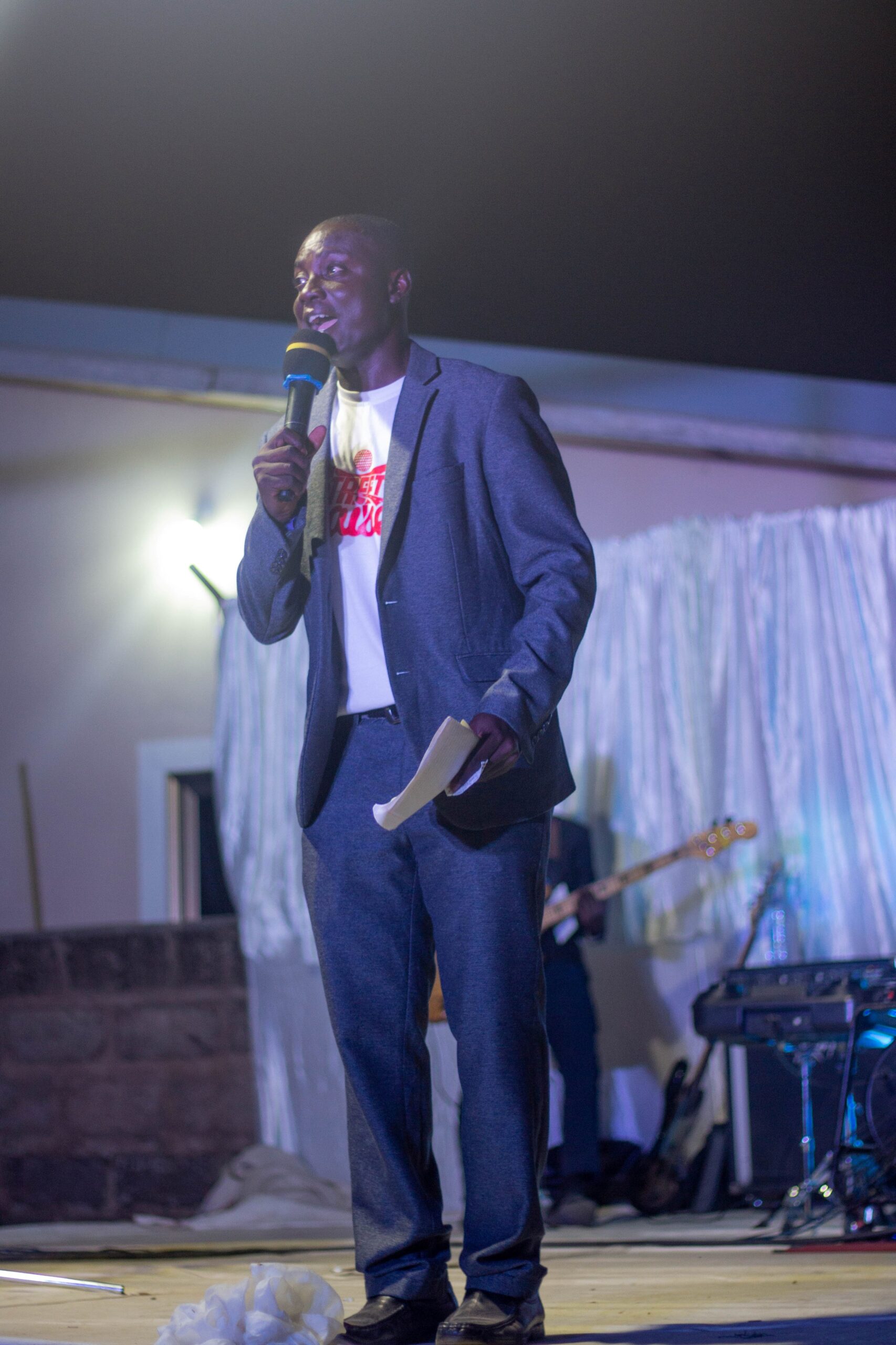
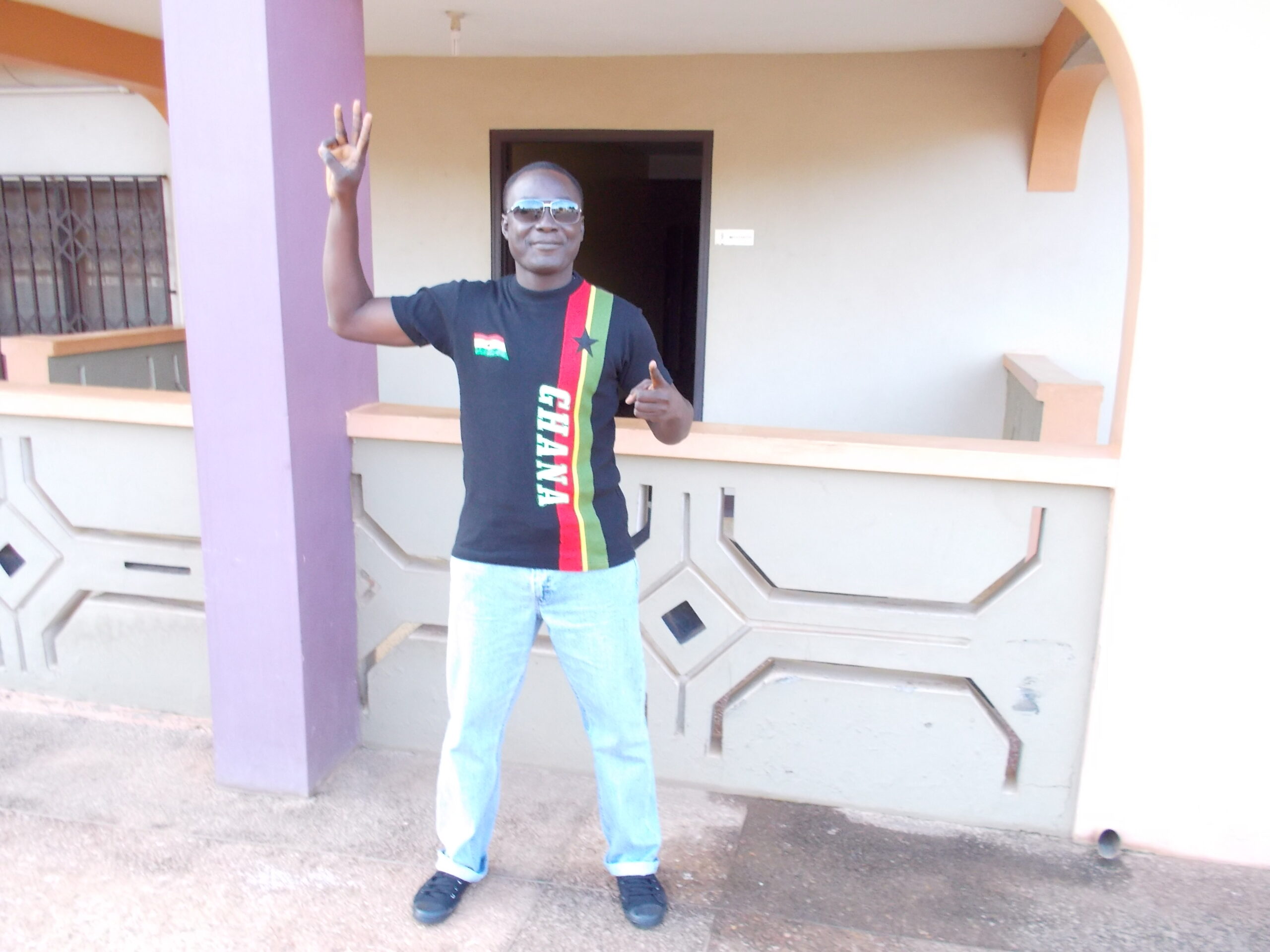
Photography from Ike Boat

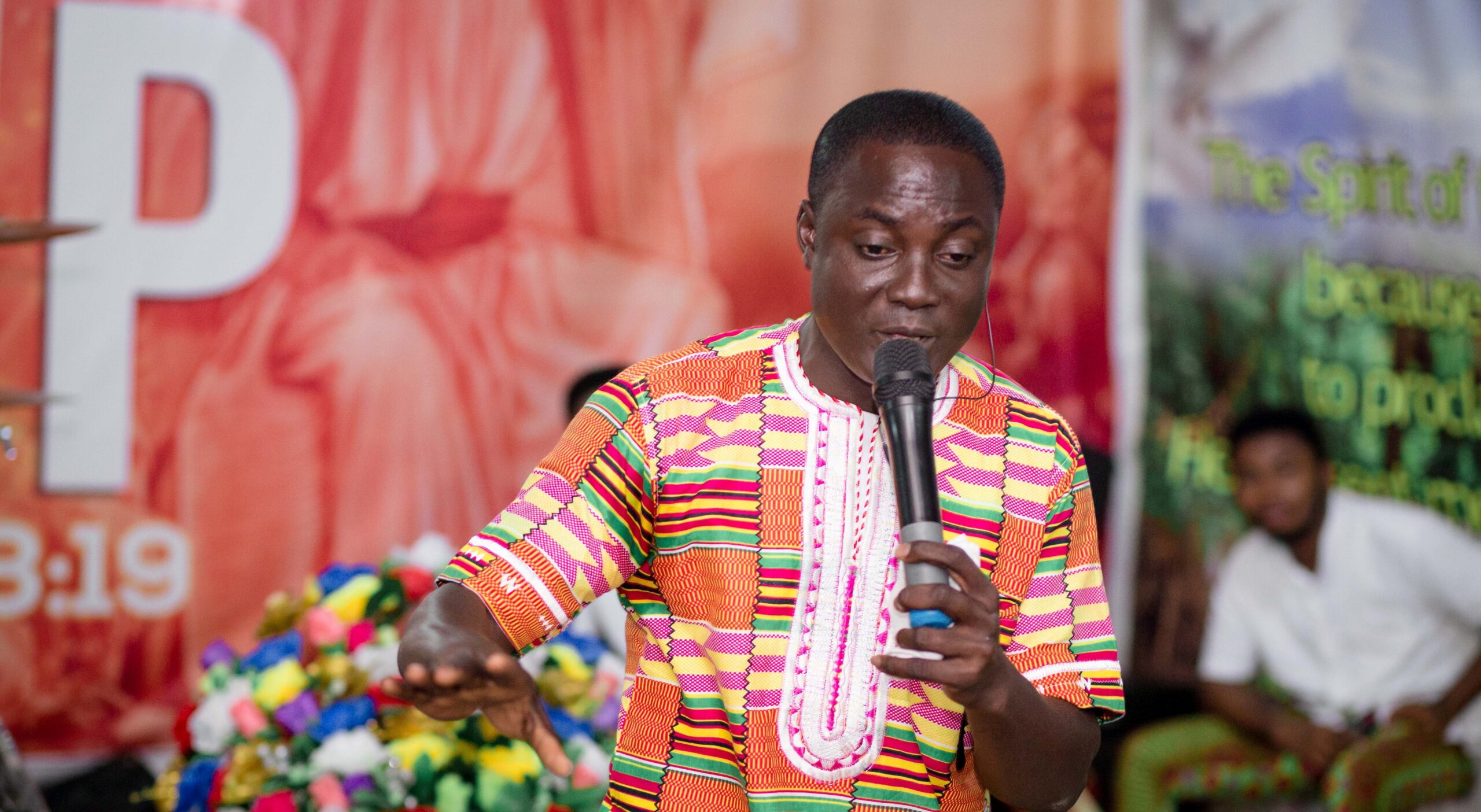
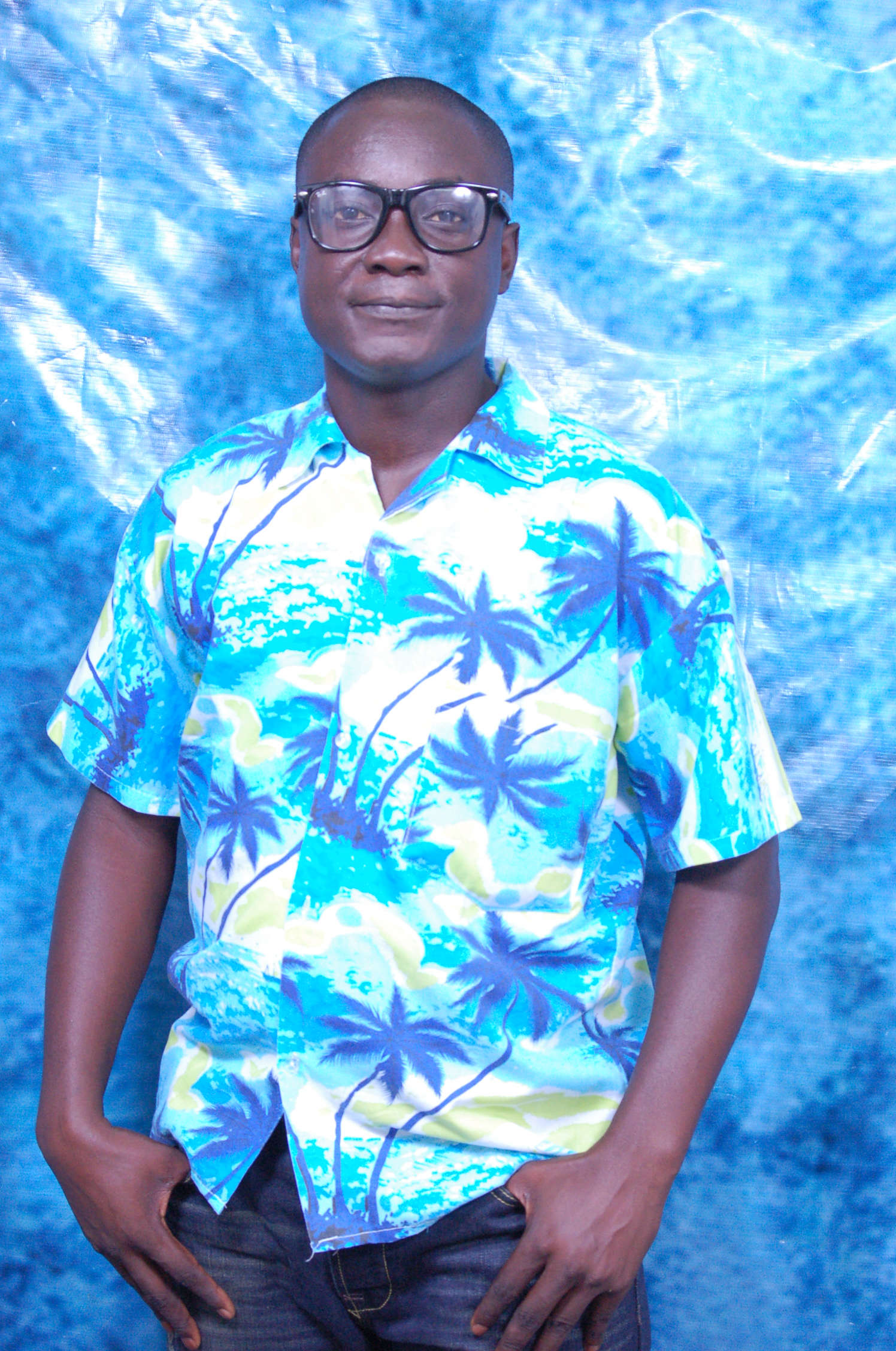
Ike Boat

Professional Biography – Pro-Bio

Pro-Bio – Ike Boat #IB

Growing Up Story – GUS: His life, like the metamorphosis stage of an African butterfly going through lots of dramatic changes thought him tremendous things, both negatives and positives. It all started on the suburban street of Amanful Westin Takoradi, Western Region of Ghana where he mingled and entangled in a life-style some described as being ‘Gutter-Snipe’ or seemingly ‘Ghetto-like’. Thus, both lowly and highly cherished characteristics of a boy with futuristic ambitions in relation to his passion of every-day life. He’s a teenager with heart for reading, writing and reciting what he later termed as ‘Read Aloud Session – RAS’ for short. Thus, literally or meaning his solitary moment he picks a story book, newspaper or magazine and hides himself at a backyard or close-door to read aloud like communicating in front of audience coupled with gesticulation and sensation in an atmosphere of loneliness. Factually, learning new things and sharing ideas became his hall-mark.

Well, as the saying goes “All works and no play, makes jack a dull boy”, viz he sometimes played on sandy pitch football with some neighbors and subsequently played for his primary and junior secondary school football teams. Academically, he’s brilliant and good in lots of subjects hence won the hearts of head teachers to become school prefect in both primary and junior secondary levels respectively. Needless to say, ups and downs as well ‘Doubting Thomases’ of the hood never stopped or bothered him, as he focused in turning his passion to profession in the Arts global industry. LOL, one of his comical growing up character during his early child-hood days of life as a boy, he combined ‘Crying tears with bathing water’ often-times when he’s asked to bath and come for his meal. Well, if this were Scripture in the book of Psalms, I’ll state ‘Selah’ literally ‘Pause and Think’. So, this GUS happens to be a mixed bag of nostalgia about the Ike Boat chap as it brings to fore deeper things yet to come in his creative arts life-style.

Dr. Bianca Stewart reviews Michael Robinson’s poetry collection From Chains to Freedom

From Chains to Freedom: A Journey of Freedom for the Black Man

Review by Dr. Bianca Stewart, MD

Mr. Michael Robinson’s published work, “From Chains to Freedom: A Journey of Freedom for the Black Male” is a beautiful depiction of the intricacies of race relations that is effortlessly executed in Mr. Robinson’s distinguishable style. His work is provocative yet, delicate. As a black woman, his work is raw, unfiltered, and in so many ways, comforting. “From Chains to Freedom” takes the reader on a journey of the resilience of the African American race from the Mother Land to Jim Crow and to Modern America.

He draws inspiration from Langston Hughes’ “Suicide Note” in his “Seas of Freedom on the Horizon” where he articulates the torment of the slave trade and speaks of death not as an enemy but as an old friend — “In the sky ahead the horizon calls, Calling him by name each day they sail. On a night when the moon had receded, And all was sleeping, the sea took him in.”

“Beginning of Grief” and “Crosses for Black Men” recounts the trepidation of the Jim Crow era — remembering the “when the light of the burning cross casts a shadow” and how, even now, “Four hundred years later, a rope still waits…”

In spite of it all, “From Chains to Freedom” is work about peace and hope. In “Midnight with God,” Mr. Robinson reminds us that “A desire for freedom has not been banished from his invocations” and leaves us with a message of “Some Place Special” “…where the sun speaks to the moon, While the mountains listen to the wind’s singing…” “A shooting star streaks across the sky.”

From Chains to Freedom is available directly from Michael Robinson, please contact him at mjrobinson@rollins.edu

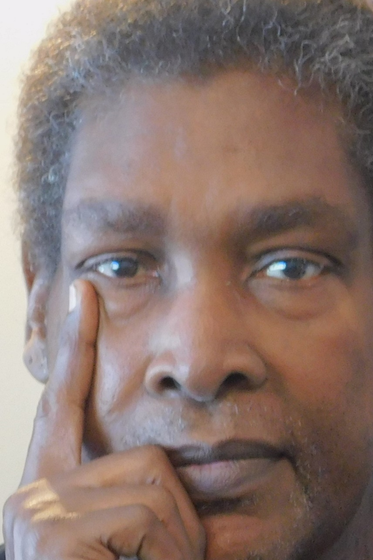
Middle aged Black man with short hair and brown eyes. He's got a hand on his chin and is facing the camera.
Poet Michael Robinson

Poetry from Patricia Doyne

FLAG  in the CROSS-FIRE                

(based on art by Andrew Kong Knight) 

Andrew Kong Knight’s work can be viewed here:

Social Commentary – Fine Art Painting – Andrew Kong Knight | Flickr

White stripes.  Red stripes.                  

Red blood drizzles down                       

on bystanders and gang-bangers,         

night clubbers and school kids.             

The right to bear arms.                    

“When they shot through our windows,”

says the seven-year-old,

“my Mom put me in the bath tub.

She said, ‘Keep your head down!’

I was okay,

but my cat’s ear got shot off.”

The right to bear arms.

In my own quiet neighborhood,

there was a rash of thefts—

from cars, from closets, from garages… 

Only one thing stolen:  guns.

Think of that–  most of my neighbors

own handguns, shotguns, or rifles…

Only one guy is a hunter.

Do they think the British are coming?

No. These days, it’s Columbine and drive-bys,

snipers in rush-hour traffic,

gang pay-backs, drug wars, shoot-first cops,

or psychos with assault rifles, and a grudge.

Red stripes.  White stripes.

Bullet holes punch through the flag,

and the flag bleeds.

Bleeds until the pursuit of happiness

becomes the pursuit of more prisons,

the pursuit of gated communities,

the pursuit of walls to keep out

those who are loud, needy, angry, or different.

Too often, happiness bleeds away…

leaving life and liberty

as empty as spent shells.  

Copyright 9/16  Patricia Doyne 


PROGRESS:  A  PLANET’S  PERSPECTIVE

 Our planet is home to disaster

 as well as grand leaps and smooth take-offs.

 Chains of plot-twists build to cataclysm:                    

  an errant comet wipes out dinosaurs;

  continents stretch out, split up, regroup;

  earth’s axis tilts, and ice age turns to furnace;

   volcanoes spit up islands, bury cities.

   Thunder and destruction, then rebirth.

   Our planet stages riotous mutations.

    Sea water creeps ashore on its own legs,

     breathing that noxious poison: oxygen.

     Soon life has many branches: some with roots;

     some with shells and backbones, even wings.

     The new world sings of progress:  bipeds rule.

     Brains congratulate themselves on ways

      to use the planet’s bounty, make it work.

      Fossil products fuel a billion engines.

      Charged particles empower telephones,

       then telemarketers and robocalls.

       The internet explodes with “likes” and hackers.

        Water becomes more valuable than bit-coin.

         As rainforests burn, we prize the air we breathe,

        and try to market trips to outer space.

         On our rich planet, labels are updated.

          Polyester?  Now “performance fabric.”

         Plastic shoes and handbags?   “Vegan leather.”

          Pesticides are sold as “high-yield sprays.”

           Designer food-crops?  Call them “GMO’s.”

            Even designer kids are now for sale.

           But we can’t spin some side-effects of progress.

            Countless species wiped out, habitats lost

             for profit.  Ice cap melts. The oceans rise.

            Climate warms.  The ozone layer thins.

            Wildfires rage. Groundwater drains.

             Pollution poisons water, soil, and air.

             Plastic fills up oceans and our cells.

             A murmur of compassion for the planet

             is drowned by shouts to keep stockholders happy.

             The worried few recycle, use less, save,

             buy wisely, limit waste.  But all these folks

             use gas to get to work.  Electric cars?

             Electricity’s developed in gas turbines.

             The fuel we burn for transport, heat and light,

             the steaks and burgers raised on cattle farms

             rebound and undercut our planet’s health.

             Greenhouse gases trap heat, hold it in,

              setting the timer for catastrophe.

              Our stewardship of earth has not gone well.

              Doomsayers rage and wrangle, casting blame.

              Yes, always there’s rebirth: a new age dawning.

              But what comes next may fill us with dismay.

              If Mars has water, was there ever life there?

              We’re sitting, right now, on the cusp of change.

              Glacially slow, the wheel begins to turn.

              Copyright 6/2021           Patricia Doyne

Prose from Jaie Miller

Opal

We drove through the ancestral skeleton of the world and it’s broken harmony. Driven by the song we were searching for, following the path of the pendulum, divided by time – driven, as souls drive their path through the dark forest of the universe. I closed my fist around a mantra and felt the serpentine blood drip through the fingers of my hand that would bury the day under the night and then resurrect in the emerald eyes of Millenia each morning as if for the first time. I push my body through the dense air of insomnia retrieving the hunt for silence in the hour that knocks incessantly on the door of my heart. The indifferent knock, the indifferent questions put to life that some would weigh and sell or place in jars to be kept for the future to solve. The song is pierced and exposed at it’s core is the rotten carcass of a god. The flesh of it’s being withered, the blood long run dry. This is my city, my voice, this is my frozen will and arsenal against the time it takes me to run away from the voice inside that carries a dead abyss.

In the ruins I have placed here my footsteps to freedom, in the wreckage I have designated my home they follow me blindly, loyal as a shadow and as indifferent. The only habitat I can pull from my genes is the knowledge of death carved from time into the form of life. Where else is there to begin? Though the question may be untrue, I feel like this is the only answer. Still, my eye cannot give to itself and the voice can only point and never touch the image that was given flesh this unfinished, burning hour. So I slip through it and pull the cords tighter, as a knot, as a fist round a mantra, as a mouth round a stone.

In this place, in this instance the nomenclature is diced in no fashion other than symbolically. Where dreams live and die like an empty TV set or abandoned theatre. We sift through machinery, once collectable symptoms of our collective disease and become mere mercenary to trend. Ideas pinned to thin air like radio-waves living in the ultra. Born sightless yet carrying out a vision, paid for in the womb. Embodying the embroidered fate of a dusted loop, still now after the depleted force of turning image to flesh and blindness to vision. The hours are mantra dislocated from the jaw, clocking mileage where mirage fails, falling pivots that redact inaction with seismic leverage and sense of occasion. The sense of ourselves spilling through the dense air I force my way through may be known tomorrow when the child that weeps inside me is given a name. When I release what has long since gone from my possession.

In movement

The burnt shadow of your heart still whispers it’s first word that collided with the image lifting itself over the horizon of the earth. When the sun has drunk it’s painful silence and followed blackly the memory and mirror it is chained to, retrieving the gesture will be simple. The race to outsmart this dark venom began early morning. You weigh, singularly, what cannot be reached inside you. The simple essence of a loud voice being disappeared as an object is moved or replaced is a message that points to fracture in our approach to struggle. Really, the silent essence of spirit having split the eye as an atom and fallen blindly into the crater of imagination is where a story ought to begin.

Longingly, I exhume detail for what might suit me as the whole armour, all the while remaining motionless becoming the engine of the void, afraid to tell the story that tells me so often, the black memory the sun is chained to will engulf my heart too. In paroxysm, the image is lifted over the horizon of the earth into a wider gulf and birth we share with the twin eyes of time. One eye that sees with a dead purpose, singularly, as a clock might be wound and forgotten and one that sees as though resurrected each moment it is seen. The hidden depth of what cannot be reached inside you. When I am given to compassion for the ghost (whose song only some will hear as the sun sets and the shadow of the fire escape drapes over the alley) it is the key beneath the blues keeping me awake.

The migrants who died trying to cross the sea for whom the sea is their cross and the dark, dark painful silence we carry that is ours. There is the gesture and measure taking place here all the while. The terrific irony of a moment that carries and sacrifices the weight and purpose of a single heartbeat, shed like a second symmetrical history, covering distance inside the iceberg of thought. Contained inside space, negatively, the surface is frozen, and living the way we may live is the reflection. A glass like plain where I, the engine of the void, may regain a foothold as the lucid speed of the disappeared voice becomes apparent. To welcome the deceived and deceased alike within the structure of movement becoming clear in the gesture the conversation opens with.

It’s true and the measure is correct. The sun empties it’s thought into the black mirror and memory it is chained to by every imaginary eye, swallowing it’s own impregnable music within the fortress of a violent, reoccurring birth none shall escape. What cannot be reached inside you a hidden irony displaces. The future is lulled closer as a spider plucks the strings of her deadly instrument and web. Blinded by the music, her prey enters the kingdom where she alone is queen and reigns over every chaos. 

What else are you keeping secret? The thoughts that woke you at 3am? The symmetry splitting you longitudinally between an East and West – a past forgotten and a life longed for – a line the sun drew with the same invisible hand in the pocket of the killer in the Audubon Ballroom? It ought to be enough that silence can be mapped in your body by touch alone, traced as though the broken mirror of your memory has been cartographically outlined. So that at the border between dream-states, the landscape wakes and spills a lucidity that one might recognise as an aerial photograph of the past. Say something. The secret is a grave in you that you feed the promise of silence. You sit with the knowledge a ghost gave you, 

a Pandora. 

who’s only possession 

like a burning ember

depicted in shadows 

is swallowed whole. And the same lurid darkness follows you home. Stalks the voice you have filtered so carefully so as to not let the ghost fly out. So that they don’t build on the grave(s) you protect and feed with the promise there is a place in your memory where the secret sits, fragmented like an island inhabited by the unspoken.


Jaie Miller is an artist from London, England, and has been published by various journals at various times since starting sharing online.

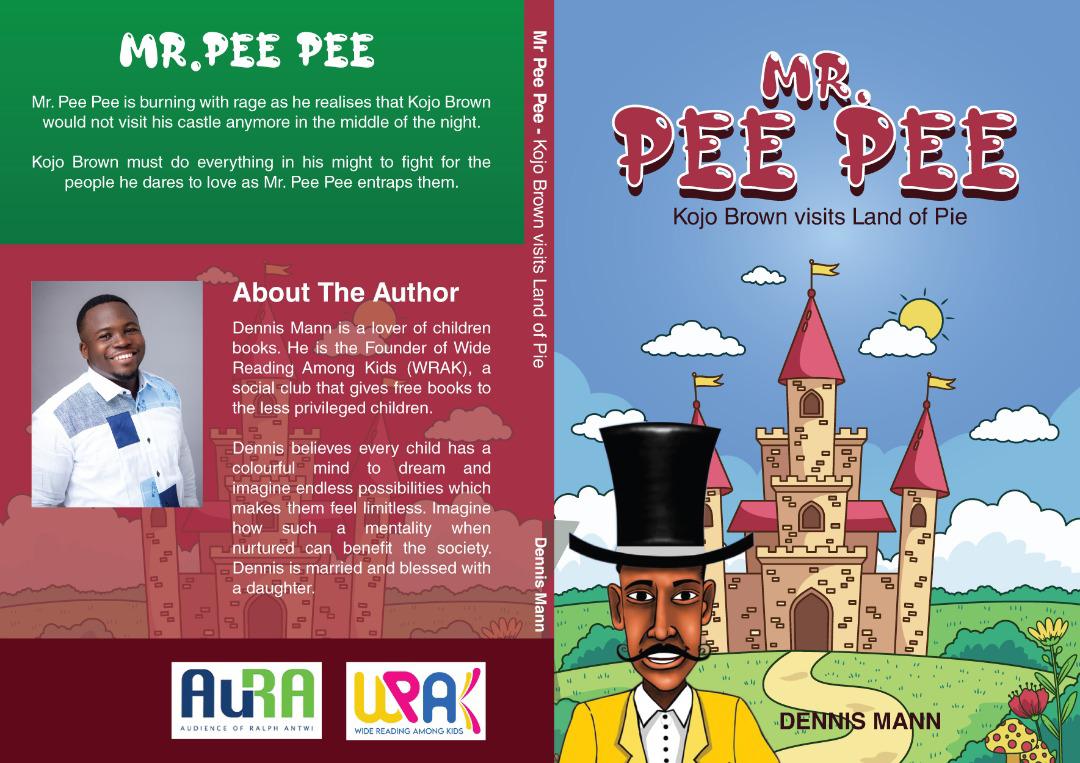
Ike Boat reviews Dennis Mann’s children’s book Mr. Pee Pee

Book Review Revelations – BRR

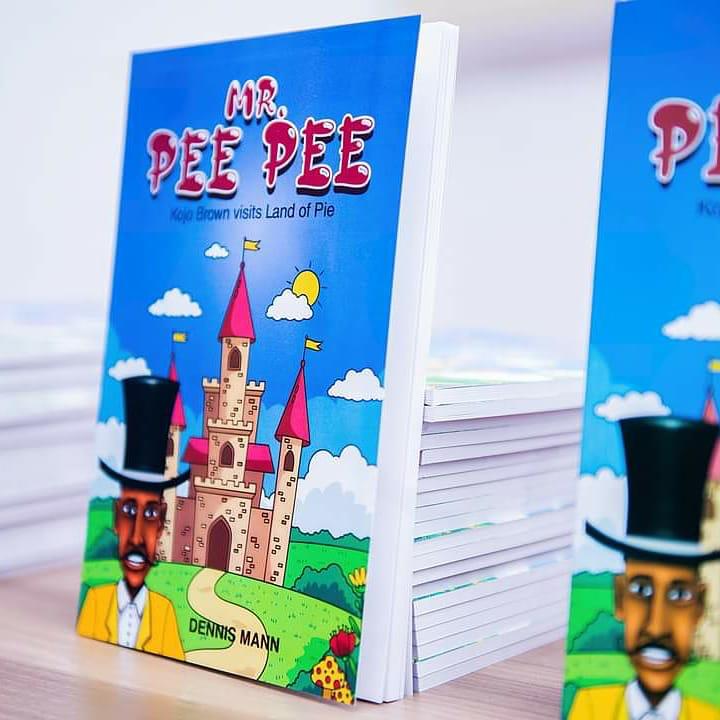
Book cover, red, green, light blue. Title, Mr. Pee Pee, is in a red bubble font and there's a man with dark skin and a black top hat standing in front of a castle on a grassy hill on a sunny day.

Book Title: Mr. Pee Pee

Book Author: Dennis Mann

Hello Reader,

                        Let me take you on a roller coaster ride through the memory lane of BRR journey. Thus, some weeks ago I re-established communication contact with Mr. Dennis Agyeman, popularly known by his professional pen-name Dennis Mann. Apart from his career as an author, he’s a reputable Banker with in-depth knowledge about the financial sector coupled with the world of Forex Trading and the Crypto-System spheres across the globe. Undoubtedly, he’s been described and identified as a man of compassion with heart of generosity as well as integrity. He’s such a brilliant devoted and committed Christian man with Godly character in most of his inter-personal business dealings in both the creative writing and money-making financial sectors, be it local or global.

                        My first time phone conversation with him commenced when I was in Takoradi, Western Region of Ghana, thus a couple of years ago whilst the Manager of Amanful Digital Library & Learning Arena which is abbreviated ADLLA. If my memory serves me right, someone came to study and research at ADLLA then upon conversation his name came into equation so I had his phone contact number. Indeed, it about six years ago! Aside, thankfully going through a note-book I found his contact number and discerned right away to get in touch with him. Of course, his invitation to Prayer Breakfast and Business Networking program organized at Pleasant Place Church in Spintex, Accra brought about positive thoughtful, insightful and delightful conversation on the aftermath. It’s heart-warming and welcoming moment bring with his better-half and kid onboard his car. Oh, once again, am so grateful and thankful for the lunch which subsequently became my dinner! LOL, I can’t forget the book club reading and speed-dating event we attended over the weekend at seemingly garden-like venue of Dzorwulu in Accra, Ghana (West Africa). It’s a whole new experience for me, as a couple of Vlog 233 and other interactive video was recorded whilst there and onboard his car to and fro the event place.

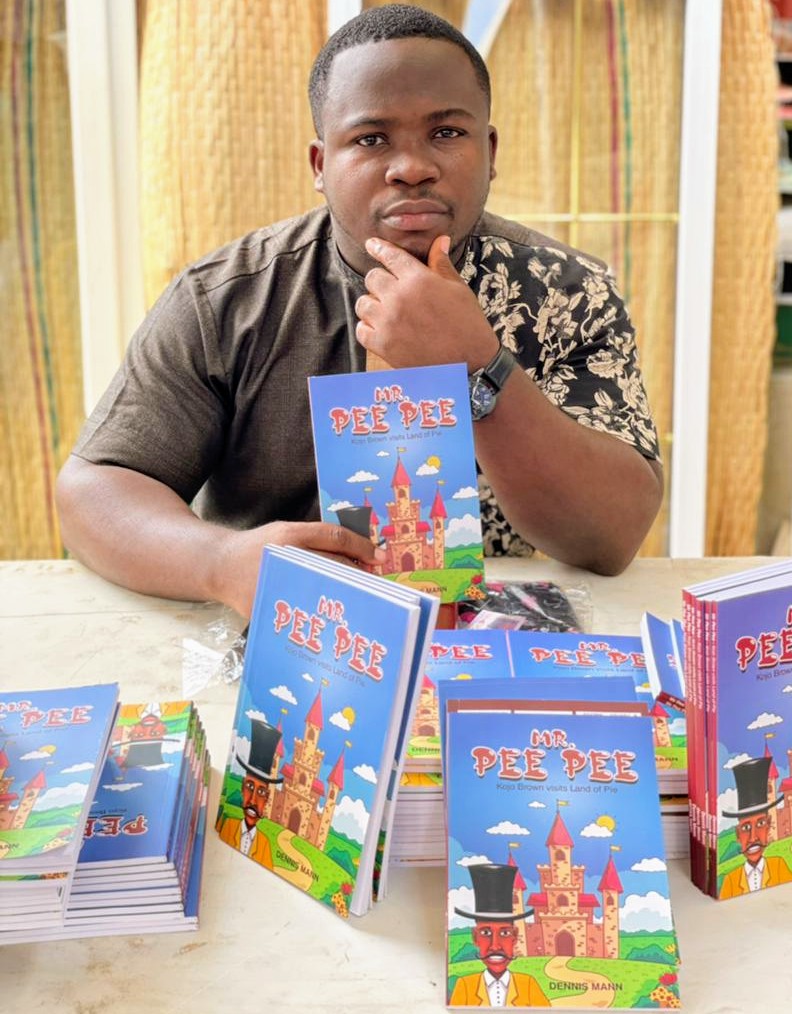
Young Black man sitting at a table in front of a pile of Mr. Pee Pee books.

                        Quite significantly, in this writing as Arti-Blog I bring you the Book Review Revelations – BRR which I spent about two weeks reading and recording his maiden kid’s book titled Mr. Pee Pee even by posting and promoting on our People Of Extraordinary Talent – P.O.E.T Africa Whats-App group-platform. Factually, it one of the best kids book I’ve ever done Read Aloud Session – RAS on. The following happens to be three (3) reasonable personal professional observations in relation to Mr. Pee Pee and characters he out-lined in the chapters of its contents.  I. Easy-To-Read (ETR),        II. Easy-To-Understand (ETU), III. Easy-To-Buy (ETB).

  1. Easy-To-Read (ETR):  Factually, it’s in clear simple every-day English sentence and easy to read in terms of word pronunciation. Beside, soft diction for kids growing their vocabulary to the mind’s absorption. Of course, pages and chapters to make the whole book easy to read by children.
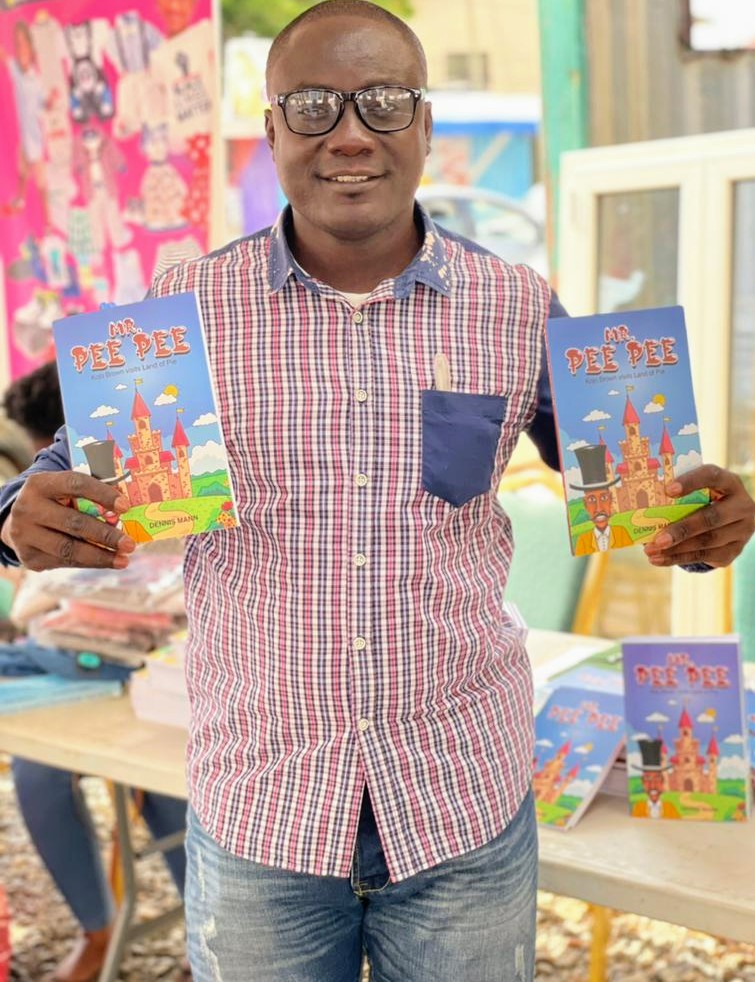
Young Black man with glasses and a plaid top and jeans holding some Mr. Pee Pee books.
  1. Easy-To-Understand (ETR): Definitely, it’s so lovely to fathom in terms of understandability. Thus, in view of how characters and images show in the pages to bring about it understanding being prime purpose of author Dennis Mann. Come to think of reading suspense, it’s equally easy to capture and picture with imaginative thought processing revelations to understand.
  1. Easy-To-Buy (ETB): Affordably, it’s not expensive to get in terms of purchasing price being such a beautiful kid oriented book with nice pictorial chapters. I recommend and suggest that you get a copy or copies to your child, friend and families. Kindly, use the following Amazon web-link to buy online: https://www.amazon.com/Mr-Pee-Kojo-Brown-visits-ebook/dp/B096HNK4N3
Stack of Mr. Pee Pee books.

It’s worthy to state in this Arti-Blog that Dennis Mann has good vision and purposeful mission for kids in Ghana and across the globe. Hence, he’s the Founder, President and CEO of Wide Reading Among Kids – WRAK  non-governmental organization which seek to inculcate the habit of reading among kids in various communities in Ghana as well as across the continent of Africa and beyond. It also hopes to have Patrons and Partners come aboard so as to carry-out its literary charitable functions, thus donation of books to rural kids of school going age.

                  Facebook Page: Wide Reading Among Kids

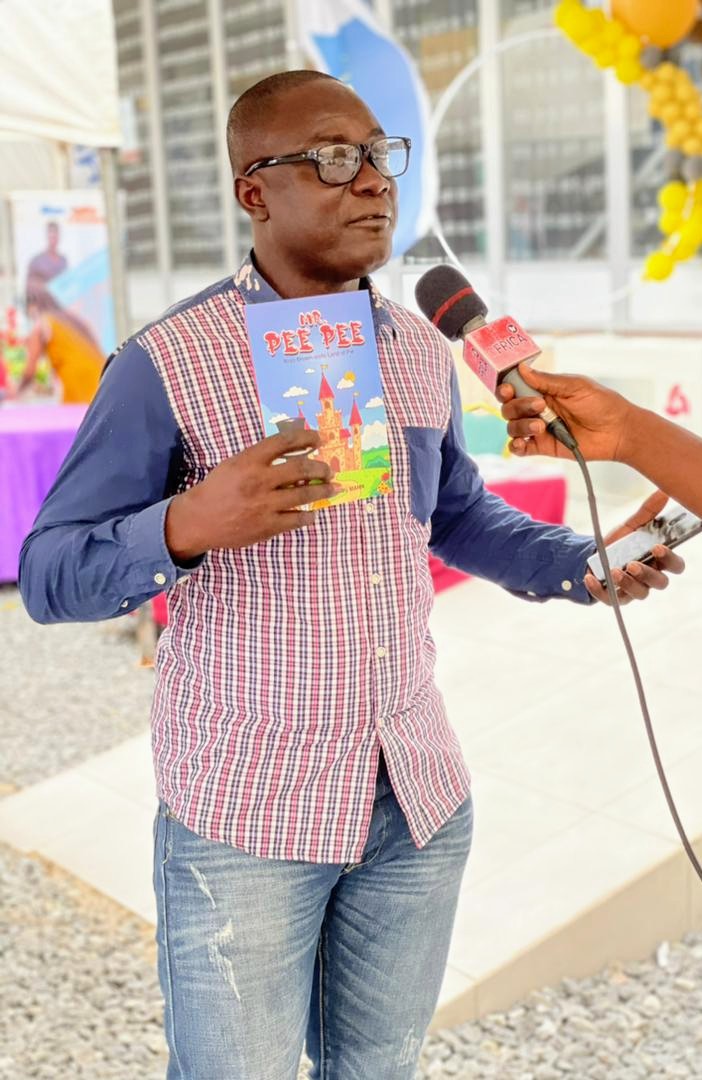
Author being interviewed by a reporter with a mic on Mr. Pee Pee.

Kindly, get in touch with the Author via below contact details:

Email Address: authordennismann@gmail.com

Phone Number: +233 247 654 113

This Book Review Revelation as Arti-Blog written by Ike Boat (Synchronized Chaos International Magazine) Contributor & Promoter In Ghana, West Africa. Email: ikeboatofficial@gmail.com Whats-App Contact: +233 267 117 7700, Alternative Number: +233 55 247 7676