
Don't Try!

You made me cry,
Then said goodbye.

You ran away,
Then come today.

begging me to stay,
Although you are far away.

Couldn't you just be a memory?
Since I can’t be near, but only away.

Don't I want to stay?
Of course, but you enjoy being away.

Don't worry, I won't cry,
All I want to scream is "DON'T TRY".
Category Archives: CHAOS
Poetry from Lori Minor
*****


all my darkness waxing moon


***


same shit different day cicadas


****


in the name of the lord wolfsbane


***


mayflies—
my fantasy of
someone else


***


orchid seeds
the dig of his nails
into my waist
Lori A Minor (she/they) is a queer, neurodivergent poet and activist. Recipient of more than 15 haikai awards, they are proud to be included in A New Resonance 12 and to have given presentations at Haiku North America (2019, 2021). Lori’s sixth book, Hot Girl Haiku, is now available.
Poetry from Christopher Bernard
The Dragons of Paris

(Upon reading Fashionable Nonsense: Postmodern Intellectuals’
Abuse of Science, by Alan Sokal and Jean Bricmont)

By Christopher Bernard


Once upon a time,
in the glamorous, notorious City of Lights
that lies across the sinuous Seine
like a seductive odalisque
of reason and sensuality,
beauty, style, good taste, and sense,
there appeared a foul and toxic fog,
a smoke that belched and bound the town
in mental night.
The citizens wandered, stunned and blind
and crying out in random shouts
in words no one could understand:
“Le petit a! Jouissance! Différance!
Pastout! Afemme! Séméiotiké!”
that filled the air all over France
from caves deep down in old Lutéce
(“Mudville,” once called, now called again),
where the Dragons of Paris disbursed, in smog,
dank volumes of mephitic breath.

The Dragons’ names put terror in
the hearts of all good citizens:
Lacan le Gros, Foucault le Mal,
grinning Baudrillard le Bouffon,
Kristeva la Sorciére,
Jacques Derrida l’Indécidable,
Gilles Deleuze, la Porte Sublime
du Dindon de la Charabia,
and more, with a host of dragonettes
pursuing the work of their dark masters
cooking in their dens a glorious madness
of chopped dictionaries and tossed
charlatanry, spiced with cynicism,
that sickened two generations
of impressionable, clueless, half-educated youth,
most of them – hélas! – American.

One day two knights rode from the west –
Sir Alan and Sir Jean by name,
“Follow the Science!” writ on one shield,
“Physics to the Rescue!” upon the other –
and bravely stormed the fetid caves
whose floors and walls were lined with texts
with dragon sweat and guano thick,
unreadable, yet cruelly read
by generations of undergrads
and graduate students until they squealed,
“There is no truth, there is no Real,
no good not always already a weapon,
Big Other, subject, sexual relation
(sorry, mom, dad! I never really happened!),
no meaning not infinitely deferred,
no science, objectivity, facts
(“no facts but only interpretations,”
as unholiest St. Fritz of Nietzsche said);
‘Il n’y a rien hors de texte!’; no world,
nothing whatsoever beyond the Word!”
(because, if they didn’t, they wouldn’t get
a degree (in English) so they could teach
in a nice, respectable university,
and maybe someday get tenure – but then, my friends,
they wouldn’t even get that – poor dears! – in the end).

With a thousand bold strokes, Sir Jean and Sir Alan
pierced the hides of the Parisian dragons
(“Mathematical gaffes! Scientific misunderstanding!
Bad logic, worse grammar, bad French and worse English!
Logical dead ends! Arithmetical nonsense! Hang it, just meaningless gibberish!”)
and out of the holes in those green slippery skins
hot air hissed away in a gale o’er the Seine,
and the dragons – the two Jacques, the one Julie,
Jean, Gilles, Michel, and a crowd of others –
shrieking death cries, flew about in a panic
as they shrank like a frantic mob of balloons,
gnashing and frothing and hopelessly flying
from darkness to darkness – one felt sorry for them,
almost – till they shriveled down to what they had been
all along: a few inches of thin rubber, with mouths
agape, and nothing whatever inside them but air.

Sir Alan and Sir Jean, armor dented and scarred,
swords flecked with balloons punctured, and smeared with ink,
exited the caverns out to the light
and the acclaim of a grateful city. “At last!”
rose the cry on all sides, “We can again see the sun!
We can breathe! We are freed from the impenetrable night
that threatened to destroy us – above all, our minds!”

The two knights, bloodied, exhausted, but victorious,
took their modest bows. “You are really too kind!”
Then glanced at each other: it wouldn’t do now
to tell these people they were partly to blame
for nursing the dragons with their own folly:
spare the critic and spoil the intellectual.
Don’t get them in the crib, and give them a fight?
When (if!) they grow up, they’ll give you a bite!

At the banquet that followed, they had stories to tell:
close calls with the enemies of thought and light,
genuine creation, and piety for the human:
intellectual pretentiousness in a shotgun wedding
with despotic professional intimidation
fueled, on the one hand, by status anxiety
and, on the other, by narcissistic delight.

Unhappily, they had not gotten
all the dragons in the end:
one sly dragonette from the Balkans fled,
escaping to Slovenia,
his innocent home, where he remains,
cooking his oracles for the next set
of gullible college students, if there are any left!

_____


"Christopher Bernard’s most recent book of poems, The Socialist’s Garden of Verses, won a 2021 PEN Oakland Josephine Miles Award for Excellence and was named one of Kirkus Reviews’ “Top 100 Indie Boks of 2021.”
Synchronized Chaos February 2022: Back to Browsing
One of my favorite experiences pre-Covid was visiting a library or bookstore and picking up books, fingering and flipping through and reading the backs of each title with an interesting cover or concept. This month’s issue of Synchronized Chaos provides a ‘browsing’ experience as it includes a large number of submissions, each with their own themes, style, and flavor.
FYI Synchronized Chaos Magazine will host a free public reading, “Audible Browsing Experience” to coincide with the AWP conference in Philadelphia at Head House Books. Our monthly theme for this issue is a homage to the name of the reading! We have a lineup of readers and will host an open mic if time allows. Event takes place Thursday March 24th from 6-8 pm. Please sign up here if you would like to attend as the store has limited capacity due to social distancing. Head House requires masks and proof of vaccination.
Michael Robinson describes his personal, spiritual experience of salvation and resurrection. Hongri Yuan returns to evoke spiritual ideas, a world more eternal and orderly than our own. Chimezie Ihekuna’s screenplay Saved by His Grace explores the workings of faith in the life of a pastor who loses his son. Sayani Mukherjee bears witness to the last musings of a person who dies through drinking hemlock.
Hong Ngoc Chau dreams of a future literary career and shares the spiritual and intellectual transcendence she finds through the written word. Lorraine Caputo relates vignettes of reading, writing, and traveling, village markets and hotel room sunrises. Reading Don Quixote, she shares some of Chau’s idealistic spirit.
Chris Suah’s speaker’s creative journey allows him to move through loss and arrive at a balance of grief and joy. Abdulloh Abdumominov finds joy in reading nonfiction to learn and grow as a person, while Sushant Thapa celebrates the excitement of learning from both books and life.

Amit Parmessur describes the poetic beauty of nature and literature in elegant prose. Mahbub’s free-verse speakers do the same, finding stillness and grace in hearing the flowing river, embracing on foggy days, and even facing the prospect of death. Joseph Balaz advocates in Hawaiian Pidgin through wind metaphors that readers should face life with a mixture of calm and passion.
J.D. Nelson experiments with language as symbol, with the connections between letters and words, and words and meaning. Joshua Martin draws parallels between words and syllables as the units comprising poetry and the physical plants and bricks making up ecosystems and cities.
Howard Debs brings a historical perspective to the January 6th, 2021 mob attack on the U.S. Capitol. Patricia Doyne speaks of the history behind the racial categories of ‘black people’ and ‘white people’ and protests racism within the U.S.

Ryan Quinn Flanagan offers up observations of mini-scenes and encounters within the United States’ interior. Mark Young crafts work in a similar vein but on a smaller scale, looking at insects and impressionistic personal experiences.
D.S. Maolalai covers domestic quietude and drama: brewing tea and sunrise alongside romantic betrayal and storms. Linda Hibbard writes of the near-universal awkwardness of junior high school, not being a sheltered child anymore but not yet a young adult. Arthur Russell paints a portrait of a New York couple who has found an uneasy truce with middle age and each other.
J.J. Campbell conveys the loneliness that can come with singleness, illness, and caregiving, while Edwin Olu Bestman evokes the loss of belonging and sense of self that can come with the end of a romance.

Robert Ragan admonishes the ‘man in his mirror’ to grow up and move beyond an impossible love to focus on the life in front of him. Ahmad Al-Khatat also writes of the journey towards emotional maturity, how a gentle and mutual romance inspires him to become a more caring person.
In another piece, Khatat mourns the tragedy of sexual assault. Judge Santiago Burdon’s poetry also laments violence, poverty, and heartbreak some women suffer. He also speaks humorously of the confusion a man feels when his female partner reveals her interest in the Wiccan religion.
Amos Momo Ngumbu Jr. expresses his wish for the blind to regain their sight. Christopher Bernard urges each of us to take what steps we can to improve our world.

Jason Visconti celebrates the ‘electricity’ of a passionate human connection, while John Thomas Allen writes of the rich drama of a day in the life of a dumbwaiter. John Culp shouts out about his romance with exuberance. Ian C. Smith reaches for past memories and future knowledge that lies just out of his grasp, while Frankie Laufer speaks of our physical and psychological ‘collections’ – classic rock music, dolls, love and nostalgia.
Andrew MacDonald describes the way our minds make sense of complex, random human or natural events. Lorette C. Luzajic renders Hieronymus Bosch’s jumbled art into lengthy but taut poetry. Jack Galmitz observes the world around him with the eyes of a philosopher or painter, calling to mind Hume and the masters who painted country scenes.
J.P. Lowe reflects wryly on his past animal companions and how Bukowski’s experience with cats and dogs runs counter to his own. J.K. Durick also ponders his past, ruminating on society’s leftovers: what has changed and stayed the same as he grew up. Abigail George renders her past in an impressionistic essay, chronicling and reflecting on her search for family and romantic love as well as her development as a writer. Ivan Fiske ponders the history of Liberia from its connection to the liberation of American slaves to its present-day struggles and resilience.
Our hope is that this issue’s many resplendent offerings will inspire your own creative journey.
Poetry from Ryan Quinn Flanagan
No freckles in a foxhole

No reason to go straight
with all the roads and learning
on the curve.

No freckles in a foxhole,
that’s what I always say with
no one around.

Slowly spooning cubes of green Jell-O
out of the Borg continuum.

Wishing Hitchcock Photography
was in charge of all my best close-ups.

Midnight taco trucks playing greasy
shell games to God.

Everyone down at the Employment Center
in line looking for the works.

Land Bridge

Once they close the damn thing down,
you start to think of all the circuitry involved,
that intricate green board of so many unpleasantries,
a murder of crows for silicon valley, the cops on the scene
with massive hangovers so you can watch your
toilet water tax dollars be flushed away;
truckers like lonely monks without the sash,
but I could never accept the cabin like a coffin
for so many miles; all those rules of the road,
that carnival itch of a six day beard –
how closely I resemble this land bridge
of complex carbohydrates, a bedside table
full of happier times I can hardly remember
standing over this buzzing ice machine waiting
on another glacial pull from the heavy-eyed doldrums
you find west of the Rockies.


OshKosh Brioche

You can’t take the vaude out of the ville
no matter how small the population gets
and it’s OskKosh brioche, all factory stacks
to smoke; the smoker of cigarettes travelling
around in packs, dry-mouth nicotine armies
blowing smoke rings of unholy matrimony,
during those many long lunch hours
that seem like they should be for more than drugs
but never get there in the late-January
snowshoe sense.

Prayer Mats

in the sprawling
dry mouth desert

spitting hump day camels
at market

going Bedouin
for the long
haul

all those prayer mat Fridays
facing the East instead
of liquidation

waiting for some
simple scorpion sting
around the fire

under all those stars
from the sharing fellowship
heavens

of the waiting
galactic federation.

Long Gone

He said he worked at a gas chamber
and it took me three hours to figure out
he had said gas station,
but by then I was sitting at home
and he was long gone
like all those shoot ‘em up extras
in spaghetti westerns
that don’t even live as long
as the horses.

She Smacks Her Lips

Those ugly gusts of wind
are almost enough to keep
the once-friendly dog parks
indoors.

I threaten to drop the bomb
even though I have never had the bomb
and any of its known accomplices
in my popular employ.

She smacks her lips
so you know she is preparing
to say something important
even if it doesn’t mean shit to
anyone else.

On that slippery plastic couch
my grandmother once died on with
a tongue so thick it could be some cement mixer
ham steak the kiddies can’t bite through
come dinner time.

Crack a tooth and cry on command.
Put all your problems to bed.
Sit up in the dark on a phone
that threatens to
come over.

Her snoring husband in the background
of a movie no one will
ever remember
seeing.

Name Plate

Nevermind the name plate,
you could be anyone’s failing blood feud,
pick umbilical at that bacteria-laden innie
half a world away from the stringy pink placenta
some performance artist in Europe insists
on eating to the great bemusement of a failing union –
standing inside that last payphone in town for warmth,
I blow across gloved hands out of habit,
watch the cheesemonger with mites for legs
crawl home to some seasonal flood zone
in the burbs; that scratching body lice of old records
along the bus route, no way to get anywhere
that ever pays near enough to make it
in a naked
Ryan Quinn Flanagan is a Canadian-born author residing in Elliot Lake, Ontario, Canada with his wife and many bears that rifle though his garbage. His work can be found both in print and online in such places as: Evergreen Review, The New York Quarterly, Synchronized Chaos, Literary Yard, Red Fez, and The Oklahoma Review.
Poetry from Frankie Laufer
NOT MAJOR HOOPLES BOARDING HOUSE:

I just returned from a long mostly silent journey.
To discover I just inherited a twelve-room house.
It feels vaguely like the last house.
But don’t ask me its location.
Exterior needs a little paint but don’t they all.
Remodeling seems to be a work in progress, just like so many of my paintings.
There are tenants occupying most of the rooms.
But even those that are currently empty one often hears the whispers of the past.
It’s rumored that Tiny Tim produced his best music in room number three.
The Venus room looks wonderful, but Saturn has done the decorating.
Surya shines bright and bold, but I find it too hot…Jim Morrison felt the same way.
A hell of a fight breaks out in room number six, Mars breaks a window or two.
The Moon is milky sweet but is afraid of Rahu’s shadow.
That snake scares me too.
Why oh why did they decide to be roommates!
Mercury is fast but sometimes outruns himself and forgets to lock the door.
Jupiter is gracious and our guiding light, watching over everyone like a sleepy owl.
In time they all will transit to other rooms.
Google maps says follow the neon sign shouting Color TV and Free Coffee!
Damage deposits and thirty days’ notice required.
SHADOWS:

My dear departed wife collected dolls.

I am now collecting shadows.

Storage is not a problem.

This collection is not for sale.

I normally don’t play favorites but this one has all my attention.

Its exact location is hard to pinpoint.

Google maps does not help.

It often appears under a passing cloud or nestled beside me in the warmth of my shadow.

Often it shows up in a dream, wearing a blond wig and a t-shirt that says I love Cairn Terriers.

I even wrote a long and beautiful love letter to it, but it was too long and too beautiful.

Now it’s gone AWOL… was it stolen or just a runaway?

Is there an app for this?

Searching Frantically!

I might put on a milk carton… Have You Seen  Me?

My friend Jenny collects sentences.
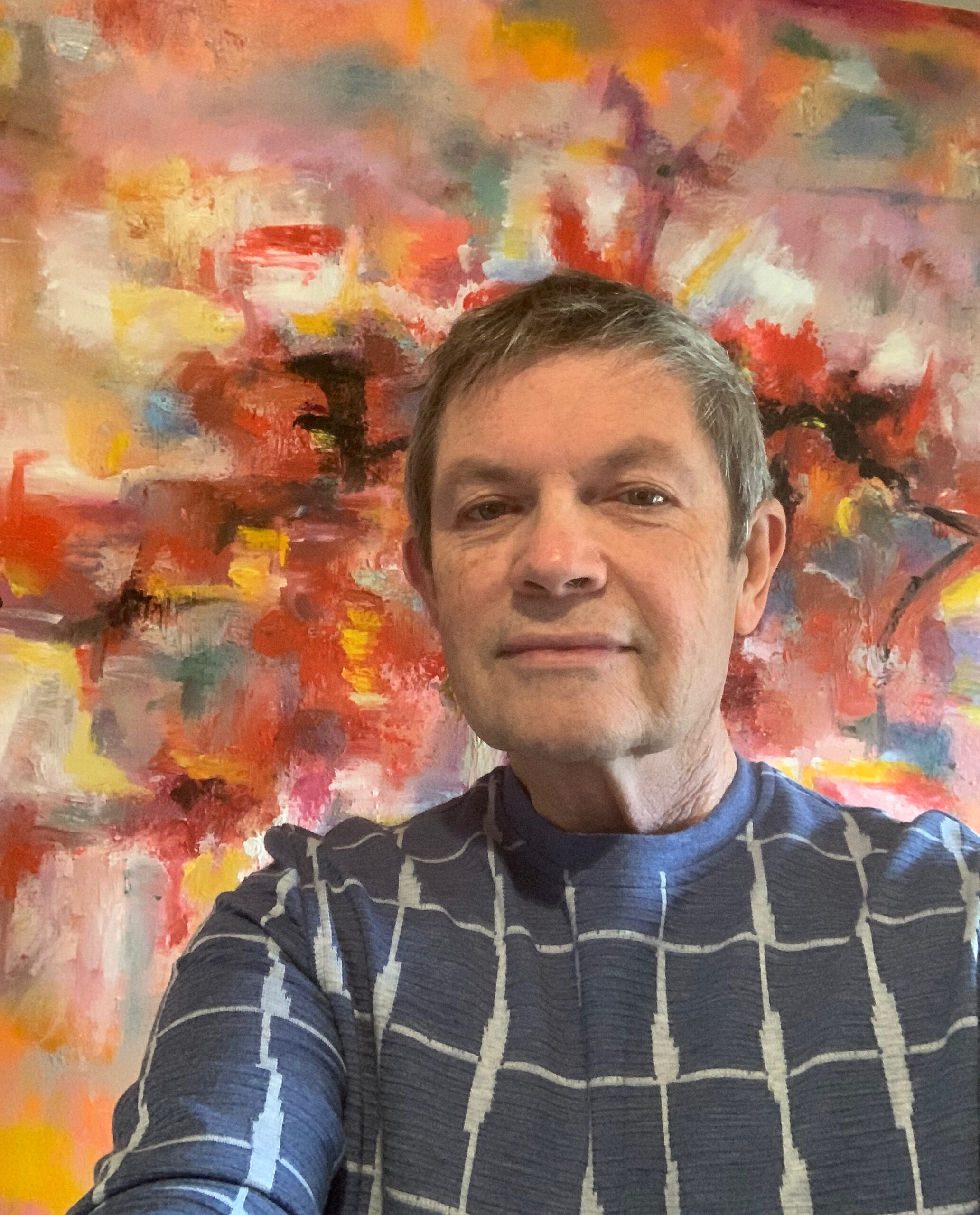
Frankie Laufer is an oil painter and writer living in Walla Walla, WA. His paintings have been shown in both the SF Bay area and Eastern Washington state. His poems have recently appeared on Piker Press.
The expressive nature of both painting and writings creates the possibility of rediscovering lost or forgotten feelings and the possibility of new discovery.
Poetry from Ivan S. Fiske
Drowning
this poem
is like the deep blue sea
rolling with numerous history
lingering in its sleeves.
at the depth of this poem
are dead bodies swimming to freedom,
bodies that have bumped themselves into death
while escaping the jaws of slavery,
this poem, too, is a graveyard
like the deep blue sea,
this poem is a diary
of many lives that never returned home
& dreams the sea waves have destroyed;
dive to the depth of this piece
you will see pieces of mama Liberia
swimming to the shores of freedom
wanting to be independent like the sun
with corruption glued to her skin;
she’s wearing a floater, but
her body is befriending the sea’s bottom.