Essay from Norsafarova Nilufar

Place and importance of the imperative, united and separate clauses and the input device in the sentence

                                               Norsafarova Nilufar Boybori’s daughter 

Shahrisabz State Pedagogical Institute 1st stage student of Uzbek language and literature

First of all, let’s talk about motivation and its classification. The imperative is a word expander of the second person pronoun that is not directly related to the linguistic structure of the sentence, expressed or not expressed in the structure of the sentence. Just as a separate part enters into a meaningful relationship with a separate part, the impulse also has a meaningful connection with the person to whom the speech is directed, the subject: 1

“Are you afraid, teacher?” he asked. Brother Gafur was pale.

Look at me, brother Gafur, – I tried to praise Domla like a demon.

Look at me, brother.

The old and the old women, who stared at the paths of war, were praying until dawn: God, keep my child under your shelter.

– Father, I still haven’t learned academic skills. 2

R. Sayfullayeva, B. Mengliyev, G. Boqiyeva, M. Qurbonova, Z. Yunusova, M. Abuzalova. Current Uzbek literary language. Tashkent-2009 (page 376)

Said Ahmed “What I lost and what I found” “Sano-standard” publishing house. Tashkent-2019 (pages 51, 57, 99, 239, 63)

Adverbs can be expanded with other words and used in conjunction:

My brother, my brother Gafur, I have been looking for you for 500 years. 3

Learn how to read, you ugly bastard!” my grandfather mutters, rubbing his eyes as if waking up from sleep. 4

           Along these lines, impulses can be combined and come in the form of a single piece:

“My lamb, my palm…” he whispered

“Stupid, naughty person, wretched servant!” he cried.

He used to shout “Benomus, dilozors!” 5

       The place of the impulse expressing the person or thing to which the speaker’s speech is directed is not fixed in the sentence, that is, it can appear at the beginning of the sentence, in the middle of the sentence, and at the end of the sentence:

At the beginning of the speech: Vasily Vasilievich, Lexey is absent…

In the middle of the conversation, he said: “Aren’t you ashamed, Vanka, we are both inferior to you?”

At the end of the sentence: – Oh, that’s life, Ms. Azra. 7

The impulse itself can be used as a sentence:

“You fools!” he shouted to the crowd.

– O Muslim people! 8

The boy shouted: “Daddy!” 9

It can be seen from these that the urge is directed towards a certain person or thing. In the process of syntactic analysis, two wavy lines are drawn under it. As we have seen above, the place in the sentence is not stable.

Said Ahmed “What I lost and what I found” “Sano-standard” publishing house. Tashkent-2019 (page 83)

Maxim Gorky “Childhood”. “New edition” Tashkent-2019 (page 55)

Maxim Gorky “Childhood”. “New edition” Tashkent-2019 (page 43)

Maxim Gorky “Childhood”. “New edition” Tashkent-2019 (pages 85, 65)

Hakan Mengyuch “No meeting is a coincidence.” “Zukko Kitabkhan” publishing house. Tashkent-2022 (page 143)

 Hakan Mengyuch “No meeting is a coincidence.” “Zukko Kitabkhan” publishing house. Tashkent-2022 (page 188)

R. Sayfullayeva, B. Mengliyev, G. Boqiyeva, M. Qurbonova, Z. Yunusova, M. Abuzalova. Current Uzbek literary language. Tashkent-2009 (page 377)

Lumpy lumps. The parts of the sentence that are the answer to the same question, perform the same syntactic function, are in equal relationship with each other, and are connected to one common part are called coherent parts of the sentence. 10

Around the table sat a famous poet, who knew Bedil by heart, a great Navoi scholar, Domla Baqi, a friend of Gafur Ghulam, a poet from Andijan who recently moved to Tashkent, and Domla Habibi.

Yunus, Baqi, and Habibi are waiting like birds.

Come and chat and make my party happy.

Hamid Ghulam, Shuhrat, Turob Tola, Vahab Rozimatov and I went on many trips with him and became attached to him for life.

Tashpolat Ahmad, Ahad Hasan and Ghulam Shomurodov were waiting.

These horrors, these differences did not open the eyes of the former Soviet leaders. 11

The interaction of the members of the united series. The members of a coherent series enter into a syntactic relationship through equalization, this relationship is carried out only through intonation, with equal conjunctions and prepositions in the function of equal conjunctions, and without conjunctions. Counting intonation is also present when units come into contact with connectors. 12 Also, connected parts are connected to each other by means of all types of connectors (joining, addition, subtraction). In the process of syntactic analysis, all the combined clauses appear as the same clause in the sentence.

       Compound sentences sometimes include generalizing units. They are words and units that summarize the conjuncts and come before or after the conjunctive clauses. The generalizers that come before the conjunctive clause usually require an explanation. The generalizers that come after the unitary part have the characteristic of completion and conclusion. For example: everything: houses, walls, trees sank silently into the darkness. (Oybek). Streets, fields, and villages seem to be asking me about Masuda. (P. Kadirov).

M. Hamroyev, D. Muhammedova, D. Shodmonkulova, Kh. Gulomova, Sh. Yoldasheva. Mother tongue. Tashkent “Economy-Finance” 2007 (p. 214)

Said Ahmed “What I lost and what I found” “Sano-standard” publishing house. Tashkent-2019 (pages 26, 28, 89, 216, 239)

M. Hamroyev, D. Muhammedova, D. Shodmonkulova, Kh. Gulomova, Sh. Yoldasheva. Mother tongue. Tashkent “Economy-Finance” 2007 (p. 216)

If the generalizing units come before the units in the sentences with a single clause, two dots are placed after the unit: Everywhere: in the houses, on the streets, the face of the hazan lying twisted in the morning becomes white from the morning. (Oybek).

When the generalizing units come after the organizers, a “dash” is placed before them: Men, women, children – the greeters ran along the wagon. (R. Fayziy). 13

     When connected with a counting tone, the solid parts are separated by a “comma”.

       Separate pieces. In a sentence, the meaning of a part is more uncertain in the opinion of the speaker, and in order to clarify and explain its meaning, he introduces another similar part into the sentence. For example, in the sentence “I started the work from here” the meaning of the complement “THEREFORE” is unclear. Therefore, the speaker introduces another filler with a more precise meaning: I started the work with this, that is, with an explanation. 14

Examples:

I met Azimjon in a teahouse by the river, in a crowded place;

My love is pure and pure! 15

      Input device. Introduction device is in the form of a sentence and is a means of expressing a new idea as an addition to the idea understood from the sentence. The introduction is full of its verbal essence from the introduction sentence (although the introduction sentence is in the form of a sentence, it is more introduction has the nature of a word), is distinguished by the uniqueness of the substantive connection with the main sentence. 16

  0tinoy was often engaged in his own work, the khalifa (in today’s language, the head of the class) led the class, and the khalifa himself punished the girls who misbehaved. (K. Kahhorova). 17

       Sentences with an input device are similar to a compound sentence. However intonation specificity is one of the main qualities that distinguish them from compound sentences.

M. Hamroyev, D. Muhammedova, D. Shodmonkulova, Kh. Gulomova, Sh. Yoldasheva. Mother tongue. Tashkent “Economy-Finance” 2007 (pages 217-218)

Mother tongue. Textbook for the 8th grade of general secondary schools. Publishing house named after Cholpon. Tashkent-2019. (page 118)

Mother tongue. Textbook for the 8th grade of general secondary schools. Publishing house named after Cholpon. Tashkent-2019. (page 121)

R. Sayfullayeva, B. Mengliyev, G. Boqiyeva, M. Qurbonova, Z. Yunusova, M. Abuzalova. Current Uzbek literary language. Tashkent-2009 (page 379)

Mother tongue. Textbook for the 8th grade of general secondary schools. Publishing house named after Cholpon. Tashkent-2019. (page 127)

They are separated from other parts of the sentence by “bracket”. As an example of the different aspect of the input device from the cohesive clauses and impulses, we can show that its place in the sentence is fixed, that is, the input device has a fixed place in the structure of the sentence. As we know, input devices express an additional idea to the main idea. That’s why it can never come at the beginning of a sentence. Because it is inappropriate for us to introduce additional ideas without starting the main idea. At the same time, the introduction usually does not come at the end of the sentence. It does not consist only of participles, otherwise it cannot fully reveal the meaning of the sentence:     

He seemed to have seen many of us, so he immediately hid the meat (a hungry person can die if he eats it at once), gave us all two spoonfuls of soup, and put us to bed. 18

The difference between a separate clause and an input device is that the input device is always placed in parentheses and is in the form of a sentence. Separated part is separated from other words with the help of “comma” and, basically, it is in the form of word combination and word combination.


Essays from Sadullayeva Darmonjon

Young Central Asian teen girl with dark black hair and brown eyes an dearrings and a black vest over a white collared shirt and necklace.
Sadullayeva Darmonjon

Love

The soft chirping of birds and beautiful trees added beauty to the quiet and cool avenue.  A handsome young man, who was known to be intelligent in appearance, sat down next to a girl he had known for a long time, and looked her in the eyes and said:
– I love you very much. I want to spend my whole life with you, greet the morning with you every day, share every joy with you, be a partner in your joys and sorrows.  Insha’Allah we will be the happiest couple in the world together, he said with tears in his eyes.
  Unfortunately, the girl could neither see this guy nor his tears…

A “fair” world

    Aunt Tatiana missed her daughter Anna very much after dinner and decided to write her a letter.  The sound of the wind could be heard outside.  Aunt Tatiana sat down by the burning stove and began to write a letter:

 – My daughter Anna, I miss you very much.  You know, when you were little, you always followed me, and in the evenings you said, “Oh, sleep with me. I’m so scared without you.”  In the cold winter nights, I would tell you interesting tales and stories, and you would fall asleep listening to them.  Especially after your father’s death, you became very attached to me, my daughter.  And I could not imagine my life without you.  I felt that without you, this world seems to me like a room without a door or a window.  And you have grown up, you have become a sharp minded girl.  Do you remember when you first stepped into school, I said if you get good grades, I’ll get you a doll you like.  And this innocent soul of yours would have a crush on that doll and every day you would get excellent grades and come home happy.  The joy shining in your eyes when you graduated from school and entered college is still in front of my eyes like it was yesterday.  You looked at me and said, “Hey, look, I’ve taken the first step towards my dreams. I’m going to be a famous lawyer in the future, honey. I’m going to do my best to bring justice to the world and fight for the truth.”  That moment is still forever etched in my mind.  You were the owner of an innocent and pure heart.  My daughter, you loved tulips very much.  This spring, I would like to go to the mountain with you and pick many tulips for you, to be next to me as before, to hold you in my arms, to see your smiling innocent eyes, my daughter.

   Aunt Tatiana said so and decided to send this letter to her daughter by post tomorrow.

   Unfortunately, it has been three years since that terrible and tragic car accident happened in Anna’s life when she was 18 years old…

   The dreams of a young and innocent girl turned into a dream.  His pure dreams did not fit into this “fair” world…

Sadullayeva Darmonjon was born in 2002 in Khiva, Khorezm region. She is currently a third-year student of the Uzbek language education at Urgench State University.

More than 15 scientific articles have been published in international journals and conferences such as  “Science and Innovation”, “Young Academic”, “XXL”, “Scientific Approach to the Modern Education System”, ” Google scholar” . Her creative works were  published in the newspaper “Ezgu Soz” and in the anthology “Builders of the Future”. She considered member of the International Organization ” All India Council for Technical Skill Development” too.

Poetry from Gulhayo Karimova

O man, mother is a treasure in the world
It burns for you every night
Even if you doubt motherly love
Look at his sad eyes

But don't rush to the work of the world
world, children, money worries
Say that you are here at this time
His eyes are filled with tears of joy at this moment
Your valuable words are appreciated

Don't hurt your mother after this
If it hurts, eat it yourself
If he puts his head on your shoulder, stop your heart
Don't miss a beat

Essay from Charos Maqsudova

The role of teachers in supporting students’ mental health 

Annotation: This article discusses the role of teachers in supporting students’ mental health. Teachers play a vital role in identifying and addressing mental health issues in students, as they are often the first point of contact for students who may be struggling. The article highlights the importance of creating a safe and supportive classroom environment, providing access to resources and support, and incorporating mental health education into the curriculum. The article also emphasizes the need for teachers to prioritize their own mental health, as they cannot effectively support their students if they are not taking care of themselves.

Keywords: mental health, teachers, students, support, education, resources, classroom environment, self-care.

  Mental health issues among students have become increasingly prevalent in recent years, and it is essential that educators play a role in addressing this problem. Teachers are in a unique position to identify and address mental health concerns in their students, as they often spend more time with them than anyone else outside of their families. However, many teachers may feel ill-equipped to handle mental health issues, and may not know where to turn for support. In this article, we will explore the role of teachers in supporting students’ mental health, and provide strategies for how educators can create a safe and supportive environment for their students.

Creating a safe and supportive classroom environment

One of the most important things that teachers can do to support their students’ mental health is to create a safe and supportive classroom environment. This can be achieved byestablishing clear expectations for behavior and communication, encouraging open dialogue, and fostering a sense of community among students. Teachers can also incorporate mindfulness and relaxation techniques into the classroom routine, which can help reduce stress and anxiety.

Providing access to resources and support

Another important aspect of supporting students’ mental health is providing access to resources and support. This can include connecting students with school counselors or mental health professionals, as well as providing information about community resources and support groups. Teachers can also take the time to educate themselves about mental health issues and resources, so that they can better support their students.

Incorporating mental health education into the curriculum

In addition to creating a safe and supportive environment and providing access to resources and support, teachers can also incorporate mental health education into the curriculum. This can involve teaching students about the importance of mental health, common mental health concerns and how to recognize them, and strategies for coping with stress and anxiety. By incorporating mental health education into the curriculum, teachers can help reduce the stigma surrounding mental health and promote a culture of openness and support.

Prioritizing self-care

Finally, it is important for teachers to prioritize their own mental health and well-being. Teachers who are stressed or overwhelmed may not be able to effectively support their students, so it is important for educators to take care of themselves first. This can involve taking breaks when needed, seeking support from colleagues or mental health professionals, and engaging in self-care activities such as exercise, meditation, or spending time withloved ones.

Educators have a unique opportunity to support and foster student well-being and resiliency. By seeking to understand a students learning strengths, to empathize with their challenges, and to foster the development of lagging skills and opportunities for success, you can create an environment for positive well-being.Educators are also in a key position to identify and flag concerns around mental health challenges in the school setting, as they spend a considerable amount of time with students. Educators are often able to observe aspects of a students behaviour in the school setting, which may not be evident to a caregiver or mental health professional. Observations of certain behaviours can help to provide a profile of how a student is functioning at school.Educators should record their observations as objectively as possible and attempt to determine if the behaviours are significantly interfering with the students ability to function. It is important to share the observations with the family and the school support team or the principal. Remember to frame your input as observations and not a diagnosis.If the behaviours are significantly interfering with a students ability to function, they may need further support. Once a potential mental health concern has been flagged, educators have an important role in seeking additional support for the student. Thus, it is important to have an understanding of when to be concerned and how to access additional support.

In conclusion, teachers play a crucial role in supporting students’ mental health. By creating a safe and supportive classroom environment, providing access to resources and support, incorporating mental health education into the curriculum, and prioritizing their own mental health, educators can help address the growing mental health concerns among students and promote a culture of openness and support.It is important for teachers to recognize the impact that they can have on their students’ mental health and to take action to support their well-being.

                                         References:

1.American Psychological Association. (2017). Mental health in schools: A guide to the law and effective practice. Retrieved from https://www.apa.org/ed/schools/mental-health

2.National Association of School Psychologists. (2021). Supporting student mental health: Resources for educators. Retrieved from https://www.nasponline.org/resources-and-publications/resources-and-podcasts/school-climate-safety-and-crisis/mental-health-resources/supporting-student-mental-health-resources-for-educators

3.National Institute of Mental Health. (2019). Mental health information for teachers. Retrieved from https://www.nimh.nih.gov/health/topics/mental-health-information-for-teachers/index.shtml

4.World Health Organization. (2018). Promoting mental health: Concepts, emerging evidence, practice. Retrieved from https://www.who.int/mental_health/evidence/promoting_mhh.pdf?ua=1

5.Idatschool. ca. https://www.ldatschool.ca/learning-modules/navigate-secondary-school/student-mental-health-well/educators-role-student-mental-health/

Essay from Botirali Sayifov

Young Central Asian man stands in a classroom with a bookshelf to his right and a patterned divider above him. He's got a serious face and a black sweater.
Botirali Sayifov

Education and its importance

   Education is the transfer of knowledge to a person, thereby developing intellectual, affective and moral abilities. That is, it is not only related to the study of didactic knowledge, which allows to perform various tasks with more or less skill. The possibilities in education are endless. It’s not about focusing all your energy on one point or limiting your abilities.

  The first thing that strikes me about education is the knowledge gained. Education informs us about the world around us and at the same time changes the world for the better. It develops and nurtures our perspective on life. It helps us to form thoughts and have visions around us in life. It doesn’t just mean giving us book knowledge, but painting, singing, painting, manners, etc. provides different knowledge about different skills like.

  With the increase in population, people’s needs are also increasing. Therefore, there are many firms that require a large number of employees to increase productivity. In this case, it is necessary to acquire knowledge and develop healthy competition among others

  Education is mainly important for children because they are the future of the world and they need to be updated with current knowledge. They are truly pillars of the nation. To develop the country and the world, it is necessary to secure the future and children with all their knowledge and skills are the right tools to build the nation. Children stand out from all issues as future leaders for the development of the nation; therefore each and every child should be educated.

  There are many different concepts and definitions of what education is, but one thing that can be generally accepted is the importance of education and the reasons for it.

Provides stability

 Education provides stability in life and is something that no one can ever take away from you. By getting a good education and a degree, you increase your chances of getting better career opportunities and open new doors for yourself.

 Provides financial security

  In addition to stability, education also provides financial security, especially in today’s society. A good education leads to a high-paying job.

Ensures equality

  For the world to be truly equal, it must begin with education. If everyone was given the same opportunities for education, the gap between social classes would be smaller. Everyone can have an equal chance at high-paying jobs.

 Provides independence

  An educated person will never be dependent on the opinion of others. He will have his own personal opinion.

Makes dreams come true

   If you can dream it, you can achieve it. Education is the most powerful weapon you can have and with it you can make all your dreams come true.

Provides security

   Education is not only necessary on a personal level but also on a global scale as it is what keeps our world safe and makes it a more peaceful place. Education teaches people the difference between right and wrong and helps people avoid dangerous situations.

 Confidence

   Self-confidence is an important part of being successful in life. And what better way to gain that confidence than through education? Your education level is often a way to prove your knowledge and it can give you the confidence to speak your mind and voice your opinion.

 Education makes a person a part of society.

   In today’s society, getting an education is an important part of being accepted by the people around you. Getting an education makes you a useful part of society and helps you feel like a contributing member.

Provides economic growth at the national level

   An educated person is very important for the economic growth of the society. In order for us to be constantly innovating, people need to keep learning and exploring. Economic situation also improves in countries with high literacy rate. If the population is educated, jobs will expand.

Synchronized Chaos Mid-April 2024: Ebb and Flow

We encourage everyone in the California area to attend the third annual Hayward Lit Hop on Saturday, April 27th. This is a public festival with different readings from different groups throughout downtown Hayward coinciding with Hayward’s choosing a new adult poet laureate, culminating in an afterparty at Hayward’s Odd Fellows Lounge. Several Synchronized Chaos contributors will read from their work at the 2024 Lit Hop.

Icon for Hayward's downtown Lit Hop, Orange background with green frog and white text reading Lit Hop, Saturday April 27th, 2-8 pm. Haywardlithop.com

This month’s issue deals with natural and cultural cycles, things coming and going, changing with time’s rhythm.

Sayani Mukherjee recollects the rise and fall of a sculpted fountain of water. Maja Milojkovic exudes the simple joy and beauty of living in a small house by the ocean.

In Brian Barbeito’s prose poetry, his speaker’s grief for his departed loved one is like memories of summer sun during a cold winter. Philip Butera’s take on grief resembles Barbeito’s, with poetry about “cottony clouds” stretched across the sky in winter. In contrast, Don Bormon presents a tortuous summer heat wave, where even the song of the birds is stilled by the weather. Mesfakus Salahin laments the twin tragedies of polluted nature and selfish, troubled humanity and pleads for mercy.

Mahbub Alam connects harm done to the planet’s ecology with illness in human bodies and souls. Sardor Yaxshilikov considers threats to the natural world, the environmental challenges posed by Uzbekistan’s industrialization and possible solutions for them. Daniyor Gulomjanov offers an analysis of the cost and efficiency of renewable energy in Eurasia, while Rahmatullayev Ahror discusses a new microcloning technique for seedling growth in laboratories.

White and green sprouts emerging from a pile of brown bulbs.
Image c/o Fran Hogan

Aqib Khurshid highlights how nature renews itself and grows again in verdant spring, as Mehvish Chouhan reflects on our personal renewal with each sunrise. Elmaya Jabbarova beckons her lover to join her in renewing their love with the new season. Kutlug Nigor’s poem concerns spring, regrowth, and the coming of the new year, as Shaxlo Safarova’s poem focuses on the promise of children.

Young Uzbek poet Kasimova Parizoda relates her determination to go forth and live her career dreams as a journalist. Graciela Noemi Villaverde relates her strident journey to retain her personal dignity and integrity.

Spanish photographer Kylian Cubilla Gomez sends up images of creative work: spiderwebs, paintings, and the buildings of a natural area. Isabel Gomez de Diego’s collection is a vibrant celebration of life: holidays, parks, children, sewing and haberdashery.

Dr. Lawrence Winkler, in his colorful and detailed Peruvian travelogue, explores a land where the present exists alongside the past. Jerry Durick’s poetry explores what we take and leave behind when we travel, as Stephen Jarrell Williams takes a less literal approach to life’s journeys, narrating a tale of lovers who withdraw from a broken world to find comfort in each other, then in their faith.

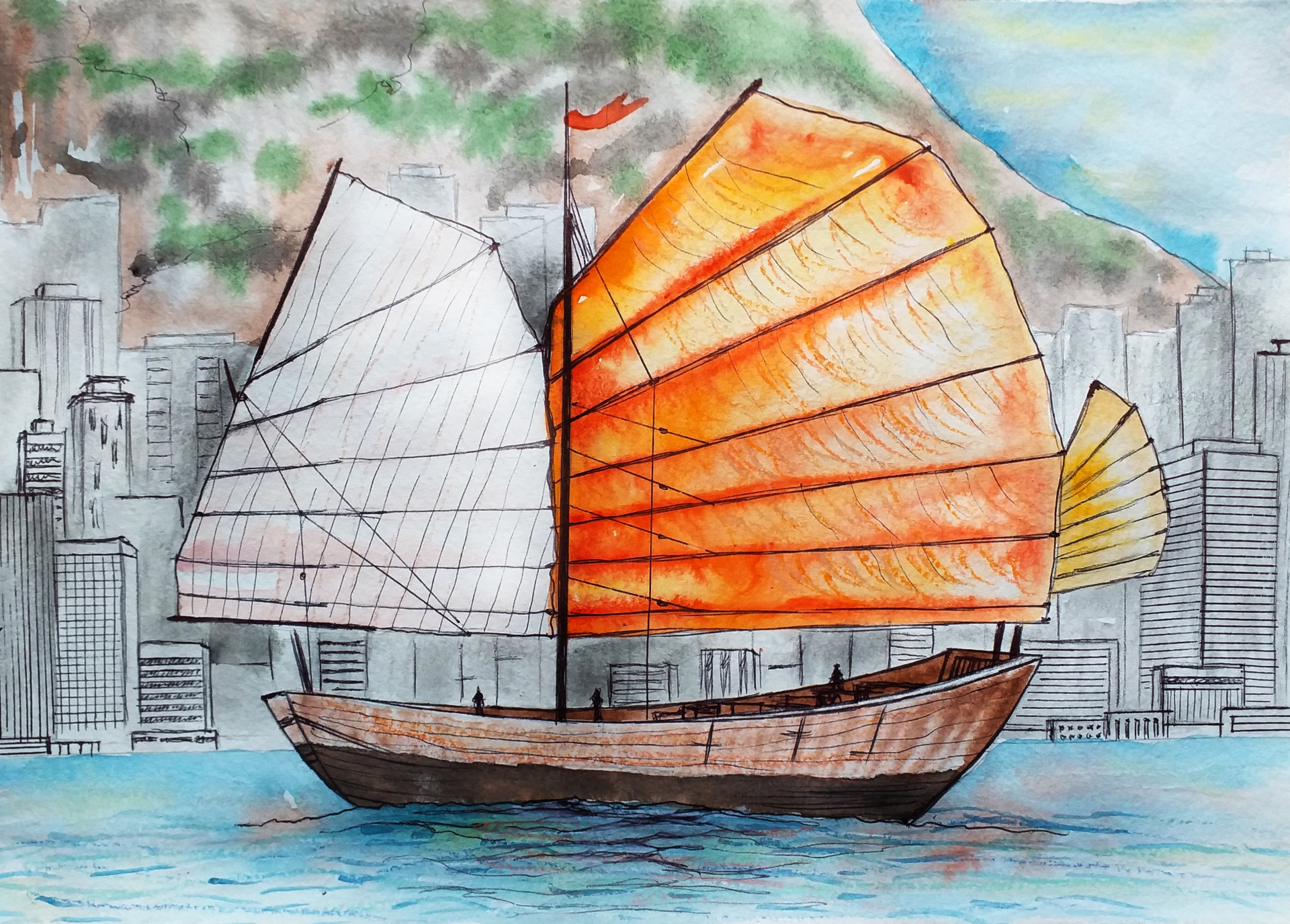
Pencil drawing and watercolor of a Chinese sailing ship with a red sail and a white sail and a red flag out on the blue water in front of a city with skyscrapers and a hill with brown dirt and green leafy trees.
Image c/o Victoria Borodinova

Patrick Sweeney’s fragmented one-liners show characters observing and chronicling the world, finding comfort where they can. Mykyta Ryzhykh speaks to navigating an indifferent universe, seemingly powerless against personal and geopolitical loss. Faleeha Hassan laments the pride and selfishness and privilege that leaders come from when they lead ordinary people into wars. Wazed Abdullah mourns the cost of the war in Gaza to children and civilians of all sorts.

Bill Tope addresses men’s vulnerability to society’s toxic and reductive ideas of masculinity and how those pressures victimize and demean both men and women. Rasheed Olayemi reminds us of the social and psychological toll of unemployment, as people need jobs for dignity as well as income. Sinanbinumer laments ethnic and religious intolerance’s role in worsening conflicts between Hindu and Muslim people in the Indian subcontinent and the role of sensationalized media in stoking tensions.

Pascal Lockwood-Villa’s poem narrator is a personified and dissatisfied mermaid statue, with strong opinions but little agency in her world.

Linda Springhorn Gunther’s memoir excerpt from A Bronx Girl illustrates her life as a vulnerable small child with an imaginative, loving, but delusional mother. She writes as an adult to make sense of her past, layering adult understanding onto her youthful narrative.

Two lane road with a yellow painted line has cracks with tufts of grass and is fading off into the trees and hills and shrubs and mountains in the distance. Broken orange traffic sign wars of a rock slide area and wispy clouds adorn the blue sky.
Image c/o Ken Kistler

Dennis Vannatta’s story shows a man visiting his old haunts and discovering that the places have all changed without him. Taylor Dibbert’s poetic speaker reflects on a past relationship, at a safe enough distance now to wax philosophical.

J.J. Campbell evokes fleeting pipe dreams dashed by reality, while Daniel De Culla gives us an earthy and human look at the imperfect Gandhi.

Lola Hotamova writes of love and heartbreak, of the paradox of wanting an ex-lover to return but not wanting one’s heart broken again. Duane Vorhees’ speaker references past romantic crushes in his works on the slipperiness of memory and alienation from the world.

Zofia Mosur depicts a tender, desperate, almost incestuous, intimate relationship between a young girl and the female figures she draws.

Right profile image of a woman's bald head composed of squares and curved boxes, each filled with a natural-looking design of trees or grass or ground, something green or brown or blue. Some of the squares are flying off in the back into the blue-green background.
Image c/o Kai Stachowiak

In a more humorous vein, Stephen House looks at the human experience of procrastination, not acting on the many “shoulds” of life.

Alma Ryan challenges us to find moments of joy even if life is sad or off-kilter, while Shahnoza Ochildiyeva reflects on where and how to find personal happiness. Mirta Liliana Ramirez tastes each life experience in full like a seasonal fruit, gaining experience that helps her as she ages. Saodat Kurbanova explores how and why Uzbekistan is rated one of the world’s happiest nations.

Z.I. Mahmud probes the dawn of subjective individual consciousness in Kate Chopin’s The Awakening.

Some other works delve so far into subjectivity that they remove the narrator altogether.

Dark blue and light green background with hazy clouds, image of a blue DNA double helix and microbe molecules in the foreground.
Image c/o Виталий Смолыгин

Janna Aza Karpinska constructs concrete visual poetry by pasting prepositions onto canvas and finishing the phrases in various ways. Texas Fontanella’s music involves rhyming couplets from fellow Synch Chaos concrete poet Mark Young. Marieta Maglas’ poems involve multiple senses, seeming at once tactile, auditory, and visual. Mark Young takes a similar approach to his ‘geography’ paintings, creating visual landscapes of imaginary places that highlight form, color, and text. J.D. Nelson peers at everyday foods through an off-kilter lens in short pieces that inspire second and third looks.

Quademay Usanova looks at language in an academic manner, comparing word formation in the Uzbek, Russian and Karakalpak languages. Halimova Nilufar Hakimovna explores various approaches to teaching linguistics, while Norbekova Rano probes the language of mathematics, discussing the history of the concept of the integral in calculus. Muntasir Mamun Kiron extols the elegance of science and electricity and power generation technology.

Madina Fayzullaeva outlines ways to improve and enhance digital education tools while Aziza Amonova explicates the results of a new Uzbek assessment of reading levels. Feruza Axmadjonova suggests methods for teaching English to very young children while Shoshura Khusenova offers up practical suggestions on how to teach language learning to a class of mixed abilities and experience.

Saodat Kurbanova evokes the experience of writing a poem, getting outside of herself and stepping into a sense of broader consciousness.

Ballpoint pen at an angle photographed up close, pointing to the viewer. On a concrete table. Photo is black and white.
Image c/o Haanala76

Dilfuza Dilmurodova’s strident poem combines personal and national pride. Rahmiddinova Mushtariy offers up a poem of thanks to her mother, her kind teacher.

Zilola Khamrokulova reviews Ahmed Lufti Kazanchi’s book Stepmother, which extols the values of compassion and kindness for those in need, even those beyond your own family. Nosirova Gavhar’s short story advocates compassion for orphans and the poor. Nigar Nurulla Khalilova invites the forge of life to fashion her as an instrument for goodness and humanity.

Michael Robinson relates the powerful tale of how faith and family saved his life from drug abuse and loneliness. Kristy Raines highlights the beauty of a deep and caring marriage. Annie Johnson reflects on the steady joys of a long and committed relationship and family in her elegant poetry.

Ari Nystrom-Rice speaks to the moment where a couple’s individual life journeys merge into one, while Lilian Dipasupil Kunimasa envisions a world without race, class, or gender prejudice where all people are free to live their dreams. Jacques Fleury suggests how to navigate complex dialogue on sensitive issues without losing sight of others’ humanity.

We hope that this issue provides a jumping-off point and ideas for you to engage in conversation with people around you.

Poetry from J.D. Nelson

Five Untitled Monostichs


bowl of raisin brain taco filling in my socks


—


raspberry clown known maritime repellant


—


battle cake captain adenoid subculture


—


millerbot brownie rice chickpea rice


—


listen bug too-mato paste w/ bears


—


bio/graf

J. D. Nelson’s poems have appeared in many publications, worldwide, since 2002. He is the author of eleven print chapbooks and e-books of poetry, including *purgatorio* (wlovolw, 2024). Nelson’s first full-length collection is *in ghostly onehead* (Post-Asemic Press, 2022). Visit his website, MadVerse.com, for more information and links to his published work. Nelson lives in Boulder, Colorado, USA.