
Stories about the Blockade
(dedicated to my grandfather)
1
Since early childhood, I remembered St. Petersburg as an amazingly beautiful, almost fabulous city. These memories were full of joyful and hilarious events. Me, father, mother, brothers and sisters – we were all healthy, full of strength, but most importantly, we were together! Everything changed in the summer of 1941.
The blockade began for us suddenly and unexpectedly, even the adults did not seem ready to accept it and did not really explain to us what would happen and how our lives would change further. Of course, we had heard disturbing news about the German offensive, but the fact that we could be locked up in our hometown for almost two years was unthinkable!
At that time, we lived in a large communal apartment in the Petrogradsky district. Our family occupied three rooms. I went to school with my older sister and three brothers. Nikolai, the oldest of us, just finished it this year, and the younger ones haven’t started yet. My father worked as a master at the university (St. Petersburg State University), and my mother was a nurse at the hospital (I don’t remember which one), later she was transferred to a military hospital.
My father and older brother Nikolai were the first to go to the front. It was like this, Nikolai received a summons from the military enlistment office, after learning about it, his father decided to volunteer with him. It all happened literally in one day. In the evening, we saw them off with the whole apartment, and in the morning, when I woke up, they were gone.
My mother was having a hard time breaking up, at that time she was missing at work all day, and in the evenings she usually came and cried quietly for hours in her corner. My two other older brothers, 17-year-old Ivan and 16-year-old Leonid, were already secretly planning to escape to the front as volunteers, but they wanted to hide it from their mother and sisters in every possible way, so they made Alexey and me promise never to tell anyone about it. And we were silent.
Autumn was quite difficult for us. There were problems with food supplies, but the worst thing was that we started to get sick, especially my younger brother Sasha and sister Lena. They lay for days with a high fever, almost motionless. A couple of times, my mother invited doctors she knew from the hospital. They examined them, gave them some medications, which, as it seemed to me, did not help them much.
My younger sister died first. I didn’t see how it happened, I just found out about it one warm November day from Masha. Alexey, I, and another of my school friends were returning from school when she met us at the entrance.
– Lena died, Mom went to bury her, – was all she managed to say.
2
Winter is coming and life is leaving the city. The streets are dark and cold, and the overhanging silhouettes of buildings seemed to press down on you as you walked down the street. Then we all learned what a bourgeois stove was, which warmed us with warmth, and one day we saw a girl pulling a sled loaded with buckets of water. For the first time, my brother and I even found it somewhat funny, but after a week we went to the Neva and other rivers for water with the whole house or even, probably, the city.
I didn’t recognize my hometown. Everything I associated him with was changing before my eyes. The warmth of summer was replaced by cold, white nights – impenetrable twilight, peaceful silence – the howling of sirens, raids and shelling… At that time, I did not dare to discuss this with my brothers and sisters, and even more so at school, so that classmates would not consider me a coward, but now it seems that all Leningraders were gripped by this feeling of devastation and uncertainty.
By the way, I was doing well at school. Due to the change in my usual lifestyle and the need to keep the fire burning in our small room stove, I plunged headlong into my studies. At that time, I read an unusually lot, wrote, and did my homework with diligence, so that I turned into an almost round excellent student, which began to strongly distinguish me from the class, because many dropped in academic performance, did not do their homework, or skipped school for days at all. Just like me, my school friend Igor proved himself great. And at the end of December, the headmaster even presented us with certificates for excellent studies.
After school, Igor and I didn’t want to run straight home and brag about our successes. On the contrary, imagining ourselves as adults, we decided to take a walk around the area, especially since neither I nor his parents were at home. So, step by step, we found ourselves at the Leningrad zoo. The once festive and grand entrance was now closed and resembled a cemetery gate.
Evil tongues have long been spreading rumors that all the animals were killed and eaten long ago. But we didn’t want to believe it, and we were curious. So we went to wander along the deserted sidewalks around the zoo, hoping to find out something. Of course, we couldn’t see anything, so my friend started reminiscing.
– How long has it been since you’ve been to the zoo? – he asked me.
– Probably two years ago,- I replied, running through the past in my memory.
– But I managed to do it in May! Imagine, there’s an elephant there now! – Igor said admiringly.
– Oh, come on, – I said.
– It’s a pity you didn’t see him, – he continued, – He’s an amazing animal! Huge and elegant, as if from an old fairy tale!
I was overcome by a slight feeling of envy. Igor talked so great about the elephant that I also certainly wanted to see it, but now it was impossible, except after the lifting of the blockade? Having seen nothing, we parted.
There was another significant event that day when I returned home. I expected Masha to meet me in the hallway and, as usual, begin to reproach me for walking home from school for so long, but surprisingly no one met me. I instinctively walked down the hall to the light that was pouring through the half-open kitchen door, hoping to meet someone from the neighbors there and maybe find out where mine were.
In the kitchen, I found my sister crying at the table and my brother trying to calm her down. The door creaked, but my arrival went unnoticed. After standing on the threshold for a second, I entered and sat down at the opposite end of the table.
– What happened? – I asked.
Masha continued to cry, turning away from me, and Alexey said:
– Ivan and Leonid went to the front…
My legs gave out. They had been talking about it for a long time, probably for several months, but it seemed to Alexey and me that it was their invention. We even teased them a couple of times, asking “how many fascists were killed.” And here it is, without warning!
– Did Mom let them go? I asked, hoping to hear that she had followed them and that everyone would return home soon.
– She doesn’t know yet, – my brother replied softly.
 FOG

my chin remains sullenly close to my chest
as all was dismantled in a wanton promenade of excess,
a foggy return of unsold goods

my mind tilts toward a grief stricken field of burnt hay,
my favorite tree in its midst torched by lightening only a few days before---

I lie with my own weight doubled on top of me, pinioned as a prisoner who has shackled himself,
and the last cloud leaves my lungs---

---I pretend I am hanging for my loss of self,
that I am truly and completely gone,
but really, I am hanging onto the precipice
of something much more looming,
something that I can't possibly as of yet know
---and I am hanging here with what seems to be my lifelessly stiffened fingers
---
but maybe----
just maybe----
that is precisely
what the 'seeming' needs to be
---for now
Born in Lubbock, Texas in 1984, AG Davis is a sound poet, author, performance artist and composer who resides in Jacksonville, Florida. Davis began his career as a Division I football recruit, having attended West Point for a brief period of time. After dropping out, he earned his degree in English Literature at the University of Florida (2006). He has written four books of highly experimental poetry, his most recent being published in 2023 through monocle-Lash Anti-Press.
Dan’s Box

In nineteen thirty-something, between the Depression and World War II, Dad built a small box, not big enough to call a chest or locker, from scraps of pine board, nailed together and screwed down with unnecessarily heavy hinges. He carved his name, Dan, into the lid, added a lock, and kept it under his bed to secure a few dollars and his precious boyhood possessions from his little brothers, Stanton and Wayne.

Dan was also my first name, but never truly belonged to me. Dan of Daniel David, two strong Old Testament origins, Daniel of the lions’ den and David, the sensitive king of Israel and Judah. I was called David, Davy, or Dave unless I was “daddy’s little helper” that day on the Jet Quality Cleaners delivery route in which case I was often called Danny by those who assumed I was a diminutive version of my father. I was Davy when I was little as all the kids watched Davy and Goliath, a creepy Christian Sunday morning claymation. (There was no beheading of Goliath as he was Davy’s dog.)

And on Saturday mornings there was Davy Jones from The Monkees TV show. I looked a bit like the very cute Davy Jones and the name Davy Jones made me think of Davy Jones’ Locker and pirates. Dad’s box looked as if it belonged to a swashbuckler who sailed the seven seas. In junior high school, I wanted girlfriends to call me Dave as it was much cooler for the brief time I was moderately and marginally popular. And to this day Dave is selected by those who don’t know me very well, attempting to be immediately chummy. I don’t correct anyone – unlike my acquaintances Robert (Bob) and Charles (Chuck).

When Dad didn’t need the box anymore as now he was a grownup with a bank account, safety deposit box, and a wall safe in the bedroom, he gave it to me to put my things in. It was empty. I hoped it wasn’t, but filled with his things, the things that were important to him. I filled it with my own boyhood treasure, the beginning of accumulating possessions.

Three arrowheads, one broken at the point, one crudely tooled, and one perfect, all found by Dad, not me in newly plowed fields after a rain. Five prehistoric shark teeth I found, not Dad, or so I liked to recollect, on the beach at Venice, Florida. It was more likely that Dad bought these along with shells and sand dollars in a cheap gift shop. A pair of gold, wire-rimmed spectacles which once belonged to a great grandparent, but no one told me which. A few walking liberty silver dollars – pure silver, Dad said.

A tiny pouch filled with gold ore Dad brought back from one of his trips to Colorado. At the time he was trying one of several new business flops, in this case selling plots of land for a new subdivision west of Pueblo. Two two-dollar bills because Thomas Jefferson was my favorite president in third grade. A note from a girl claiming she liked me – also from third grade.

Several inconsequential Army lapel insignia misplaced from uniforms at the dry cleaners. Later I wondered if any of these belonged to young men who were killed in Vietnam as I started my collection in the mid-1960s. Dad’s Ohio National Guard marksmanship badge which resembled a German Iron Cross a little too much, a decoration found around the necks of Nazis. One jumbo marble shooter, cracked, and five equally chipped cat eyes from the playground at Elmwood Elementary (I wasn’t very successful at marbles.)

A skeleton key to a door of which I had no knowledge. Maybe it was Grandma and Grandpa’s extra key, but they wouldn’t need it as they left their doors unlocked knowing no one would want to rob their old farmhouse. And when they did rarely lock the door, they hung the key from a nail on a post on the porch where anyone could easily find it. Coins and brightly colored bills from the Bahamas from when Mom and Dad travelled there for a dry cleaners’ convention. A Saint Christopher’s medal from catechism, maybe First Communion, which I never wore because of how my enthusiastically evangelical protestant grandmother talked about Catholics.

One pocketknife with a broken blade and one mini penknife meant for a key chain. And a fountain pen that, depending upon how it was tilted, the ink revealed the woman depicted on the side as either clothed or naked. All of this was locked up with a combination lock, the combination frequently lost or forgotten. And I often needed to ask Dad to open it as I could never get the turn-left-and-turn-right-past-the-last-number just right. I am not sure what became of Dan’s box. Despite filling my it, the box remained more Dan and Dad than Davy, Dave, or David.


David Sapp, writer, artist, and professor, lives along the
southern shore of Lake Erie in North America. A Pushcart nominee, he was awarded Ohio Arts Council Individual Excellence Grants for poetry and the visual arts. His poetry and prose appear widely in the United States, Canada, and the United Kingdom. His publications include articles in the Journal of Creative Behavior, chapbooks Close to Home and Two Buddha, a novel Flying Over Erie, and a book of poems and drawings titled Drawing Nirvana.
SEEDS OF HOPE
In the soil, small seeds are embrace
Dreaming to be out of the tent.
& With a slice of sun and tears of the sky
They will grow and bloom again.
My mother always tongued me that—-
Hope is like a tiny seeds,
Fulfilling all our Nightmare,
With a little love and care,
Dreams will blossom and withdraw
Through the storms and leg off
Seeds still reach towards the light.
Roots grow deep, and stems rise in heights
Reaching ever for the sky.
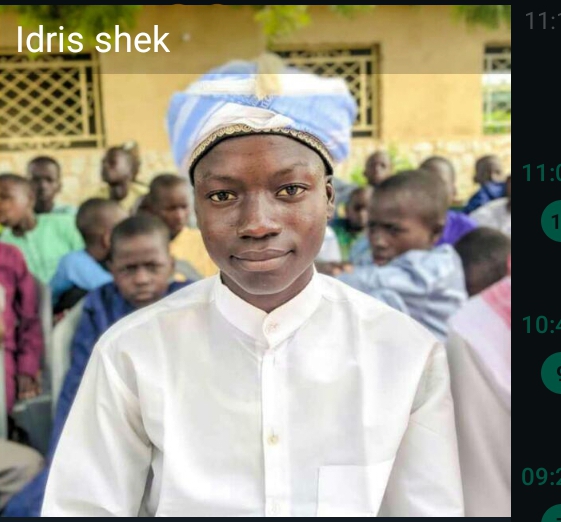
Idris Sheikh Musa (Newborn Poet) is a Nigerian teen writer from Niger state. He started his early education at Hasha International school Bosso Minna,Niger state.And he’s currently a student of Legend International school Minna. He is a poet, short story writer,spoken word artist,novela and essayist. Also, he is a member of Hill top creative art ( HCAF) along David mark road,Minna,Niger state,He ia also a member of new born poet,The Newborn Poets, and Hill-Top Creative Arts Foundation, (Minna,Niger State chapter).Idris is a contributor at Newborn Poets Anthology 2024 yet to be published, He is a lover of African literature, and has some of his works that he submit for prizes and call for submissions, some are forthcoming on Magazines such as Legend school, Hcaf,and also want to be aspirant of Britle paper, and other literary spaces.
Idris Sheikh Musa has consistently demonstrated writing skills, creativity and dedication to his craft. He is an outstanding student with a passion for writing that is evident in his creative and imaginative stories. His writing often explore themes that showcase his unique perspective and insight.
With his pen and paper,he shaped the future,sketch the world and paint the world,he is a young,talented,gifted poet ( Lyra fahari).
Betrayed In Exile
They say life is short, and we must enjoy every bit of it. But in my country, life hasn’t given us a brief moment of peace, and we can only enjoy it by continually losing trust in one another. In the mid-80s, six other soldiers and I were running away from military service. We just wanted to continue our studies and pursue our dreams. On a rainy day, a soldier named Ayman told us about a hidden cart we could discreetly jump into. By then, we hoped to escape the horrors of the war and the threat of being caught, which would lead to the death penalty. Around seven in the morning, we all met at Ayman’s house to gather and drive to the train station. We were crying differently, as if we knew our lives were no longer protected, and that if Ayman made a mistake, we were all dead. The rain covered our faces, making it hard to tell who was crying with tears and who was weeping from a broken heart.
We entered a dark, dusty, and foul-smelling compartment on the train. Just by looking around, I saw blood and animal waste. Ayman asked us to remain silent until the next day, when we would be in a different country. We all fell quiet, some of us lighting cigarettes, while others whispered about the terrible conditions. They knew they had to suppress their hunger and thirst. The hours were slow, long, and unbearably dull. It was terrifying to hear rockets falling around the cities. Some children cried as they watched their grandfathers being dragged from the trains to fight in the war. Those sounds were impossible to ignore—words so heartbreaking that none of us could sleep.
I drifted away into fantasies, thinking about my girlfriend, my siblings, my parents—wondering if they were praying for my safe journey into exile. I wondered if we would ever meet again, if we would even recognize each other. How long would this war last? How many friends’ funerals would I attend before my own? Meanwhile, Ayman smoked like a man possessed, sitting in the corner, staring at all of us. None of us doubted his promise or loyalty—until the rain stopped, and the train halted. Ayman took his weapon from his back and ordered us to stand in line. A few soldiers with guns appeared, ready to shoot us, but it was Ayman who shot us mercilessly.
Yes, we died fearlessly. Yes, we died in this hopeless country. Yes, we died without taking a single life. Ayman smiled, and in that moment, we knew who the leader of our miserable nation will be.