Our society is in the hands of young people!

The growing young generation is the future of our society. Parents should lay the foundation for their education, language learning, and professional development. They should be an example to their children.

There is a saying in our people: "A bird does what it sees in its nest." Of course it is. Parents are role models for their children.

We found it permissible to give examples from events in life. A friend of mine from a long time ago used to take all his pain from his little child as a result of misunderstandings in his family, relations between mother-in-law and daughter-in-law. His child was still two years old. The quarrels and passions that took place at home were getting imprinted in the child's memory. He was growing up as a timid, shy, lonely child...

Big mistakes of parents in child rearing started to surface. The result of their mistakes knowingly and unknowingly hit them like a slap in the face in the example of their children...

When the child reaches adulthood, he does not respect his parents, gets angry at the slightest problem, and fights with his friends on the street every day. His life was meaningless and fruitless...
You definitely don't want to get into this situation. But such mistakes are made in case of ignorance.

Dear parents, let's open our eyes. Let's not ignore the future of our children.

The future of our society is in the hands of our children and youth! They should be given knowledge in every field, be an example, read books together, and have useful activities. Then the child develops.
Why does a child born in a family of intellectuals necessarily get a higher education? Why does a child born in an artistic family become an artist? So?! Because such talents and abilities are a process that passes through genes. If you want to change the genes of your ancestors, first change yourself. Read, develop, gain knowledge, set goals. Action and action.

Let's not forget that it is in the hands of parents to form an educated, intelligent class for our society!

Tuliyeva Sarvinoz
The owner of the state award named after Zulfiya.
Teacher of native language and literature at Shaikhontohur District Vocational School of Tashkent city.
Marital Reflections


They had an

Ernest Hemingway

Old Man and the Sea

Kind of marriage,

A big catch

And a lot

To be

Excited about

But then they

Went through

A bunch

And once they

Returned home

Everything was gone.


Taylor Dibbert is a writer, journalist, and poet in Washington, DC. “Rescue Dog,” his fifth book, was published on May 7.
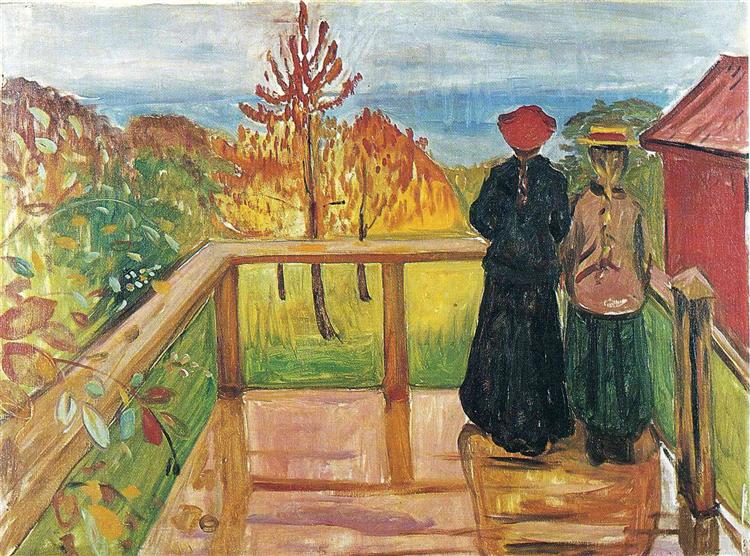
The Regntiden1

for Lloyd A. Jacobs, Ejaz Rahim & Leonidas Efthmiou

after Rain (Regn) by Edvard Munch (Norway), 1902 C.E.

 I

 The Bookshelf //
I assemble the newly procured bookshelf
and place the wooden statues of The Zulu Warriors—
my father had brought back with him from Kenya
in the Summer of ’96 C.E.—
on either side of the five-shelved rack,
as if The Valkyries at the Valgrind to Valhalla.
I place the books horizontally on the wooden planks,
not vertically—since, the weight of the words
can also force the spine of the book to bend.

*

The weight of the words of some books
is also (in)famous for forcing the minds-of-wo/men
to bend & mend! And I ponder: if the weight of the words
of my books will also succeed in serving such a purpose?

 II

 East & West //
I literally use the compass to figure out
the exact eastern-end and the western-end of my room,
and place the 4’ tall wooden lamp—
a present I had received from my ex-girlfriend
in the Summer of ’14 C.E.—
in the Eastern Corner.

[Perhaps,] it’s the effect of the sweet intoxication
from the aroma of the freshly rain-bathed soil
that forces me to take the proverb,
the sun rises in the East
and sets in the West,
 literally!

And I place the stone incense burner
(with an uncovered opening to the compartment
inside for hosting a miniature candle)—
procured from The Body Shop—
atop the lid of the lamp to symbolise the Stella/Sol.2

 III

 The Vahana //3
 I think of pulling my vahana –
Toyota Aqua (Hybrid) 1500 cc
(procured via a local car dealer
in the Summer of ’17 C.E.) –
out of the porch and
letting her also bathe and breathe
in the mint-fresh rain.

*

This early, early ante meridiem
cata-doxa4 is a call for Celebration ‘n Change:
the (in)famous Indian Monsoon is early
in the Summer of ’22 C.E.

Both the man & the beast will be observing
the Thanksgiving early, too—
since the sunrays, like the uninvited guests,
had the dramas-of-life rather shackled, lately.

______________

1. Regntiden (Norwegian): The Rains.
2. Sol (Roman Mythology): The Sun God.
3. Vahana (Hindu Mythology): The Ride of a God/Goddess.
4. Cata-Doxa (Greek idiom): (Raining) Cats and Dogs.
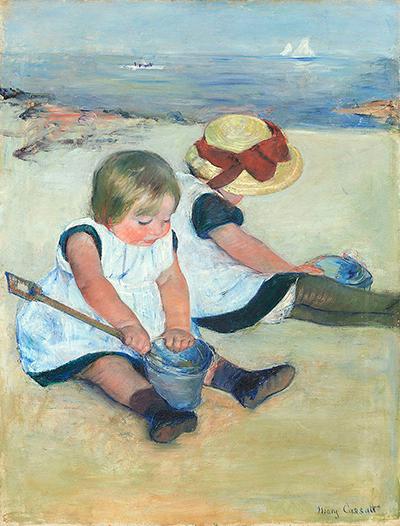
On the Beaches in Bulgaria: 2016 C.E.for Cameron, Monika & Aleksandra
after Children Playing On The Beach by Mary S. Cassatt (USA), 1884 C.E.
I
Today —
Solis-roasted Sand2;
Solis-burnt Sea2.
It makes you appreciate e=mc2
in a rather strange, strange way.
Or maybe it’s the beer (?)
Under the gaze of the Thirsty Solis,
a pint of Heineken barely manages
to stay cool for > 300 seconds.
II
“… And pile it up more around the chest, belly & limbs.
… But spare the face!
You know I’m rather proud of my Persian Face!”
He asks me to help him
cover his body with the sunbaked sandy beach.
“Don’t turn this into a burial rehearsal now!”
I mock his idea of the sand-therapy.
~
The Scene / Act reminds me of the street hawkers
from back home—
roasting the corn-on-the-cobs & chickpeas
in the salty-sea shore-sand on their mobile-stalls.
III
“We won’t let you drown.
Trust Us!”
Monika & Aleksandra make a support
with their arms and teach me
how to make my body float on the water.
“When I was 9, I had drowned
in The Indus River on a picnic day-out,”
I stutter as I raise my legs &
let the buoyancy take charge.
IV
Today —
I’ve been rather unfaithful to myself:
I violated the vow of Literary-Celibacy
i.e. I broke the promise-to-self
to not to indulge in any poetry & poems.
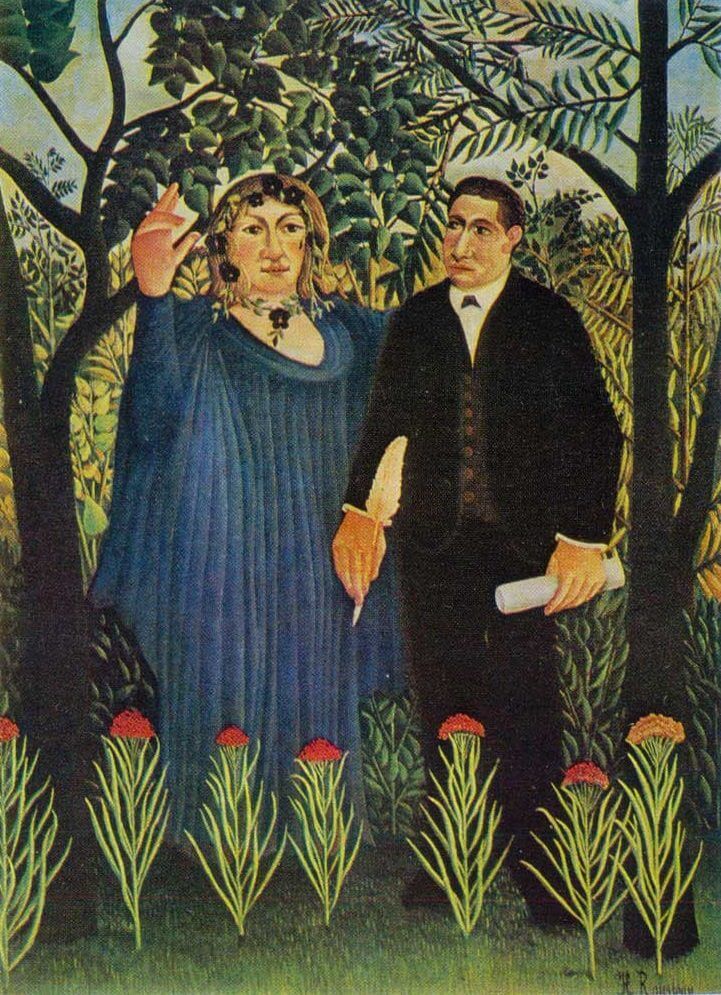
Cigarette-Smoke Halos
for Family & Friendsafter The Muse Inspiring The Poet (La Muse Inspirant le Poete) by Henri Rousseau (France), 1909 C.E.
I
Mercury/Steel Cigarette-Smoke Halos for all my dreams.
Why shalt I feel
intimidated by an Israfel?*
II
Of late – poems are frequenting me
like an Ottoman Emperor frequents
his favourite mistresses in the harems.
III
Sometimes – I feel like/as if I’m a Socrates,
a Constantine, a Rumi, a Ghalib,
but without any fast acolytes.
Sometimes – I feel like/as if I’m a line
without any alphabet
and commas and apostrophes and periods.
Sometimes – I feel like/as if I’m an epic
that can’t be bound
by any spiral or saddle-stitched spines.
Sometimes – I feel like/as if I’m a thumb,
a forefinger, a middle finger on a hand
that can’t seem to be able to strangle the wind.
Sometimes – I feel like/as if I’m a medallion,
an untied knot
on an Eshfahan, a Kashan, a Farahan kilim.
Sometimes – I feel like/as if I’m a verse,
a couplet, a ghazal, a sonnet,
but without any regards in her chest.
Sometimes – I feel like/as if I’m a curse,
a prayer on a broken mother’s lips,
who lost a youngling to some war.
Sometimes – I feel like/as if I’m a Man
—with a Free Will—
but only as free as his idioms and narratives.
______________
*Israfel: One of the Four Archangels in the Islamic Theology. The named Angel is assigned with the duty of making the announcement for the arrival of Youm al Qiyama (The Judgement Day).Saad Ali (b. 1980 CE in Okara, Pakistan) has been brought up and educated in the United Kingdom and Pakistan. He holds a BSc and an MSc in Management from the University of Leicester, UK. He is a bilingual poet-philosopher and literary translator. His new collection of poems is titled Owl Of Pines: Sunyata (AuthorHouse, 2021). He has translated Lorette C. Luzajic’s ekphrastic poetry and micro/flash fictions into Urdu: Lorette C. Luzajic: Selected Ekphrases: Translated into Urdu (2023). He is a regular contributor to The Ekphrastic Review. He has had poems published in The Mackinaw and Synchronized Chaos. His work has been nominated for the Best of the Net Anthology. He has had ekphrases showcased at an Art Exhibition, Bleeding Borders, curated at the Art Gallery of Grande Prairie in Alberta, Canada. He has had poems featured in two anthologies of poetry—Poetry is a Mountain (2019) and This Uncommon Place (2019)—by Kevin Watt (ed.). Some of his influences include: Vyasa, Homer, Attar, Rumi, Nietzsche, Freud, Jung, Kafka, Tagore, Lispector, et alia. He enjoys learning different languages, travelling by train, and exploring cities/towns on foot. To learn further about his work, please visit: www.saadalipoetry.com; www.facebook.com/owlofpines.
Reasons preventing the younger generation from revealing their talents
Annotation: This article took into consideration about a variety of negative factors which can prevent children from pouring out their own ability and talent
The key words: Attention, kindness, fear, defeat, dream
The one and only supreme task of man in this world is to achieve his own destiny. All people know their destiny when they are young. But as time passes, a mysterious force convinces them that it is impossible to realize their destiny. This mysterious power seems to be a blessing to the human race,but in fact, it is this same power that shows the way to realize one’s destiny. It prepares the human spirit and freedom for that great task. There is a supreme truth in this kurrai land:when you really want something, you will definitely achieve it, because such a desire is born in the spirit of the world. That’s why you were created on earth.Paulo Coelho(The Alchemist).
Before a person is born, his parents or grandparents decide who he will be, what profession he will take or what kind of person he will be. It seems that if a child grows up based on the scenariothey choose , they will become the most famous person, a person who can conquer great heights and take bold steps towards great goals. For them, children’s wishes and abilities seem to be completely unimportant and unnecessary. Do you know what professions parents choose first? Yes, of course,they want and choose the most modern, high-income profession, which they are engaged in at the moment, as well as their successors.
A child comes into the world, slowly begins to take steps towards his destiny. What is “own destiny”? This is the supreme assence of our life on earth. However, not everyone is lucky enough to find the courage to follow this path to the prospect of the most sacred dreams. In Paulo Coelho’s work “The Alchemist”, it is written that 4 pitfalls prevent the realization of human dreams. The first is that the biggest dreams in life are broken to the human being from childhood as unfulfilled dreams. He grows up with this undersanding. As the years go by, his heart is filled with guilt and guilt. One day there will come a moment when the desire to follow the path of one’s destiny seems to him more frightening than death because of this ugky burden, and then a person will lose the sense of understanding why he came to this world. Feels as if it has become.
When he overcomes these fears and begins to step towards his dreams, a new test and hardships will be waiting for him. The thing that hurts people is that they give up everything at the last step. Oscar Wilde wrote: ”Man always destroys what he loves most in life’’. Dear parents, who condemn their children to life-long disappointment because of money and material world, you should never forget that, unlike other creatures, man always strives for excellence in this world and sets his sights on a good life. Lives but not everyone understands the concept of “good life” correctly. Maybe some people think that the only way to reach the top is to satisfy their needs in material life and try to achieve it without even committing crimes, while others choose a completely different path.
Knowing very well that material things and the desires of the soul are not a guarantee of true highness, true highness and a good life is to be spiritually strong and spiritually perfect, and he gives his all in this way. There are such people that it is impossible not to envy them, parents who could see their talents and abilities have become famous all over the world today because of their support for their children.
Let’s say that Kim Ung-Yong is a 4-year old university student with a Guinness world record. As the owner of the IQ ”210” level, he was recorded in the “Guinness” book of records. Gregory Smith was nominated for the Nobel Prize 4 tines in 12 years, and became a university student at the age of 10. Akrit Yaswal is a 7-year old surgeon and a university student at the age of 15. His biggest goal is to find a cure for cancer. Kleopatra Stratan is the youngest performer, at the ago of 3 she gave a 2-year old artist, her mother, seeing her interest in art, takes her to an art teacher in Melbourne and shows her. At the age of 4, her solo exhibition opened in New York.
There are people among us who, when they talk about great people like this, it is in their blood, and they think that their circumstances and our circumstances are drastically different. In fact, they do not know how many great breeds are flowing in our blood. At that time, they read books by candlelight. Now let’s think, nothing can stop your child from becoming the owner of the profession he wants from the moment you make it possible for him. English biochemist S.Gouse says that there are more obstacles to the development of human abilities in social conditions than in biology. The English psychologist D.Kidgin comes to the same conclusion and thinks about the decisive influence of education on the intellectual development of a person.
Representatives of the second concept argue that the ability is completely determined by the social conditions of life and aducation. For example, Gelvesiy once said that it is possible to create a genius with the help of education. Russian scientist A.N.Leont’ev with his theory of functional organs, which was founded by A.Ukhtomsky, supports a similar concept. Prominent Russian psychologist S.L.Rubinstein objects to the concept of A.N.Leontev. In his opinion, innate talent is areality, it should be developed. No one person has the same fingerprints, so their talentsare different from each other. It is up to us to preserve such unique talents, to further improve and improve them. It is true that we are influenced by external factors, social environment and some of our parents in order to reveal our talent. Yes, of course, our parents wish only the best for us, but they do not know that they have extinguished our talent without knowing it. In this regard, many people do not become mature specialists by choosing professions they do not like and face many difficult situations throughout their lives. Dear parents, always support your child’s opinion, because the country needs mature specialists.
References
F.I.Khaidarov and N.I.Khalilova “General psychology” Tashkent-2009
Diloram.E.(2023).FACTORS OF DEVELOPMENT OF INDEPENDENCE IN COGNITIVE ACTIVITY OF PRIMARY CLASS STUDENTS.OBRAZOVANIE NAUKA I INNOVATSIONNYE IDEI V MIRE,16(1),47-51.
MIRVALIYEVA M THE PROBLEM OF PERSONAL AGGRESSIVENES IN INTERPERSONAL RELATIONS IN THE FAMILY//”SCIENTIFIC APPROACH TO THE MODERN EDUCATION SYSTEM”.-2022
Fresh dream

        The smell of soil, the smell of ground...Oh , so lovely and dear this smell. Especially, the soil of native land is closer to the heart. Repentance, the sun of homeland also seem special. After all, only one sun shines on the whole world. But, as if the sun caresses the people with its rays, looks at them with a special smile.

        Barno stopped in the modern airport which crowded with people. Looked around one by one . The words resonated in her native language sounded very pleasant to her ears. Barno was coming back to Uzbekistan for missing her sister and village very much. Although she wanted to wander through Tashkent which is capital of Uzbekistan , she decided to go to Surkhandarya. She promised to return again to Tashkent before went to Surkhandarya. The roads were far away... Barno remembered the past, leaning his face against the window of the car.

        Barno was born in Surkhandarya region. She grew in anticipation of the scorching rays of the sun. Maybe so that, she was so beautiful girl like so many  girls of Surkhandarya. Her childhood was very happy. She saw no grief, no worries. But at the age of 17,  she lost his father and a year later her mother. They died.

         She and her sister started living with their old grandmother. Barno's dream of being student at university also did not come true. The main reason for this is that, after finishing from school , she went to work abroad with aunt Robia who was both their neighbour and her mother's closest friend. Her sister was 10 years old and her grandmother was old. Moreover,  it was also difficult to find a job. They hadn't got any relatives who can help, almost. Five years ago she left her homeland with deep sadness in his heart.

     She began working with her aunt in a confectionery factory. She worked a lot to earn much money. It will be much more difficult, if you do not have a person and a home that wait you when you return late from work. Sometimes, when Barno came from work, she was weeping remembering her country, village and loved ones. She would  stop weeping, thinking that she would hurt her parents who were looking from the skies. She worked hard and sent a lot of money to her grandmother.  One day, When she was talking with her sister on the phone, her sister said that there were many new developments in New Uzbekistan, and youth had different chances to do business. Barno had hope in her heart. She decided to come back to her home. She wanted to live happy in her country.

        She  remembered her stories in her life. When she got up they had almost arrived at the destination. The taxi entered into the street which known for her. Barno was over the moon.

     As long as, her sister and grandmother were waiting without sleeping. Barno was so happy to see them, to return to her country. That situation was impossible to describe in words. She hugged her grandma and sister with her heart, not with her hands. After she rested for few days, she began her work. "We always support youth who had a talent in their heart" they said to Barno, and they gave credit in very fast opportunities. Barno created her own confectionery factory in her village. Apart from she called it "Fresh dream" . This name was similar to her life and feelings . The "Fresh dream" factory was opened in a lot of areas of her country. Her factory and her sweets were famous and lovely for everyone.
                                                           **********
      Barno was invited to the forum of youth and students of Uzbekistan. The main reason for this is that she was one of the best business girl of her country. Now she was not an unhappy girl but one who came back to her homeland with longing for her country. She was really happy!

Shahnoza Ochildiyeva
Uzbekistan
The Wages of Sen-Sen


“I’ll take care of it,” said Tom, reeking of cigarette smoke and Sen-Sen, a licorice-flavored candy he used to block the smell. He scooped the black cash deposit bag -- the till --from the table. Although she had Tom’s word, Lisa wasn’t convinced that the redhead had ever been a noble creature. Certainly, she thought, Tom wasn’t above stealing from the marginalized, the poor, the disaffected. She had worked the streets with him over the past three months, collecting for Children In Need  -- CIN -- and more than once the two of them, both becoming increasingly prone to indulge in drugs and alcohol, had absconded with the funds they’d collected from high-minded and generous contributors to the cause.

In one instance, after a hard night soliciting for CIN, they had wound up at a tavern on the west side and drunk their way through the $200 they’d managed to collect in four hours -- on top of the hourly wages they’d subsequently collected for their efforts. The organization was lax, however, and Lisa suspected that management half-expected their employees to exploit the weaknesses in the structural integrity of the charity in order to supplement their meager wages. Another time, Tom and she had spent $75 for some smack -- injected on the streets by a man who called himself a “doctor,” and who used the same needle on both of them. Lisa was experimenting, but the experience had frightened her half to death.

Now, miraculously, she had happened upon the cash sack that another of their fellow employees had somehow lost track of. Unsure how to restore the property to its proper owner, Lisa had asked Tom, “What’ll we do now?” Tom, naturally, had all the answers. And out the door he went, money bag in hand. Would she ever see Tom -- or the money -- again? she wondered. Tom was sort of a loose cannon, she knew. He was moody, arrogant and unpredictable; Lisa never knew quite what to expect from Tom.

Lisa didn’t know the employee who’d lost her till -- Anna -- but Tom said that he did. Anna, Tom said, worked in the Edgewood neighborhood, about three miles distant; her partner had gotten a different job and so Anna was temporarily working alone. Tom was Lisa’s ride back to the suburbs where she lived, so she just stood on the corner, waiting, for what seemed like hours.

“Hey, you ready to go?” asked Tom, materializing like a spirit out of the shadows, a lighted cigarette burning in the darkness.

“You get her?” asked Lisa.

Unconsciously, Tom smirked. “Yeah, I got her,” and his smirk blossomed into a wide grin.

Lisa tried to ignore the cynical sexual allusion. “Was she happy to get her money back?” she asked.

Then Tom laughed, a deep, reproachable chuckle. “I was happy enough for both of us,” he said.

“You gave her the money, didn’t you, Tom?” said Lisa, worried that she had been played for a fool.

“She had more than $300 in her till,” remarked Tom, as if in admonishment. “We bartered,” he explained. Lisa only stared at him. “I gave her two hundred and fifty bucks and she gave me a blowjob and I came away $50 the better; sweet, ‘eh?”

“You extorted her?” asked Lisa incredulously. “But, she’s one of us, she’s not an enemy. She works the streets...”

“And tomorrow,” said Tom, deadly serious now, “she'll work the streets again. Do you know what would have happened if she didn’t recover the till?” he asked. “She would have lost her job,” he said harshly. “So,” he concluded, “for a modest fee, I saved her job.” He chuckled at his own cunning. “Hey,” said Tom suddenly, “you wanna do some more smack?”

Lisa had only done heroin the one time, with Tom, and it had made her violently ill. “No,” she answered, then asked, in spite of her growing mistrust of Tom, “what else you got?”

“Nothing,” he replied. “Either smack or squat. C’mon, do a spoon.” Lisa shook her head no. She had been foolish with Tom once before, but she was afraid of becoming addicted. “I’m good,” she said.

“Then come on, I’ll take you home.” On the ride home, Lisa began to get the itch of drug deprivation, of the melancholy and feelings of dismay that came from being always alone. She was almost always lit up nowadays, from whateverTom provided, but mostly, from pot. And Tom, unaccountably, eschewed weed. Yet, he smoked cigarettes like a chimney. Then he chewed that detestable Sen-Sen to try to cover the smell. Lisa shook her head, uncertain what to make of her mentor.

In spite of their proclivity for peculation, Tom and Lisa were the most profitable pair on the CIN circuit. They regularly outcollected all other duos. This was due in part to Tom’s patented hang-dog expressions and raspy, pitiable utterings, and his street smarts, but it was due as well to the fact that Lisa was a very pretty woman, and very good with the contributors. Sometimes, Tom behaved more like a pimp than a charitable fundraiser. He made $6 per hour; Lisa $5.25, plus all that they scammed off the collections.

. . . . .

Tom knocked upon the blistered wood of the apartment door and waited. In a few seconds came a cry from inside: “Whozzat?”

Tom exchanged a glance with Lisa, then replied, “Children in Need Charity. We’re asking for donations.” They waited.

Next, several locks were loudly disengaged and the door swept open, revealing a twenty-something African American woman with two small children hanging onto her legs, as she endeavored to balance a third child in her arms. “Come in,” she invited them. "Watch your step," she cautioned. The uncarpeted floor was littered with toys.

Into the chilly, smokey, onion-scented room filed the two fundraisers, batting away the aromatic smoke of a wood fire and coughing into handkerchiefs. “Please have a seat,” she instructed them. They plopped onto a bedraggled sofa. “You with Children in Need?” she asked. “I seen them on TV,” she added, waving vaguely in the direction of an ancient B&W television set against the wall. “They hep’ little children in Africa, ain’t that right?” Tom agreed that they did. Lisa only nodded. “How much you want?” she asked, all business now.

Tom’s eyes took on an avaricious glimmer, but Lisa spoke up: “Whatever you think you can afford, ma’am.” The young mother nodded and, reaching to a coffee table, took a ten dollar bill from a care-worn purse and proferred it.

Lisa, looking around the apartment, felt instant remorse. “Ma’am,” she said, “if you can’t really afford it, that’s alright. We don’t want to take food off your table or...”

“What's the matter, my money ain’t good enough for you?” asked the woman, getting her back up a little. “It green like any other, it spend the same,” she pointed out. “Poor folk wanta help, do their part, just the same as all youse. So take the money, Miss,” she insisted.

Lisa nodded. “Thanks very much for your contribution. ma’am,” said Lisa, climbing to her feet. In an instant, Tom and his cohort were back in the hallway.

“Good deal,” said Tom enthusiastically, taking the bill from Lisa. “I can use a couple packs of cigarettes.” He folded the sawbuck and put it not into the till, but into his own shirt pocket. At Lisa’s reproachful look, he hastened to explain, “Well, we made our quota at the last apartment. The rest,” he said with a grin, “is just gravy.” And he lit another cigarette and slipped a Sen-Sen between his lips.

Later, as the duo traversed the streets of the city, searching for a housing project which Tim indicated was “always good pickings,” Lisa, behind the wheel this time, stopped the car at a corner, where a  large man stood like a sentinel, watching them carefully as they approached. Lisa rolled down the window.

“Excuse me, sir, but do you know where Chambers Rock is?” referencing the low-rent projects on the city’s east side. Slowly, the mountain of a man approached the vehicle.

“You po-lice?” he asked warily. Lisa blinked in bewilderment. “You po-lice?” he repeated with barely concealed hostility.

Lisa shook her head. “No, I’m not police.” He appeared mollified by this. “I’m just looking for the Chambers Rock Projects; do you know where it is, sir?” She spied in the man’s large hands a plethora of tiny plastic bags of some white substance -- crack? she wondered.

Apparently satisfied by her explanation, the man muttered out directions. With a smile and a thanks, Lisa sped away.

“Huh!” muttered Tom, sitting in the passenger seat during this exchange. “That spook had a lot of dope. Maybe we should go back and take it?”

Lisa rolled her eyes. “He’d have your white ass on a meat hook in about a minute, Tom.” Tom, a large man, looked skeptical. “He was packing, partner,” she told him.

, , , , ,

Finally reaching Chambers Rock, Lisa and Tom climbed out of their vehicle and sought out their destination. Choosing the first apartment at random, Tom again pounded on a weathered door and was granted entrance, this time by an ancient, white-haired woman, who pointedly told the duo to take a seat on her sofa. There was, Lisa discerned, a chirring, humming sound emanating from the walls. What was it? she wondered. Taking a chair facing the sofa, the old woman scowled and then pounded upon the wall with her fist. The chirring ceased. “Damn roaches,” she seethed, then smiled at her guests.

As Tom went through his spiel, Lisa glanced around the room, and noted the fireplace, in which a robust flame blazed. Across the carpeted floor were various components of cheap furniture which had been hacked to pieces with a hatchet, which lay upon the floor. The woman, seeing Lisa’s appraisal, explained, “Power company turned off the gas in November.” Silently, Lisa nodded her understanding.

Finally getting five dollars and change from Mrs. Seibold--aged 90, she told them proudly--the two  exited the depressing edifice.

When Tom told her how he’d manipulated the feckless Anna into a compromsing position, Lisa had wondered why he had never propositioned her. Was she unattractive? she asked herself. No, she had been told by many that she was cute and had in fact received her fair share of sexual overtures in her 21 years. What was it, then? She put the question to Tom.

His eyes bugged out, but then he regained his aplomb. “We work together,” he explained tersely.

“So?” she asked.

“Like my daddy always said,” continued Tom. “Don’t mix peter with payroll.” It was at that point that Lisa realized how integral she was to Tom’s continued success. Tom was, after all, just some faceless stiff with a tin cup. He wasn’t particularly attractive or articulate or personable. That’s why he was paired with Lisa, she now realized, because she was everything that Tom was not. Slowly, the gears of reason began to grind in her brain and she began to feel -- a little -- better about herself.

At quitting time -- nine p.m., Lisa and Tom pulled into the parking lot back of what had become their favorite tavern, The Lotsa Luck. Stepping inside, they relished the warmth, after the chilly December air. While Lisa ordered a pitcher of beer, Tom drifted to the rear of the bar and began a mindless game of Pac-Man. Standing at the bar, waiting for her beer, Lisa was approached by a gaunt blonde woman with tattoos spread over her bare arms. She stood staring at Lisa. The other woman acknowledged her with a smile.

“I can get you a better deal,” whispered the newcomer conspiratorially.

Lisa blinked in confusion. “I beg your pardon?”

“I seen you with that fat man,” continued the woman, gesturing with her head toward the back of the bar. “He your pimp.”

“He’s my partner,” Lisa corrected the blonde. “You’ve got him confused with someone else,” she told her. “Tom and I solicit contributions for a charity.” The pitcher of beer arrived.

“That right, Tom!” declared the woman in hushed tones. “He a pimp onna streets. He my pimp a year ago, till I got a new deal. I can make you $75 a trick, none of this shitty twenty-five for you, seventy-five for him.”

Lisa grasped the pitcher by the handle. “I don’t what what you’re talking about. Tom isn’t my pimp. He’s my partner.”

The other woman looked archly at Lisa and nodded knowingly. “You’ll see, baby,” she murmured, then turned away.

. . . . .

At the end of the week, Tom picked Lisa up at her apartment and as they rode into the city he remarked, “We have to go into the office before we go on the streets tonight.” He lit another cigarette. Winstons, Lisa decided --sickenly sweet.

“What for?” she asked. “Are we in trouble?” This would be her first visit to Trenor Street since she was hired, three months ago. She felt uneasy.

“Quarterly work evaluation,” explained Tom. “They tell you what you’re doing right and what you’re doing wrong, ask you if you’re happy on the job, all that shit.” He didn't seem nonplussed, so Lisa relaxed.

“So we’re not in trouble, then?”

“Hell, we rake in more dough than any two other teams put together,” Tom crowed. “They might give us a raise,” he said optimistically.

A few minutes later, their car turned into the stark, unadorned parking lot on Trenor Street, which faced a stark, unadorned two-story, red-brick office building. Pushing through the metal and glass doors, Lisa was struck by the cluttered, claustrophobic interior. She followed Tom as they approached the front desk.

“Hi, Eleanor,” said Tom with a gloating smile. Eleanor, a 30-something, dark-haired woman standing behind a counter, regarded Tom cooly.

“Go on back, Mrs. Albright is waiting for you.” Shrugging at the rebuff, Tom led the way past a rabbit warren of small offices, down a narrow corridor. Arriving at the regional CIN director’s office, Tom knocked on the open door.

Mrs. Albright, 50, military haircut and no-nonsense, said in a clipped voice, “Follow me to the conference room.” She preceded them down the corridor to a larger room, with a dozen captain’s chairs arrayed around a huge table. Stepping into the room, they found the space already occupied. Round the table were two men, in suits, and a woman, young and pretty.

“Lemme do the talking,” Tom whispered clandestinely.

They all sat round the table. “This,” began Mrs. Albright, snapping on and speaking into a tape recorder, “is an investigative session in the case of allegations by Anna Triphonas against Thomas Rice." She recited the time and date. Lisa glanced at Tom; his red brow was deeply furrowed. Clearly, he had not expected this. "Although Miss Triphonas is represented by counsel and CIN is represented by our attorney, they are here only as observers,” said Albright, nodding at the two men in turn. “Mr. Rice,” she went on, since this is an investigatory and not a disciplinary hearing, you are not entitled to counsel at this time. Tom began to sweat. Lisa held her breath.

"Miss Triphonas, would you make your statement?" Anna’s eyes gleamed and she smiled tightly. She went on to recount various incidents in which Tom Rice solicited sexual favors from her and other employees of CIN, none of whom had agreed to come forward. She recalled extortion, drug use and even violence. Tom, she said, had promoted the addiction of women, some as young as 18, and had managed a “stable” of prostitutes, some of them even younger than that. At length the young woman concluded her tale of depravity. The room was utterly silent.

“Mr. Rice,” said Albright, “do you have anything to say by way of reply to these allegations?” She stared at him blankly.

Glibly, Tom took the floor, citing his long years as a CIN employee, his unblemished record, his highly-profitable work performance and his selfless mentoring of other workers. He had, he admitted, briefly dated Anna, but that things didn’t work out and she hadn’t handled the rejection well. Lisa absorbed all these lies with no expression, until which time as Tom said, “Just ask Lisa.” Her face fell.

"Miss Curtis -- Lisa" said Mrs. Albright kindly, " -- do you have anything to add?" Lisa glanced at Tom, saw the smirk on his face. Then she looked at Anna, whom Lisa knew was really putting her neck on the line in what would likely be dismissed as a he-said, she-said dispute.

Lisa took a great breath and let it out. “Well,” she began, “Tom never touched me.” She glanced at Tom again; his smirk had become a grin. “But he did steal money from the till to buy drugs and he and I did some heroin he bought from the money we collected for CIN.” Lisa heard Tom draw a strangled breath; sitting next to him, she could smell the cigarette smoke on his clothes and his hair, plus the Sen-Sen that he always gobbled up to try to cover the stench. She almost gagged. “And,” she added, “he bragged about blackmailing Anna and receiving sexual favors from her.” She glanced once more at Tom; his face was a solid block of hate. “But,” said Lisa, “I drank the beer and took the drugs that Tom bought with the donation money; I’m as guilty as he is.”

In the end, Mrs. Albright agreed with Lisa. The confab morphed immediately into a disciplinary hearing and both Lisa and Tom were summarily fired. As they rose from the table, Lisa looked at Tom a final time. At six feet two inches tall, and 260 pounds, the mercurial man could easily be believed to be capable of violence, she thought. He stalked from the room without a word, leaving Lisa to wonder how she would get home without a ride. She shoved her hand into the pocket of her jeans and pulled out a few coins.

She looked up with a start, saw Anna standing before her. “Need a ride?” she asked with a gentle smile.

Lisa nodded. “Thanks. I don’t have enough for bus fare; this wasn’t what I had been expecting,” she said lightly. Then she grew serious again. “You were so brave to come forward. I wish...I wish I were that strong."

"In the end," said Anna, "you were."

Mrs. Albright approached the two women.

“Virginia,” said Anna, addressing the director, “do you think you could give Lisa another chance? She’s weathered the wars. And I still need a new partner.” She smiled at her boss.

Virginia stared sternly at Lisa for a moment, then her face relaxed and she smiled too. “Would you like to partner with Anna, Miss Curtis?”

Lisa felt her face balloon into a smile.  "Yes. I would. Thank you, I really would." Yay! thought Lisa. No more Sen-Sen.
Four Haiku


he walks home wearing
his black graduation gown
pics of pink flowers


—


baroque music plays
for the marble queen pothos
between dog & wolf


—


moon thru the window
or ceiling light’s reflection?
YouTube before bed


—


would you call this stuff
rainy snow or snowy rain?
wet April Fools’ Day


—


bio/graf

J. D. Nelson’s poems have appeared in many publications, worldwide, since 2002. He is the author of eleven print chapbooks and e-books of poetry, including *purgatorio* (wlovolw, 2024). Nelson’s first full-length collection is *in ghostly onehead* (Post-Asemic Press, 2022). Visit his website, MadVerse.com, for more information and links to his published work. His haiku blog is at JDNelson.net. Nelson lives in Boulder, Colorado, USA.